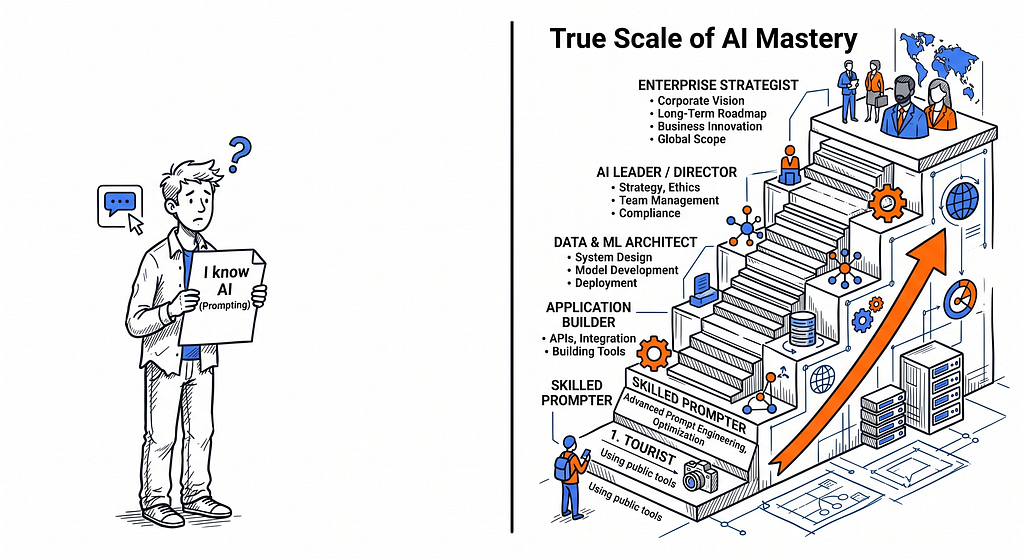
In the tech microcosm, we are going through a phase of profound semantic confusion. With over 20 years spent designing information system architectures, I have learned to recognize hype cycles by the smell of bluffing that saturates executive meetings. What I observe today looks furiously like the artistic blur surrounding foreign language proficiency. Everyone claims to be “Bilingual” or “Fluent” after a three-week vacation in London. When it comes to AI, we are caught in the same drift: the market rewards the illusion of competence. We place the user asking ChatGPT for a recipe in the same “AI Mastery” category as the system architect capable of orchestrating autonomous agents over a complex semantic knowledge mesh.
The Need for a Framework
If we were to use the Common European Framework of Reference for Languages (from A1 to C2), 90% of today’s professionals would be strutting around at the C2 level when they can barely stammer the basics of level A1. They know how to ask the AI a question, but they are incapable of understanding the grammatical structure of the answer, the reliability of the dictionary used, or the underlying ontology that allows the model to reason. This blur is not a simple terminological inaccuracy; it is a major strategic risk. Multi-million-dollar projects collapse because decision-makers confuse a “shiny” user interface with a robust data architecture.
My thesis is simple: AI maturity is not binary. It is not “I use it” or “I don’t use it.” It is a scale from 0 to “AI Enterprise Strategist”, a progression from technical curiosity to systemic wisdom. Pure technique — knowing which button to press or which new model is trendy — has become a commodity. It’s the price of admission, not the competitive advantage. The real advantage lies in the ability to transform a probabilistic black box into a deterministic, reliable, and value-creating system. If your value lies in your ability to write a “good prompt,” you are already obsolete. The prompt is the most volatile and least valuable layer of the tech stack. True maturity begins where the text stops and where system architecture, metadata governance, and knowledge engineering take over.
Part 1: The 5 Dimensions of AI Expertise and the “Coefficient Paradox”
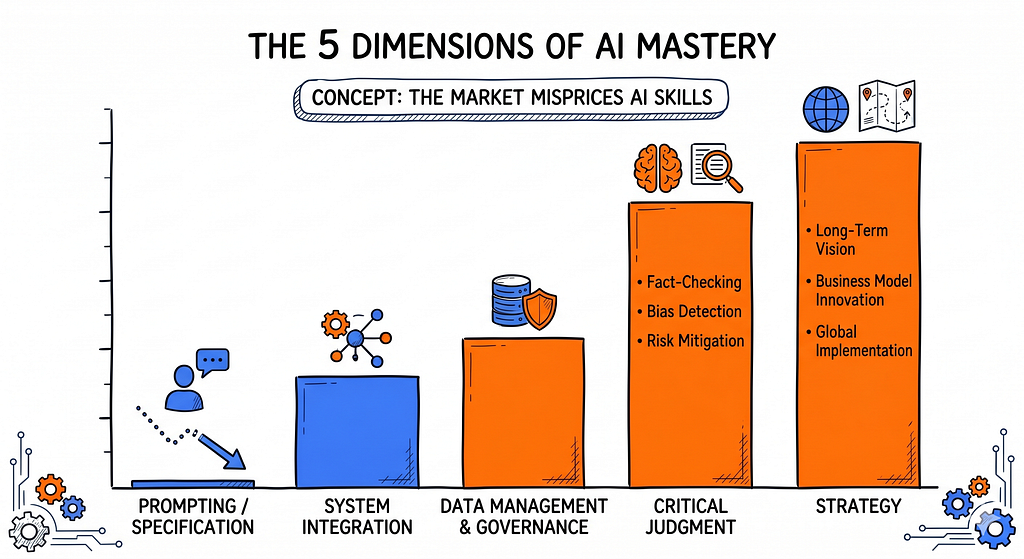
The current market is obsessed with tool certifications. People collect OpenAI, Microsoft, or AWS badges like hunting trophies. This is a mistake. Tying your career or your corporate strategy to such volatile assets is like building a skyscraper on quicksand. Models change every six months, APIs evolve, and what was a clever “hack” yesterday becomes a native feature tomorrow. As an enterprise architect, I evaluate AI expertise across five critical dimensions, each weighted with a radically different coefficient of value.
1. Strategy (Very high coefficient): The “Why” before the “How”
Higher maturity starts with a cold opportunity analysis. An expert doesn’t start by choosing an LLM, but by evaluating the Total Cost of Ownership (TCO) and data representativeness. Does the productivity gain offset the cost of human verification required by hallucination risks? Maturity means knowing how to say “no” to AI when the cost of remediating errors exceeds the benefit of automation. This requires a fine-grained understanding of data representativeness: including examples of correct captures, but also every type of frequent failure or anomaly to avoid overfitting.
2. Specification / Prompting (Very low coefficient): Inevitable mechanization
This is the most visible dimension, yet the least enduring. Prompting is becoming mechanized via “metaprompting” and the natural evolution of models that are increasingly capable of understanding vague instructions. In a mature architecture, the manual prompt disappears in favor of instructions based on structural metadata. If your expertise is limited to knowing that adding “Take a deep breath” improves model performance, you are not building anything sustainable.
3. Integration and Ecosystem: From Browser to Production Pipeline
Here, we leave “gadget” AI for “system” AI. Maturity consists of transforming static knowledge bases into dynamic and semantically meshed ecosystems. We are talking about moving from simple vector search (basic RAG) to a semantic layer using Knowledge Graphs. An expert at this level knows how to manipulate RDF triples (Subject-Predicate-Object) and SPARQL queries to force the AI to follow explicit logical paths rather than mere vector proximity probabilities.
4. Critical Judgment (Very high coefficient): The veracity audit
The mature expert doesn’t rely on a “feeling.” They rely on strict qualitative metadata (Gartner’s Table 3). They evaluate the Verification Level (degree of validation by a business expert) and the Confidence Level (certainty of accuracy). They identify Failure Modes (known failure patterns) — for example, “this model systematically fails if the device has undergone a factory reset.” This auditing capability transforms a risky tool into a reliable industrial asset.
5. Systemic Vision: Algorithmic Management
This is the understanding of how the value chain is being redefined. We are moving from a human assisted by a tool to a system where AI orchestrates continuous improvement cycles. This requires building Self-improving Knowledge Bases. The system must be able to detect its own gaps (via zero-result search logs or human escalation rates) and initiate corrective action, such as generating an article draft to fill an identified knowledge void.
The paradox is here: companies spend fortunes training “prompters” (low coefficient), but desperately lack strategists capable of designing a business ontology or judges capable of auditing the veracity of a complex system (very high coefficients).
Part 2: The Glass Ceiling of Tech
The evolution of maturity follows a curve that seems linear but quickly hits a glass ceiling. This is the zone where pure technique is no longer enough to guarantee success.
The Absentee and the Tourist
At this stage, AI is treated like a supercharged search engine. The user asks vague questions and accepts the answers without flinching. The risk? A massive loss of productivity. Contrary to marketing promises, amateur use can degrade overall performance by 43% compared to an advanced user. Why? Because the time lost correcting hallucinations and reformulating sterile queries cancels out the initial gain. This is the era of “Garbage in, Garbage out.”
The Copyist and the “Bolted-on” AI
Here, AI is integrated into daily life, but externally. This is the reign of copy-paste. We don’t change the process; we graft a generation step onto it. AI remains a bolted-on addition to the workflow. The structure remains unchanged, and without governance, invisible security and compliance risks are introduced.
The Prompter and the “Vibe Coder”
This is the technical wall. The Vibe Coder produces code, text, or analyses at phenomenal speed without any real product vision. They “feel” that it works. The major danger here is what Gartner calls the “Self-reinforcing confidence loop”: mathematical overconfidence that compensates for mediocre data. At this level, we move from “Garbage in, Garbage out” to the much more dangerous concept of “Garbage in, Garbage amplified”. Without semantic structure to guide the model, AI amplifies the biases and inconsistencies of the initial knowledge base. To get past this stage, you must stop learning how to talk better to the machine and start learning how to structure the information it consumes. We must stop tweaking prompts and start tweaking descriptive metadata.
Part 3: The Architect and the Infra-verbal Zone
The shift towards real expertise happens at this level. We leave the realm of conversation with the machine to enter the realm of system design.
The Practitioner and Disciplined RAG
The expert no longer settles for “providing documents.” They redesign knowledge assets to structurally neutralize hallucinations. They apply a strict Content Standard: every article in the knowledge base must address a single topic, use the end-user’s language for search, and be segmented into concise sections (under 200 words). They understand that AI doesn’t “read” like a human; it needs clear semantic anchors.
The Cartographer and the MVM
The Cartographer no longer sees files, but entities and relationships. This is where the notion of the “Infra-verbal zone” comes in. What is “Taste” in architecture? It is the expert’s neuro-architectural ability to recognize a structure of excellence even before they can explain it. An architect at this level “feels” if an ontology is wobbly or if a graph is overloaded.
To materialize this intuition, they build a Minimum Viable Model (MVM). Instead of aiming for an exhaustive and unmaintainable ontology, they identify the smallest set of essential entities: Product, System, Incident, Role, Region. This model becomes the backbone of the semantic layer. The challenge at this level is no longer technical, it is pedagogical: how do you explain to a team obsessed with LLM selection that the quality of Metadata-driven Knowledge Graphs is the sole factor that will determine whether the system becomes an industrial tool or an expensive toy?
Part 4: Algorithmic Management and Strategy
Here we enter the sphere of leadership where AI becomes the engine of the organization itself. This is where we begin to talk about Algorithmic Management.
The Agent Factory Designer
At this stage, manual prompting is a distant memory. The expert designs agentic frameworks governed by AI-Enabling Metadata (Table 4). They configure Temporal validity windows (so the AI doesn’t use an obsolete procedure), define Preconditions (the user must be verified in Okta before receiving this instruction), and list Prohibited AI actions (e.g., prohibition of generating autonomous execution code). They no longer manage tools; they manage behaviors. They implement Change Recognition & Alerting processes: if the rate of data change suddenly accelerates, the system alerts the model to prevent semantic drift.
The Creator and Advanced GraphRAG
They master the synergy between LLMs and Knowledge Graphs. They deploy GraphRAG solutions capable of Multihop Reasoning. Where a classic RAG fails because it finds no direct semantic similarity, GraphRAG follows explicit logical links to connect disparate pieces of information. To manage complexity, they use community detection algorithms, like the Leiden algorithm, to partition the graph into semantically coherent subsets. This allows the AI to navigate hierarchically through knowledge, radically improving the accuracy of comprehensive answers. They also begin experimenting with LightRAG, utilizing dual-level retrieval (Low-level for precise details, High-level for abstract themes), while remaining cautious about pushing it to production.
The Strategist and AI Data Readiness
The Strategist is the primary point of contact for executive leadership. Their role is to manage Risk Transfer. They use the AI Data Readiness matrix (Gartner) to assess whether a project should remain a POC (risk managed by human skills) or if it can move to Production (risk mitigated by the system). They don’t ask “Does the AI work?”, they ask “Do we have enough usage metadata so that automated governance tools can replace manual validation?”. They transform human expertise, often siloed and volatile, into a structured, sustainable, and self-learning digital asset. They know that the true value of the company is no longer in its documents, but in its validated business ontology.
The Theoretical Asymptote
This is the stage of a fully self-evolving system, where human supervision is limited to high-level ethical governance and top-tier financial arbitrations.
Conclusion: The Downward Escalator and the Action Plan
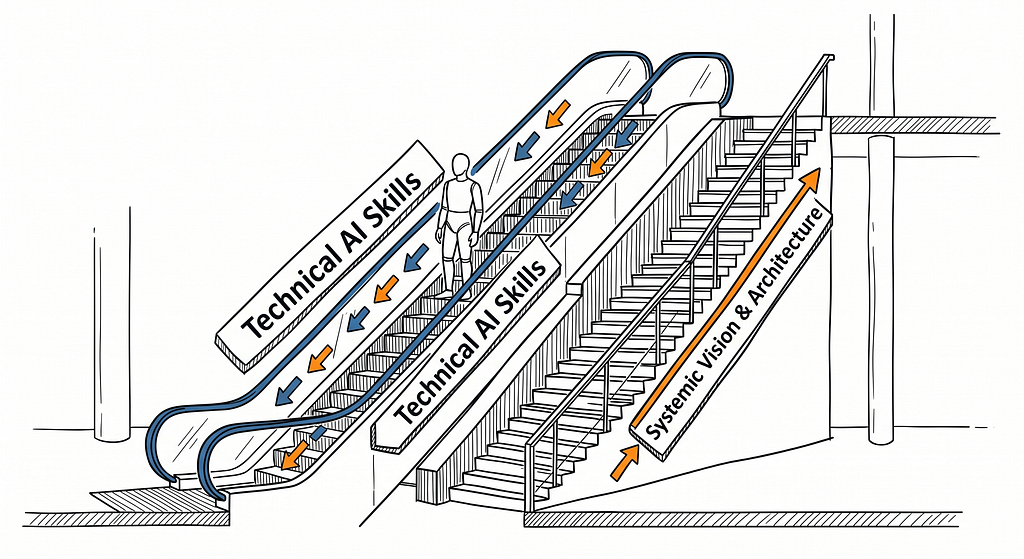
There is a brutal reality that the hype tries to hide: AI expertise is a downward escalator. Technology evolves so fast that standing still amounts to regressing. What is a rare expertise today will be a standard and free feature in the tools of tomorrow.
To avoid being swept away by this movement, you must adapt your Enterprise Architect posture. Here is your action plan:
- Stop the prompting obsession. Stop collecting text “hacks.” Treat the prompt as a temporary and fragile technical instruction. Focus your attention on the semantic layer.
- Build an MVM (Minimum Viable Model) in 15 days. Take a critical business process. Identify the 5 to 7 key entities and their relationships. Do not seek ontological perfection; seek structural clarity. Force your data into this mold before submitting it to an LLM.
- Implement metadata governance. Stop settling for measuring user “satisfaction rates.” Start tracking the Verification Level and Failure Modes. Use Gartner’s tables as a mandatory checklist for every production rollout.
- Develop your “Taste” through cross-experimentation. Force the use of three different models (a proprietary leader, a massive open-source model, and a small specialized model) on the same data structure. It is by observing the reasoning nuances between these models that you will forge your architectural intuition.
AI is not an interface revolution; it is a structural revolution.
Your value does not depend on the quality of your question, but on the solidity and intelligence of the platform you have built to generate the answer.
Did you enjoy this analysis? Hit the Follow button and connect with me on [LinkedIn].
Do not build a toy. Build a platform.
The AI Tech Trap: The 5 Dimensions to Evaluate Your True AI Maturity was originally published in Towards AI on Medium, where people are continuing the conversation by highlighting and responding to this story.