The $1.6 Trillion Silence: Why Gulf Construction Has an Information Crisis — and How Agentic AI Will End It
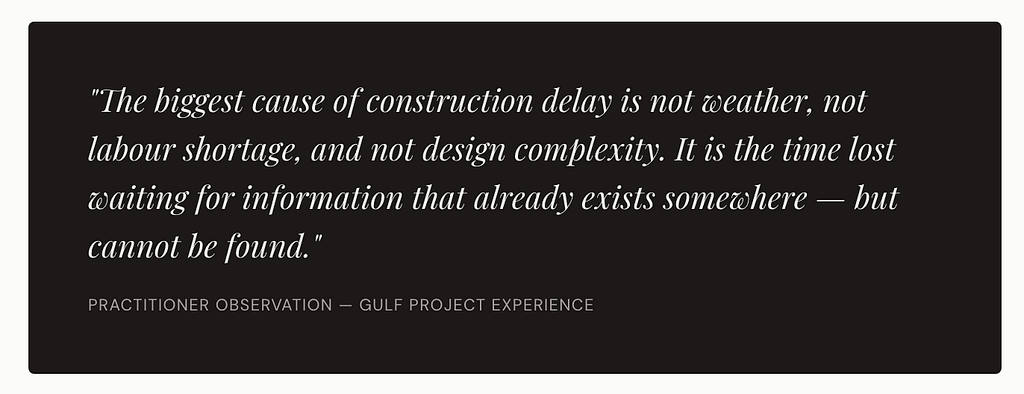
Construction projects don’t fail because engineers aren’t working hard enough. They fail because the right information never arrives in the right hands at the right time. After decades of treating this as normal, the industry has run out of excuses.

The Gulf Cooperation Council is building at a scale that has no historical precedent in peacetime. Saudi Arabia’s Vision 2030 alone carries over $1.3 trillion in planned construction and infrastructure investment (Bloomberg, 2024). The UAE’s industry is projected to reach AED 189.6 billion in 2025. Qatar rebuilt its entire infrastructure around a football tournament. And yet, across this landscape of extraordinary ambition, the same quiet disaster keeps repeating itself — not on the cranes, not in the concrete, but in the documents.
I have spent years sitting inside those meeting rooms across Doha and Dubai. The planning engineer defending a delay. The contracts team searching through email threads. The billing team arguing over a variation that was verbally approved in a site meeting three weeks ago — the minutes of which were never formally issued, and whose paper trail has since dissolved into a chain of unanswered correspondence. The project manager staring at a dashboard marked “green” while everyone in the room knows the project is bleeding.
The problem was never engineering. It was information.
And for the first time in the industry’s history, a technology exists that is genuinely capable of solving it.
The Scale of a Problem the Industry Normalized
McKinsey Global Institute’s landmark 2017 report — Reinventing Construction: A Route to Higher Productivity — delivered a verdict the industry has been slow to accept: global construction productivity has grown at just 1% per year over the past two decades. For comparison, manufacturing grew at 3.6% annually over the same period. Agriculture — an industry associated with manual labour and weather dependency — outperformed construction (McKinsey Global Institute, 2017).
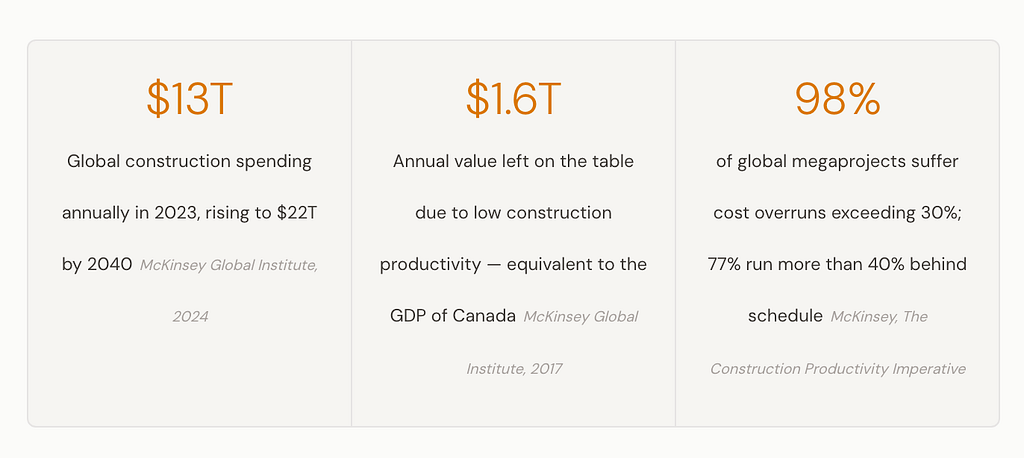
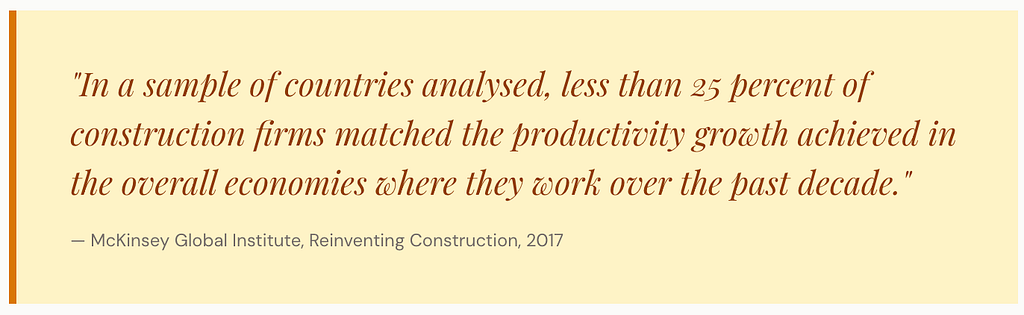
These are not statistics about incompetent organizations. They describe the structural condition of an industry where information moves slower than money does. McKinsey’s own researchers identified poor project management, inadequate design processes, and fragmented data flows as the primary drivers of this productivity collapse — not a shortage of skilled engineers (McKinsey Global Institute, 2017).
In the Gulf specifically, the challenge is compounded by scale. The GCC construction market reached USD 147.1 billion in 2024 and is expected to grow to USD 226.2 billion by 2033 (IMARC Group, 2024). Saudi Arabia alone captured 45.6% of GCC market share in 2025, driven by NEOM, Qiddiya, and the Red Sea destination projects (Mordor Intelligence, 2025). These are not projects that can tolerate the information fragmentation that was tolerable on a single-tower commercial build in 2010.
What “Information Chaos” Actually Costs — In Numbers
The KPMG Global Construction Survey (2021) — drawing on responses from nearly 300 project owners and engineering firms globally — found that more than 37% of respondents reported missing budget and/or schedule targets by a factor of 20% or more. Only 58% of organizations consistently monitored, tracked, and reported on actual project benefits (KPMG International, 2021).
At the project level, the pain is visible in specific KPIs that every Gulf construction practitioner recognizes:
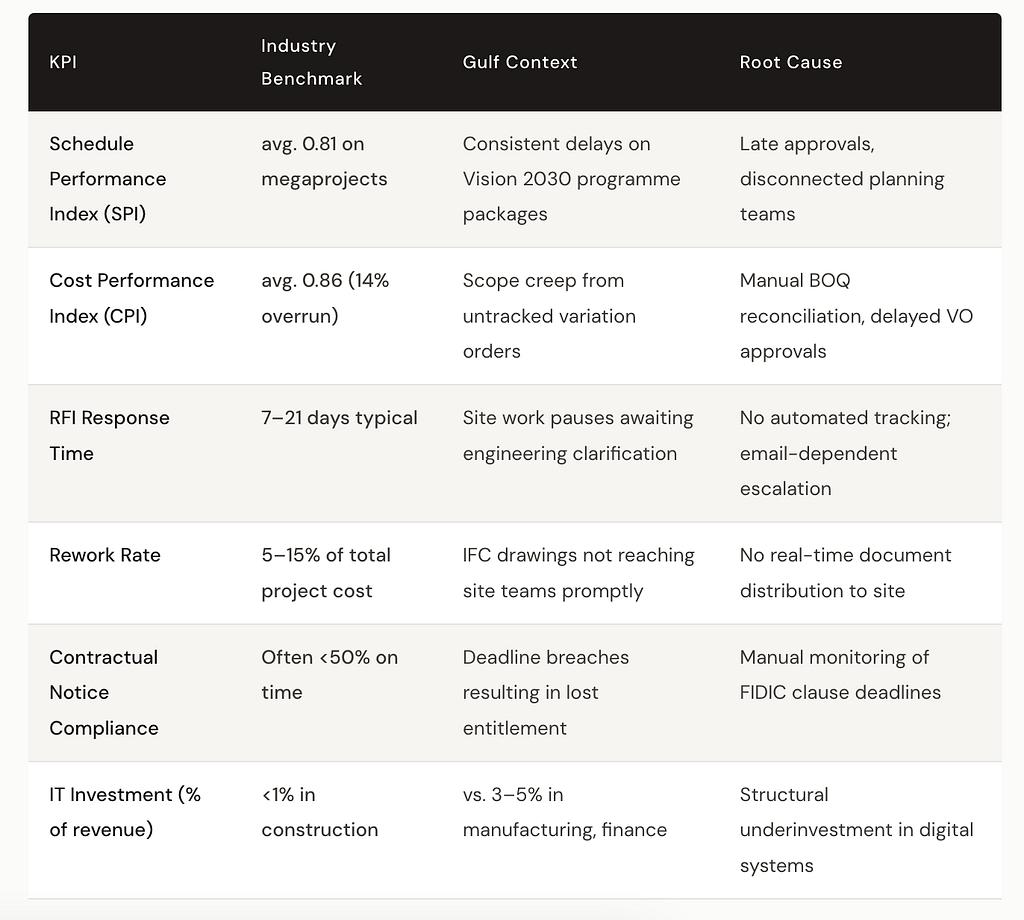
The rework figure deserves particular attention. FMI and Autodesk research found that poor project data accounts for approximately 22% of all rework, while poor communication accounts for a further 26% — together representing nearly half of all rework costs (FMI / Autodesk, 2020). On a $500 million Gulf infrastructure project running at a 10% rework rate, that is $50 million in avoidable expenditure — the cost of adding a hospital wing, or building 200 additional residential units.
What the Books Said — and the Gap That Remains
The academic and professional literature on construction project management has been remarkably consistent in diagnosing this problem for over three decades. The challenge is that reading the diagnosis has never automatically produced the cure.
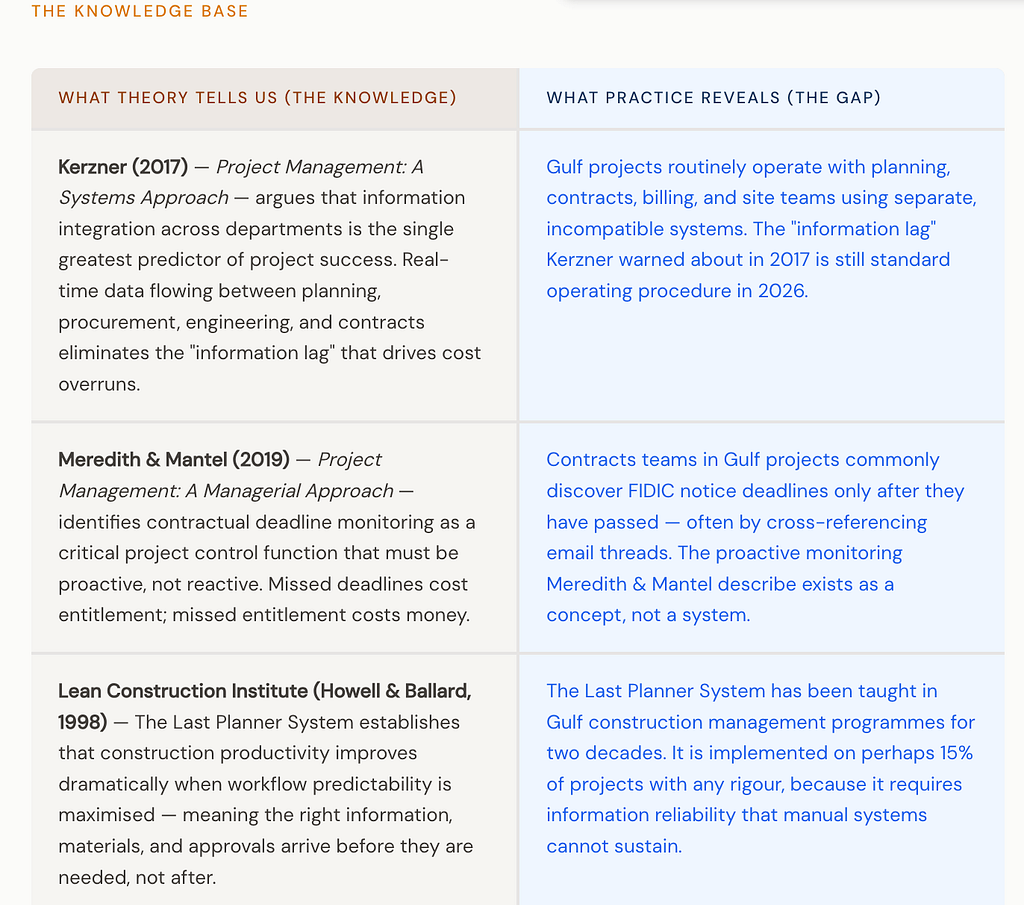
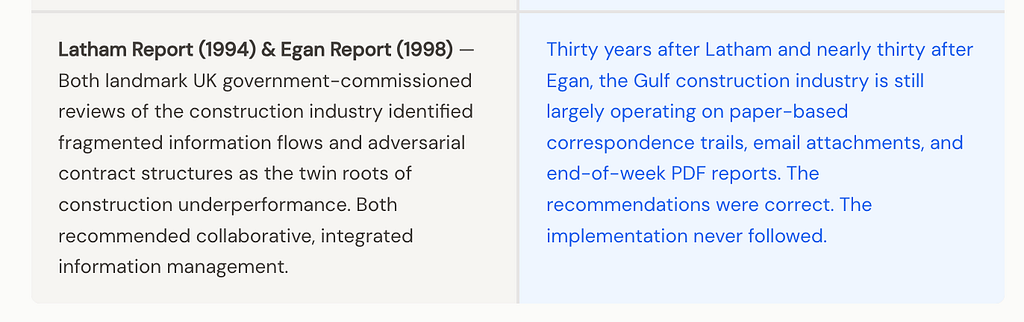
The pattern is stark. The industry has known, with rigorous academic certainty, what its information problem is and how it should be fixed for at least a generation. What it has lacked is a technology capable of implementing that fix at the scale, speed, and complexity that Gulf mega-projects demand.
That technology has now arrived.

Agentic AI: Not a Chatbot. A Colleague That Never Sleeps.
There is an important distinction the construction industry must understand before it dismisses AI as another software tool that promises much and delivers dashboards. The relevant technology in 2025 is not generative AI in the sense of “ask it a question and get an answer.” It is agentic AI — systems that can reason, plan, take multi-step actions, and autonomously complete complex tasks across connected data sources without requiring a human prompt for every move (Atlassian, 2025; Oracle, 2025).
The global AI in construction market was valued at USD 4.86 billion in 2025 and is projected to reach USD 35.53 billion by 2034, growing at a CAGR of 24.8% (Fortune Business Insights, 2026). This is not a technology that is arriving — it is arriving.
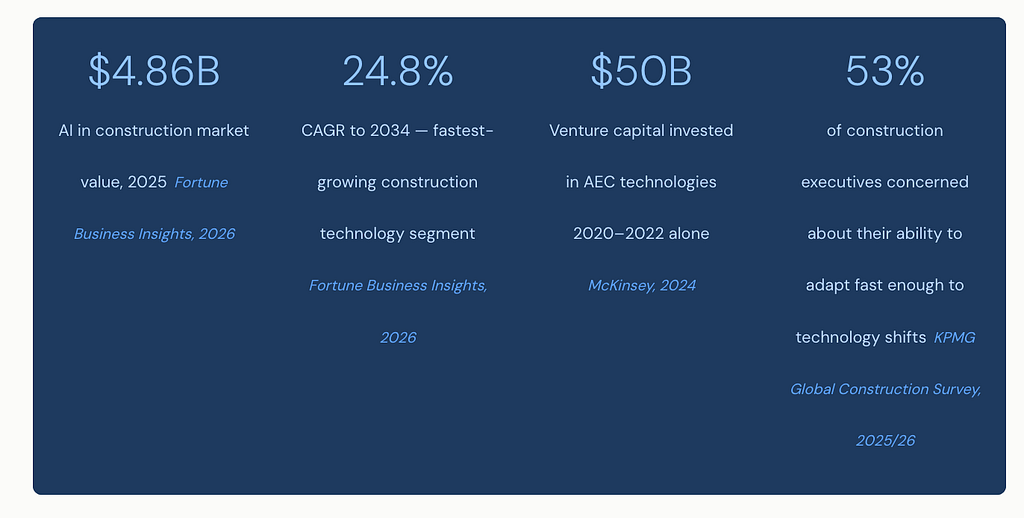
What makes agentic AI different from the project management software that construction companies already have? The answer is autonomy combined with integration. Where traditional software requires a human to input, update, retrieve, and interpret — agentic AI can do all of that continuously, across all connected systems, without being asked (Atlassian, 2025).
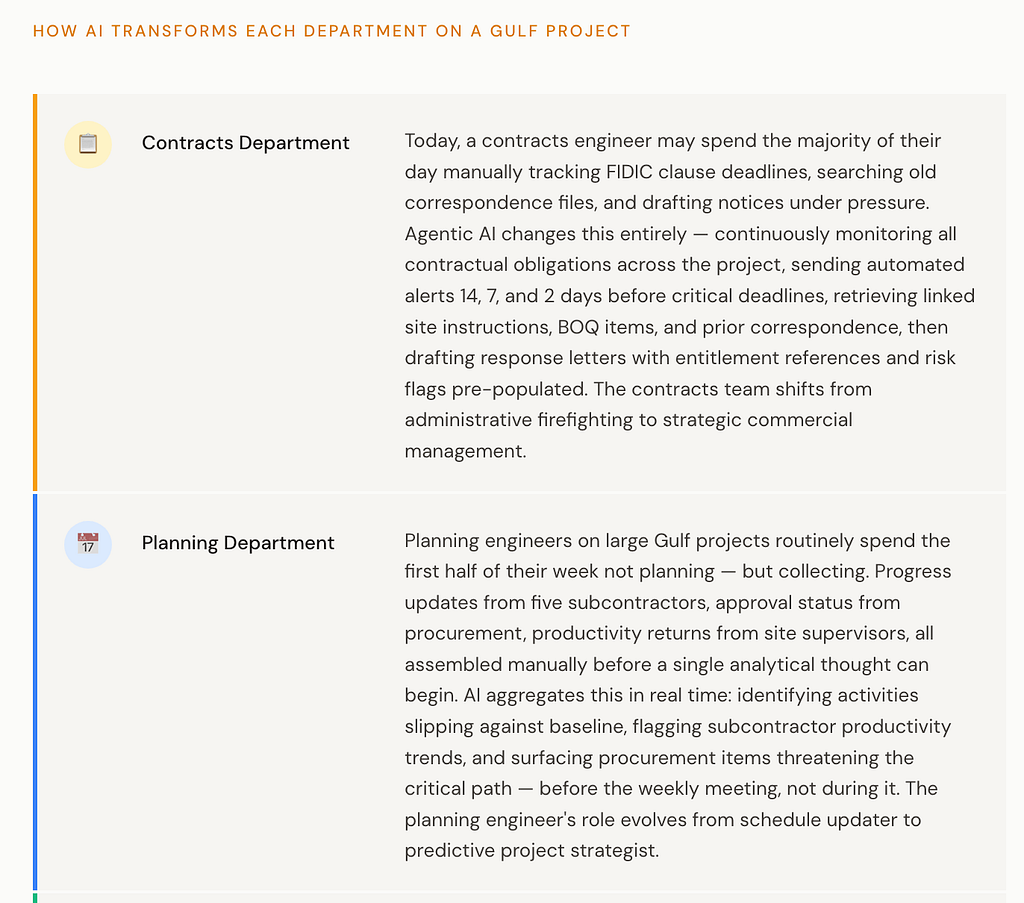
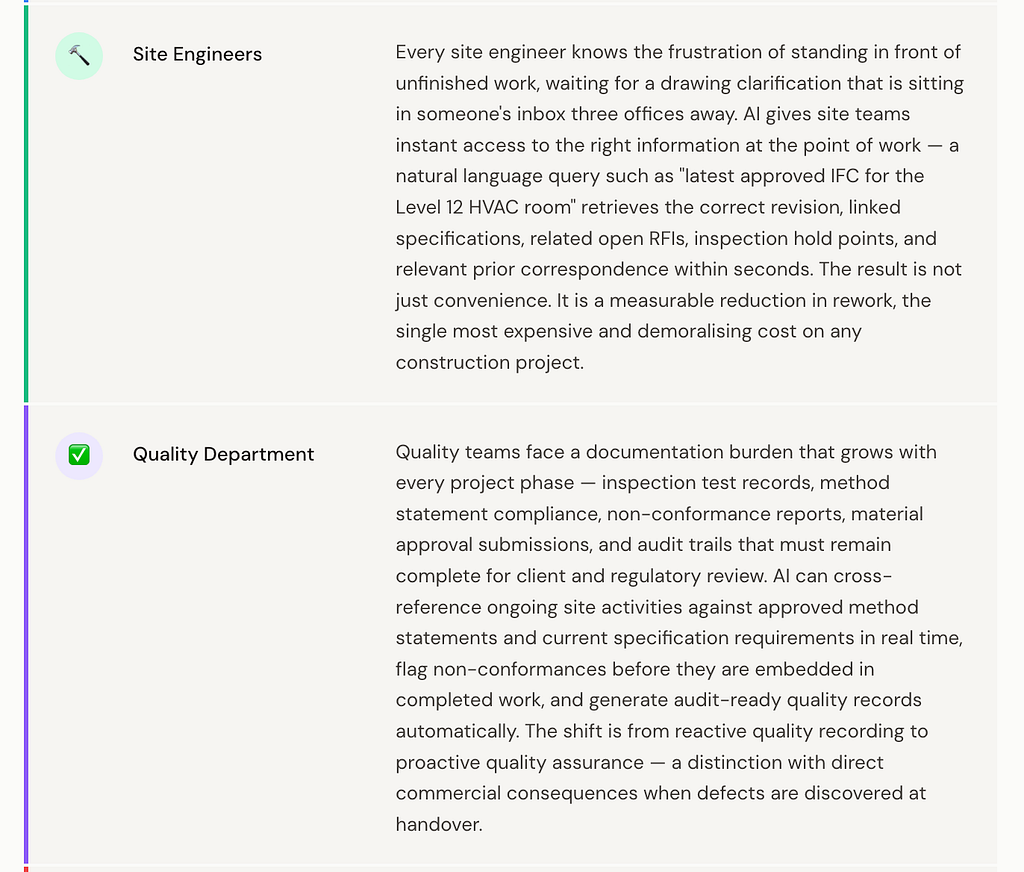
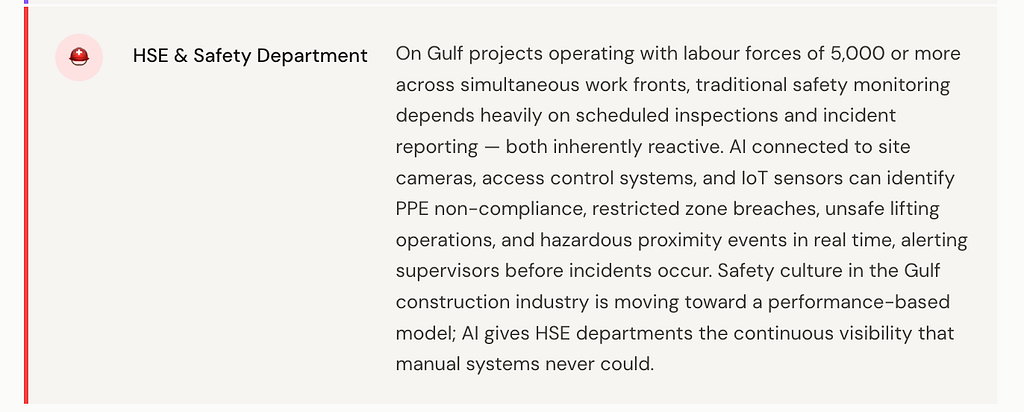
These are not futuristic concepts. Oracle’s construction intelligence platforms, Autodesk’s AI-driven project planning tools, and specialist platforms from Datagrid and Procore are already deploying agent-based architectures across large infrastructure projects (Oracle, 2025; Autodesk, 2025; Datagrid, 2025). The competitive question for Gulf contractors is not whether to adopt them — it is how quickly they can do so before their competitors do.
Closing the Gap: From What We Know to What We Do
The academic literature — Kerzner, Meredith, the Lean Construction Institute — gave us the map. Agentic AI provides the vehicle to travel it. But the journey requires a deliberate architecture of change, not just a software subscription.
Three principles from research and practice define what successful implementation looks like in the Gulf context:
First: Connect before you automate. Agentic AI cannot function across information silos. The prerequisite for any intelligent construction system is a unified data environment — drawings, schedules, contracts, procurement, and site reports flowing into a single connected platform. This is not a technical recommendation; it is what Kerzner (2017) and the Lean Construction Institute (1998) have been advocating for decades under different terminology. AI makes the case with economic urgency that theory alone could not.
Second: Redefine roles, not headcount. The fear that AI will reduce construction employment misunderstands what AI does in this context. The planning engineer who spent six hours collecting data now has six hours to analyse it. The contracts engineer who spent a day drafting a response letter now has a day to build a claims strategy. The project manager who spent three meetings gathering information now has three meetings to make decisions. AI does not remove engineers from construction. It removes the administrative burden that was preventing them from being engineers.
Third: Start with the information that already costs you money. Every Gulf project already knows where its information failures live — the RFIs that sit unanswered, the variation orders that disappear between approval and billing, the FIDIC deadlines that nobody tracks systematically. Agentic AI does not require a wholesale transformation. A targeted contracts monitoring agent on a single active project will demonstrate measurable ROI within months (HCL Technologies, 2025).
The Future Belongs to the Company That Connects Best
The GCC is building at a speed and scale that the world has rarely seen. NEOM, Lusail, Masdar City, the Riyadh Metro — these are not just infrastructure projects. They are civilizational statements. And they are being built using information management practices that would be recognisable to a site engineer from 1995.
The McKinsey data says $1.6 trillion is lost globally every year because construction cannot match the productivity of other industries. The KPMG data says 37% of projects miss their targets by more than 20%. The FMI and Autodesk research says nearly half of rework — the most visible, avoidable, and demoralising cost in construction — is rooted in poor information and poor communication.
None of this is inevitable. None of it is an engineering problem. Every one of these failures is an information problem that has been documented, analysed, and solved on paper — by Kerzner, by Latham, by Egan, by Howell and Ballard — without a technology capable of implementing the solution at scale.
Agentic AI is that technology.
The construction company that wins the next decade in the Gulf will not necessarily be the one with the largest labour force or the most experienced management team. It will be the company that figured out how to connect its drawings to its schedules, its schedules to its procurement, its procurement to its contracts, its contracts to its billing — and let intelligent agents work across all of them, continuously, without being asked.

References
- Atlassian (2025). AI agents in project management: Benefits and key use cases. Atlassian.com.
- Autodesk (2025). Construction trends report 2025: AI and the future of project planning. Autodesk.
- Bloomberg (2024). Saudi Arabia’s Vision 2030 construction and infrastructure investment pipeline. Bloomberg Intelligence.
- Datagrid (2025). AI agents for construction: Key statistics and trends. Datagrid.com.
- Egan, J. (1998). Rethinking construction: Report of the Construction Task Force. HMSO.
- FMI / Autodesk (2020). Harnessing the data advantage in construction. FMI Corporation.
- Fortune Business Insights (2026). AI in construction market size, share, and growth forecast to 2034.
- HCL Technologies (2025). Revolutionizing project management with agentic AI. HCL White Paper.
- Howell, G., & Ballard, G. (1998). Implementing lean construction: Understanding and action. Proceedings of IGLC-6, Guarujá, Brazil.
- IMARC Group (2024). GCC construction market size and growth forecast to 2033. IMARC Group Research.
- Kerzner, H. (2017). Project management: A systems approach to planning, scheduling, and controlling (12th ed.). Wiley.
- KPMG International (2017). Make it or break it: Global construction survey 2017. KPMG.
- KPMG International (2021). An industry ready to transcend: Global construction survey 2021. KPMG.
- KPMG International (2025/26). Global construction survey 2025/2026. KPMG.
- Latham, M. (1994). Constructing the team: Final report of the government/industry review of procurement and contractual arrangements in the UK construction industry. HMSO.
- McKinsey Global Institute (2017). Reinventing construction: A route to higher productivity. McKinsey & Company.
- McKinsey & Company (2024). Delivering on construction productivity is no longer optional. McKinsey & Company Operations Practice.
- McKinsey & Company (2015). The construction productivity imperative. McKinsey Quarterly.
- Meredith, J. R., & Mantel, S. J. (2019). Project management: A managerial approach (10th ed.). Wiley.
- Mordor Intelligence (2025). GCC construction market — industry size, market share, and forecast to 2031. Mordor Intelligence.
- Oracle (2025). Agentic AI: A game changer for the construction industry. Oracle AI & Data Science Blog.
The $1.6 Trillion Silence: Why Gulf Construction Has an Information Crisis — and How Agentic AI… was originally published in Towards AI on Medium, where people are continuing the conversation by highlighting and responding to this story.