Crossposted from babbo.dev/intentio. To experience the piece in its more autological, intended form, please visit there.
A Manifesto for the Intentional Internet
"And Nothing is very strong: strong enough to steal away a man's best years not in sweet sins but in a dreary flickering of the mind over it knows not what and knows not why, in the gratification of curiosities so feeble that the man is only half aware of them, in drumming of fingers and kicking of heels, in whistling tunes that he does not like, or in the long, dim labyrinth of reveries that have not even lust or ambition to give them a relish, but which, once chance association has started them, the creature is too weak and fuddled to shake off."
— C.S. Lewis, The Screwtape Letters (1942)
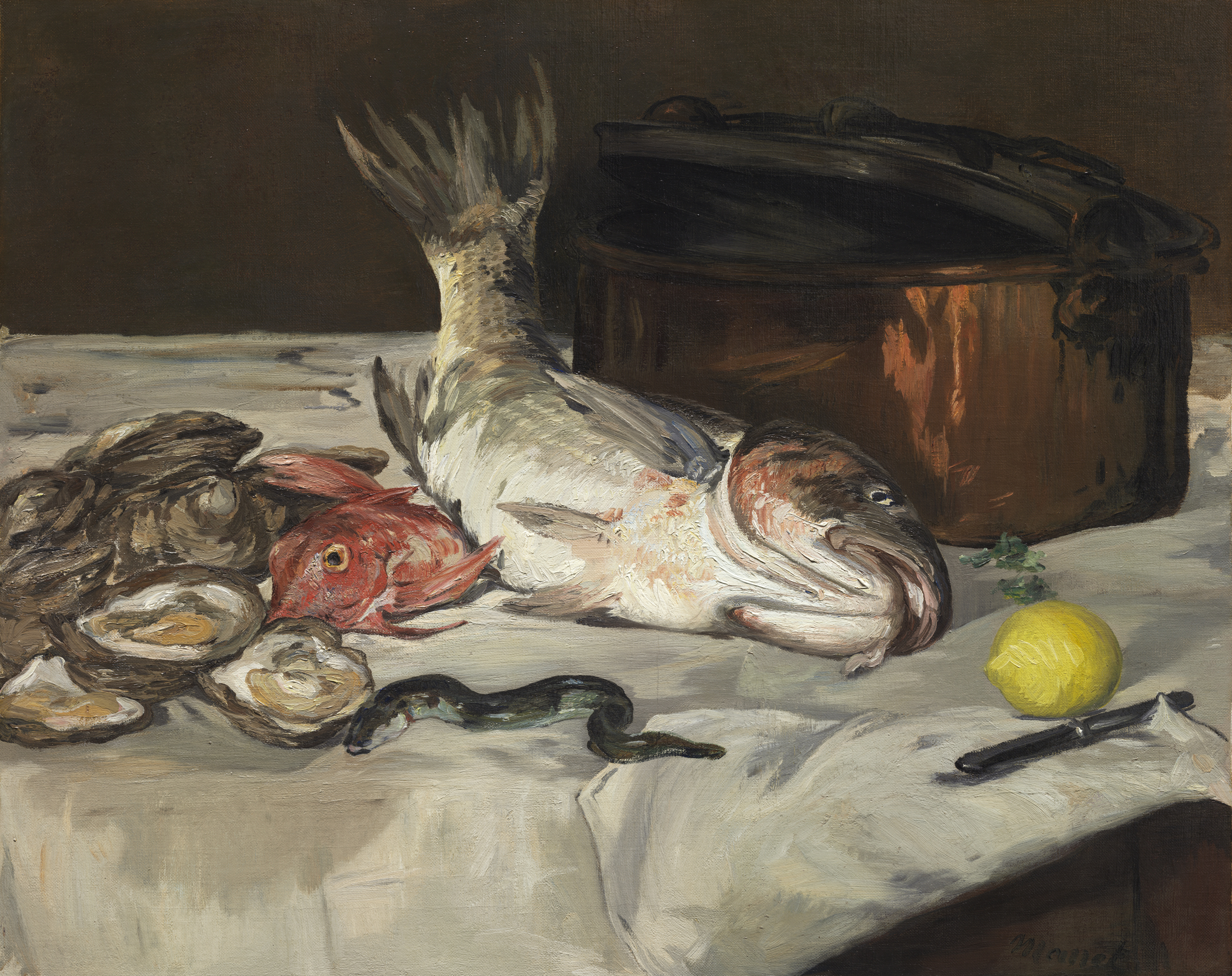
Fish (Still Life), Paul Cézanne, 1864. Art Institute of Chicago
Author's note: The internet is rotting, and the miasma is infecting us, its inhabitants. Declensionist narratives, though, by themselves, are not cures. The issues are structural, and so must the solution be. What follows is a diagnosis of what went wrong and an introduction to Intentio, my project for a more intentional web.
I. The Quiddity of Slop
Slop has been the word du jour over the past year.[1]Both the Economist[2]and the American Dialect Society[3][4]named 'slop' their 'Word of the Year' for 2025. The term has been used to describe everything from the bizarre faux-Christian 'shrimp Jesus'[5]images which briefly flooded Facebook, to the sludge-like interchangeable fast-casual meals derided as 'slop-bowls'.[6]
However, there has not been a succinct description for the quiddity; the essence of, 'slopness'. It has a phenomenological character people can intuitively feel: Potter Stewart's test of "I know it when I see it,"[7]seems apt. Yet I believe we can do slightly better. To put it concretely, slop is something created or consumed without intention.[8]
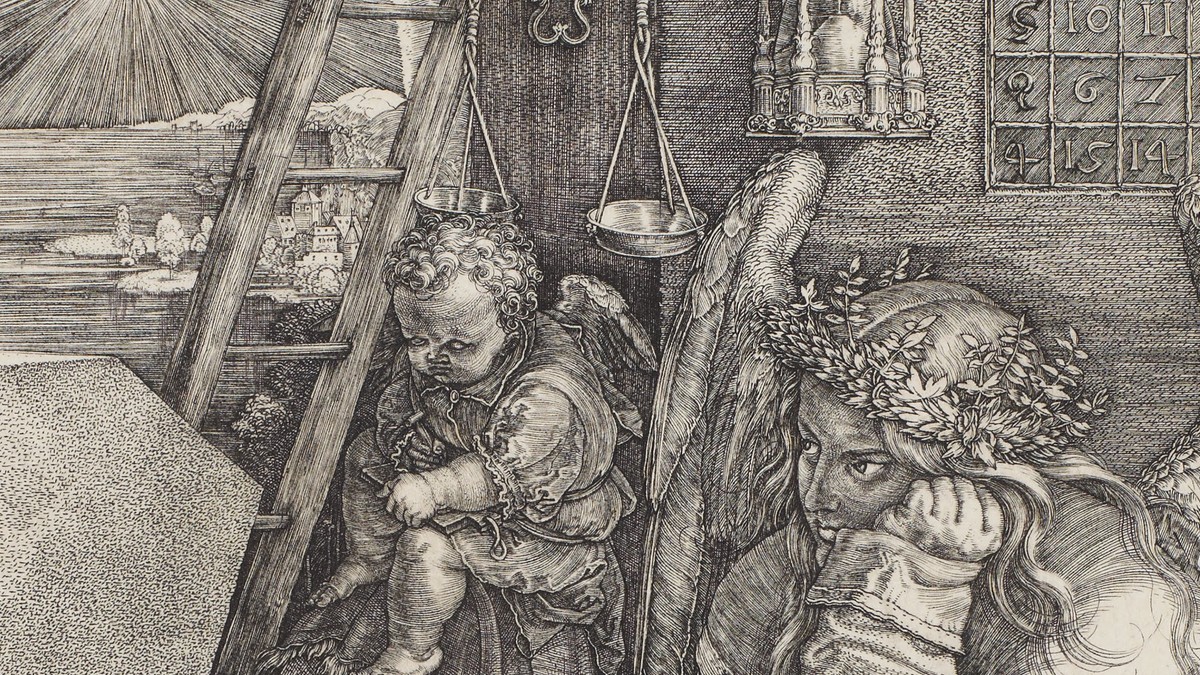
Melencolia I, Albrecht Dürer, 1514. Minneapolis Institute of Art
Imagine Albrecht Dürer's Melencolia I materializing through random quantum fluctuations on the far side of the universe.[9]Though Dürer's original is a work pregnant with meaning, here it has none. Meaning is something constituted between an agent and object, not something which inheres to an object itself.[10]Meaning requires a rational agent to direct an object towards an end; without that intention what remains is slop.[11]

The Allegory of Painting, Johannes Vermeer, 1666. Kunsthistorisches Museum, Vienna
The set of slop then is not identical to the set of AI-generated works. It is possible to create slop without AI when creating something solely for the sake of the entity itself, with no greater telos. It is also possible, though currently rare, to use AI as a tool to create intentional, meaningful works.[12]Vermeer is said to have utilized a camera obscura to aid his works.[13]Few though would argue that The Allegory of Painting is slop. What generative AI does though is greatly lower the barriers that used to serve as signals for intentionality.
A well formatted Github 'README'[14]used to be a strong indicator of the quality of the underlying software. A structured comment with perfect grammar helped signal a well thought out argument or reasoned review. Proxies for time spent indicated some degree of intentionality.[15]Of course this was not a completely lossless signal. It was possible to find a diamond in the rough and lesser works might try to fake a veneer of quality without the same underlying craftsmanship. Goodhart's adage, "When a measure becomes a target, it ceases to be a good measure"[16]had some strength.

New Year's Day Letter (元日帖), Mi Fu (米芾). Osaka City Museum of Fine Arts
However, due to the cost of replicating, even the pursuit of mimicry here created a ratchet effect to pull the floor of quality upwards. A junior programmer copying a senior's design patterns improves not only the immediate product, but improves his own skills in the copying. Mi Fu only developed his unique style of calligraphy after years of copying the ancients.[17]
Due to the increasing algorithmic flood of information we are bombarded with, well-tuned signals are more important than ever. However with the advancement of AI, we increasingly have a 'Market for Lemons'.[18]As our signals degrade, adverse selection increases, driving high-quality goods away as they become harder to immediately distinguish. Even if one desires to be intentional in their consumption, there is only so much value that can be extracted from a work created without intention.
The Eruption of Vesuvius, Pierre-Jacques Volaire, 1771. Art Institute of Chicago
II. The Rise and Fall (and Rise Again) of the Gatekeepers
There have long been gatekeepers that controlled access to the cultural realms. During the Song dynasty, the imperial examination system came to define the intellectual and cultural bounds of society.[19][20]In the Occident, this role was played by the Catholic Church.[21]Even in a more open American society, the high costs of production and distribution ensured that culture was bottlenecked through studios, broadcasters, and publishers.[22][23]
The internet though disintermediated the cultural landscape. As distribution costs were driven to zero, there was no need for a gatekeeper between the consumer and producer. Through blogs, personal websites, community run forums, and direct-to-consumer retail creators could reach audiences directly. There would be, "an army of Davids taking the place of those slow, shuffling Goliaths."[24]
However, in systems, value naturally wants to centralize: power accumulates to the executive,[25]capital consolidates in monopolies,[26]"The empire, long divided, must unite".[27]Without a structural balance of powers and intentional protocols to promote decentralization, gravity collapses the system back toward a single point.
So it was on the internet. The shape was slightly different; with supply abundant, demand instead was consolidated.[28]But the conclusion was the same and the end of the early internet was heralded by the emergence of the new social media giants such as Facebook, Twitter, and YouTube.
This is not to say that centralization is necessarily bad. Economies of scale are real and can provide consumer surplus at least in the short term. The internet titans won mainly by solving the very real problems of search and discovery for people.
Once demand was aggregated, advertising emerged as the natural monetization model. From this two incentives emerged: increase ad load and improve ad targeting.
There are two main ways to raise total advertising load. The first is to simply increase advertising density; play five minutes of ads for every five minutes of content. However, this degrades the user experience to the point where users eventually revolt.[29]
The second approach is more pernicious. Ad load can also be raised by increasing the user's time on platform. At first blush this seems mutually beneficial: the easiest way to keep a user on your platform is to provide them with content that interests them. However, what momentarily engages us is not necessarily what is 'good' for us. It is easier to target the limbic system over the prefrontal cortex.[30]
The experience of the chronological 'following' or 'subscriptions' feed is diminished and defaults are switched to algorithmically personalized home pages which cater to immediate impulses. The platform slowly 'enshittifies,'[31]but user session duration continues to increase.
However, ad targeting can still be improved. The best way to improve targeting is through increased data collection. Not just off-platform personal data,[32]but also through tracking on-platform behavioral patterns.
TikTok revolutionized here first with the short form video feed.[33]Watching or swiping produces a new data point every 15 seconds at most. Youtube and Instagram soon followed with 'shorts' and 'reels'. The new format turns out not only to be great for data collection but also gets users more hooked.[34]
No longer does one even choose from a set of algorithmically provided options. There is no friction to continue consuming. No impetus to engage with the material on a deeper level. All content turns into pure ephemera to momentarily satiate brief lulls of dopamine.

The Banquet, René Magritte, 1958. Art Institute of Chicago
III. Potemkin Agoras
In 2021, pseudonymous user IlluminatiPirate posted a conspiracy theory to niche internet forum Agora Road. Titled Dead Internet Theory,[35]it describes a world dominated by fake data created by bots in order to control and shape public perception.
In 2025, cybersecurity firm Imperva measured 51% of web traffic coming from bots.[36]Cloudflare found 57% of HTML requests were from non-human sources.[37]Russia has used covert AI tools such as Meliorator to, "create 'authentic' appearing personas en masse, allowing for the propagation of disinformation... [to exacerbate] discord and [try] to alter public opinion as part of information operations."[38]
The Prigozhin backed Internet Research Agency (IRA) utilized Facebook, Instagram, Twitter, Youtube, Google+, Gmail, Reddit, Tumblr, LinkedIn, Medium, Pinterest, Vine, Gab, Meetup, VK, LiveJournal, 4chan, 9GAG and Pokémon Go among other avenues to sow discontent on the American populace.[39][40]On Facebook alone, as many as 126 million Americans came into contact with IRA manufactured content between 2015 and 2017.[41][42]
On Instagram the IRA ran 12 accounts with over 100,000 followers and 133 with over 10,000. There wasn't a single leaning to the IRA's propaganda. Accounts included those focused on African-American cultural issues, Second Amendment rights, Texas secession, gender identity rights, and Christianity, among other topics.[43]The goal was not to promote a specific ideology, but rather to increase tensions among the American public.[44]
The IRA was not alone in carrying out coordinated influence operations. In just December 2025[45], Google terminated accounts linked to Myanmar, Belarus, Bangladesh, Pakistan, Indonesia, the People's Republic of China, and Russia.[46]
When X rolled out a feature showing where accounts were based from, it exposed that many highly inflammatory US political accounts on the platform are actually based out of different nations. '@MAGANationX' with 392,000 followers was registered in Eastern Europe.[47]'@AmericanVoice__' with over 200,000 followers was shown to be run from South Asia.[48]Ron Smith, "Proud Democrat" and "Professional MAGA hunter", deleted their 52,000 follower account when it was traced to Kenya.[49]
There is still something to be said for anonymity. Hamilton, Madison, and Jay wrote the Federalist Papers as Publius. Kierkegaard published under a dozen different pseudonyms.[50]Soviet dissidents circulated samizdat unsigned, or under names that could not be traced back to a kitchen table in Leningrad. Privacy has often been a precondition for honesty, particularly where power makes honesty costly.
Even our ersatz agora though is now crumbling. 38% of webpages that existed in 2013 are no longer accessible. Digital institutions such as Wikipedia are not immune from 'link rot' with 54% of articles containing at least one link in their 'References' section which no longer exists.[51][52]As bots flood the commons, the old internet fades away.
Umbrellas in the Rain, Maurice Prendergast, 1899. Museum of Fine Arts, Boston
IV. An Intentional Web
"[A] mere demarkation on parchment of the... limits of the several departments, is not a sufficient guard against those encroachments which lead to a tyrannical concentration of all the powers... in the same hands."
— James Madison, Federalist No. 48 (1788)
While a myriad of serious issues plague the current state of the web, our diagnosis is not a prognosis. People have begun to feel the costs of the present arrangement: hours scrolling without satisfaction, feeds that reward impulse over interest, replies that turn out to be bots.
As people independently seek ways out, a collective action problem which used to look intractable now requires only a path forward. Intentio is our answer: a new peer-to-peer, local-first social network; designed for deliberation, discovery, curation, and sharing; self-sovereign, with pluralistic governance, and free from algorithmically induced passivity.
It is common to look for incremental improvements and nudges to larger issues.[53]This is often the correct choice when the overall system is healthy. However, when the overall structure is broken, incremental improvements can get us stuck in short-term local maxima. We need to take a 'Brandeisian', holistic view of the health of the entire market.
A similar error tempts at the individual scale. It would seem the easiest way to not consume slop is to simply not interact with it. Manufactured propaganda is only an issue in so far as people fall for it. The lowest-energy state of the system though runs against these notions. While interventions like the above can work in the short-term or among those of preternaturally strong will, entropy drags the system back to its lowest-energy configuration.
It is easier to leave a bad environment than to repeatedly choose well inside of one. The addiction literature shows that removing someone from a cue-rich setting massively improves recovery.[54]In the Catholic Act of Contrition, the penitent resolves not only to avoid sin itself but also the near occasion of sin.[55]What concrete, structural changes can be made to create better environments for the long-term?
There are a number of primitives; core constructs in Intentio, that we believe when integrated will give communities the conditions to flourish:
Curation over consumption. Works should be treated as artifacts worth keeping, not ephemera to scroll past. We want to design in a way that encourages curation over pure consumption; to inject friction to encourage deeper contemplation of materials.[56]
Individuals, not algorithms. People might consume slop, but share based on higher values.[57]Discovery should occur through following specific curators and creators. Content should spread based on quality, not algorithmic dictate.
Local-first data. Having data locally, in open formats, forces communities and platforms to compete on quality rather than exit cost.[58]
Decentralized, shared hosting. Content should live across many hosts rather than a single server.[59]Canonicity should be communally negotiated. No single node should be load-bearing to avoid loss.[60]
Incremental identity, distributed trust. Users should be able to prove specific claims about themselves without exposing the underlying data,[61]and maintain separate personas across contexts.[62]Communities should set their own identity requirements, with trust accumulating from different systems.[63]
Pluralistic governance. Online communities today default to autocracy. What we want is subsidiarity. Governance should take the form that suits the community and operate at the scale that fits the decision.[64][65]
Humans while containing radical freedom are also social animals.[66]Together we can create systems and communities to point our freedom closer to the Good, the True, and the Beautiful.
Join us in choosing a more intentional internet. Join us in Intentio.
To receive updates on Intentio, you can sign your email to the manifesto at babbo.dev/intentio.
While we build out the platform, you can also join the community on Discord.
Thanks to Tyler Cowen, Cory Doctorow, James J. Heaney, Alex Russell, Robin Sloan, Dan Wang, Saar Wilf, and my family for reviewing earlier drafts of this work.
Google Trends, Interest in "slop" in the United States, 2004–2026. ↩︎
"And the Economist's Word of the Year for 2025 Is…," The Economist, accessed May 8, 2026. ↩︎
"American Dialect Society Selects Slop as 2025 Word of the Year," American Dialect Society, January 9, 2026. ↩︎
Runners up include 'rage-bait' and '6-7'. Not the most auspicious sign for the future. ↩︎
Alex Hern and Dan Milmo, "Spam, junk … slop? The latest wave of AI behind the 'zombie internet'," The Guardian, accessed May 8, 2026. ↩︎
Julie Creswell, "The Allure of 'Slop Bowls' Fades as Consumers Tighten Spending," The New York Times, accessed May 8, 2026. ↩︎
Justice Potter Stewart, concurring opinion in Jacobellis v. Ohio, 378 U.S. 184, 197 (1964). ↩︎
More precisely, 'slopness' is closer to a scalar than a binary; works possess it in varying degrees, inversely with the intentionality of their creation and consumption. The threshold itself for calling something 'slop' is Sorites-like. ↩︎
Think Boltzmann brain. ↩︎
Thomas Aquinas, building on Aristotle's observation that the soul receives forms "without the matter,"[67]distinguished between esse naturale, the bare physical existence of a form in matter, and esse intentionale, the existence of that same form as constituted in a mind directed toward it.[68]A thing may have the first without the second. Our imagined Dürer has esse naturale in abundance; what it lacks entirely is esse intentionale. (For a fuller treatment, see the Stanford Encyclopedia of Philosophy's entry on mental representation in medieval philosophy.) ↩︎
Slop is not interchangeable with 'bad', it is possible to create 'high-quality' non-'slop' works which are 'bad' as they are directed towards a 'bad' end. ↩︎
Or at least interesting works; see, e.g., acclaimed Chinese director Jia Zhangke's Dance (2026), created using Seedance 2.0. ↩︎
This is a contested topic, with experts debating if, what, and the extent of tools used.[69]↩︎
The 'landing page' for a software project (repository) hosted on Github. Github renders the markdown put into a file called README.md in the project's root directory.[70]↩︎
"Literature and everyday experience suggest that the allocation of time is a ubiquitous and persistent signal sometimes used deliberately as a screening device."[72]↩︎
Goodhart's original formulation was: "Any observed statistical regularity will tend to collapse once pressure is placed upon it for control purposes." The pithier wording quoted was popularized by Marilyn Strathern.[71]↩︎
"A major reason why Mi Fu was able to go beyond the Chin masters and formulate a style of his own is that he studied calligraphic works of many masters, styles, and periods... He writes: 'People say my calligraphy is a compendium of old characters, because I took the best part of them all and formed them into a synthesis. Finally in my old age did I establish a style of my own.'"[78]↩︎
George A. Akerlof, "The Market for 'Lemons': Quality Uncertainty and the Market Mechanism," Quarterly Journal of Economics 84, no. 3 (1970): 488–500. ↩︎
Precursor systems existed under the Sui and Tang, but the system came to full prominence under the Song as a counterweight to the landed aristocracy, and persisted through to the Qing where it was abolished in 1905.[73]↩︎
"Cultural construction of neo-Confucian orthodoxy through the required educational curriculum for examination candidates guaranteed the long-term dominance of neo-Confucianism in intellectual life. The imperial state, gentry society, and neo-Confucian culture were tightly intertwined by the 'educational gyroscope' that centered on civil service examinations. Through their interdependence, all three dimensions were thereby perpetuated and stabilized for 500 years."[73]↩︎
"So the church was not only a state, it was the state; it was not only a society, it was the society — the human societas perfecta. Not only all political activity, but all learning and thought were functions of the church. Besides taking over the political order of the Roman Empire, the church appropriated the science of Greece and the literature of Rome, and it turned them into instruments of human well-being in this world."[80]↩︎
"The cost of physical capital was for more than 150 years the central organizing principle of information and cultural production, from the introduction of high-cost, high-volume mechanical presses, through telegraph, telephone, radio, film, records, television, cable, and satellite systems. These costs largely structured production around a capital-intensive, industrial model."[81]↩︎
To be clear, this is a purely descriptive, not normative, argument. ↩︎
Glenn Reynolds, An Army of Davids: How Markets and Technology Empower Ordinary People to Beat Big Media, Big Government, and Other Goliaths (Nashville: Nelson Current, 2006), 9. ↩︎
Arthur M. Schlesinger Jr., The Imperial Presidency (Boston: Houghton Mifflin, 1973). ↩︎
"[M]erchants and manufacturers, who being collected into towns, and accustomed to that exclusive corporation spirit which prevails in them, naturally endeavour to obtain, against all their countrymen, the same exclusive privilege which they generally possess against the inhabitants of their respective towns. They accordingly seem to have been the original inventors of those restraints upon the importation of foreign goods, which secure to them the monopoly of the home market."[79]↩︎
Luo Guanzhong, Romance of the Three Kingdoms, trans. Moss Roberts (Berkeley: University of California Press, 1991), opening line. ↩︎
Ben Thompson, "Defining Aggregators," Stratechery, September 26, 2017. ↩︎
Lower switching costs to other entertainment sources online force platforms to maintain a minimum standard of user-friendliness. This is brought into stark relief when watching a sports match on traditional cable. Online platforms have genuinely improved the experience here, at least in ad-load per minute. ↩︎
Engagement is also not valence-neutral. Humans have an innate negativity bias and so are naturally drawn more towards content that promotes negative stimuli.[82]This results in a 'doomscrolling' loop, where people get stuck watching content promoting anxiety[83], fear, and conspiracy;[84]pulling them into increasingly fetid echo chambers. ↩︎
Cory Doctorow, "Social Quitting," Locus Magazine, January 2023. ↩︎
Though this has also gotten increasingly egregious.[85][86][87]↩︎
Or really Vine, but never in a way that truly took off. ↩︎
There is currently no social media use disorder in either the DSM-5 or ICD-11, and whether social media can technically be described as 'addictive' is controversial.[76]However, it seems clear that social media can, at the least, induce addiction-like effects.[77]↩︎
IlluminatiPirate, "Dead Internet Theory: Most of the Internet is Fake," Agora Road's Macintosh Cafe, January 5, 2021. ↩︎
"2025 Imperva Bad Bot Report," Thales/Imperva, 2025. ↩︎
"2025 Year in Review: AI Traffic Share," Cloudflare Radar, 2025. ↩︎
"State-Sponsored Russian Media Leverages Meliorator Software for Foreign Malign Influence Activity," FBI/IC3, July 9, 2024. ↩︎
Renée DiResta et al., The Tactics & Tropes of the Internet Research Agency, New Knowledge, 2018, 5. ↩︎
U.S. Senate Select Committee on Intelligence, Russian Active Measures Campaigns and Interference in the 2016 U.S. Election, vol. 2, sec. VII, 43–62. ↩︎ ↩︎ ↩︎ ↩︎
"An estimated 3.3 million Facebook users followed IRA-backed pages, and these pages are the predicate for 76.5 million user interactions, or 'engagements,' including 30.4 million shares, 37.6 million likes, 3.3 million comments, and 5.2 million reactions. Facebook estimates that as many as 126 million Americans on the social media platform came into contact with content manufactured and disseminated by the IRA, via its Facebook pages, at some point between 2015 and 2017."[40]↩︎
Though, it should be noted, there is little evidence this had any meaningful impact on the 2016 presidential election.[93]↩︎
e.g., top IRA Instagram accounts included '@Blackstagram' (300,000+ followers), '@american.veterans' (215,680), '@rainbow_nation_us' (156,465), and '@_american.made' (135,008).[40]↩︎
A particularly emblematic anecdote: in May 2016, the IRA organized a "Stop Islamization of Texas" protest through its "Heart of Texas" Facebook page. Simultaneously, they promoted a separate event to "Save Islamic Knowledge" through their "United Muslims of America" page at the same time and place. The two crowds met each other and the protests escalated into confrontation and verbal attacks.[40]↩︎
The last month with a Google Threat Analysis Group report at the time of writing (April 27, 2026). ↩︎
8 Youtube accounts linked to Myanmar, 10 related to Belarus, 27 to Bangladesh, 170 to Pakistan, 2,584 to Indonesia, 6,280 to the People's Republic of China, and 1,313 Youtube accounts and 122 domains across 13 operations related to Russia.[75]↩︎
Yan Zhuang, "X Displays Users' Locations, Fueling Scrutiny Over Political Accounts," The New York Times, November 24, 2025, accessed May 9, 2026. ↩︎
Anders Hagstrom, "X's New Location Feature Exposes Apparent Fraudster Accounts Posing as Americans, Gaza Journalists," Fox News, November 23, 2025, accessed May 9, 2026. ↩︎
Shayan Sardarizadeh, Thomas Copeland, and Tom Edgington, "How X's New Location Feature Exposed Big US Politics Accounts," BBC News, November 24, 2025, accessed May 9, 2026. ↩︎
Including Johannes de Silentio, Constantine Constantius, Johannes Climacus, Anti-Climacus, Vigilius Haufniensis, Nicolaus Notabene, Hilarius Bookbinder, Judge William, Victor Eremita, and Frater Taciturnus, among others.[88]↩︎
Athena Chapekis, Samuel Bestvater, Emma Remy, and Gonzalo Rivero, "When Online Content Disappears," Pew Research Center, May 17, 2024. ↩︎
The decay reaches even domains demanding rigorous citation: "50% of the URLs within U.S. Supreme Court opinions suffer reference rot."[94]↩︎
See, e.g., YouTube's new easily bypassable Shorts feed timer.[74]↩︎
Lee N. Robins, Darlene H. Davis, and Donald W. Goodwin, "Drug Use by U.S. Army Enlisted Men in Vietnam: A Follow-up on Their Return Home," American Journal of Epidemiology 99, no. 4 (1974): 235–249. ↩︎
"Act of Contrition," United States Conference of Catholic Bishops, accessed May 9, 2026. ↩︎
These 'works' should be the central 'entity' in the system which can then be interacted with in a multitude of ways depending on their 'type'. This includes basic actions such as sharing, linking, annotating, and commenting, but also more complex interactions such as spaced repetition[89]to help develop deeper engagement with the works. ↩︎
As sharing has a reputational 'cost', content has to increase in value to overcome the reputational credit spread risk. These 'costs' can flow through a network creating a system with more intentional discovery.[90]↩︎
This also helps enforce protections of security, privacy, and long-term data-integrity at a structural level.[91]↩︎
Bram Cohen, "Incentives Build Robustness in BitTorrent," May 22, 2003. ↩︎
Reciprocity requirements can be enforced at a community level. This also has the advantage of mitigating some forms of bot traffic. Things which are cheap at an individual level, such as storage space on a personal device, become prohibitive at scale. ↩︎
Shafi Goldwasser, Silvio Micali, and Charles Rackoff, "The Knowledge Complexity of Interactive Proof Systems," SIAM Journal on Computing 18, no. 1 (1989): 186–208. ↩︎
Christopher Allen, "The Path to Self-Sovereign Identity," Life With Alacrity, April 26, 2016. ↩︎
For an example of an alternate peer-based trust model, see Mitchell Hashimoto's Vouch. ↩︎
Communities should be able to compose into each other and be able to easily design and structure various governmental structures that best align with their ends.[92]↩︎
These primitives naturally compose into a stack:
- Local-first data → data layer (where information lives)
- Decentralized, shared hosting → distribution layer (how it propagates and persists)
- Curation over consumption → interaction layer (how it can be acted upon)
- Incremental identity, distributed trust → identity layer (who can act upon it)
- Individuals, not algorithms → discovery layer (how it can be found)
- Pluralistic governance → governance layer (how it is regulated)
Aristotle, Politics I, trans. Benjamin Jowett, The Internet Classics Archive. ↩︎
- ^
Aristotle, De Anima II, pt. 12, trans. J.A. Smith, The Internet Classics Archive. ↩︎
Thomas Aquinas, Summa Theologiae I, q. 56, trans. Fathers of the English Dominican Province, 2nd ed. (1920). ↩︎
"Camera Obscura: Sources and Studies," Essential Vermeer. ↩︎
"About READMEs," GitHub Docs, accessed May 8, 2026. ↩︎
Marilyn Strathern, "Improving Ratings: Audit in the British University System," European Review 5 (1997): 305–321. ↩︎
A. Michael Spence, "Signaling in Retrospect and the Informational Structure of Markets," Prize Lecture, December 8, 2001. ↩︎
Benjamin A. Elman, "Political, Social, and Cultural Reproduction Via Civil Service Examinations in Late Imperial China," The Journal of Asian Studies 50, no. 1 (1991): 7–28. ↩︎ ↩︎
Stevie Bonifield, "YouTube Now Lets You Turn Off Shorts," The Verge, April 15, 2026, accessed May 9, 2026. ↩︎
Billy Leonard, "TAG Bulletin: Q4 2025," Google Threat Analysis Group, January 29, 2026, accessed May 9, 2026. ↩︎
Tania Moretta and Elisa Wegmann, "Toward the Classification of Social Media Use Disorder: Clinical Characterization and Proposed Diagnostic Criteria," Addictive Behaviors Reports 21 (2025): 100603. ↩︎
Jonathan Haidt, Zach Rausch, and Jean Twenge, "Social Media and Mental Health: A Collaborative Review," unpublished manuscript, New York University, accessed May 9, 2026. ↩︎
Lothar Ledderose, Mi Fu and the Classical Tradition of Chinese Calligraphy (Princeton: Princeton University Press, 1979), 64. ↩︎
Adam Smith, The Wealth of Nations, Book I, Ch. X, Part II (1776). ↩︎
R.W. Southern, Western Society and the Church in the Middle Ages (London: Penguin, 1970), 22. ↩︎
Yochai Benkler, "Coase's Penguin, or, Linux and The Nature of the Firm," Yale Law Journal 112, no. 3 (2002): 369–446, at 377. ↩︎
Paul Rozin and Edward B. Royzman, "Negativity Bias, Negativity Dominance, and Contagion," Personality and Social Psychology Review 5, no. 4 (2001): 296–320. ↩︎
Reza Shabahang et al., "Doomscrolling Evokes Existential Anxiety and Fosters Pessimism About Human Nature? Evidence from Iran and the United States," Computers in Human Behavior Reports 15 (2024): 100438. ↩︎
Michela Del Vicario et al., "The Spreading of Misinformation Online," Proceedings of the National Academy of Sciences 113, no. 3 (2016): 554–559. ↩︎
Todd Feathers, Katie Palmer, and Simon Fondrie-Teitler, "'Out of Control': Dozens of Telehealth Startups Sent Sensitive Health Information to Big Tech Companies," The Markup, December 13, 2022. ↩︎
Treasury Inspector General for Tax Administration, "The Information Collected by Online Providers and Shared With Third Parties Is Not Clearly Disclosed to Taxpayers and Is Unknown to the IRS," Report No. 2024-400-062, September 17, 2024. ↩︎
Frasco v. Flo Health, Inc., No. 21-cv-00757-JD, Order Re Class Certification (N.D. Cal. May 19, 2025). ↩︎
Katalin Nun and Jon Stewart, eds., Kierkegaard's Pseudonyms, vol. 17 of Kierkegaard Research: Sources, Reception and Resources (London: Taylor & Francis, 2016). ↩︎
Andy Matuschak and Michael Nielsen, "How Can We Develop Transformative Tools for Thought?," October 2019. ↩︎
Sepandar D. Kamvar, Mario T. Schlosser, and Hector Garcia-Molina, "The EigenTrust Algorithm for Reputation Management in P2P Networks," WWW '03: Proceedings of the International Conference on World Wide Web, Budapest, 2003. ↩︎
Martin Kleppmann, Adam Wiggins, Peter van Hardenberg, and Mark McGranaghan, "Local-First Software: You Own Your Data, in Spite of the Cloud," Onward! 2019, October 2019, 154–178. ↩︎
Amy X. Zhang, Grant Hugh, and Michael S. Bernstein, "PolicyKit: Building Governance in Online Communities," Proceedings of the 33rd Annual ACM Symposium on User Interface Software and Technology (UIST), 2020, 365–378. ↩︎
Gregory Eady et al., "Exposure to the Russian Internet Research Agency Foreign Influence Campaign on Twitter in the 2016 US Election and Its Relationship to Attitudes and Voting Behavior," Nature Communications 14, no. 62 (2023). ↩︎
Jonathan Zittrain, Kendra Albert, and Lawrence Lessig, "Perma: Scoping and Addressing the Problem of Link and Reference Rot in Legal Citations," Harvard Law Review Forum 127 (2014): 176–193. ↩︎
Discuss