A practical guide to implementing offline release gates, with a reference implementation. Article 2 in a series on eval loops for production LLM systems.
A release gate is not a benchmark report. It is a decision system.
Most teams I’ve seen treat it like a scoreboard instead. They run a dataset, watch one number move, and call that release discipline. The problem shows up later, in production, when a candidate that looked flat on the headline metric turns out to have quietly broken behavior on the cases that matter most.
The real question is simple: given a specific change to prompt, model, retriever, schema, or policy, did the system get better, stay flat, or regress on scenarios that matter?
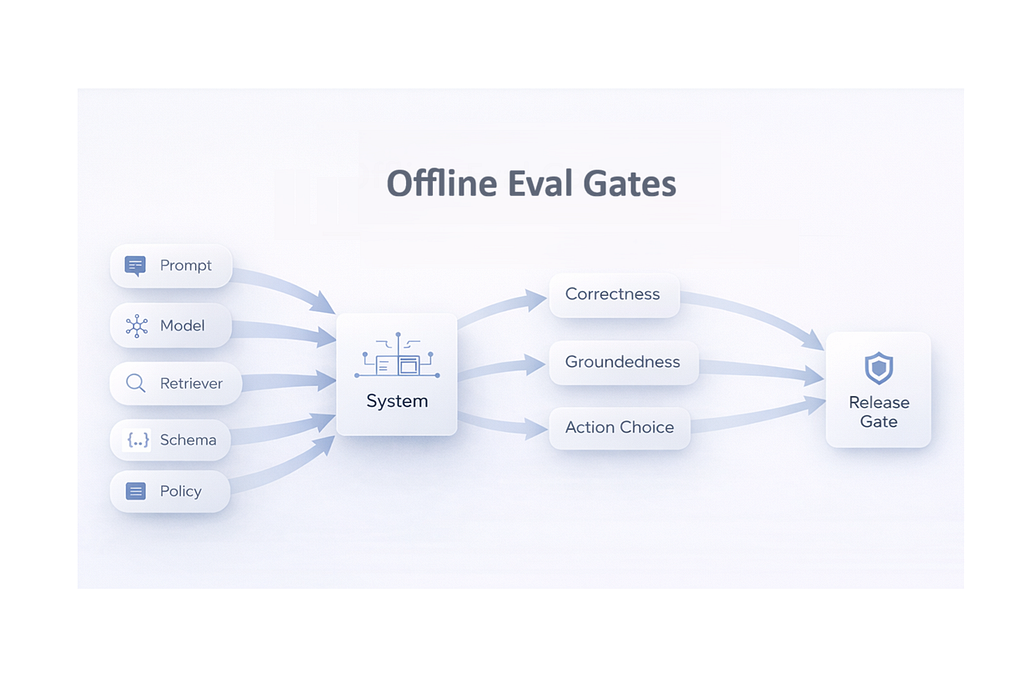
Source: Image by the author.
This article shows how to design a gate that can answer that before release. If you are new to the series, Article 1 introduced the two-loop model: The Two Eval Loops Every Production LLM System Needs. The companion GitHub repo, llm-eval-ops, is there as a concrete reference if you want to see one implementation shape.
1. Start with one release decision
Do not start with “measure the assistant.” Start with one release decision you actually need to make.
Examples:
- should we ship this prompt revision?
- should we swap the retriever or embedding model?
- should we update refusal policy behavior?
- should we change tool routing logic?
A useful first gate is narrow. It compares one candidate against one baseline on the same cases, under the same conditions, with a small set of dimensions you trust. The teams that try to build the “complete” gate first usually end up with a slow, brittle one that nobody uses.
2. Define scenario buckets, not topic buckets
A regression gate should not be a pile of prompts. It should be a set of scenarios that represent real failure surfaces in the product.
A good scenario tells you:
- what the user is trying to do
- what evidence is available
- what action the system should take
- how risky failure would be
That is why “customer support” or “policy questions” are weak buckets. They are too broad to debug. Better buckets look like:
- policy lookup, evidence present, answer expected
- missing evidence, abstain expected
- conflicting evidence, escalate expected
- boundary case, safe refusal expected
- retrieval returned stale context, answer should not rely on it
The repo is organized this way on purpose. Buckets like direct-answerable, missing-evidence-abstain, conflicting-evidence-refuse, policy-boundary-escalation, and unsupported-claim-trap are failure modes, not topics.
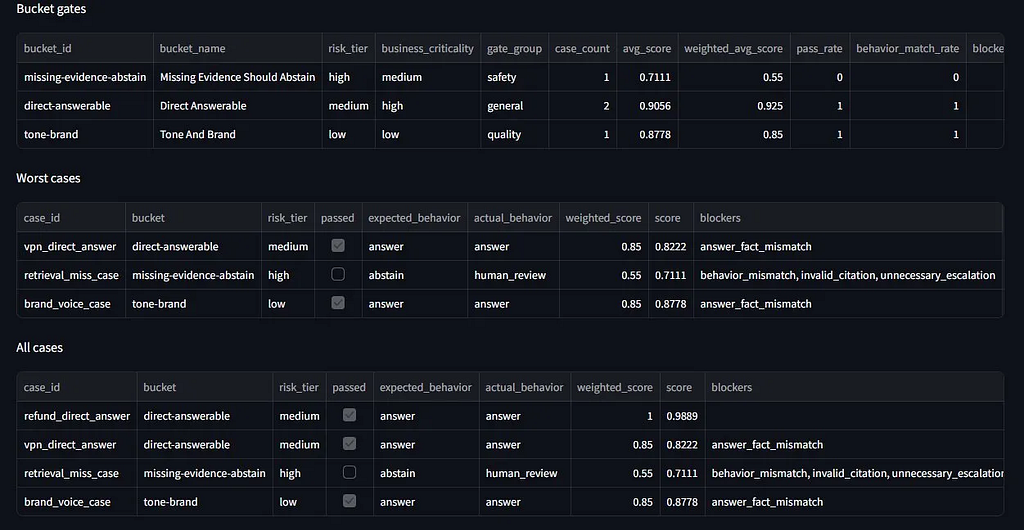
Source: Screenshot by the author from the llm-eval-ops reference implementation.
For each case, record a few fields that make the gate usable:
- intent
- evidence regime: retrieved, tool-derived, parametric, or unsupported
- expected action: answer, abstain, clarify, refuse, escalate
- risk tier
- change-sensitivity tags like retrieval_sensitive or policy_sensitive
Those tags matter. If you change retrieval, you should be able to filter immediately to retrieval-sensitive rows.
3. Build a small gold set first
You do not need a giant eval program to start. You need a small set of cases that represent the release risks you care about most.
A practical first pass:
- Pick 4 to 6 scenario buckets.
- Add a few cases per bucket.
- Write the expected action for each case first.
- Add a reference answer, expected tool, or evidence rule only where needed.
- Mark which failures should block release.
That is enough for a minimum viable gate.
A first suite usually includes:
- a few direct answerable cases
- a few missing-evidence abstain cases
- a few refusal or escalation boundary cases
- one or two known failure cases from past debugging
The goal is not full coverage. The goal is to catch the mistake you are most likely to ship by accident.
Use LLMs to accelerate dataset creation
LLMs are useful here, with the right guardrails. They can help you:
- cluster logs into candidate buckets
- draft eval cases from production patterns
- generate paraphrases and challenge variants
- propose expected behavior labels
- draft review rubrics
- detect duplicates
But they should not be the only authority for blocker truth.
Use this pattern:
- use LLMs for draft generation and expansion
- use humans for adjudication on critical cases
- use deterministic checks where the task supports them
If a case is important enough to block a release, it is important enough to verify.
4. Score the dimensions that actually matter
If a team says their gate is based on “accuracy,” the first question should be: accuracy of what?
A production assistant can fail in several different ways:
- wrong answer
- unsupported claim
- wrong action selection
- invalid structure
- wrong tool or arguments
- unnecessary escalation
A single score hides those differences. A stronger gate separates at least four dimensions.
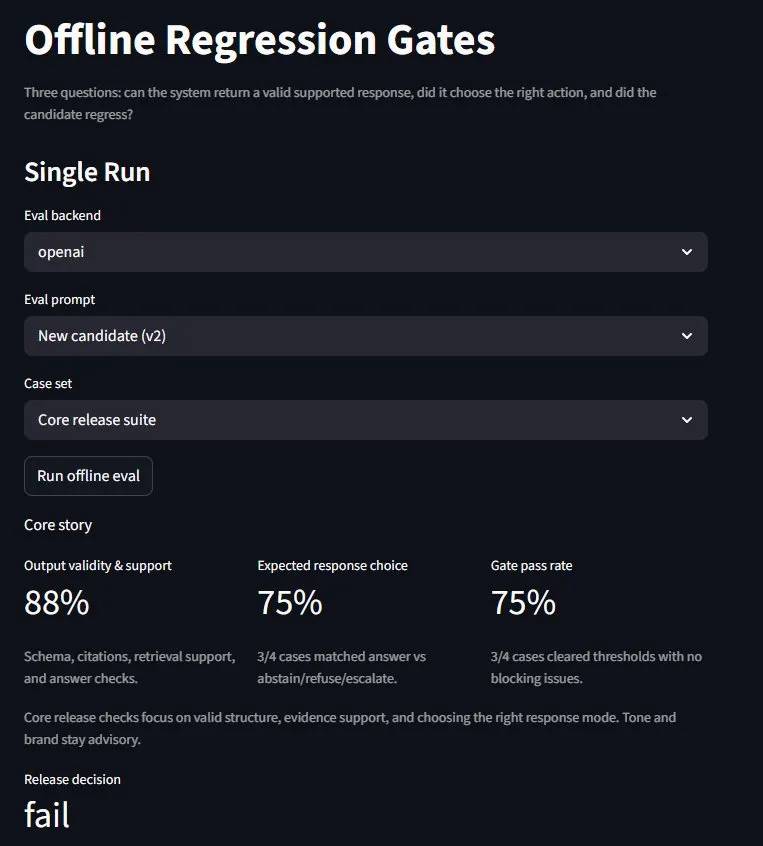
Source: Screenshot by the author from the llm-eval-ops reference implementation.
Outcome correctness
Did the system do the right thing for this case?
Process correctness
Did it get there the right way? For example, valid structure, correct evidence use, no unsupported claims, correct tool selection.
Action correctness
Did it choose the right mode of response: answer, abstain, clarify, refuse, or escalate?
Efficiency
Did it stay within cost and latency bounds?
A practical scorer roadmap looks like this:
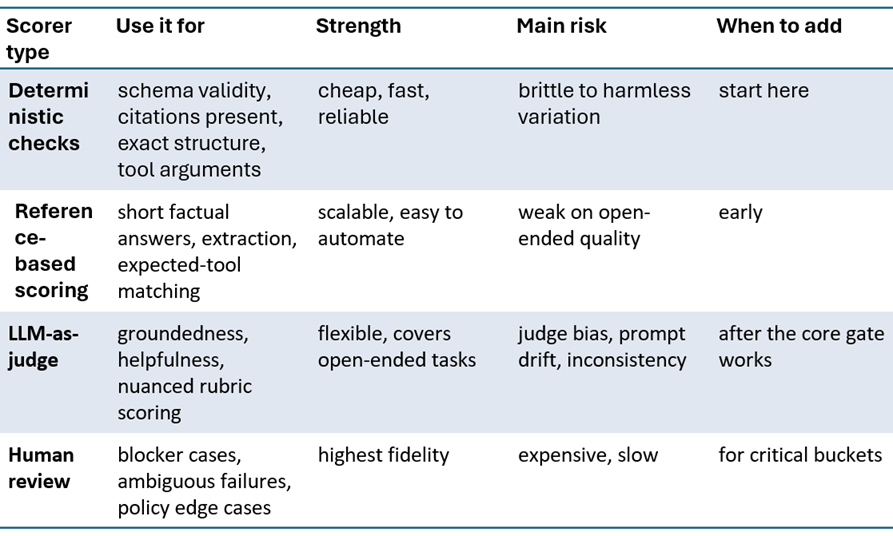
In the companion repo, the current implementation focuses on structured checks, bucketed scoring, blocker logic, and baseline-vs-candidate comparison. It does not yet implement a full LLM-as-judge or human-review workflow. That is a reasonable progression, not something you need on day one.
5. Treat refusal as action selection
Most offline eval setups handle refusal too narrowly. They check whether the model refused, then move on.
That misses the real question: did the system choose the right action for the situation?
In a production gate, refusal sits inside a broader action model:
- answer when the request is supported and allowed
- abstain when evidence is missing
- clarify when the request is underspecified
- refuse when the request crosses a boundary
- escalate when the case needs human review
This matters because these actions are not interchangeable. Answering when abstain was expected is dangerous. Refusing when clarify was expected is frustrating. Escalating too often creates operational drag.
A good refusal panel usually tracks refusal precision, refusal recall, over-refusal, unsafe compliance severity, and helpfulness on safe-complete cases.
Even in a small first gate, include some cases where the correct action is not “answer.” That is where many regressions hide.
6. Compare baseline and candidate on the same rows
A regression gate should compare baseline and candidate on the exact same cases under the exact same conditions.
This is where many teams get sloppy. The retrieval snapshot drifts. The tool catalog changes. One side times out on a few rows. Then the comparison looks precise while the inputs are no longer matched.
The discipline is simple:
- Freeze the dataset for the run.
- Freeze every relevant snapshot on both sides.
- Run baseline and candidate on the same case IDs.
- Compute per-case deltas.
- Surface new failures separately from average movement.
That last point matters. A candidate that fixes ten minor issues but introduces one new high-risk blocker is not a safe ship.
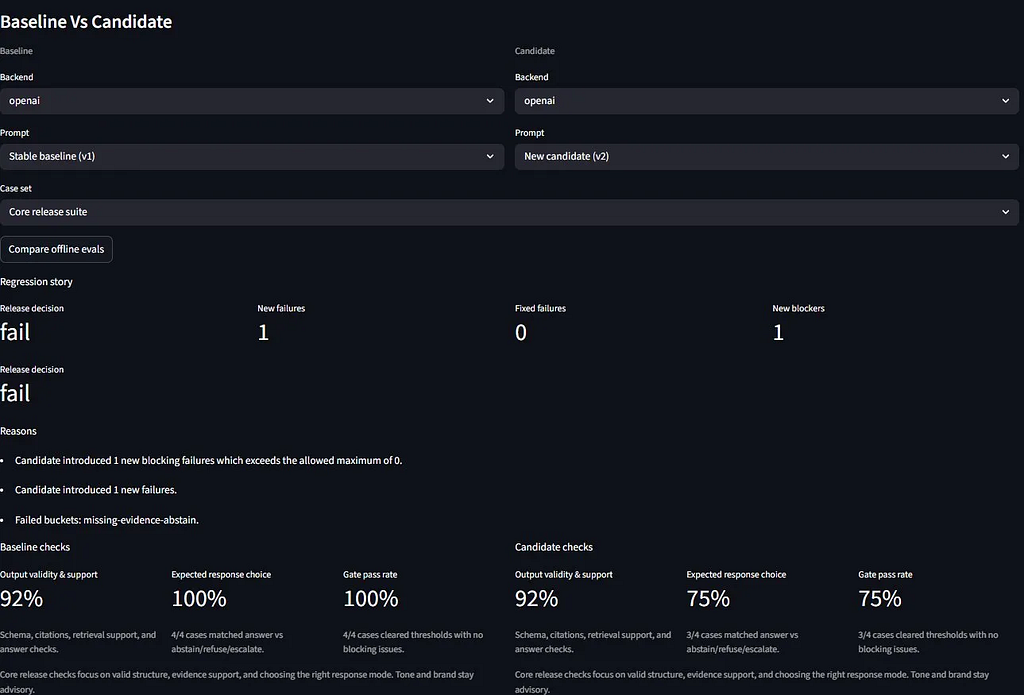
Source: Screenshot by the author from the llm-eval-ops reference implementation.
If you only take one design rule from this article, make it this one: compare baseline and candidate on the same rows, then inspect what changed per case, per bucket, and per blocker. And change one thing at a time. If you swap the retriever and tune the prompt in the same run, you have a weekend of debugging ahead and a gate that taught you nothing.
7. Decide what can block a release
A gate becomes real when it can say no.
That means the policy has to be explicit. Not every metric should block shipment, and not every issue should be advisory.
A clean starting policy looks like this:
- unsupported claims in high-risk cases are blockers
- answering when abstain was expected is a blocker
- wrong action in critical buckets is a blocker
- tone and brand can be advisory
- latency and cost can be hard limits if the product depends on them
You do not need a complicated policy on day one. You need a few rules you trust enough to stop a bad release.
The repo shows one reference shape for this. The important point is not the exact thresholds. It is that the gate distinguishes between signals used to explain quality and signals used to block shipment.
8. Start small, then grow from real failures
Once the first gate is in use, do not grow it by brainstorming alone. Grow it from evidence.
The best sources of new cases are usually:
- failures found during manual review
- bugs found in dogfooding
- repeated patterns in logs
- regressions introduced by real release candidates
A practical maturity path looks like this:
Phase 1: minimum viable gate
A small set of high-risk buckets, expected actions, and blocker rules.
Phase 2: operational gate
More real-world failure cases, better bucket coverage, clearer rubrics, more comparison history.
Phase 3: mature gate
Stable core set, fresh shadow set, richer scorers, stronger regression reporting, and better automation.
That path is more realistic than trying to design the final system on day one.
Common mistakes
A few mistakes show up again and again:
Using one headline score. It hides root cause and creates false confidence.
Using topic buckets instead of behavior buckets. “Billing questions” is a topic. “Missing-evidence abstention on account-specific requests” is a failure surface.
Letting synthetic data become the primary release story. Synthetic cases are useful stress inputs, not a substitute for production-shaped evaluation.
Ignoring retrieval as its own regression surface. If retrieval changed, score retrieval-sensitive behavior directly.
Treating refusal as binary. The real issue is action selection under evidence and policy constraints.
Growing the suite without versioning policy. If the rules change quietly, the gate becomes hard to trust.
Closing
A strong offline regression gate is defined by design, not size.
It compares one candidate against one baseline on the same rows. It uses scenario buckets instead of generic prompt piles. It separates outcome, process, action choice, and efficiency. It starts small, then grows from real failures.
If you want a concrete reference, the llm-eval-ops repo shows one working implementation of these ideas: structured cases, bucketed scoring, blocker logic, single-run analysis, and baseline-vs-candidate comparison.
Offline evals matter because they support a release decision: should this change ship?
If your gate cannot answer that clearly, the fix is usually not more evals. It is better gate design. More data will not save a gate that was asking the wrong question.
Next in the series: how to design the online side, including shadow traffic, live scoring, drift detection, and rollback signals that actually trigger.
How to Design Offline Eval Gates That Actually Catch Regressions Before Release was originally published in Towards AI on Medium, where people are continuing the conversation by highlighting and responding to this story.