Where to Start and How to Scale It Right
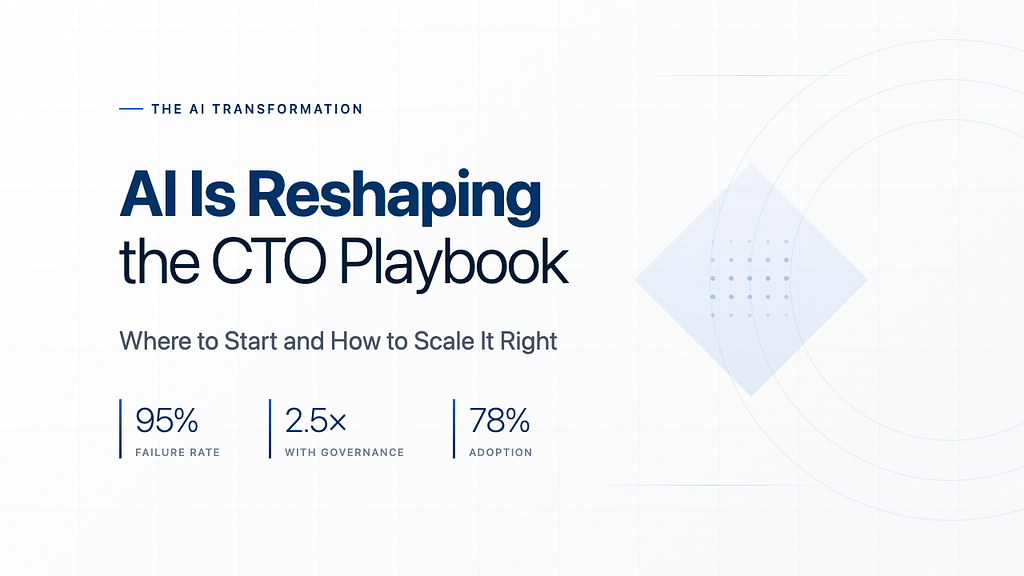
I’ve rewritten my CTO playbook three times in my career. First for cloud migration (painful, given IOT combination, but worth it). Then for mobile-first architecture (easier than expected). Now AI is forcing another rewrite, and honestly? This one’s different. It’s not just adding a new capability; it’s rethinking how we build everything.
In the last 12 months, AI has moved from curiosity to core capability. Boardrooms are asking what the “AI strategy” is, investors are pricing it in, and customers are beginning to expect it. For CTOs, the question is no longer if to use AI, but how to make it count. Where to start, where it fits, and how to scale it without chaos.
The Reality Check: 95 Percent of AI Projects Fail, and That’s OK.
MIT Sloan and Gartner have both highlighted a hard truth: roughly 95 percent of AI projects never deliver measurable business impact, and over 80 percent never make it past the pilot stage. That sounds discouraging at first, but it’s really a sign of where organizations are in learning to use these powerful new tools.
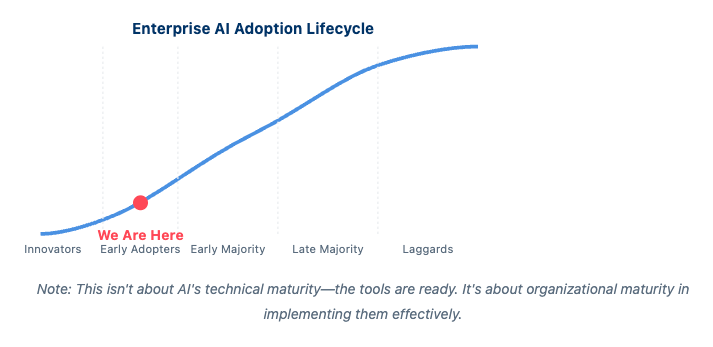
We Are Here Innovators Early Adopters Early Majority Late Majority Laggards Enterprise AI Adoption Lifecycle
Note: This isn’t about AI’s technical maturity — the tools are ready. It’s about organizational maturity in implementing them effectively.
“Look, 95% failure rate sounds terrible until you remember our first cloud migrations had similar stats. We’re just learning what works.”
We’ve been here before. Early cloud migrations blew past budgets. Mobile apps launched with excitement but no users. IoT projects stalled because of integration challenges. AI is simply in that same learning phase.
Here’s what matters: AI is here to stay, but only disciplined organizations will turn experiments into enterprise value. The hype phase is fading; the execution phase has begun.
AI’s Acceleration: Why CTOs Can’t Wait Any Longer
In just the past few months, the AI landscape has taken another major leap forward, faster than most organizations expected. ChatGPT introduced app integrations, long-term memory, and SDK hooks that make it feel more like a platform than a chatbot. Claude released Opus 4.1, improving reasoning, persistence, and agent-driven task handling. Google’s Gemini advanced into real-world tool use, navigating browsers and applications like an operator rather than a text generator.
These are not small updates. They represent a clear shift from assistants that respond to agents that act.
Just last week, I attended what Oracle now calls “AI World,” the same conference that was “Cloud World” just a year ago. When a company with Oracle’s legacy rebrands its flagship annual conference around AI, you know the shift isn’t coming. It’s here. Even the giants are pivoting their entire narratives.
All three major platforms are moving in the same direction:
- Persistent memory across sessions
- Deeper integration with tools and APIs
- Multi-step task execution
- Stronger enterprise-level control
“Six months ago, AI could tell me how to fix a bug. Now it just fixes it.”
This is no longer a time to wait for clarity or to see how the market settles. AI is ready for production. The platforms, SDKs, and agent frameworks available today can already deliver measurable productivity and efficiency gains when applied with focus.
Over the past month, I’ve seen what happens when AI agents are deployed with the right structure and discipline. Different agent personas are now assisting in documenting legacy systems, designing and implementing new features, and shaping requirements. This is no longer about conversational bots. These are digital teammates delivering real outcomes.
For CTOs, that means:
- Revisit your architecture. Modernize data access and integration layers so your systems are AI-ready.
- Start experimenting with agents. Begin small with internal copilots, code reviewers, or documentation assistants. Track the results.
- Integrate, don’t isolate. The most effective AI projects fit naturally into existing workflows instead of sitting beside them.
- Build governance early. Set standards for data usage, retraining, and auditability before expanding.
- Develop capability, not dependency. Use third-party APIs/partners where it makes sense, but build internal knowledge so you stay in control.
Bottom line? AI is not a future trend. It has become part of the technology foundation every company will build on. CTOs who move now, with structure and purpose, will lead that transformation instead of reacting to it later.
Start from the Ground Up: Build Your AI Foundations
Before diving into AI pilots or agent prototypes, make sure your foundations are in place. Skipping these steps is the fastest way to join the 95 percent of projects that fail to scale.
Data Readiness
Even if your organization uses third-party LLMs, the real value still comes from your data.
Take a hard look at your data landscape: where it lives, who owns it, and whether it reflects how your business operates. External models can only perform as well as the data and context you provide.
Actionable steps:
- Bring key data sources together or make them accessible through a consistent interface.
- Establish clear governance around ownership, privacy, and retention.
- Build APIs or connectors that let your systems pass the right context into AI workflows. If required extend your API’s with MCP.
- Improve data quality and structure before you focus on prompts or workflow design.
Team and Skill Readiness
Adopting AI through third-party models is still a team effort. Your engineers need to understand how to orchestrate and monitor model usage, while product and data teams should develop skills in prompt design, context engineering, and API integration.
In my own experience, assigning even one senior engineer to experiment with an AI agent for tasks like code reviews or documentation has real impact. Pairing that effort with DevOps closes the loop between experimentation and deployment quickly.
Engage third party, if needed, to setup the process, tools and templates that internal team can carry forward and apply to different projects.
“AI maturity is not about building models from scratch. It is about creating systems that use the right process, tools, models and agents effectively, learn from real results, and keep improving.”
Where to Apply AI First
Start where the pain is visible and the payoff is clear. The goal is not to chase novelty but to remove friction in the daily work that slows your teams down. AI delivers the fastest value when it’s embedded in repeatable, low-glamour processes that touch many people.
Here’s my advice after few months of experiments: forget the moonshots. Start with the boring stuff that everyone hates doing. Documentation? Perfect. Code reviews? Even better. That mundane ticket categorization system? Gold mine. Why? Because when AI handles the tedious work, your team immediately feels the impact. And they’ll want to help you expand it.
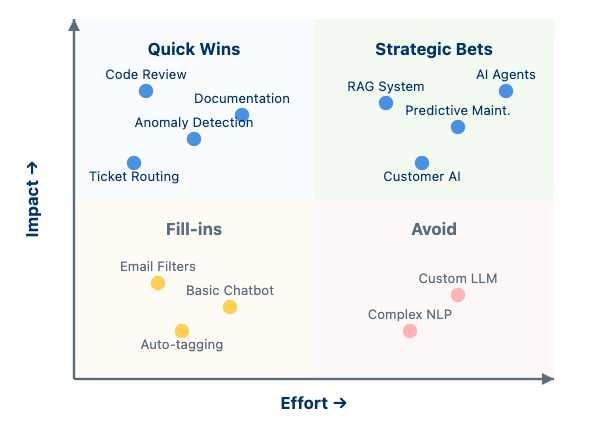
Effort → Impact → Quick Wins Strategic Bets Fill-ins Avoid Code Review Documentation Anomaly Detection Ticket Routing RAG System Predictive Maint. AI Agents Customer AI Email Filters Basic Chatbot Auto-tagging Custom LLM Complex NLP
Pick battles you can win. Early AI wins should be low-risk, high-visibility, and clearly tied to business outcomes. Based on organization size and stage below are few areas to consider:
Internal Productivity
- Developer copilots OR code generators for code completion, documentation, and unit-test generation.
- Automated knowledge bases that answer internal questions.
- Summarization tools for reports, tickets, or logs.
Customer Experience
- Conversational AI for support and onboarding.
- Personalization engines for SaaS or e-commerce experiences.
- Sentiment analysis to surface customer pain points.
Operations and Risk
- Predictive maintenance for IoT or infrastructure.
- Fraud or anomaly detection for transactional systems.
- Forecasting and demand planning in supply chains.
Product Innovation
- AI-powered recommendation or search inside products.
- Generative design for marketing or UI content.
- Embedded natural-language interfaces.
In my own organization, we’ve begun experimenting with AI agents for code reviews and documentation (for brownfield projects) and agentic development process for greenfield projects. The gains aren’t just speed they also raise consistency and knowledge sharing across teams. When you’re building greenfield AI systems, make sure it’s a multi-agent, multi-step process from the start. Otherwise, you will quickly find yourself in vibe-coding inconsistency hell, where every workflow behaves differently and debugging turns into archaeology. Weave your organization’s coding standards, code quality checks, Git process, branding colors, tool chain, and security guidelines directly into the agentic development workflow from the start.
We also built an internal RAG system that searches our knowledge base and answers questions for internal teams in seconds, pulling context from data spread across multiple systems.
Not every use case is worth chasing. Evaluate each idea through three lenses:
1. Business Value — Will it reduce cost, increase revenue, or improve satisfaction?
2. Feasibility — Do we have the data, talent, and tech to execute?
3. Risk Profile — What could go wrong legally, ethically, operationally?
Plotting ideas on this grid reveals the quick wins and the moonshots. Start with high-value, medium-feasibility projects; keep the high-risk, high-reward ones for later phases.
“The best AI use cases are not the flashiest. They are the ones employees rely on every day.”
Governance and Guardrails
Without governance, AI becomes a liability. Set up a lightweight but clear framework around:
- Transparency — Make outputs explainable where possible.
- Bias Monitoring: Audit data and output regularly.
- Security & Privacy: Handle PII and proprietary data with zero trust principles.
- Compliance: Stay aligned with GDPR, CCPA, and emerging AI acts.
- Human Oversight: Keep humans in the loop for critical decisions.
According to McKinsey’s State of AI 2025, organizations with strong governance and KPI tracking report 2.5× higher likelihood of achieving measurable financial impact than those without.
“Strong AI governance isn’t a constraint. It’s what prevents costly mistakes at scale.”
People and Culture: The Human Layer of AI
Technology is the easy part. Adoption is the hard part. If people feel AI is replacing them, they’ll resist it. If they see it as a tool that elevates them, they’ll champion it.
Getting buy-in means over-communicating the ‘why’ behind every AI initiative. Share the wins, even small ones, loudly and often. And give people a path to learn; internal certifications work better than you’d think.
- Recognize employees who integrate AI effectively into workflows.
- Cultural alignment transforms AI from a side project into part of how the company works.
Scaling from Pilots to Platform
Once your early pilots show measurable results, the next step is to operationalize. Even if you rely on third-party LLMs, the challenge is the same: building consistency, governance, and scale.
Build an Internal AI Framework
You may not need to host or train your own models, but you still need a controlled environment for how your organization uses them. Centralize data access, API management, observability, and compliance controls. Think of it as an AI framework as a layer that governs how different tools, models, and agents interact with your systems.
This includes managing authentication, usage limits, data retention, and model selection. Build shared utilities for prompt orchestration, RAG pipelines, and logging so every team doesn’t reinvent the wheel.
Create a Center of Enablement
Instead of a traditional Center of Excellence focused on research or modeling, shift to a Center of Enablement. Its role is to define patterns, maintain internal templates, and support teams that want to integrate AI into their workflows. The team should vet third-party APIs, monitor costs, and track compliance with your data and security policies.
The goal is not to centralize control but to provide structure, speed, and safety at scale.
Encourage Federated Innovation
Give business units freedom to experiment but anchor them to shared standards and observability tools. Encourage teams to build AI-driven workflows that plug into a common orchestration layer.
This balance between autonomy and alignment keeps creativity high without turning into chaos.
From Stanford’s AI Index 2025: 78 percent of companies now use AI in at least one function, but only about 30 percent have scaled it enterprise-wide. The gap isn’t about technology it’s about organizational discipline.
“Scaling AI isn’t about building more models. It’s about designing an organization that knows how to use them intelligently, safely, and at scale.”
Measuring Success
If you can’t measure it, you can’t scale it. Define metrics that map to real outcomes, not vanity stats.
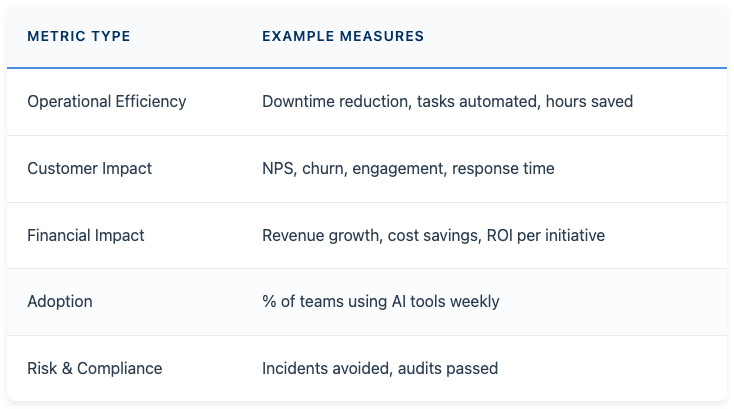
According to multiple industry surveys, projects that define success metrics up front are 3× more likely to deliver measurable ROI.
Lessons from the Field: Why Projects Fail and How to Avoid It
When MIT and RAND cite 80–95 percent failure rates, the root causes are strikingly consistent:
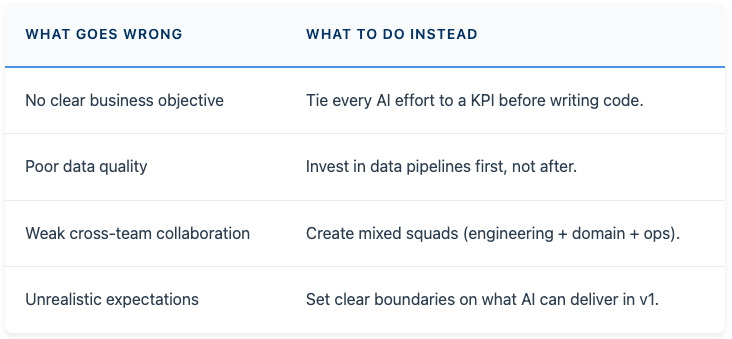
Each failed proof-of-concept teaches what readiness really means. CTOs who treat those lessons seriously become the ones who scale successfully later.
“AI failure isn’t fate. it’s feedback.”
Every failed AI project left us with something useful. The chatbot that couldn’t understand customer intent? That forced us to rebuild our entire knowledge base structure. The predictive maintenance system that predicted nothing? Exposed massive gaps in our sensor data. I’d rather fail fast on five projects than spend a year perfecting one that might not work.
The Emerging Role of the CTO
The CTO’s role is shifting from building systems to orchestrating intelligence. Today, you are expected to balance innovation, governance, and culture at the same time.
Today’s CTO must:
- Translate AI hype into credible strategy.
- Align technology, data, and business goals.
- Establish safe experimentation zones.
- Build reusable platforms instead of isolated pilots.
- Foster a learning culture where AI augments every role.
In my own journey, building internal AI capabilities such as RAG systems for knowledge retrieval, agentic code development for greenfield projects, and code-review agents and automated documentation for brownfield projects has shown clear value. But what’s equally clear is that success isn’t automatic. It takes iteration, guardrails, and constant dialogue between engineering and leadership. Our RAG system now cut down time to respond to RFP questions from hours/days to minutes.
The Call to Action
If you haven’t started your AI journey, this is the time. Start smart and move with intent, because waiting for the perfect moment means watching others pass you by. Here’s the truth: the tools are good enough. Your data is probably messier than you think but workable. Your team is capable of learning this.
- Audit your foundations: data, skills, infrastructure.
- Select one pragmatic use case, something measurable within 6 months.
- Define success metrics before any line of code.
- Build governance early, not as an afterthought.
- Share wins internally to build trust and momentum.
“The real winners won’t be the first to deploy AI. They’ll be the ones who deploy it responsibly, consistently, and at scale.”
AI is already changing how companies build, operate, and compete. For CTOs, this is the next major inflection point. Those who move now with clarity and discipline will define how their industries operate for years to come.
Start small but start now.
Experiment. Measure. Learn. Then scale with intent.
AI is not a future technology. The playbook’s already being rewritten. Question is: are you holding the pen or just watching?
About the Author
Yoganand (Yogi) Rajala is CTO at Sentinel Offender Services, where he leads AI transformation initiatives including the RAG systems and agent deployments mentioned in this article. With 25+ years in technology leadership, he co-founded Omnilink Systems (acquired by Numerex), holds 20+ patents, and has navigated four M&A transactions.
Having rewritten his CTO playbook for cloud migration and IoT platforms, Yogi brings hands-on experience from building products that captured 33% market share and managing 200+ engineers globally. His recent AI implementations have reduced RFP response times from days to minutes.
Connect on LinkedIn
AI Is Reshaping the CTO Playbook was originally published in Towards AI on Medium, where people are continuing the conversation by highlighting and responding to this story.