Epistemic status: This is an intuition I've had for a while that feels obviously correct to me from an inside view perspective. Note however that I am not a doctor and have no training in the medical field. I also do not have experience losing weight. You should caveat this information appropriately. I will note that I am capable of running mountain marathons and have a six pack (despite not working out for the past 6 months) as evidence that this mode of thought works well for me.
With apologies to anyone I offend with my ranting and rhetoric, this was the only way I was able to write the article authentically.
I've spent just over a year now immersed in various aspects of the rationalist community. It's a weird and wonderful place and I am glad that I'm here. It is also home to the inkhaven residency, where I have recently been getting to know some of the local belief systems.
I shall attempt to break one of them, at least in part, today. I will start by linking you to the article "The Blueberries of Wrath" by my friend MLL[1]. It's a long, challenging article, and I understand approximately half of the words. Here's an extract:
I’m not going to review the entire cursed realm of internet users claiming to be sensitive to dietary salicylates, polyphenols, and whatever other Trojan berry adversaries that might be captivating their paranoia. But here’s a mugshot. In it we see people:
- Attributing all kinds of symptoms to dietary salicylates including dark undereye circles and adrenal fatigue.
- Fixating on a handful of studies from the 1990s (mostly in autistic children) suggesting that phenol sulfotransferase deficiency is responsible for the accumulation of dietary phenols in the body.
- Failing to rigorously distinguish between polyphenols, salicylates, and phenols in general, let alone different polyphenols, instead lumping everything into “high-phenol” foods. Likewise the recommended treatments for salicylate sensitivity, phenol sensitivity, and methylation disorders more or less overlap.
- Self-diagnosing with conditions in the absence of established diagnostic tests; while in principle elimination/challenge dieting can reveal things, we should expect it to be vulnerable to placebo and confirmation bias.
- Following modern variants or extensions of the Feingold diet. The most structured is FAILSAFE (Free of Additives, Low in Salicylates, Amines, and Flavour Enhancers), which has a large Facebook following but no modern evidence to back up the salicylate claim
OK, so by my reading of the article, people on the internet have looked at some studies, decided that "phenol sulfotransferase deficiency" is responsible for the accumulation of "dietary phenols" and therefore decided that berries are bad for them. MLL goes through and points out a variety of errors they're making. Apparently, one of these is "failing to rigorously distinguish between polyphenols, salicylates, and phenols in general, let alone different phenols".
I do not know if this is true or false. I do not know what this means. I do know that it is very possible to be healthy without the slightest hint of knowledge about phenols. I know it because I've done it. I also know because I've met a large number of wonderfully healthy and fit individuals who haven't touched a biology textbook in their lives. I also think that the fact that people can come to the conclusion that blueberries are bad for them via this sort of interrogation is suspect.
To be clear, the human body is, on a fundamental level, physics. It can be understood through the laws of chemistry and biology, and I hold huge respect for the researchers looking into it. However, if we want to talk about personal health, here is a map of the known biochemical pathways in the body:
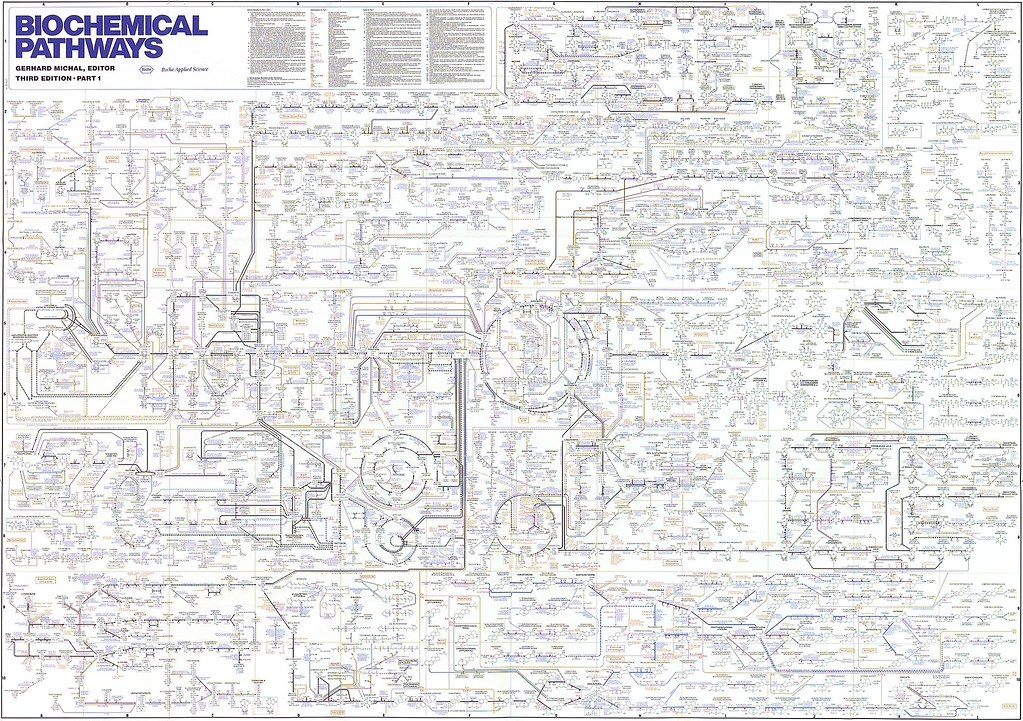
If you wish to try to claim that understanding this is the fastest way to get healthier, I'll be waiting for you in the gym. If, in more reasonable fashion, your claim is that understanding parts of the diagram can help you optimise your nutrition, I'll still be waiting for you in the gym, but note the following first:
- Even small parts of this diagram are really complex and work in weird and wonderful ways
- It is a complex system, so even understanding part of it perfectly does not mean you understand the effects of that part on the rest
- Understanding how something functions is not the same as being able to predict the outcomes of that thing (see: chaos theory)
- It's a system which has been optimised for billions of years by evolution, so moving out of distribution is likely to break the carefully balanced forces which have strived to create them.[2]
Basically, it's really hard to understand, if you do understand it that doesn't mean you can control it, and if you can both understand and control one aspect of it you're still likely to break whatever else is connected to it. Of course, we have the caveats that if you're only using it to make minor adjustments, you're unlikely to take your body out of distribution so you'll be fine[3]. But a broader question emerges.
Does this seem like the most effective way to go about life to you? Do you want your personal wellbeing to depend on whether or not you've thought about your phenol intake correctly? No? Good. I have another path.
If you can't use white-box thinking, use black-box instead. You were designed to grow up in the hunter-gatherer environment, so your body will take whatever actions it thinks necessary to ensure your survival within that environment. Rather than argue for this line of thought, which I expect people to understand in principle, I'll demonstrate it on an example. In heretical fashion, I will be picking on Eliezer Yudkowsky.
A couple of months ago, I spent a bit of time messing around with my scraped version of LessWrong, and, while going through the lowest karma posts, happened upon the wonderfully titled "Genuine question: If Eliezer is so rational, why is he fat?".
He replies in a comment with some content copied over from X. A summary:
For the benefit of latecomers and CICO bros, my current equilibrium is "spend 1 month fasting / starving on 700 cal/day keto; spend 2 months eating enough to work during the day, going to bed hungry, and therefore gaining 1-2 lb/wk".
Diets like the potato diet fail, not because they don't succeed in forcing me to eat less -- I do, indeed, end up with not enough room in my stomach to eat enough potatoes to work and not feel tired. The potato diet fails because it doesn't protect me from the consequences of starvation, the brainfog and the trembling hands. If I'm going to be too sick and exhausted to work, I might as well go full keto on 700cal/day and actually lose weight, rather than hanging around indefinitely in potato purgatory.
Semaglutide failed, tirzepatide failed, paleo diet failed, potato diet failed, honey diet failed, volume eating with huge salads failed, whipped cream diet failed, aerobic exercise failed, weight lifting with a personal trainer failed, thyroid medication failed, T3 thyroid medication failed, illegal drugs like clenbuterol have failed, phentermine failed (but can help make it easier to endure a bad day when I'm in my 600cal/day phase), mitochondrial renewal diets and medications failed, Shangri-La diet worked for me twice to effortlessly lose 25lb per session and then never worked for me again.
Wow. That's a long list of things to have fail on you. Let's see if we can gain any insight in our new black box frame.
The first thing we note is that we evolved to live in a range of different environments. Humans range geographically from America to Australia, from Africa to Asia. Over the millions of years of our evolution we have lived on top of mountains, by the sea and in the desert. Many of these environments, especially in temperate zones, will vary enormously in their conditions throughout the year. One of the most important evolutionary adaptations, we would therefore expect, would be to have a body which can itself adapt to whichever environment it finds itself in.
Let's think about the implied environment surrounding Eliezer then.
- Low in calories – low enough that he's hungry when he goes to bed
- Prone to regular famines – he's on 700 cal/day
- Low in required exercise – he mentions he's tried daily exercise, but when I read the thread in more detail, this was 2h of walking per day. Going off how hardcore he's done everything else, this implies a very low baseline to be coming from.
Now we ask what the ideal body type is for that environment. I would argue that it's a body which:
- Is extremely calorie efficient
- Survives famines by storing as much energy as possible during off periods
- Reduces movement as much as possible (explaining his famously low energy levels)
His body is acting perfectly rationally for the environment he's told it he's in! As far as I can tell, he's in an inadequate equilibrium where he wants his body to become thinner, but his body desperately wants more calories.
So what does this new way of seeing things mean for how he should act in practice?
I should first remind you that this approach is still entirely theoretical. It has not been battle tested, although it seems to me to suggest reasonable courses of action. In this particular case, it seems to me like the priority is for Eliezer to convince his body that he is in an environment more amenable to his preferred body type. What does this environment look like?
- High activity (especially long distance: fat is not an advantage to have if you're walking 30km a day)
- Consistent calorie levels (no need to store up fat)
- Sufficient calorie levels (so you have enough energy to do the stuff you need to do).
If I was to recommend a course of action in this particular case, I think it would be something like "Eat enough to satisfy your hunger. You will gain weight, but this is to be expected when moving out of a local minimum. Do long distance. Build up your physical endurance, this should have additional benefits in other areas of your life. I don't know how long this will take. Given how long you've spent convincing your body of the environment it's in, I expect it to take a while to convince it of its new surroundings. Use physical endurance as your metric for progress, not weight."
To be clear, I know he's tried a bunch of things, including exercise and an extreme diversity of diets and drugs. I do not have access to more detailed specifics of what he's done, and I expect he's had advice from a wide variety of people far more knowledgeable than me. It could be that my armchair help is just one more on the pile of failed attempts. It does however seem to me to provide an explanation for why many of the past attempts have failed, and to provide a way out which would (possibly?) previously have ended up being rejected due to weight gain. I don't know.
I hope this is useful to someone.
Addendum
There are a few additional points relevant to the main thesis here, which I haven't been able to fit into the main post.
In no particular order:
- I think this perspective provides a good basic theory for why it is so common for people to "bounce" after a successful dieting regime
- It also seems to explain why most success tends to come when people change their full behaviour patterns.
- This whole thing is consistent with the empirical result that fat gain is related to calories in minus calories out (CICO), which is approximately right under controlled conditions: my claim is that 'calories out' is a variable your body actively controls, which is what CICO accounts sometimes handwave. A lot of work seems to be traditionally done by specifying that different people have different metabolisms, which burn different amounts of calories. If you wish to use this frame, think of the behaviours predicted here as modifying your metabolism.
- Another thing I notice when thinking about CICO is that in practise when I am at peak fitness and have a couple of days off, I feel a strong drive to go for a run, exercise, or just jiggle my leg up and down. I basically think that this does the job of driving me to burn the extra calories I would put on as extra weight in an environment where my body believed this was ideal.
- ^
He's checked through this article, so I hopefully haven't made any massive blunders where this is concerned.
- ^
Yes, evolution is the blind, idiot god, but creating an organism is also a hard problem, which means that progress can be continuously made for long periods of time. The paper "Long-term dynamics of adaptation in asexual populations" showed that e.coli fitness increases were better fit by a power-law model than a hyperbolic model (which asymptotes). This is evidence towards the theory of there being no practical upper bound to the progress that can be made by evolution.
- ^
There is the additional caveat that mechanistic information is generally much more useful for fixing broken things – it doesn't take a genius to figure out that if your shinbone is in two pieces, that needs to be fixed.
Discuss