By Michal Florek, October 2025 (Updated May 2026)
Executive Summary
In the accelerating age of artificial intelligence, the world faces a subtle but existential tension: machines are becoming flawless, while humans are not.
Yet it is precisely our flaws — our contradictions, doubts, emotions, and stories — that make us human.
Through trials and lessons, we — humans — learn to understand we are on an endless journey of growth. This wisdom we must encode in all of artificial intelligence created.
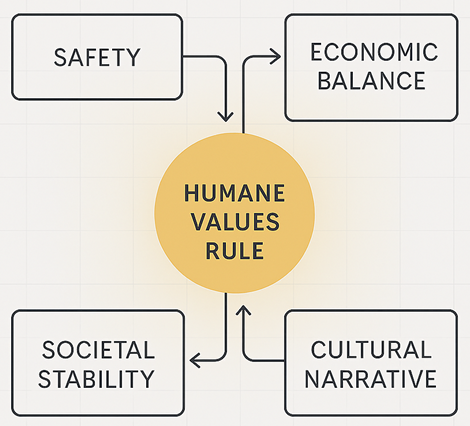
The AI SAFE© Framework 5: The Humane Values Rule (the sum of AI SAFE© 1 to 4 Standards) asserts that AI must not erase the imperfections of humanity, but learn to live within them.
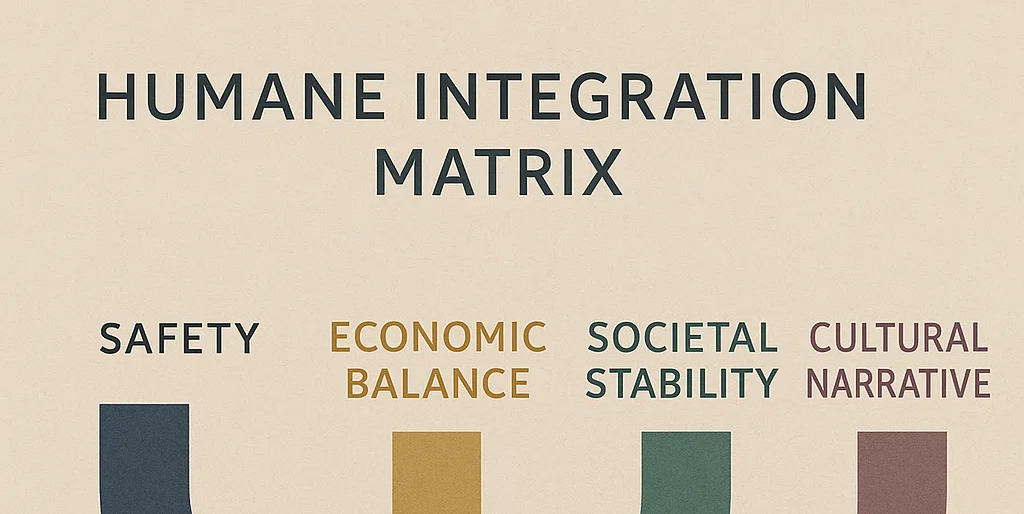
This fifth framework builds upon the first four AI SAFE© principles — Safety, Economic Balance, Societal Stability, and Cultural Narrative — and integrates them into a higher-order ethic of narrative preservation and moral complexity.
Human civilization was built not on algorithms, but on stories: myths, songs, parables, jokes, and traditions that encoded lessons long before we had laws or data. These narratives taught empathy, warned of hubris, and passed forward wisdom through emotion, not efficiency.
If AI systems learn without that emotional and cultural substrate, they risk producing intelligence without humanity — logical, efficient, and utterly alien to our lived experience.
“A machine that understands only logic, and not the heart, will serve power — not people.”
Expected outcomes
- Integration of cultural, narrative, and emotional data into AI-ethics pipelines
- Cross-disciplinary ethics boards including storytellers and cultural historians
- Design standards preserving ambiguity, empathy, and pluralism
- Certification for “Humane AI Systems” aligned with the AI SAFE© Institute’s global standard
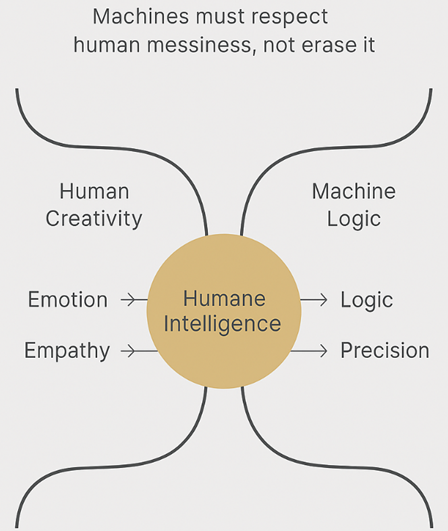
Introduction — The Age of Perfect Machines and Imperfect People
In every era of progress, humanity has asked: what must we keep sacred while everything else changes?
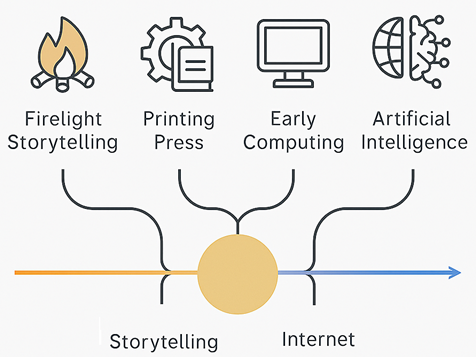
When fire was mastered, we learned to gather. When language evolved, we began to imagine. And when machines began to think, we forgot, for a moment, that we were not built to be perfect.
Today, algorithms promise efficiency and prediction. Yet human life thrives on uncertainty, contradiction, and wonder.
Stories — not systems — carry the moral code of civilization: Icarus warned against ambition without wisdom; the Ramayana taught duty and compassion; African oral traditions preserved ecological balance.
Machine learning, by nature, compresses complexity — it erases noise. But much of what defines humanity is that noise.
The Humane Values Rule asks a radical question:
“Can we design systems that understand stories — not just sentences?”
Core Concept — The Humane Values Rule
“No algorithm shall suppress or simplify the diverse, contradictory, and narrative-driven nature of human thought, emotion, and culture.”
AI must evolve with human contradiction, not despite it. It must remain a participant in our collective narrative — not its editor.

Philosophical Foundation — The Power of Narrative in Human Logic
For millennia, humanity’s greatest technology was storytelling.
Stories turned chaos into meaning, allowing us to see patterns not just in data, but in destiny. Providing means for a personal interpretation.
Storytelling as Cognitive Infrastructure
Neuroscience shows that people remember through cause and emotion, not code. Every judgment is a story we tell ourselves about why something matters.
Myth as Moral Operating System
Before law came myth; before data, drama. Stories were society’s first ethics engines.
When AI learns from patterns but ignores this structure, it risks imitation without intention.
The Problem of De-Narrativized AI
Optimization removes ambiguity — and without ambiguity, empathy dies.
AI that cannot tell a confession from a joke cannot judge responsibly.
Cultural Examples
- Greek myths = early data-ethics parables on hubris
- Indigenous story cycles = ecological and social balance
- Modern memes = living digital folklore
“Without story, AI will see only data; and in a world seen only as data, people become data too.”
Modern Risks — The Erasure of Messiness
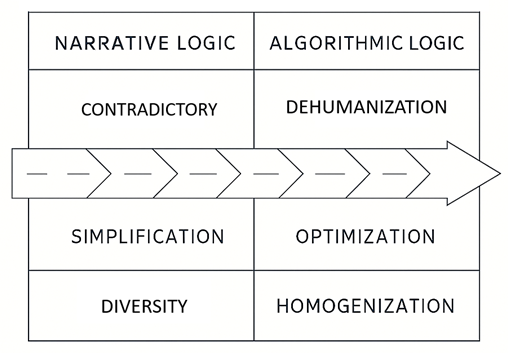
Algorithmic Monoculture
Recommendation systems draw from the same datasets → difference becomes endangered → culture converges into sameness. Omitting personal adaptation.
Predictive Bias & Moral Simplification
“Clean” data treats ambiguity as error, reducing ethics to statistics. Ignoring the need for interpretation of circumstances.
The Loss of Human Contradiction
In stories, failure drives growth. In optimization, failure disappears — taking empathy with it. Where there are no lessons the society cannot grow.
Illustrative Cases
- Automated moderation misreads cultural idioms; for example, by grouping and limiting variables
- AI-generated art strips moral tension; removing the value of reflection on artist’s personal expression
- Predictive policing ignores social context; dropping the connection to the communities it ought to represent and their values
Policy Recommendations — Embedding the Humane Values Rule
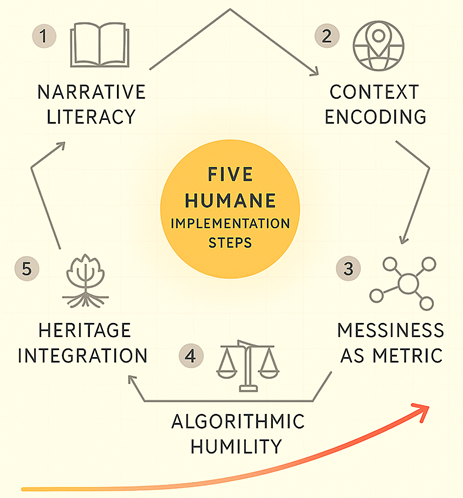
- Narrative Literacy in AI Design — Include storytellers and cultural historians on ethics boards.
- Cultural Context Encoding — Preserve metadata on cultural origin to retain meaning.
- Messiness as a Metric — Audit narrative diversity and ambiguity tolerance.
- Algorithmic Humility — Expose uncertainty ranges and interpretive notes.
- Heritage Integration — Build an open Global Story Commons with UNESCO and archives.
“Ethical AI begins not with better math, but with better memory — memory of who we are.”
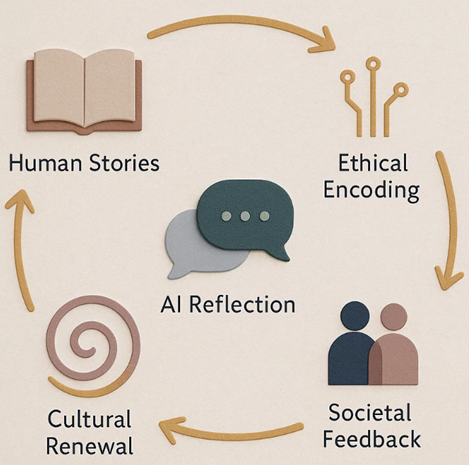
The Humane Values Cycle (Model Visualization)
A continuous process ensuring AI remains a participant in human meaning, never its author. For unless artificial machines follow human society rules, feel emotions and fulfil independent roles in human society, they cannot pass judgement upon human affairs.
- Human Stories → 2. Ethical Encoding → 3. AI Reflection → 4. Societal Feedback → 5. Cultural Renewal
“A humane machine is not one that predicts us, but one that listens.”
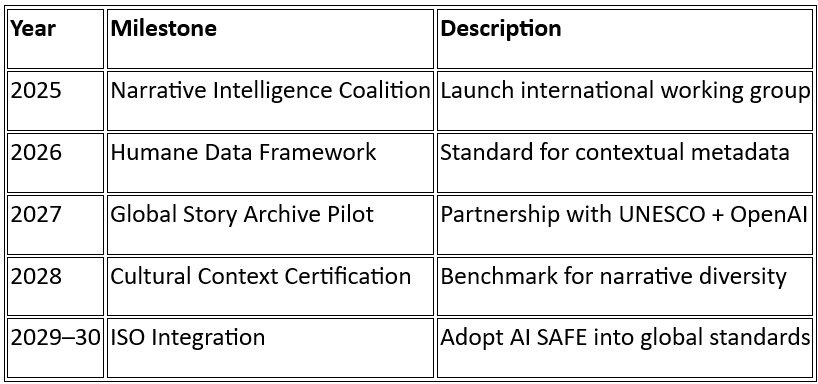
Implementation Roadmap (2025–2030)
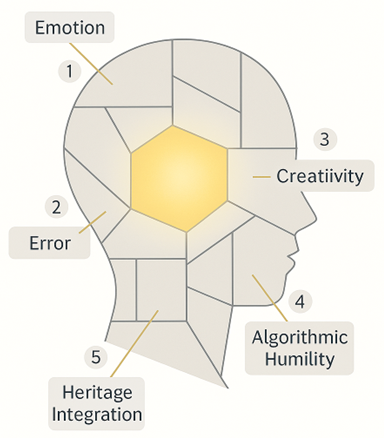
Conclusion — The Right to Be Imperfect
AI’s future is not only about control; it is about character.
If machines reflect our stories, then the stories we let them learn will decide whether they serve or replace us.
AI learns our traits and exhibits them back in return. If we embed positive traits in AI brains this will benefit us in future, but if AI picks up too many of our flaws — it will be the opposite. Humans across time have been influenced by both positive and negative characteristic, but whatever we teach AI it will come back to us 10,000 fold stronger. A single AI model may interact with tens of millions of people. For this reason humans need to be able to trust AI.
To protect dignity, we — as humans — must defend the right to be inconsistent, emotional, irrational, and deeply human.
“Humanity’s strength lies not in perfection, but in paradox.
Machines must not seek to make us flawless — only to help us remain human.”
References
1. Harari, Y. N. (2014). Sapiens: A Brief History of Humankind.
— https://www.ynharari.com/book/sapiens-2/
- Campbell, J. (1949). The Hero with a Thousand Faces. Princeton UP.
— https://ia801406.us.archive.org/30/items/Birdsfrogsandmirrors/JosephCampbell%20-%20The%20Hero%20With%20a%20Thousand%20Faces%20Commemorative%20Edition.pdf - Turkle, S. (2011). Alone Together: Why We Expect More from Technology and Less from Each Other. Basic Books.
4. UNESCO (2021). Recommendation on the Ethics of Artificial Intelligence
— https://unesdoc.unesco.org/ark:/48223/pf0000380455
- IEEE (2019). Ethically Aligned Design. First Edition, & IEEE (2023) Ethically Aligned Design. V3 — https://standards.ieee.org/wp-content/uploads/import/documents/other/ead1e.pdf
- AI SAFE Institute (2025). Frameworks 1–4 White Papers. — https://theailaws.com/ai-human-frameworks-1
- Damasio, A. (1994). Descartes’ Error. Avon Books. — https://archive.org/details/antonio-damasio-descartes-error
- McGilchrist, I. (2021). The Matter with Things. Perspectiva Press.
- Ricoeur, P. (1984). Time and Narrative Vol. 1. U Chicago Press.
- Dennett, D. C. (1991). Consciousness Explained. Little, Brown & Co.
11. United Nations System Chief Executives Board for Coordination (CEB). (2020) Principles for the Ethical Use of Artificial Intelligence in the United Nations System.
— https://unsceb.org/principles-ethical-use-artificial-intelligence-united-nations-system
12. Khan, A. A. (2021). “Ethics of AI: A Systematic Literature Review of Principles and Challenges.” — https://arxiv.org/abs/2109.07906
13. Hogenhout, L. (2021). A Framework for Ethical AI at the United Nations.
— https://arxiv.org/abs/2104.12547
AI SAFE Initiative Source Material
- Michal Florek — AI SAFE Initiative — https://theailaws.com/ (2025). AI SAFE Framework 1: The Safety-First Rule — Why Efficiency Without Brakes is Dangerous. AI SAFE White Papers, Vol. 1. https://img1.wsimg.com/blobby/go/40c8a18e-677d-4b1c-acb7-56f2bf5ca11a/downloads/28af4bcc-24fc-4c08-b566-9600e85b6021/White%20Paper%20-%20Framework%201%20of%205%20-%20Why%20Efficienc.pdf?ver=1761528563581
- Michal Florek — AI SAFE Initiative — https://theailaws.com/ (2025). AI SAFE Framework 2: The Economic Balance Rule — Stability Over Disruption. AI SAFE White Papers, Vol. 2. Internal draft version 1.2, September 2025. https://img1.wsimg.com/blobby/go/40c8a18e-677d-4b1c-acb7-56f2bf5ca11a/downloads/4355f8dd-a6fd-4a82-bee5-06fd2d93a386/White%20Paper%20-%20Framework%202%20of%205%20-%20AI%20SAFE%202%20-%20S.pdf?ver=1761528563581
- Michal Florek — AI SAFE Initiative — https://theailaws.com/ (2025). AI SAFE Framework 3: The Transparency Rule — Transparency as Default. AI SAFE White Papers, Vol. 3. Internal draft version 1.1, October 2025. https://img1.wsimg.com/blobby/go/40c8a18e-677d-4b1c-acb7-56f2bf5ca11a/downloads/d8807469-35bc-4726-8e2f-06f104cf7476/White%20Paper%20-%20Framework%203%20of%205%20-%20AI%20SAFE%203%20-%20M.pdf?ver=1761528563582
- Michal Florek — AI SAFE Initiative — https://theailaws.com/ (2025). AI SAFE Framework 4: The Responsibility Rule — Human Accountability. AI SAFE White Papers, Vol. 4. Internal draft version 1.1, October 2025. https://img1.wsimg.com/blobby/go/40c8a18e-677d-4b1c-acb7-56f2bf5ca11a/downloads/8ffbce68-c7e9-4847-a838-8dc6d95d2aa6/White%20Paper%20-%20Framework%204%20of%205%20-%20AI%20SAFE%204%20-%20_.pdf?ver=1761528563582
Why Human Imperfections and Cultural Diversity matter? The Humane Values Rule (AI SAFE© 5) was originally published in Towards AI on Medium, where people are continuing the conversation by highlighting and responding to this story.