Two Failing Scenarios, Two Root Causes
Every senior AI engineer has been there. Your RAG pipeline works beautifully in demos. Then a compliance officer leans over and asks a question, and your system returns three confidently-worded hallucinations.
That question was not a semantic similarity problem. It was a graph traversal problem. And you built the wrong database for it.
This is the architectural trap most engineers fall into not because they don’t understand databases, but because they never stopped to ask: what kind of question am I actually trying to answer?
Before we get into the architecture, there’s one thing worth establishing first: the kind of failure you’re trying to prevent. The two scenarios below illustrate the exact gap between semantic similarity and explicit connectivity, and once you see the difference, the right database choice becomes obvious.
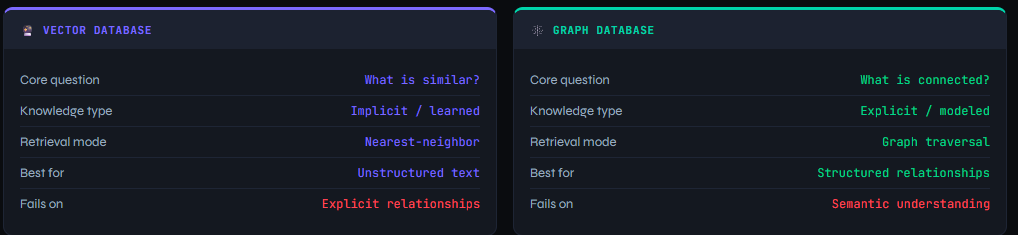
Two Failing Scenarios, Two Root Causes
Let me give you two scenarios that I keep coming back to when explaining this.
Scenario one. You’re building an internal knowledge base for your engineering team, hundreds of Confluence pages, runbooks, design docs, post-mortems. You hook up basic keyword search. A junior engineer types:
“How do we handle cascading failures in the payment pipeline?”
Zero results. The actual document title is “Circuit Breaker Patterns in Checkout Services.” Same concept, completely different words. The engineer gives up and messages Slack instead.
Scenario two. A fraud analyst at a fintech company needs to run a query:
“Show me all accounts connected within 3 hops to this flagged transaction.”
A traditional relational database would need four or five expensive JOINs and a query optimizer nightmare. By the time results surface, the fraudster has already moved the money.
Two different failures. Two different root causes. And two different database technologies built specifically to solve them:
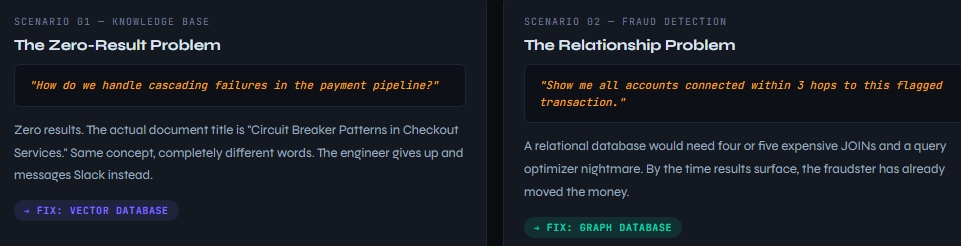
- Vector databases answer: What is semantically similar?
- Graph databases answer: What is explicitly connected?
Hope this below screenshot diagram make you clear:
Let me explain with one more example
Imagine a mid-market bank building an AI compliance assistant. The team needs it to answer questions across two fundamentally different types of knowledge:
Type A : Unstructured regulatory knowledge: 50,000+ pages of AML guidelines, OFAC rules, Basel III documents, internal policy memos, and transaction audit narratives. Dense, text-heavy, semantically rich. A classic retrieval problem.
Type B: Structured relational knowledge: 180,000 entity relationships corporate ownership hierarchies, beneficial owner registries, correspondent banking networks, sanction list cross-references, and transaction counterparty graphs. Every node connects to others through typed, directional edges.
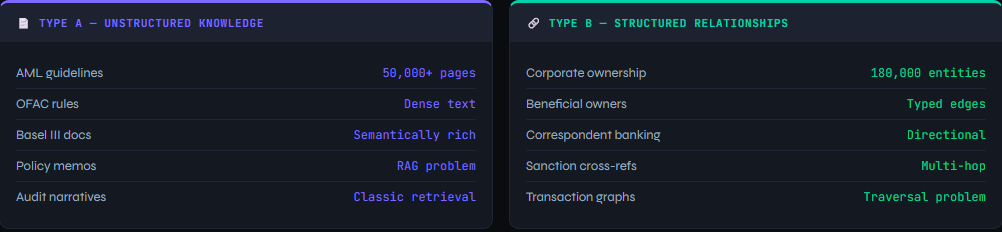
The Critical Point: You cannot solve Type A with a graph database. You cannot solve Type B with a vector database. And a compliance officer asking about beneficial owners connected to sanctioned vendors needs both answers fused into one.
This article will give you the architecture intuition, the working code, and the decision framework to know when to reach for each and more importantly, when you need both at the same time. That is exactly the architecture problem this article is about.
Why No Amount of Prompt Engineering Fixes This
The failure in the compliance scenario wasn’t the model. The model was doing exactly what it was trained to do generating plausible, coherent text given the context it was provided. The context it was provided was wrong.
The retrieval gave it documents about Vendor XYZ. It didn’t give it the structural fact that Vendor XYZ shares a beneficial owner with two other entities a relationship that would only surface through explicit graph traversal, not document similarity. That information was never in the vector store, because vector stores don’t model ownership chains. No retrieval tuning fixes that. No prompt engineering fixes that.
Think of it this way: a vector database is a map of meaning. A graph database is a map of facts. One knows that “neural network” and “deep learning” are neighbors because it learned this implicitly from millions of documents. The other knows that Company A owns Company B, which in turn controls Company C because someone explicitly encoded those relationships as edges in a graph.
One is a map of meaning. The other is a map of facts.
What vector databases actually do
At its core, a vector database is a storage and retrieval system optimized for high-dimensional numerical vectors also called embeddings.
A vector database doesn’t store documents. It stores meaning.
When you embed a piece of text, you’re converting it into a point in high-dimensional space typically 768 to 3072 dimensions, depending on the model. The key insight is documents with similar meaning end up close together in that space, even if they share zero words.
“Circuit breaker pattern” and “handling cascading failures” are far apart alphabetically. They’re neighbors geometrically.
The search operation isn’t string matching. It’s nearest-neighbor lookup: find the N points in embedding space closest to the query vector. Fast approximate algorithms such as HNSW, IVF which make this viable at scale. A well-tuned vector index searches millions of documents in under 100 milliseconds.
What it’s genuinely good at:
- Semantic search over unstructured text
- Document retrieval for RAG pipelines
- Recommendation (“find content similar to this”)
- Deduplication across paraphrased content
- Cross-lingual search when using multilingual embeddings
Where it breaks:
Vector similarity is not relevance. “What is mathematically close in embedding space” and “what will actually help answer this question” overlap but they’re not identical. A document can be semantically close to a query and still be the wrong answer. The gap between them is where quietly broken RAG pipelines live.
It also has no concept of relationships. A vector database can tell you that two documents are about the same topic. It cannot tell you that the company in document A is a subsidiary of the company in document B.
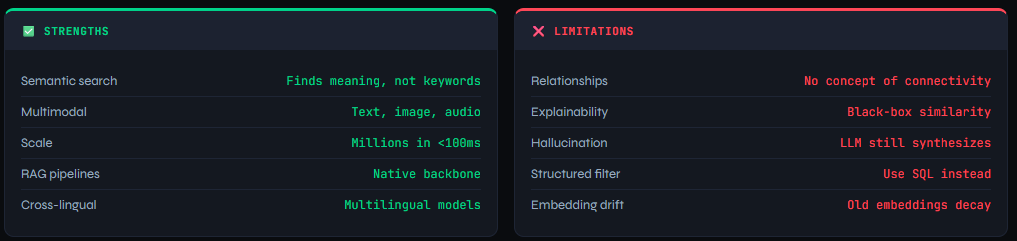
For quick reference, here’s a summary of vector database strengths and limitations:
Embeddings
An embedding is what you get when you run text (or an image, or audio) through a neural network trained to encode meaning. The output is a list of floating-point numbers typically 384 to 3072 dimensions where proximity in that number space reflects similarity in meaning.

The sentence-transformers library by Reimers & Gurevych (2019) made this accessible in Python with a single call:
from sentence_transformers import SentenceTransformer

model = SentenceTransformer("all-MiniLM-L6-v2")
embedding = model.encode("machine learning")
# Returns a numpy array of shape (384,)
What Problem Embeddings Solve
Traditional databases index on exact values. Embeddings let you index on meaning. A vector database stores millions of these embeddings and, at query time, efficiently finds the ones closest to your query vector, a process called Approximate Nearest Neighbor (ANN) search.
Popular vector databases:
- Pinecone — managed cloud vector DB
- Weaviate — open-source, hybrid search support
- Chroma — lightweight, ideal for local RAG prototyping
- FAISS — an in-process index library (not a full DB, but widely used)
- pgvector — vector extension for PostgreSQL
How a Vector DB Query Actually Flows
Here’s the end-to-end architecture:
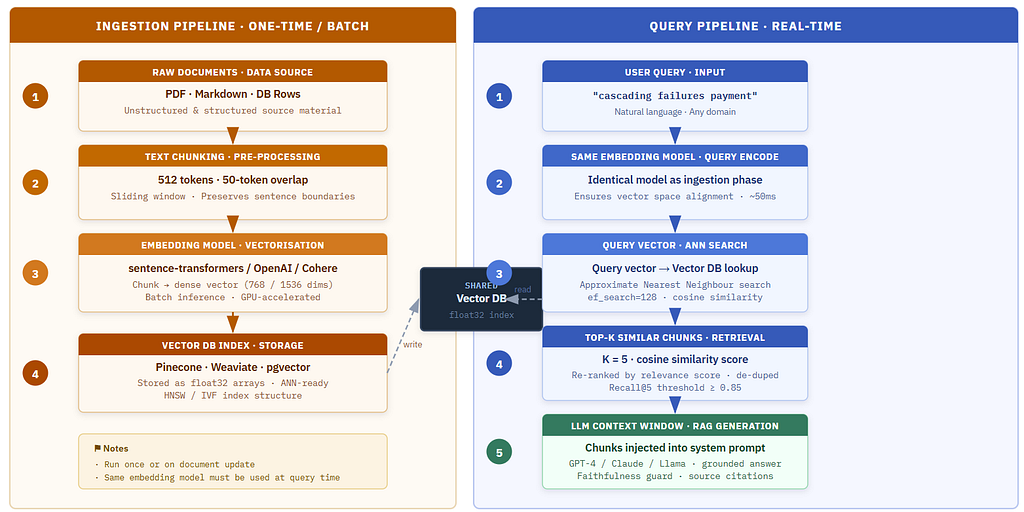
A working FAISS implementation from embeddings to ranked results. This is the exact pattern that powers every production RAG system , simplified to its essential bones.
Step 1 — Embed Your Documents
import faiss
import numpy as np
from sentence_transformers import SentenceTransformer

model = SentenceTransformer("all-MiniLM-L6-v2")

docs = [
    "Circuit breaker patterns in checkout services",
    "Handling cascading failures in distributed systems",
    "Payment pipeline timeout configuration",
    "How to debug Kubernetes pod OOMKills",
]

# Encode all documents
embeddings = model.encode(docs)
embeddings = np.array(embeddings, dtype="float32")
Step 2 — Build the Index & Query
# IndexFlatL2 = exact L2 distance search (great for small datasets)
dimension = embeddings.shape[1]
index = faiss.IndexFlatL2(dimension)
index.add(embeddings)

# Semantic search — no keyword match needed
query = "cascading failures payment pipeline"
query_vec = model.encode([query]).astype("float32")
distances, indices = index.search(query_vec, k=3)

for rank, idx in enumerate(indices[0]):
    print(f"Rank {rank+1}: {docs[idx]}")

# Rank 1: Handling cascading failures in distributed systems  ✓
# Rank 2: Circuit breaker patterns in checkout services       ✓
# Rank 3: Payment pipeline timeout configuration              ✓
Keyword search would have found nothing. Semantic search finds the right concept. In details, Keyword search on “cascading failures payment pipeline” would have returned zero results, none of the documents contain those exact phrases.
Semantic search finds the right concept instantly, because the embeddings for “cascading failures” and “circuit breaker” live close together in the 384-dimensional space.
Chunking Strategy → Production Note
def chunk_text(text: str, chunk_size: int = 300, overlap: int = 50) -> list[str]:
    """Sliding window chunking with overlap to preserve context at boundaries."""
    words = text.split()
    chunks = []
    for i in range(0, len(words), chunk_size - overlap):
        chunks.append(" ".join(words[i : i + chunk_size]))
    return chunks

# chunk_size: 300 words ≈ one coherent topic
# overlap: 50 words → context preserved across boundaries
# Tune these per your domain — legal docs often need smaller chunks
What Is a Graph Database?
A graph database models data as nodes (entities) and edges (relationships), both of which can carry properties. Unlike relational databases where relationships live in join tables, in a graph database relationships are first-class citizens, stored directly and traversable at constant time regardless of dataset size.
The most widely-used graph query language is Cypher (Neo4j), though GQL is emerging as a standard.
(User {name: "Alice"}) -[:FRIEND]-> (User {name: "Bob"})
(Bob) -[:WORKS_AT]-> (Company {name: "Stripe"})
(Alice) -[:PURCHASED]-> (Product {sku: "GPU-4090"})
Graph Traversal vs JOIN
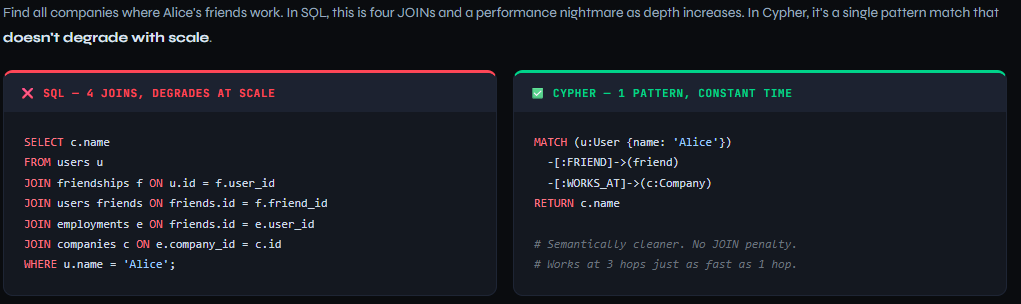
To find “all companies where Alice’s friends work” in SQL:
SELECT c.name
FROM users u
JOIN friendships f ON u.id = f.user_id
JOIN users friends ON friends.id = f.friend_id
JOIN employments e ON friends.id = e.user_id
JOIN companies c ON e.company_id = c.id
WHERE u.name = 'Alice';
In Cypher (Neo4j):
MATCH (u:User {name: 'Alice'})-[:FRIEND]->(friend)-[:WORKS_AT]->(c:Company)
RETURN c.name
The Cypher version is not just shorter, it’s semantically clearer and doesn’t degrade in performance as hops increase, because graph databases index edges natively.
The diagram below provides a visual summary of the comparison:
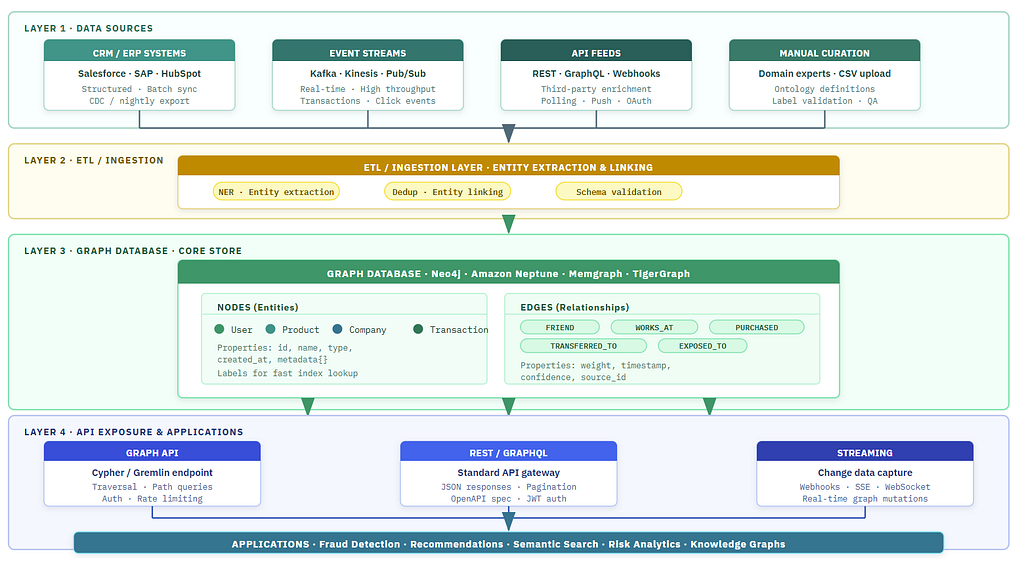
Graph Database Architecture: End-to-End
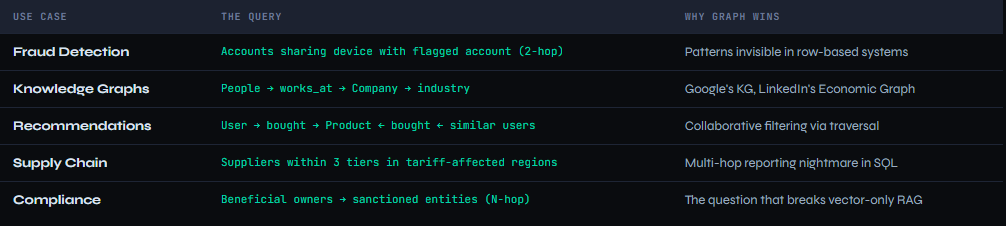
Use Cases Where Graph DBs Shine
Fraud detection. Fraudsters create rings of synthetic identities. Graph databases detect shared phone numbers, addresses, or devices across accounts patterns that are invisible in row-based systems. A 2-hop query: “Show all accounts that share a device with a flagged account” runs in milliseconds.
Knowledge graphs. Google’s Knowledge Graph and LinkedIn’s Economic Graph are graph databases at planetary scale. They capture entities (people, companies, schools) and explicit relationships (works at, studied at, knows) to power smarter search and recommendations.
Recommendation via relationships. Amazon’s “Customers who bought X also bought Y” can be modeled as a bipartite graph (users ↔ products) with collaborative filtering traversals, distinct from vector-based recommendations, which rely on embedding similarity.
Supply chain and org hierarchy. “Find all suppliers within 3 tiers of this semiconductor that are in a tariff-affected region” is a multi-hop graph traversal that would be a reporting nightmare in SQL.
The diagram below summarizes the key use cases where graph databases excel:
Strengths at a glance:
- Relationship-first → traversals stay fast regardless of data size
- Explainable paths → you can show why two entities are connected
- Multi-hop queries → 2, 3, N-hop traversals with natural syntax
- Dynamic schema → add new relationship types without migrations
- Fraud and anomaly detection → structural patterns become visible
Limitations to keep in mind:
- No semantic understanding → “Circuit Breaker” and “Fault Tolerance” are unrelated unless you explicitly connect them
- Data modeling complexity → graph schema design requires careful upfront thinking
- Not great for bulk analytics → aggregate queries across millions of nodes are slower than columnar databases
- Smaller ecosystem → fewer managed solutions compared to relational databases
The Real Difference: Implicit vs Explicit
This is the intuition most articles miss.
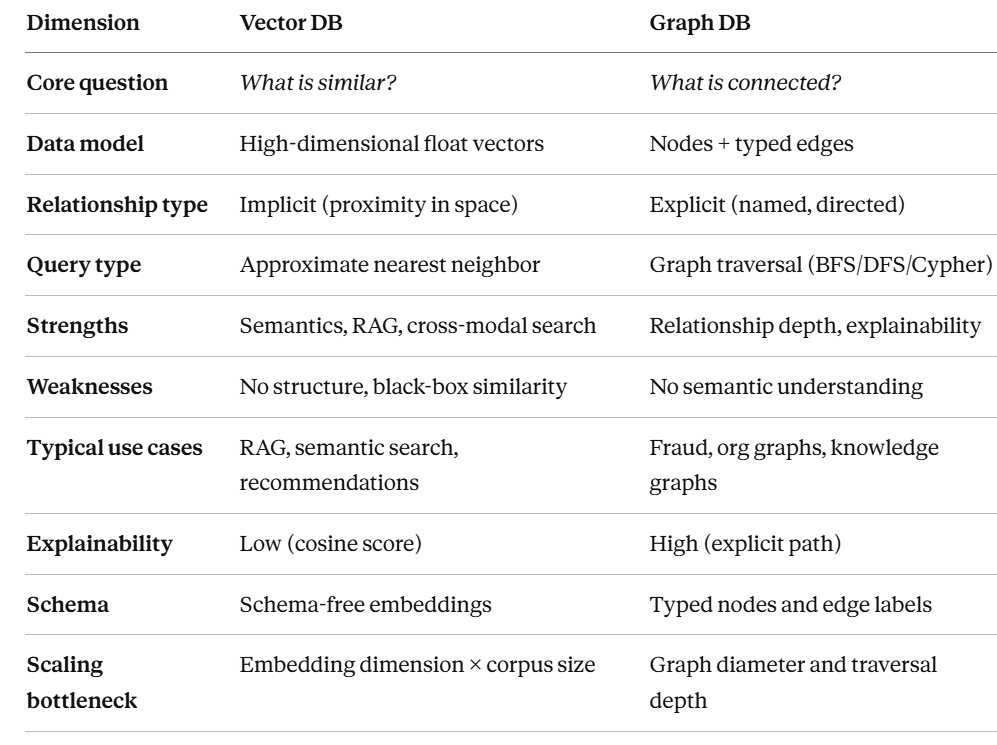
Think of it this way:
Vector DB knows that “neural network” and “deep learning” are neighbors because they appear in similar contexts across millions of documents. It learned this implicitly.
Graph DB knows that “Geoffrey Hinton” works at “University of Toronto” and “Google Brain” — because someone explicitly encoded that relationship.
One is a map of meaning. The other is a map of facts.
The Architecture Decision
Here’s the framework, simplified:
Default to vector when you’re building semantic search, document retrieval, or RAG over unstructured content. It’s faster to implement, easier to maintain, and sufficient for most question types.
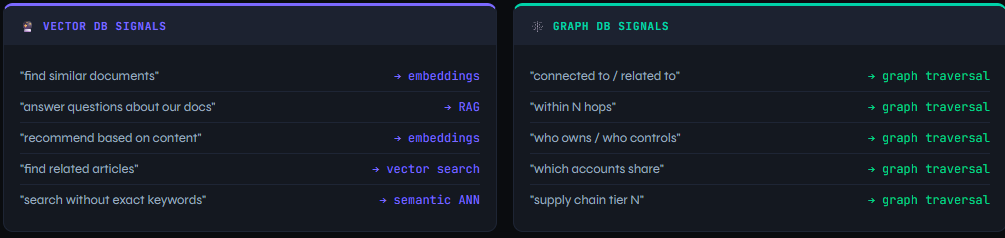
Add graph when you start hearing words like “connected,” “related to,” “within N hops,” “who owns,” “what changed,” “which accounts.” These are traversal signals. When your domain naturally has entities with explicit relationships financial instruments, org charts, supply chains, access control systems model those relationships explicitly from the start. Retrofitting graph structure onto a vector-only system is painful.
Build hybrid when your users ask both kinds of questions, or when answering correctly requires both structural facts and semantic context. This is most enterprise AI applications above a certain complexity threshold.
The vector database is not wrong. The graph database is not wrong. The mistake is assuming one of them is always right.
Using Both Together: The KAG Pattern
The most powerful modern AI architectures combine both databases. Microsoft Research’s GraphRAG paper (Edge et al., 2024) formalized one approach: using graph-structured knowledge to augment retrieval before generation. A related pattern is Knowledge-Augmented Generation (KAG), pioneered by Ant Group (Liang et al., 2024), which tightly couples knowledge graphs with LLM reasoning chains.
Here’s why neither database alone is sufficient:
Pure vector RAG retrieves semantically relevant text but misses structural relationships. It doesn’t know that Stripe and SVB are connected through a specific banking relationship unless that text happens to appear in a chunk.
Pure graph traversal finds the connection but can’t synthesize a natural-language answer or pull in long-form context.
Combined: graph gives structure and precision. Vector gives depth and language fluency. The LLM synthesizes both into an answer.
Here is a practical combined query flow:
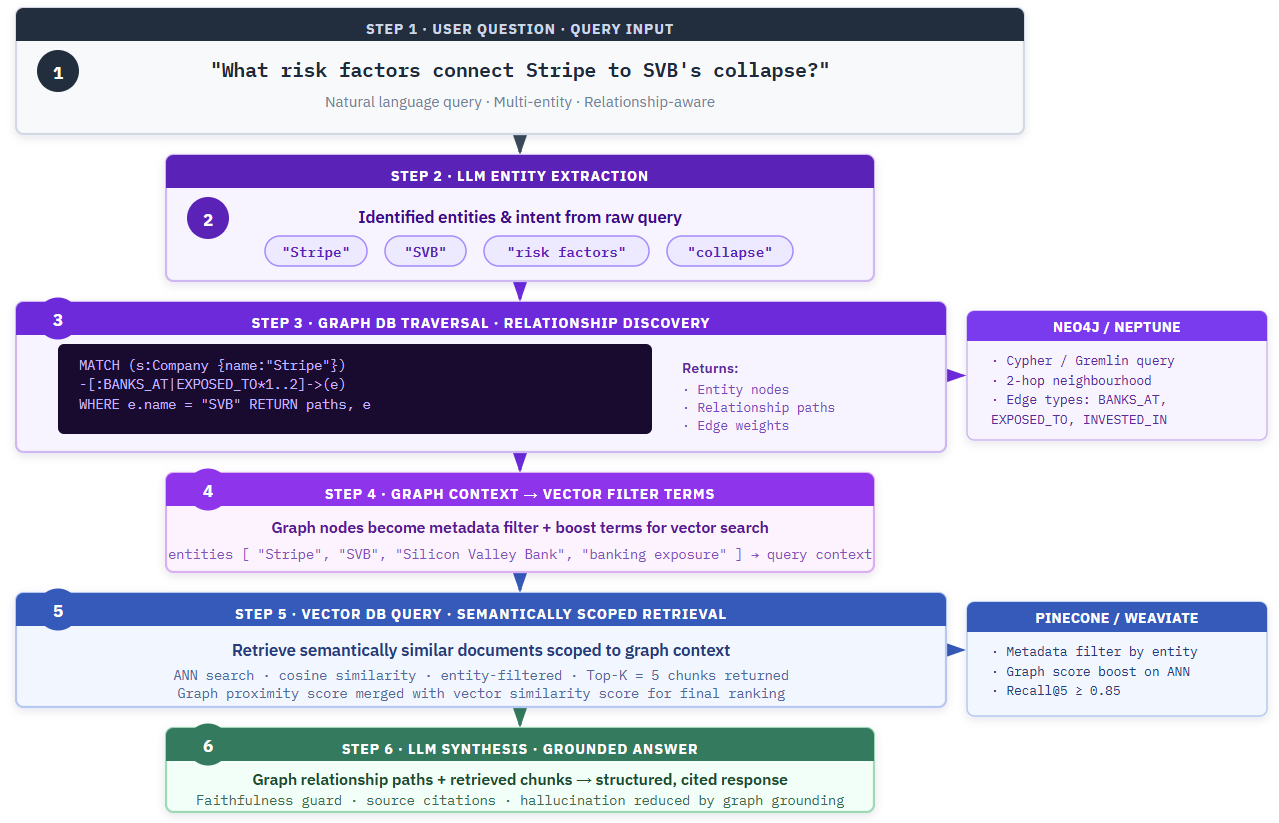
What Each Layer Contributes

Query Enrichment Pattern → The Key Trick
def combined_query(question, graph, index, metadata, top_k=5):
    # Step 1: Extract entities from question
    entities = extract_entities(question, graph)
    # → ["LangGraph"]

    # Step 2: Graph traversal — expand context structurally
    graph_nodes = graph_context(entities, graph, hops=2)
    # → ["LangGraph", "LangChain", "RAG", "Vector DB", "Neo4j"]

    # Step 3: Enrich query with structural facts, run vector search
    enriched_query = question + " " + " ".join(graph_nodes)
    query_vec = model.encode([enriched_query]).astype("float32")
    distances, indices = index.search(query_vec, top_k)

    # Result: semantically relevant chunks + structural context fused
    return build_results(distances, indices, metadata, graph_nodes)
Why This Works?
The graph traversal expands “LangGraph” to its structural neighborhood (LangChain, RAG, Vector DB). That expanded context enriches the vector query so the semantic search now retrieves documents about all those related concepts. Structure guides retrieval. Retrieval enables synthesis. Neither alone gets there.
End-to-End Demo Project
A complete project combining FAISS vector search and NetworkX graph traversal to answer engineering questions with both structural and semantic context. Swap to Pinecone + Neo4j for production.
Repository Structure
tech-knowledge-assistant/
├── data/
│   ├── raw_docs/           # Markdown blog posts / README files
│   └── tech_graph.json     # Graph seed data (nodes + edges)
├── src/
│   ├── ingest.py           # Chunk docs and build vector index
│   ├── graph_builder.py    # Build NetworkX graph from JSON
│   ├── retriever.py        # Combined graph + vector retrieval
│   └── query.py            # Entry point: answer a question
├── vector_store/
│   └── faiss_index/        # Persisted FAISS index + metadata
├── requirements.txt
└── README.md
requirements.txt
sentence-transformers==2.7.0
faiss-cpu==1.7.4
networkx==3.3
numpy==1.26.4
Step 1: Ingest Documents and Build Vector Index
# src/ingest.py
import os
import json
import faiss
import numpy as np
from sentence_transformers import SentenceTransformer
from pathlib import Path

DOCS_DIR = "data/raw_docs"
INDEX_DIR = "vector_store/faiss_index"

model = SentenceTransformer("all-MiniLM-L6-v2")

def chunk_text(text: str, chunk_size: int = 300, overlap: int = 50) -> list[str]:
    words = text.split()
    chunks = []
    for i in range(0, len(words), chunk_size - overlap):
        chunks.append(" ".join(words[i : i + chunk_size]))
    return chunks

def ingest_docs():
    chunks, metadata = [], []

    for filepath in Path(DOCS_DIR).glob("*.md"):
        text = filepath.read_text()
        for chunk in chunk_text(text):
            chunks.append(chunk)
            metadata.append({"source": filepath.name, "text": chunk})

    print(f"Encoding {len(chunks)} chunks...")
    embeddings = model.encode(chunks, show_progress_bar=True)
    embeddings = np.array(embeddings, dtype="float32")

    os.makedirs(INDEX_DIR, exist_ok=True)
    index = faiss.IndexFlatL2(embeddings.shape[1])
    index.add(embeddings)
    faiss.write_index(index, f"{INDEX_DIR}/index.faiss")

    with open(f"{INDEX_DIR}/metadata.json", "w") as f:
        json.dump(metadata, f)

    print(f"Saved index with {index.ntotal} vectors.")

if __name__ == "__main__":
    ingest_docs()
Step 2: Build the Graph
# src/graph_builder.py
import json
import networkx as nx

def build_graph(graph_json_path: str = "data/tech_graph.json") -> nx.DiGraph:
    with open(graph_json_path) as f:
        data = json.load(f)

    G = nx.DiGraph()

    for node in data["nodes"]:
        G.add_node(node["id"], **node.get("properties", {}))

    for edge in data["edges"]:
        G.add_edge(edge["from"], edge["to"], relation=edge["relation"])

    return G

# Example tech_graph.json structure:
# {
#   "nodes": [
#     {"id": "LangChain", "properties": {"type": "framework", "language": "Python"}},
#     {"id": "LangGraph", "properties": {"type": "framework", "language": "Python"}},
#     {"id": "RAG", "properties": {"type": "pattern"}},
#     {"id": "Vector DB", "properties": {"type": "infrastructure"}},
#     {"id": "Neo4j", "properties": {"type": "database"}}
#   ],
#   "edges": [
#     {"from": "LangChain", "to": "RAG", "relation": "IMPLEMENTS"},
#     {"from": "LangGraph", "to": "LangChain", "relation": "EXTENDS"},
#     {"from": "RAG", "to": "Vector DB", "relation": "REQUIRES"},
#     {"from": "RAG", "to": "Neo4j", "relation": "OPTIONALLY_USES"}
#   ]
# }
Step 3: Combined Query — Graph + Vector
# src/retriever.py
import json
import faiss
import numpy as np
import networkx as nx
from sentence_transformers import SentenceTransformer

model = SentenceTransformer("all-MiniLM-L6-v2")

def load_vector_index(index_dir: str = "vector_store/faiss_index"):
    index = faiss.read_index(f"{index_dir}/index.faiss")
    with open(f"{index_dir}/metadata.json") as f:
        metadata = json.load(f)
    return index, metadata

def extract_entities(question: str, graph: nx.DiGraph) -> list[str]:
    """Simple entity extraction: check if any graph node appears in the question."""
    found = []
    for node in graph.nodes:
        if node.lower() in question.lower():
            found.append(node)
    return found

def graph_context(entities: list[str], graph: nx.DiGraph, hops: int = 2) -> list[str]:
    """Return all nodes reachable within N hops from the seed entities."""
    related = set(entities)
    for entity in entities:
        if entity in graph:
            neighbors = nx.single_source_shortest_path_length(
                graph, entity, cutoff=hops
            )
            related.update(neighbors.keys())
    return list(related)

def combined_query(
    question: str,
    graph: nx.DiGraph,
    index: faiss.Index,
    metadata: list[dict],
    top_k: int = 5,
) -> list[dict]:
    # Step 1: Extract entities from the question
    entities = extract_entities(question, graph)
    print(f"Entities found: {entities}")

    # Step 2: Graph traversal — expand context
    graph_nodes = graph_context(entities, graph, hops=2)
    print(f"Graph context nodes: {graph_nodes}")

    # Step 3: Enrich query with graph context and run vector search
    enriched_query = question + " " + " ".join(graph_nodes)
    query_vec = model.encode([enriched_query]).astype("float32")
    distances, indices = index.search(query_vec, top_k)

    # Step 4: Return ranked results with graph context
    results = []
    for dist, idx in zip(distances[0], indices[0]):
        results.append({
            "text": metadata[idx]["text"],
            "source": metadata[idx]["source"],
            "score": float(dist),
            "graph_context": graph_nodes,
        })
    return results
Step 4: Entry Point
# src/query.py
from graph_builder import build_graph
from retriever import load_vector_index, combined_query

def main():
    print("Loading graph and vector index...")
    graph = build_graph()
    index, metadata = load_vector_index()

    question = "How does LangGraph relate to RAG systems?"
    print(f"\nQuestion: {question}\n")

    results = combined_query(question, graph, index, metadata, top_k=3)

    print("\n--- Results ---")
    for i, r in enumerate(results):
        print(f"\n[{i+1}] Source: {r['source']}")
        print(f"    Score: {r['score']:.4f}")
        print(f"    Graph Context: {r['graph_context']}")
        print(f"    Text: {r['text'][:200]}...")

if __name__ == "__main__":
    main()
To run locally:
pip install -r requirements.txt
python src/ingest.py     # build the vector index
python src/query.py      # run a combined query
This is a starting point but in production you would swap FAISS for Pinecone/Chroma and NetworkX for Neo4j, but the architecture pattern is identical.
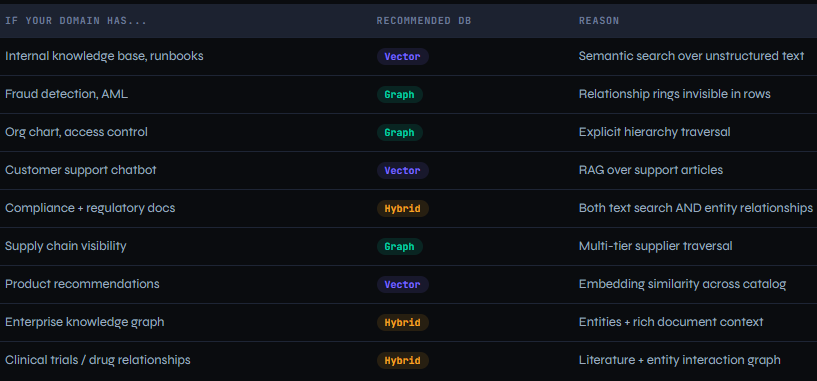
When to Use Which (Decision Guide)
Ask yourself: what kind of question am I actually trying to answer?

Signal Words That Tell You Which Database
Full Decision Table
The Final Word: Vector search finds what sounds related. Graph traversal finds what is related. When the stakes are regulatory compliance, fraud detection, or ownership chains that difference is measured in fines, not percentages. Pick the right tool for the right question. Build the right database before the compliance officer asks.
Conclusion
The decision between vector and graph databases is not a technical debate it is a vocabulary problem. Once you understand what question each database is designed to answer, the architecture falls into place on its own.
- If your problem is “find what’s like this” → embeddings and a vector index.
- If your problem is “find what’s connected to this” → a graph database.
- If your problem is “find what’s like this, within the context of what’s connected to it” → you need both, and you need them talking to each other.
The most sophisticated AI systems in production today LinkedIn’s knowledge graph, fraud detection at financial institutions, enterprise RAG at scale all sit at the intersection of these two paradigms. Neither alone is sufficient for the hardest problems.
Vector search finds what sounds related. Graph traversal finds what is related. When the stakes are regulatory compliance, that difference is measured in fines, not percentages.
Pick the right tool for the right question. Your users will notice the difference.
A Final Thought
The failure wasn’t the model. The model was doing exactly what it was trained to do generating plausible, coherent text given the context it was provided. The context it was provided was wrong.
No amount of prompt engineering fixes that. No retrieval tuning fixes that. The information was never in the vector store, because vector stores don’t model ownership chains.
The database was wrong for the question.
Build the right one before the compliance officer asks.
References
- Reimers, N., & Gurevych, I. (2019). Sentence-BERT: Sentence Embeddings using Siamese BERT-Networks. Proceedings of EMNLP 2019.
- Johnson, J., Douze, M., & Jégou, H. (2021). Billion-scale similarity search with GPUs. IEEE Transactions on Big Data.
- LinkedIn Engineering. Building LinkedIn’s Knowledge Graph. LinkedIn Engineering Blog.
- Edge, D., Trinh, H., Cheng, N., et al. (2024). From Local to Global: A Graph RAG Approach to Query-Focused Summarization. Microsoft Research.
- Liang, L., Sun, M., Gui, Z., et al. (2024). KAG: Boosting LLMs in Professional Domains via Knowledge Augmented Generation. Ant Group / arXiv.
I’m a GenAI Engineer/Data Engineer with deep roots in the data world , the kind of person who has spent years building, breaking, and rebuilding systems until they behave in production. I write because this field moves fast, and sharing what I learn helps all of us move faster. If you’re someone who loves exploring new architectures, pushing boundaries, high and low level design and leveling up your craft, you’re in the right place.
Let’s keep experimenting, learning, and building the future together.
Thanks for sticking with me till the end 🙏 If this article helped you to some level of understanding VectorDB Verses GraphDB, you’re going to love what’s coming next.
I publish weekly deep dives on AI engineering, AI Agents patterns, MCP architecture, and real‑world data engineering pipelines.
👉 Follow for weekly insights: https://medium.com/@banisusan045
Vector DB vs Graph DB: The Architectural Trap That Breaks Production AI Systems was originally published in Towards AI on Medium, where people are continuing the conversation by highlighting and responding to this story.