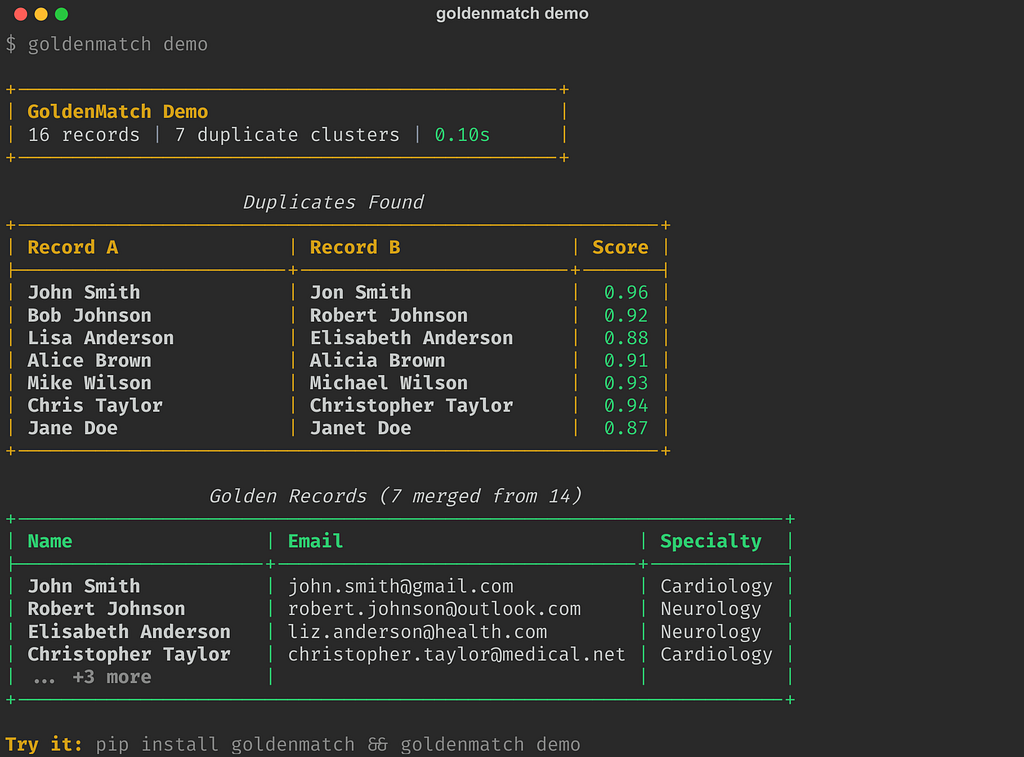
Entity resolution — finding records that refer to the same real-world entity — is one of the oldest problems in data management. And for structured data (names, addresses, phone numbers), we’ve largely solved it. Modern fuzzy matching algorithms routinely achieve 95%+ accuracy.
Product data is a different story.
THE PRODUCT MATCHING PROBLEM
Consider matching these two records:
Source A: “Sony Cyber-shot DSC-T77 Silver”
Source B: “Sony — Cyber-shot 10.1-Megapixel Digital Camera — Silver”
A human instantly recognizes these as the same product. But for an algorithm, the token sort ratio is 0.72, Jaro-Winkler gives 0.81, and embedding cosine similarity is 0.83. All borderline. None confident.
The fundamental issue: product names encode different information across sources. One includes the model number, the other includes megapixels. They describe the same thing using different words.
Traditional approaches hit a wall:
Fuzzy matching alone gets 37% F1 on the Abt-Buy benchmark.
Embedding + ANN retrieval gets 44.5% F1 — better recall, but precision drops to 35%.
Cross-encoder reranking gets 42% F1 — marginal improvement.
Fine-tuned classifier gets 58.7% F1 — but needs labeled data you don’t have.
THE THREE-TIER LLM APPROACH
What if we let fuzzy/embedding matching handle the easy cases and only call an LLM for the hard ones?
In GoldenMatch v0.3.0, I implemented a three-tier scoring system:
Tier 1 — Auto-accept (score >= 0.95). These are near-identical records. No LLM needed. Score set to 1.0.
Tier 2 — LLM judge (score 0.75–0.95). These are the borderline pairs where fuzzy/embedding matching isn’t confident. Send them to GPT-4o-mini with a simple prompt: “Are these the same entity? YES or NO.”
Tier 3 — Auto-reject (score < 0.75). Too different to be matches. Keep original score. The pipeline filters them out.
THE RESULTS
The Abt-Buy dataset has 1,081 products from Abt.com and 1,092 from Buy.com, with 1,097 known matching pairs.
Using embedding + ANN blocking (sentence-transformers all-MiniLM-L6-v2, top-20 candidates per record):
Without LLM: 35.5% precision, 59.4% recall, 44.5% F1.
With LLM (GPT-4o-mini): 95.4% precision, 50.9% recall, 66.3% F1. Cost: $0.04.
The breakdown:
- 1,836 candidate pairs from embedding blocking
- 79 auto-accepted (score >= 0.95)
- 1,757 sent to LLM in 88 batches of 20
- Total cost: $0.0364 (less than 4 cents)
- Precision jumped from 35.5% to 95.4%
WHY THE LLM WORKS HERE
The LLM isn’t finding matches that fuzzy matching missed. Recall actually drops slightly (59.4% to 50.9%) because the LLM rejects some true matches it’s uncertain about.
What the LLM excels at is rejecting false positives.
When an embedding says “Sony Cyber-shot DSC-T77” and “Sony Cyber-shot DSC-T700” are 87% similar, a fuzzy matcher accepts both. The LLM reads the model numbers and knows T77 is not T700.
This is the right division of labor:
Embeddings for recall — cast a wide net, capture semantically similar records.
LLM for precision — apply reasoning to reject the ones that look similar but aren’t the same.
BUDGET CONTROLS
Real-world datasets can have millions of candidate pairs. Without controls, LLM scoring costs could be unpredictable.
GoldenMatch’s budget system lets you set a hard cap:
llm_scorer:
      enabled: true
      model: gpt-4o-mini
      budget:
        max_cost_usd: 5.00
        max_calls: 500
The BudgetTracker estimates token costs before each batch, records actual usage from API responses, and stops when the budget is exhausted. Remaining candidate pairs keep their fuzzy scores — graceful degradation, not a crash.
For the Abt-Buy dataset, a budget of $0.05 covers everything. For a 100K record product catalog, you’d likely need $1–5 depending on the number of candidate pairs.
You can also configure model tiering — use GPT-4o-mini for most pairs and escalate to GPT-4o only for the hardest cases (score 0.80–0.90), with a cap on what percentage of the budget goes to the expensive model.
STRUCTURED DATA IS ALREADY SOLVED
On the DBLP-ACM bibliographic benchmark (4,910 records, 2,224 known matches), pure fuzzy matching with Jaro-Winkler + token sort + multi-pass blocking achieves 97.2% F1. No embeddings needed. No LLM needed. Cost: $0.
For names, addresses, and other structured fields, the combination of good scorers + good blocking is enough. The LLM approach shines specifically for product data, company names, and other domains where the same entity gets described in fundamentally different ways across sources.
THE BIGGER PICTURE
This approach works because LLMs are becoming cheap enough to use as a component in data pipelines, not just as chat interfaces. GPT-4o-mini at $0.15 per million input tokens means scoring 1,700 product pairs costs less than a cup of coffee.
The key architectural insight: don’t replace your matching pipeline with an LLM. Use the LLM as a precision filter on top of cheap statistical matching. You get the recall of embeddings and the precision of human judgment, at a cost that scales linearly with the number of borderline pairs.
GoldenMatch is open source (MIT license) and available on PyPI:
pip install goldenmatch
GitHub: github.com/benzsevern/goldenmatch
It includes the LLM scorer, Fellegi-Sunter probabilistic matching, learned blocking, plugin architecture, connectors to Snowflake/Databricks/BigQuery/HubSpot/Salesforce, streaming mode, and multi-table graph entity resolution. 792 tests passing.
FULL BENCHMARK RESULTS
DBLP-ACM (bibliographic, 4,910 records): Weighted fuzzy — 97.2% F1, 1.2 seconds
DBLP-Scholar (bibliographic, 66,879 records): Multi-pass fuzzy — 74.7% F1, 109 seconds
Abt-Buy (product, 2,173 records): Embedding + LLM — 66.3% F1, $0.04
Amazon-Google (product, 4,589 records): Embedding + ANN — 40.5% F1
The structured data story (97.2% F1) is already strong. The product data story is improving — and the LLM scoring approach is the most promising direction I’ve seen for closing that gap further.
Using GPT-4o-mini as an Entity Resolution Judge: 95% Precision for $0.04 was originally published in Towards AI on Medium, where people are continuing the conversation by highlighting and responding to this story.