Understand Machine Learning, NLP, Computer Vision, and Generative AI with simple explanations and real-world examples
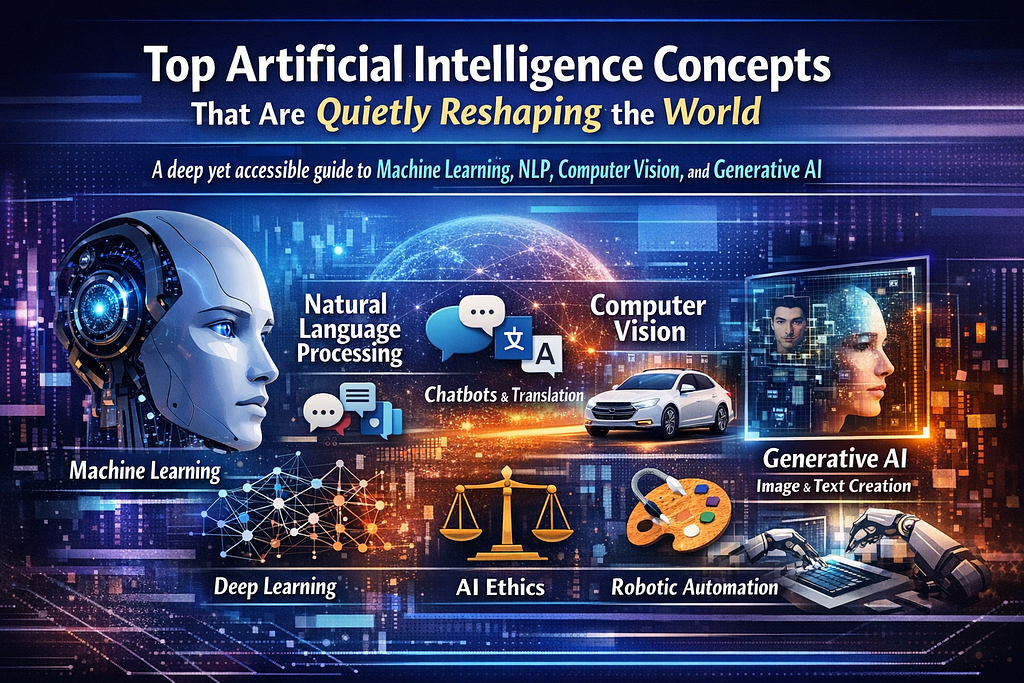
Artificial Intelligence is often described as the new electricity, but that comparison only captures part of the story.
Electricity powered machines. AI powers decisions.
What makes AI fundamentally different from previous technological shifts is not just automation, but cognition. Systems today are no longer limited to executing predefined instructions. They are learning patterns, adapting to new data, generating original content, and in many cases, outperforming humans in narrow domains.
From banking systems that detect fraud in milliseconds to healthcare models that assist in early diagnosis, AI is now embedded into critical infrastructure. And yet, despite its widespread impact, most discussions around AI remain either too technical or too superficial.
To truly understand AI, one must look beyond buzzwords and focus on the core concepts that drive these systems.
This article breaks down Ten foundational AI concepts, not as isolated definitions, but as interconnected capabilities that together form the backbone of modern intelligent systems.
1. Natural Language Processing (NLP)
Natural Language Processing focuses on enabling machines to understand, interpret, and generate human language in a meaningful way.
It deals with challenges such as ambiguity, context, intent, sentiment, and linguistic structure. Modern NLP systems rely heavily on transformer-based architectures that capture relationships between words in context rather than in isolation.
Examples
- Customer Support Chatbots :- Organizations deploy NLP-based chatbots to handle customer queries. These systems interpret user intent, extract key information, and provide contextual responses. Over time, they improve using interaction data.
- Language Translation Systems :- Translation tools analyze sentence structure, grammar, and context to convert one language into another. Unlike earlier rule-based systems, modern NLP models preserve meaning rather than performing word-to-word translation.
- Sentiment Analysis in Social Media:- Companies analyze customer feedback to understand public perception. NLP models classify text as positive, negative, or neutral, helping businesses respond proactively.
- Email Classification Systems :- Email providers categorize messages into primary, promotions, or spam. NLP models analyze subject lines, content, and user behavior to make these decisions.
- Document Summarization Tools :- Long reports or articles are condensed into shorter summaries while preserving key information. This is widely used in legal, research, and corporate environments.
2. Computer Vision
Computer Vision enables machines to extract meaning from images and videos by identifying patterns in pixel data.
It involves tasks such as object detection, image classification, segmentation, and motion tracking. Deep learning models, particularly convolutional neural networks, have significantly advanced this field.
Examples
- Facial Recognition Systems :- Used in security and authentication, these systems identify individuals based on facial features. They compare real-time images with stored data for verification.
- Autonomous Vehicles :- Self-driving systems analyze road conditions, detect obstacles, and interpret traffic signals using visual data from cameras and sensors.
- Medical Imaging Analysis :- AI assists doctors by identifying abnormalities in X-rays, MRIs, and CT scans. It improves diagnostic accuracy and reduces human error.
- Retail Shelf Monitoring :- Stores use computer vision to track product availability and placement. It helps automate inventory management.
- Quality Inspection in Manufacturing :- AI systems detect defects in products during production. This ensures consistency and reduces manual inspection effort.
3. Machine Learning (ML)
Machine Learning allows systems to learn patterns from data and make predictions or decisions without explicit programming.
It includes supervised, unsupervised, and reinforcement learning paradigms, each suited for different types of problems.
Examples
- Spam Detection Systems :- Email providers train models on labeled data to classify messages as spam or not. The system continuously adapts to new patterns.
- Credit Scoring Models :- Financial institutions evaluate loan applications based on historical data, predicting the likelihood of default.
- Recommendation Systems :- Platforms suggest products, movies, or content based on user behavior and preferences.
- Demand Forecasting :- Businesses predict future demand using historical sales data, enabling better inventory planning.
- Customer Churn Prediction :- Companies identify customers likely to leave and take preventive actions to retain them.
4. Deep Learning
Deep Learning is a subset of Machine Learning that uses multi-layered neural networks to model complex patterns.
It excels in high-dimensional data such as images, audio, and text, where traditional ML approaches struggle.
Examples
- Image Recognition Systems :- Deep learning models identify objects within images with high accuracy, enabling applications like photo tagging.
- Speech-to-Text Systems :- These systems convert spoken language into text using deep neural networks trained on audio data.
- Self-Driving Car Perception Systems :- Deep learning models process sensor data to understand the driving environment in real time.
- Medical Diagnosis Models :- Deep learning assists in detecting diseases such as cancer by analyzing complex medical data.
- Handwriting Recognition :- Systems convert handwritten text into digital format, widely used in digitizing historical documents.
5. Reinforcement Learning
Reinforcement Learning focuses on decision-making through interaction with an environment.
The system learns optimal behavior by receiving rewards or penalties based on its actions.
Examples
- Game AI Systems :- AI models learn to play games by exploring strategies and improving through feedback.
- Robotic Control Systems :- Robots learn tasks such as walking or object manipulation through trial and error.
- Dynamic Pricing Models :- Businesses adjust prices based on market conditions and user behavior to maximize revenue.
- Traffic Signal Optimization :- AI systems manage traffic flow by learning patterns and adjusting signals dynamically.
- Recommendation Optimization :- Platforms refine recommendations based on user engagement feedback.
6. Generative AI
Generative AI focuses on creating new content by learning patterns from existing data.
It uses models such as transformers and diffusion models to generate text, images, audio, and more.
Examples
- Content Writing Assistants:- AI generates articles, summaries, and reports based on prompts.
- Image Generation Tools :- Systems create realistic or artistic images from textual descriptions.
- Code Generation Systems :- Developers use AI to generate code snippets, improving productivity.
- Music Composition Tools :- AI creates original music based on style and input parameters.
- Synthetic Data Generation :- Organizations generate artificial datasets for training models while preserving privacy.
7. Expert Systems
Expert Systems replicate decision-making processes using predefined rules and knowledge bases.
They are particularly useful in domains where knowledge can be structured explicitly.
Examples
- Medical Diagnosis Systems :- These systems suggest possible conditions based on symptoms and medical rules.
- Loan Approval Systems :- Banks use rule-based systems to evaluate applications against predefined criteria.
- Legal Advisory Tools :- AI provides guidance based on legal rules and precedents.
- Fault Diagnosis Systems :- Industries use expert systems to identify equipment failures.
- Tax Calculation Systems :- Software applies tax rules to calculate liabilities accurately.
8. Speech Recognition
Speech Recognition converts spoken language into text, enabling voice-based interaction.
It involves acoustic modeling, language modeling, and signal processing.
Examples
- Voice Assistants :- Users interact with devices using voice commands for tasks like setting reminders or searching information.
- Call Center Transcription :- Conversations are transcribed in real time for analysis and record-keeping.
- Voice Search Systems :- Users perform searches using voice instead of typing.
- Dictation Software :- Professionals use voice input to create documents efficiently.
- Accessibility Tools :- Speech recognition helps individuals with disabilities interact with technology.
9. AI Ethics
AI Ethics ensures that AI systems are fair, transparent, accountable, and aligned with societal values.
It addresses issues such as bias, privacy, and explainability.
Examples
- Bias Detection in Hiring Systems :- AI tools are evaluated to ensure they do not discriminate against candidates.
- Explainable AI in Healthcare :- Doctors require transparent models to understand AI-driven decisions.
- Data Privacy Compliance :- Organizations ensure user data is handled responsibly.
- Fair Lending Practices :- Financial models are monitored to avoid discriminatory outcomes.
- Content Moderation Systems :- Platforms ensure fair and unbiased enforcement of policies.
10. Robotic Process Automation (RPA)
RPA automates repetitive, rule-based digital tasks using software bots.
When combined with AI, it enables intelligent automation.
Examples
- Invoice Processing Systems :- Bots extract data from invoices and update accounting systems automatically.
- Employee Onboarding Automation :- HR processes such as document verification are automated.
- Data Entry Automation :- Repetitive data input tasks are handled by bots, reducing errors.
- Report Generation Systems :- Automated tools generate daily or weekly reports without manual effort.
- Claims Processing in Insurance :- RPA systems handle claims verification and processing efficiently.
Final Thoughts
Artificial Intelligence is not a single technology. It is an ecosystem of ideas working together.
Each concept you have seen here plays a specific role, but their true power emerges when they are combined. A voice assistant, for example, uses speech recognition, NLP, machine learning, and sometimes even reinforcement learning in a single interaction.
Understanding these building blocks gives you a different perspective. You stop seeing AI as magic and start seeing it as a system of design choices, trade-offs, and possibilities.
That shift in perspective is powerful.
Because once you understand how these systems work, you begin to think differently. You start identifying opportunities, questioning assumptions, and building solutions that are grounded in both logic and creativity.
If you found value in this, I would really appreciate your support. A like helps this reach more people, a comment starts meaningful conversations, and a share can help someone else who is trying to understand AI but does not know where to start.
If you enjoy content that simplifies complex concepts into practical insights, consider following me. I am consistently working on breaking down data science, AI, and real-world systems in a way that is useful, relatable, and easy to apply.
Top Artificial Intelligence Concepts That Are Quietly Reshaping the World was originally published in Towards AI on Medium, where people are continuing the conversation by highlighting and responding to this story.