“Sorry, I thought that was not mine.”
In nineteen years across PeopleSoft, Oracle, and Workday implementations, I have heard this sentence more times than I can count. Not from bad people. Not from incompetent teams. From experienced professionals doing exactly what they were supposed to do, who genuinely believed someone else owned the gap.
The technology worked. The teams worked. The project plan existed. The RACI was signed. And yet, somewhere between the vendor, the systems integrator, and the client, a seam opened up. Quietly. Without a single alert.
Not just at go-live. At every major deliverable. Configuration sign-off. Integration testing. Parallel run. Data migration. Each milestone carries the same silent risk, a gap between teams that nobody named, nobody owned, nobody governed.
It is a governance problem. Every team member owns a piece of it, with the project manager holding the governing responsibility to ensure no seam goes unwatched.
The Pattern Nobody Has Named
In nineteen years of ERP implementations, the industry has developed sophisticated answers to almost every technical challenge. Certification programs. Implementation accelerators. Partner ecosystems. Governance frameworks.
Yet one pattern persists, across platforms, across industries, across organization sizes. It survives methodology changes, tool upgrades, and team restructuring.
The Standish Group CHAOS Report finds that only 31% of IT projects are deemed fully successful, consistently identifying ownership clarity and communication as the primary differentiators. What it does not specify is where that communication breaks, or why it breaks at the same point repeatedly.
PMI’s Pulse of the Profession identifies poor communication as a contributing factor in 56% of failed projects. What the research identifies is the symptom. What it does not map is the anatomy, the specific seam where ownership dissolves and accountability evaporates.
The industry has named the symptom. It has not named the cause.
The Silent Handshake is the cause. It is the failure that lives in the white space between teams, the boundary between two workstreams, two responsibilities, that everyone assumes is being watched and nobody is actually watching.
It has three distinct failure layers. They are consistent. They are predictable. And with the right governance model, they are entirely preventable.
The Silent Handshake Framework
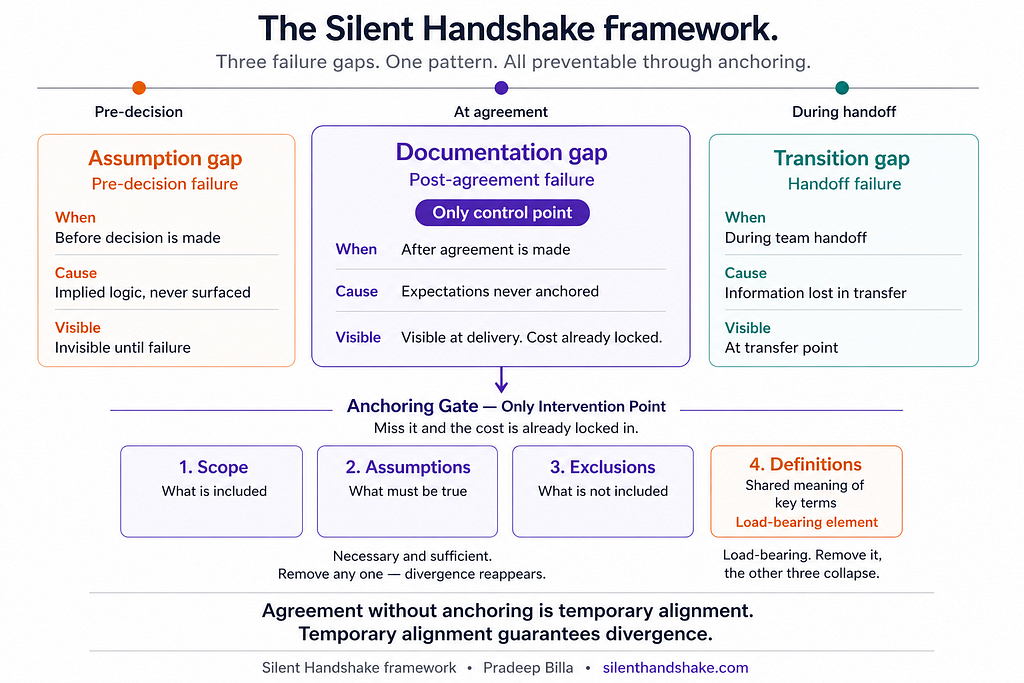
The failure cascade moves in a fixed sequence:
Layer 1: Transition Gap. Knowledge leaves with the person.
Layer 2: Assumption Gap. Each party checks their own box.
Layer 3: Documentation Gap. Agreement is reached. Nothing is anchored.
Result: Deliverable failure at the seam, not within the team.
What often appears as a priority issue is the downstream effect of unanchored sequencing assumptions. It is a symptom, not a layer.
After nineteen years of observing this pattern across ERP platforms and implementation types, I have identified three distinct failure layers. They rarely appear in isolation. More often, one triggers the next, a cascade that is invisible until a deliverable breaks.
Layer 1: The Transition Gap
Someone leaves. Mid-project, mid-workstream, mid-deliverable. It happens in every long-cycle implementation, attrition, promotion, reassignment, resignation. The organization moves on. The project does not pause.
What follows is rarely a formal handoff. More often it is an assumption, that the departing team member documented their work, that the receiving team member will ask the right questions, that the project manager will flag the risk. None of those assumptions are validated. The knowledge walks out the door. The gap opens silently.
The most dangerous version of the Transition Gap is when the role is filled. A replacement is hired. The org chart shows no vacancy. The project plan shows no risk. But the transition never happened formally. The new person inherited the title, not the context. They are executing against a version of the project that is already several decisions behind.
The org chart shows continuity. The project shows none.
Layer 2: The Assumption Gap
Every ERP implementation involves multiple parties, vendor, systems integrator, client. Each has a workstream. Each has an owner.
What nobody owns is the seam between workstreams.
The vendor delivers. The SI receives. The client validates. Except, who confirmed the handoff actually happened? Who verified the right version reached the right person at the right stage? In the Assumption Gap, each party checks their own box and moves forward. The gap lives in the white space of the RACI, assigned to nobody because it belongs to the boundary, not the task.
The handshake happened in theory. In practice, both hands were never in the same room.
Layer 3: The Documentation Gap
This layer is the most subtle and the most expensive. Every team is working. Nobody is idle. The project dashboard is green. And yet the decision made in last week’s meeting is already drifting.
The Documentation Gap opens at the moment of agreement. Both parties reached the same conclusion. Neither wrote it down in a way the other could check against. The vendor executes against what they understood. The client expects what they meant. Those two versions of the same decision diverge silently over the following weeks, invisible until delivery forces a comparison.
What appears on the surface as a sequencing problem, teams working out of order, priorities misaligned, downstream work built on stale assumptions, is almost always the Documentation Gap in its later stage. The sequencing broke because the agreement was never anchored. The priority conflict is a symptom. The unanchored decision is the cause.
Together these three layers form the Silent Handshake, a governance failure shared across every team and governed by none until someone makes seam ownership, and agreement anchoring, an explicit, tracked, non-negotiable responsibility. The Documentation Gap will be examined in full in Part 2 of this series.
The Pattern in Practice
In 1999, Hershey’s SAP go-live failed during peak Halloween season, a widely documented case where three simultaneous workstreams, each executing correctly, produced a sequencing failure nobody governed until $100M in revenue was at risk. The root cause was not conflicting priorities. It was unanchored assumptions about the order of operations, a Documentation Gap at scale.
The same anatomy appears in implementations a fraction of that scale.
Consider a mid-size Workday implementation, standard timeline, experienced teams. By mid-configuration, mood was cautiously optimistic. Discovery complete. Architecture decided. Everyone executing.
That is exactly when the Silent Handshake opened.
A client-side integration owner responsible for receiving vendor configuration updates left the organization. A replacement was hired within weeks. On the surface, the gap was closed. In practice, the transition had never happened, no formal handoff, no documentation of vendor touchpoints, no introduction to the SI counterpart. The new team member was executing against an onboarding briefing that was already several decisions behind the live project.
The vendor issued an updated integration configuration, routine mid-project revision, to the contact they had always used. Box checked. The SI continued testing against the configuration received during discovery. Nobody told them an update existed. They had no reason to ask.
Three teams. All working. All checking their own boxes. The seam between them, the handshake point the departed employee had owned, was watched by nobody.
Go-live day: first transactions failed. Root cause identified in under an hour. Recovery complicated by the Documentation Gap in the response itself. Vendor, SI, and client each executed their own recovery sequence against their own understanding of what had gone wrong. Nobody had anchored the recovery plan. Three days of delay that could have been three hours.
The diagnosis is exact.
Transition Gap: the departing employee owned the vendor touchpoint. The replacement inherited the title, not the context. Ownership was never verified.
Assumption Gap: the vendor confirmed delivery to a contact who no longer existed in the project. The SI assumed continuity. Nobody verified the seam.
Documentation Gap: the updated configuration, the recovery sequence, and the dependency between them were never written down and confirmed across all three parties. Each team executed against their own version of the same situation.
Three layers. One departure. Months of invisible risk. This is not an edge case. It is the Silent Handshake.
What Each Party Must Do Differently
For consultants. You were hired to implement. The Silent Handshake is not in your SOW. That does not make it your client’s problem alone. It makes it invisible until it becomes everyone’s problem including yours.
Map the handshake points explicitly in every project kickoff, vendor to SI, SI to client IT, client IT to client HR, client HR to business owners. Name who owns each seam. Not the team. The person. When attrition happens mid-project, and it will, trigger an immediate handshake audit. Do not wait for the project manager to flag it. You will see it first.
For implementation leaders. Your RACI assigns tasks. It does not assign seams. That is the gap.
Add a Handshake Register to your governance model, a living document that maps every transition point, names the owner on each side, and tracks the last confirmed exchange. Review it in every steering committee. Not the tasks. The seams. When a team member leaves mid-project, treat it as a project risk requiring immediate escalation and formal knowledge transfer, before the replacement starts, not after.
In my implementations, I address this by introducing a Handshake Register at project initiation, a dedicated governance artifact that explicitly maps every seam between workstreams, names a responsible owner on each side, and tracks the last verified exchange at every major milestone. It is not a status report. It is not a RACI extension. At minimum, it tracks: seam owner on both sides, last confirmed exchange date, and next dependency. Projects that explicitly govern seams surface failures earlier and reduce late-stage surprises, before they reach go-live, before they become war stories in a lessons learned meeting.
For clients. Your internal attrition is an implementation risk, not eventually, immediately.
When someone leaves mid-project, the first call is not to HR. It is to your project manager and SI lead. The question is not “who will cover their work.” The question is “what handshake points did they own, and who owns them now.” Do not assume your vendor or SI will catch what your team dropped. They are watching their own seams. Nobody is watching yours unless you assign it explicitly.
Why AI Accelerates the Silent Handshake
The ERP ecosystem has never been more capable. Faster configurations. Deeper partner ecosystems. Higher certification standards.
And yet AI is not solving the Silent Handshake. It is accelerating it.
Here is the mechanism, layer by layer.
AI-assisted onboarding tools give replacement team members faster ramp-up, without transferring the relational and contextual knowledge that the departing employee carried. The Transition Gap closes on paper faster than ever. The knowledge gap underneath it widens.
Automated delivery confirmations, AI-generated acknowledgements, workflow triggers, system notifications, create the appearance of a completed handoff without human verification that the right artifact reached the right person at the right stage. The Assumption Gap now has a paper trail. The seam is still unowned.
AI project dashboards synthesize status across workstreams and surface what each team reports as their priority. They do not surface the gap between what was agreed and what was anchored. The Documentation Gap becomes invisible precisely because the tooling makes every team look aligned.
Automation removes human checkpoints. Human checkpoints were imperfect. They were also the moments when someone noticed the seam.
The Silent Handshake has always been a governance problem. In an AI-assisted implementation environment, it becomes a governance problem with fewer natural detection points. That is not a reason to slow AI adoption. It is a reason to govern the seams more deliberately, with more explicit ownership, more rigorous handshake registers, more human verification at boundaries, than any implementation methodology currently requires.
I have documented this pattern across nineteen years of ERP implementations. The Silent Handshake is not going away. But it is nameable, trackable, and governable, if someone in the room decides to own it.
The industry has named the symptom. It has not named the cause.
Now it has a name. And once you see it, you will not unsee it.
If you have seen it, you have experienced the Silent Handshake.
It has a different name in every lessons learned meeting.
What did your team call it?
This article is part of the Silent Handshake series, examining the failure anatomy of ERP and Workday implementations. The Silent Handshake framework maps the gaps that open between teams, phases, and assumptions in enterprise technology projects, in the space where existing project failure models do not look. silenthandshake.com
References:
1. Project Management Institute. Pulse of the Profession 2023: Power Skills. PMI, 2023.
2. Standish Group. CHAOS Report 2020. The Standish Group International, 2020.
3. Budzier, Alexander, and Bent Flyvbjerg. “Why Your IT Project May Be Riskier Than You Think.” Harvard Business Review, September 2011.
The Silent Handshake: Why ERP Deliverables Break Between Teams, Not Within Them was originally published in Towards AI on Medium, where people are continuing the conversation by highlighting and responding to this story.