Why the real engineering challenge is context, not chips — and what it means for how we build AI agents today
By Dharani Eswaramurthi, Lead AI Engineer at aXtrLabs
When supply chain analyst Ming-Chi Kuo posted that OpenAI is building a smartphone — not a ChatGPT shortcut, but a full device with a custom processor co-developed with MediaTek and manufactured by Luxshare — most coverage landed on the hardware angle. Qualcomm’s stock surged 12% on the report. Sam Altman posted that it’s “a good time to seriously rethink the design of operating systems.”
I’m less interested in the stock reaction. I build AI agent pipelines for production systems, and when I read Kuo’s architecture description, I recognized the same constraint I debug in agent systems every week — the context problem.
This article breaks down the actual engineering challenge the OpenAI phone is trying to solve, what Kuo’s leaked hardware specs reveal about the intended architecture, and what it means for practitioners building agents today.
The Core Problem: Apps Don’t Share Context
To understand why this phone matters technically, you need to understand why phone-based AI agents are constrained right now — not by model capability, but by context isolation.
Modern operating systems are built around an application sandbox model. Each app runs in an isolated process, with strict OS-level permissions governing what it can read from other processes. This protects users from malicious apps. It also makes cross-application AI reasoning nearly impossible.
Consider what an AI agent needs to be genuinely useful across a workday: access to your calendar, your email thread, the document you were editing, the message you just received, your location, and your recent search history — all simultaneously, in a single context window. On iOS or Android, accessing even two of these from a third-party app requires explicit user permissions for each. Reading them in real time requires background execution privileges most apps don’t get.
The result: every “AI assistant” on existing phones is a series of isolated tool calls with no persistent cross-application state. The model has to pretend it knows your context. It doesn’t. It reconstructs a shallow version on each invocation.
This is the exact same problem I encounter when building enterprise agent pipelines. The hardest part is never the model — it’s getting all relevant context into the model’s window before inference runs. The difference is that on a server, I can stitch APIs together. On a phone, the OS architecture prevents it at a fundamental level.
What Kuo’s Architecture Description Actually Means
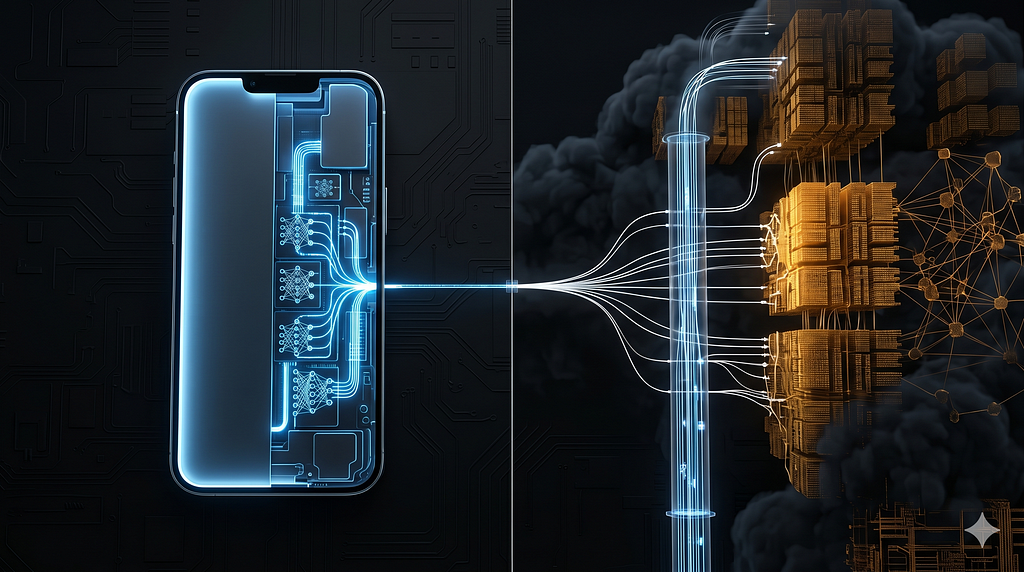
The technical detail in Kuo’s report that matters most is this: the device would maintain a “full real-time state” — continuously capturing location, activity, communication, and environmental context — while using a hybrid architecture that processes lighter workloads on-device and offloads complex inference to the cloud.
This is a well-established pattern in applied AI systems called edge-cloud hybrid inference, and it maps directly onto how production agent pipelines are architected when you need both low latency and high reasoning quality.
Here’s how the two-tier pattern works in practice:
On-device (edge) layer:
- Lightweight embedding models for semantic routing
- Context capture and compression
- State management and short-term memory
- Intent classification (is this a simple lookup or a multi-step task?)
- Sensor fusion (location, activity, audio environment)
Cloud layer:
- Large language model inference for complex reasoning
- Multi-step agent orchestration
- Long-context retrieval-augmented generation
- Tool execution across external APIs
The reason this split matters on a mobile device is power efficiency. Continuous inference on a 3B+ parameter model would drain a smartphone battery in under two hours. Routing decisions and context capture using a 100M–500M parameter on-device model costs a fraction of that energy while keeping the experience responsive.
Kuo’s updated report — revised from the initial 2028 target to 1H 2027 for mass production — also revealed specific hardware choices that confirm this architecture is real:
- Processor: Customized MediaTek Dimensity 9600 on TSMC’s N2P node (sub-2nm class process)
- Compute topology: Dual-NPU architecture for heterogeneous AI compute (handling vision and language tasks simultaneously without resource contention)
- Memory: LPDDR6 + UFS 5.0, addressing the memory bandwidth bottleneck that currently limits on-device LLM performance
- Security: pKVM + inline hashing, isolating the agent’s persistent state from other processes
The dual-NPU design is particularly significant. It allows the device to run a vision model (for environmental awareness) and a language model (for reasoning) on separate silicon simultaneously — something current single-NPU architectures handle serially, introducing latency spikes.
The On-Device AI Landscape in 2026
It’s worth grounding this in what current hardware already does, because the OpenAI phone is not starting from zero.
Qualcomm’s Snapdragon 8 Elite Gen 5 delivers 37% faster AI processing than its predecessor and already ships with a personal knowledge graph and continuous context awareness through an upgraded sensing hub. MediaTek’s Dimensity 9500 matches Qualcomm and Apple in CPU performance at lower cost with better efficiency at mid-range price points.
In 2025, Qualcomm demonstrated OpenAI’s gpt-oss-20b reasoning model running natively on Snapdragon processors — a model with 20 billion parameters executing on-device. The memory bandwidth to run models of this scale locally now exists in production silicon.
The gap that remains is not compute — it is OS-level access. Running a capable model on-device while being unable to read your calendar or monitor your messages in the background produces an expensive offline assistant that still can’t act on your behalf.
This is the constraint only a custom OS can remove.
The Permission Problem Is Architectural, Not Incremental
Apple Intelligence, Google Gemini, and Samsung’s Galaxy AI have all run into the same ceiling: they are powerful models operating under OS constraints designed for apps, not agents.
An agent differs from an app in one critical way: an agent needs persistent, proactive state access. An app reads data when you open it. An agent reads data continuously so it can act before you ask.
On iOS, background execution is tightly throttled. On Android, Doze mode and battery optimization aggressively kill background processes. Both decisions were made for sound reasons — battery life and privacy. Both decisions make persistent agent operation structurally impossible without first-party OS access.
Kuo’s argument is that “only by fully controlling both the operating system and hardware can OpenAI deliver a comprehensive AI agent service.” This isn’t a marketing position. It is a correct diagnosis of a real systems constraint. The permission model that protects users from malicious apps is architecturally identical to the permission model that prevents agents from operating as designed.
The only paths forward are: (1) Apple and Google grant first-party agent frameworks levels of OS access they currently deny to third parties, or (2) a new OS is built without those constraints from the start.
What the Humane Pin and Rabbit R1 Got Wrong
The comparison to failed AI devices is legitimate but often made imprecisely.
The Humane AI Pin failed for two reasons: it had no display, and it had no persistent OS context. Every interaction was stateless. The model had no idea what you’d done five minutes earlier. It also had severe latency problems because all inference was cloud-side with no on-device routing.
The Rabbit R1 failed because it tried to abstract over existing app UIs using a Large Action Model trained on screen interactions rather than building OS-level integrations. The approach was fragile and slow.
The architecture Kuo describes avoids both failure modes. On-device inference handles routing and state without cloud latency. OS ownership means direct API-level access rather than UI scraping. The comparison is not equivalent.
The relevant risk for the OpenAI phone is different: consumer trust and developer ecosystem. An agent that continuously captures location, communications, and activity is the most surveillance-capable consumer device ever built. That is not a paranoid reading — it is what the “full real-time state” feature literally requires. OpenAI has had a complicated several years on the trust front, and this device will test that relationship at scale.
Implications for Agent Engineers Building Today
If you’re building agent systems now, here’s what this development signals:
The context window management problem is the central problem in agent engineering. Whether you’re building on LangChain, LangGraph, or raw API calls, the bottleneck is not model intelligence — it is getting the right context into the model’s window at the right time. Systems that solve this well (hierarchical memory, semantic retrieval over long-term state, efficient context compression) are the ones that will map cleanly onto agent-native hardware when it ships.
Edge deployment matters more than it did two years ago. The on-device inference trend is not speculative. Qualcomm, MediaTek, and Apple Silicon are all investing heavily in NPU performance specifically for LLM workloads. If your agent architecture assumes cloud-only inference, you are building a system that will require significant re-architecture within two to three years.
OS-level integrations will become a competitive moat. The developers who are building agents with deep calendar, email, and communication integrations today — through Google Workspace APIs, Microsoft Graph, and similar — are building the muscle memory for agent architectures that a native OS will eventually enable without permission negotiation.
The app paradigm is ending, not today, but directionally. The shift from apps as primary interface to agents as primary interface is a platform transition of the same magnitude as mobile displacing desktop. Platform transitions do not happen overnight, but they are obvious in hindsight. The question for engineers is not whether to prepare — it is how far ahead to build.
Conclusion
The OpenAI phone is not primarily a hardware story. It is an attempt to solve an OS-level constraint that prevents AI agents from operating as designed on existing mobile platforms.
The edge-cloud hybrid architecture Kuo describes is technically sound and maps to patterns already proven in production agent systems. The hardware specs — dual-NPU, LPDDR6, TSMC N2P node — confirm this is engineering reality, not a concept. The revised production timeline of 1H 2027 suggests the project is moving faster than initially projected.
What remains genuinely uncertain is not the architecture, but the trust question. A device that operates as intended requires continuous, comprehensive context capture. That is both the feature and the risk. How OpenAI resolves the privacy and trust dimension of that requirement will determine whether this succeeds as a product — independent of whether it succeeds as an engineering achievement.
For engineers building agent systems today, the most useful takeaway is not to wait for the hardware. The problems this phone is designed to solve — persistent context, cross-application state, efficient hybrid inference — are the same problems you are solving in production right now.
References
- Ming-Chi Kuo, TF International Securities — OpenAI smartphone supply chain analysis (April 2026). Reported via TechCrunch and 9to5Mac
- Qualcomm Snapdragon 8 Elite Gen 5 Technical Brief — Hexagon NPU specifications, personal knowledge graph architecture (Qualcomm Developer Network, 2025)
- MediaTek Dimensity 9600 — Architecture overview, dual-NPU design, TSMC N2P process details (MediaTek Developer Resource, 2026)
- Qualcomm acquisition of Edge Impulse (2025) — Strategic significance for on-device AI inference pipelines
- gpt-oss-20b on Snapdragon — Qualcomm on-device LLM demonstration (Qualcomm, 2025)
- Apple OS Permission Model documentation — Background execution, Doze mode, and third-party AI access constraints (Apple Developer Documentation)
- LangGraph Agent Memory Patterns — Persistent state and context management in production agent systems (LangChain Documentation)
Dharani Eswaramurthi is a Lead AI Engineer at aXtrLabs, building LangGraph agent pipelines and RAG systems for production environments. He writes about AI infrastructure, agent architecture, and the technical realities beneath AI product announcements.
The OpenAI Phone Is an Agent Architecture Problem, Not a Hardware Story was originally published in Towards AI on Medium, where people are continuing the conversation by highlighting and responding to this story.