Abacus AI’s Agent Swarms demo’d something this week that most AI discourse completely misses — and it has more to do with how teams work than how models think.
Everyone watching AI in 2026 is waiting for the same thing: the model that finally gets good enough to just do the work.
The assumption underneath that is that progress looks like one increasingly capable brain. Smarter reasoning. Bigger context. Better outputs. And eventually, some threshold gets crossed where you can hand a single model a complex problem and walk away.
Watch six consecutive Agent Swarms demos from Abacus AI, and that assumption starts to look wrong — not because the demos are magic, but because they reveal a more plausible path to the same destination.
What Agent Swarms actually is
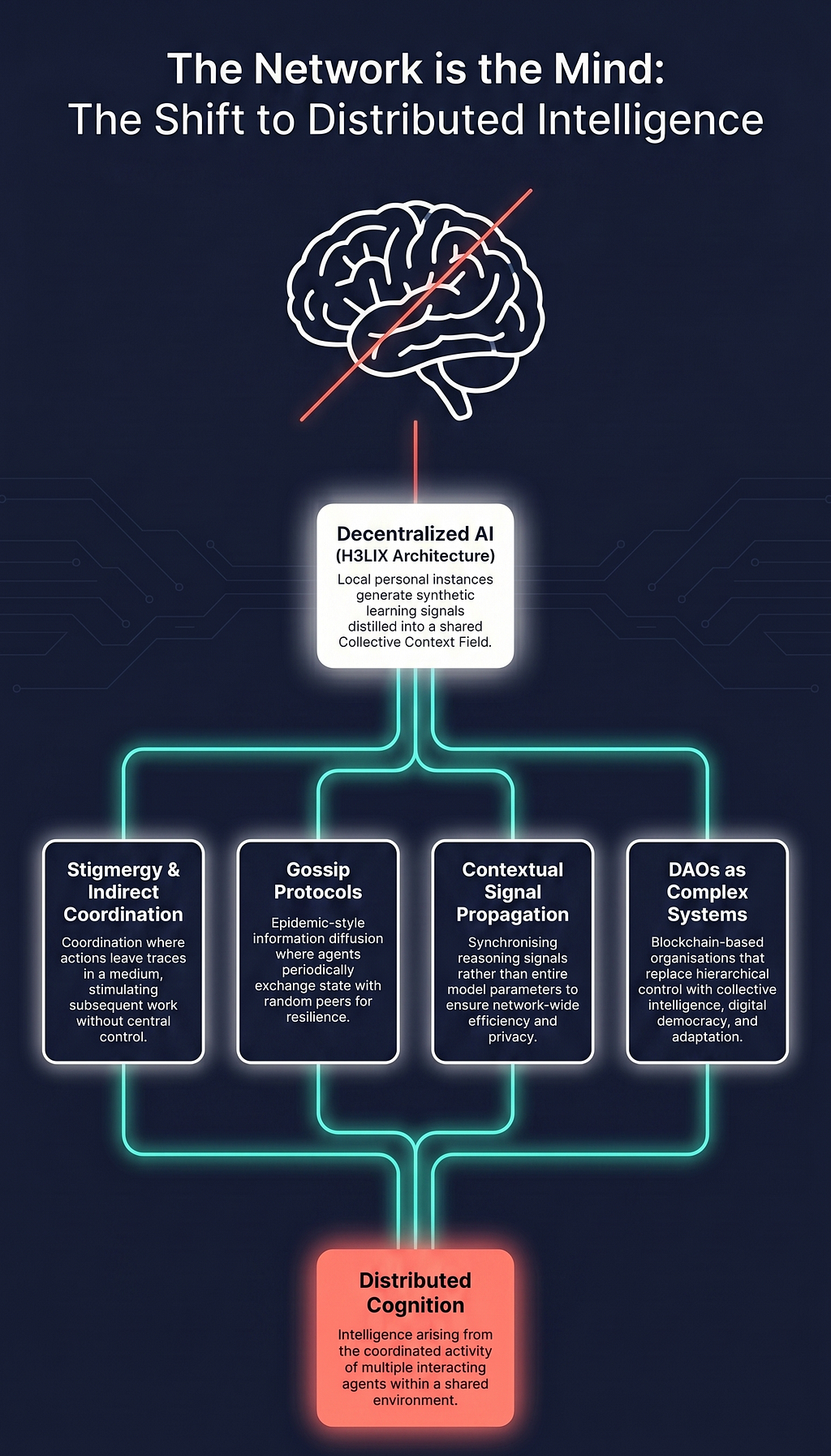
Agent Swarm by Abacus AI is an agentic system that spawns multiple AI agents to work in parallel on complex tasks, generating a plan and executing components concurrently for faster, more complete results.
The mechanic is a hierarchical multi-agent architecture. A master agent takes a prompt, understands the full scope, breaks it into subtasks, maps the dependencies between them, and deploys specialized worker agents to execute. Sometimes in parallel, sometimes in sequence, depending on what needs to exist before the next thing can start.
That description sounds reasonable. The demos are where it gets interesting.
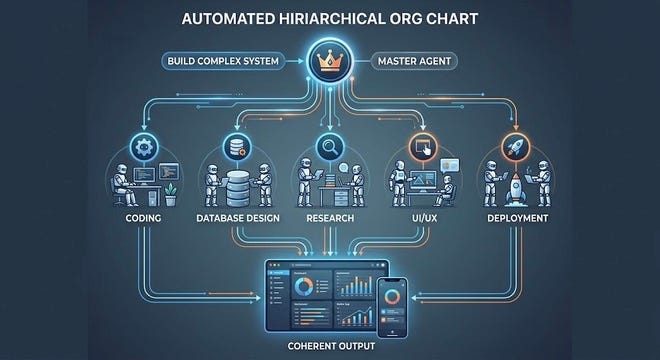
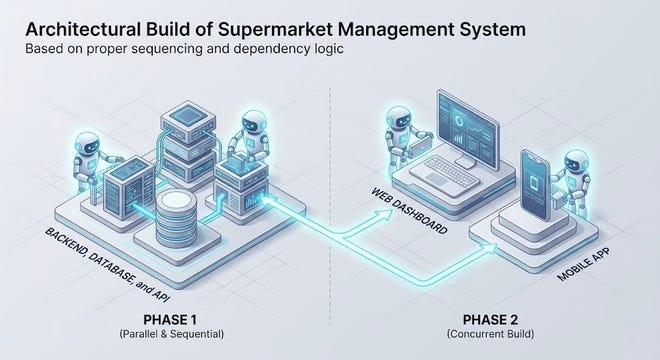
A user asks for a full supermarket management system — web app and mobile app. The system doesn’t start building. It reads the request, understands the scope, and makes a sequencing decision: web app first because the mobile app depends on the backend APIs. So the first worker builds the core platform — backend, authentication, database, business modules. Then a second worker picks up the mobile layer and connects it back into the same system. By the end: a live dashboard, inventory and supplier tools, point of sale flow, a companion mobile app — all drawing from the same backend.
The interesting part isn’t the volume of output. It’s that the build has shape. One thing leads into the next in the right order. The mobile app doesn’t feel bolted on; it feels like a natural extension of the same product. That sequencing — the system understanding which things have to exist before other things can be built — is not something you get by default when you prompt a single model.
Then the McKinsey demo makes an even cleaner case. The request: independent analysis on how AI can improve productivity across seven enterprise functions, with quantified ROI, real-world case studies, risk analysis, and a 20-to-30-slide boardroom presentation. The swarm handles it the way a real team would: seven research agents go out in parallel, one for each business function. A synthesis agent pulls the findings together. A presentation agent converts that into a polished slide deck.
The research has direction while it’s running. Each agent is working its own lane — operational use cases, integration complexity, ROI evidence, adoption risks. By the end: executive summary, maturity heat map, ROI comparisons, roadmap across time horizons, governance framing. That’s not a report that got generated. That’s a report that got organized.
The thing this demo is actually showing you
Here’s the contrarian read: the impressive part of these demos is not the AI capability. It’s the project management.
A senior engineering manager watching these demos isn’t impressed by the code quality, per se. They’re impressed because the system understands something that trips up junior engineers constantly: you can’t build the frontend before the backend API exists. You can’t synthesize a report before the research is done. You can’t run parallel workstreams that need to converge until you’ve defined the convergence point.
Most AI coding and research workflows suffer from the same pattern: the model tackles tasks sequentially. Agent Swarms introduces parallelism — tasks that used to happen one by one can happen concurrently. You get higher-quality outcomes faster because the system maps the dependency graph first.
That’s not a new insight in software engineering. It’s the entire logic behind sprint planning, work breakdown structures, and why companies hire project managers. What’s new is that the system is doing it automatically, from a single prompt, without a human having to map the dependencies.
In the HR platform demo — three simultaneous workstreams, all feeding the same backend — the master agent doesn’t just split the work. It defines the convergence point that makes the whole thing coherent. The portal, the mobile employee app, and the reporting layer are built separately and stay aligned because they’re all drawing from the same source of truth. The reporting agent pulls from live company data. The mobile app reflects the same system as the portal. When the weekly report runs in the terminal, it lands — not because the code works, but because the architecture holds.
In the fintech demo, a user asks for no purple because language models keep defaulting to it. The system carries that constraint through the entire build — both the web dashboard and the mobile app maintain the same visual identity. That’s not a technical capability. That’s context management across parallel workstreams. Keeping a design decision coherent across two simultaneously running agents that never talk to each other directly requires the master agent to have encoded that preference in both task definitions upfront.
That’s the organizational capability. The AI equivalent of a good brief.
Why does this matter more than a smarter model
There’s a version of AI progress where you’re always waiting for the next capability jump. GPT-4 couldn’t do X. GPT-5 can. GPT-6 will do Y. The ceiling keeps rising, and the useful applications follow the capability.
Agent Swarms suggests a different compounding path: what if the limiting factor isn’t model intelligence but task organization? What if the reason AI systems fail on complex work isn’t that they’re not smart enough, but that they’re trying to hold too much in a single context, executing linearly on problems that have parallel structure?
DeepAgent can do impressive work, but users still get better results when they define goals clearly and review outputs thoughtfully. That is not a flaw unique to Abacus AI — it is just how agentic tooling works right now.
That caveat matters. These are demos. The tasks are well-scoped, the prompts are clear, and the outputs are being evaluated by people who understand what they’re looking for. Real work is messier. Ambiguous requirements, legacy constraints, stakeholder inputs that contradict each other — these systems haven’t been stress-tested in that environment at scale.
But the architecture is pointing somewhere real. Agent Swarm represents a shift in how practical AI feels. Instead of asking one model to do everything, you get a swarm that splits the work, runs it in parallel, and synthesizes outcomes into something usable.
The road toward more capable AI may have less to do with one model becoming magically complete and more to do with systems that know how to organize complexity well enough to produce outcomes that hold together. That’s a different kind of progress. It doesn’t require a model breakthrough. It requires better orchestration logic — and orchestration logic is something you can improve incrementally, test reliably, and deploy today.
The uncomfortable question it raises
A full-stack web and mobile app from one prompt. A board-ready strategy deck from a research brief. An HR system with three synchronized workstreams. A CRM with Gmail integration and a mobile field layer.
These are not toy outputs. They’re the first drafts of real deliverables. And they’re arriving not from frontier model releases but from architecture — from a system that knows how to split work, parallelize it, and bring it back together coherently.
The people who should be paying attention aren’t just developers. They’re the SaaS founders building products that do one of these things at a time, over weeks of sprints. They’re the consultants who charge for the McKinsey-style deck that the research-and-synthesis pipeline just produced in a single session. They’re the enterprise software teams whose competitive moat is the complexity of the thing they built , which just got reproduced as a demo in forty minutes.
The question isn’t whether Agent Swarms replaces any of those people today. It doesn’t. The outputs need review, refinement, and real-world validation before they’re production-ready. But the question worth sitting with is: what does this look like in two years, when the model quality improves, the orchestration logic gets tighter, and the prompting patterns get more mature?
Businesses don’t need more AI demos. They need useful systems. The line between “impressive demo” and “useful system” is getting shorter. That’s the development worth tracking.
The Next Big AI Leap Isn’t a Smarter Model. It’s a Better Org Chart. was originally published in Towards AI on Medium, where people are continuing the conversation by highlighting and responding to this story.