Three people left your team this year. None of them were replaced. That is not a coincidence.
Last month, Capital One’s multi-agent AI system handled customer inquiries, flagged compliance issues, updated CRM records, and drafted weekly summaries for over 100 million customers. Not a pilot. Production. Running right now.
Your company probably isn’t Capital One. But your company does use Salesforce. And Salesforce’s AI agents just resolved 83% of enterprise customer queries without a human touching them.
You had a team of 20 doing that work. The math now says you need 4.
Nobody got called into HR. Two people found other jobs. One retired early. One relocated. Nobody replaced any of them. That is not an accident. That is a strategy. And it is already working.
There are two flavors of articles about AI and jobs.
Flavor one: doom. “AI will take 300 million jobs by 2030.” Big number. Zero useful information about what to do. You close the tab feeling anxious.
Flavor two: optimism. “Don’t worry, new jobs will emerge. Focus on uniquely human skills.” This advice has been copy-pasted since steam engines replaced textile workers. It’s not wrong. It’s also not helpful if you need to understand what’s happening in your industry this quarter.
Both miss the real story.
The real disruption isn’t showing up in layoff trackers. It’s showing up in headcount freeze emails. In job requisitions that get quietly canceled two weeks after posting. In junior roles that “won’t be backfilled this cycle.” The CEO of one of the largest enterprise software companies described this shift on a podcast with the calm energy of someone explaining a traffic route. Not a catastrophe. An update.
That tone should be what unsettles you.

Most people still think AI means ChatGPT. Type something, get an answer. That mental model is two years out of date.
Here’s a better analogy. You’re the head chef at a busy restaurant. ChatGPT is the prep cook who gives you brilliant answers when you ask directly. “How do I fix this sauce?” Excellent answer. But you still have to ask, interpret, pick up the pan, and cook.
An AI agent is different. It’s the prep cook who shows up before you arrive, reads tonight’s menu, checks the inventory, identifies what’s missing, places the supply order, preps everything to spec, and sends you a message saying “ready for service” before your first coffee.
One assists. The other executes.
The difference that matters: tools require a human at every step. Agents require a human only to set the goal and review the result. Everything in the middle? Gone.
That middle is where most jobs actually live.
Here is what an agent workflow looks like next to the old way:
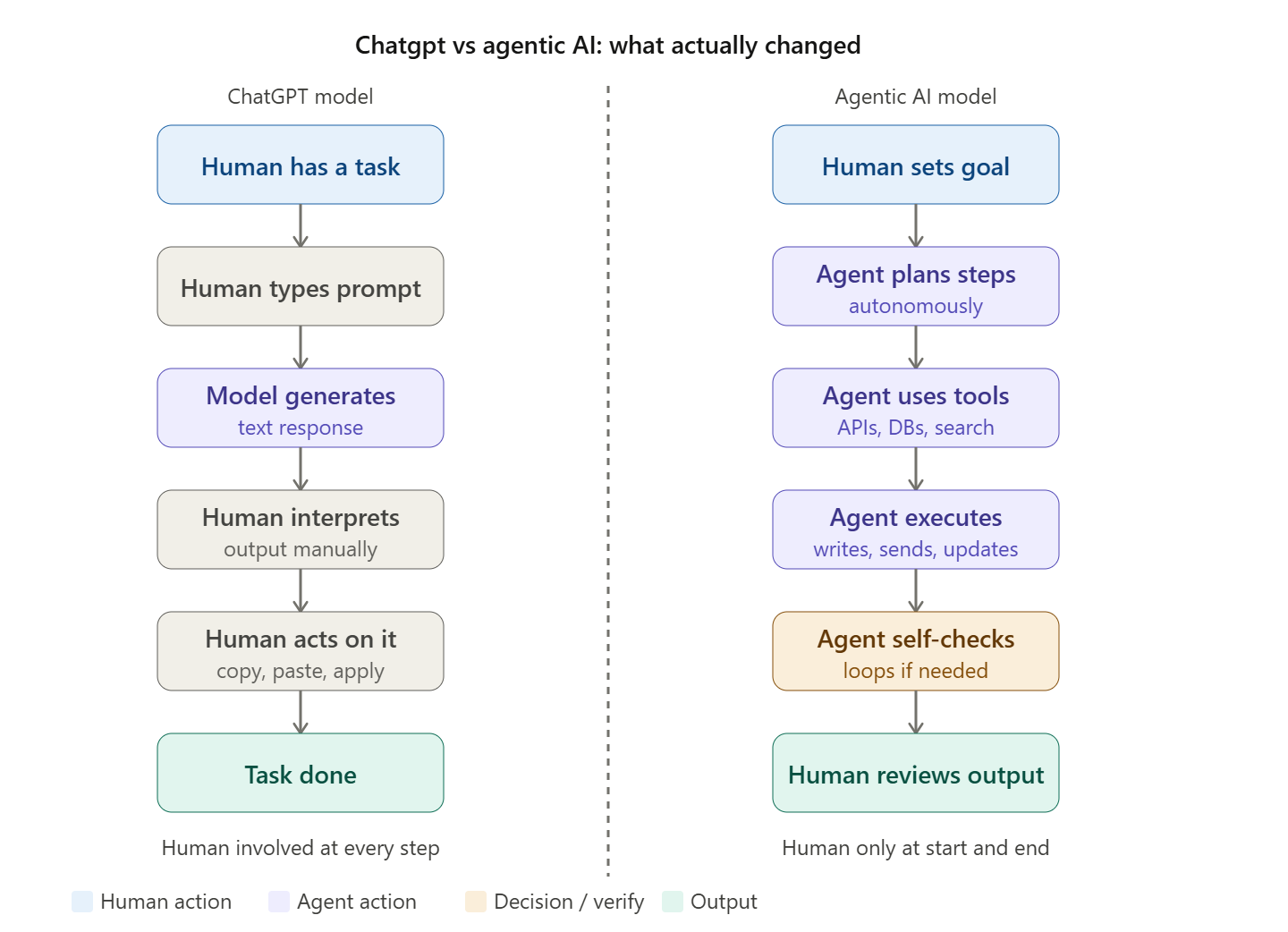
Capital One didn’t build a chatbot. They built a network of agents that plan, act, verify, and loop until the task is complete. Latency dropped fivefold since launch. They keep tuning it. They keep not replacing the people it covers for.
Salesforce’s Agentforce platform processed over 3 billion automated workflows last quarter. Annual recurring revenue from their agentic products crossed $540 million. 6,000 enterprise deals closed. Those are not experiment numbers.
Here’s what’s actually happening, role by role.
Junior developers. Cursor crossed $500 million in revenue in roughly its first year and a half. Not because it makes senior engineers slightly faster. Because it eliminates entire categories of what juniors spent their days on. Boilerplate, refactoring, test coverage, translating specs into working functions. Claude Code autonomously manages codebases and submits pull requests. Companies aren’t firing junior devs. They’re just accepting 60% fewer applications this cycle.
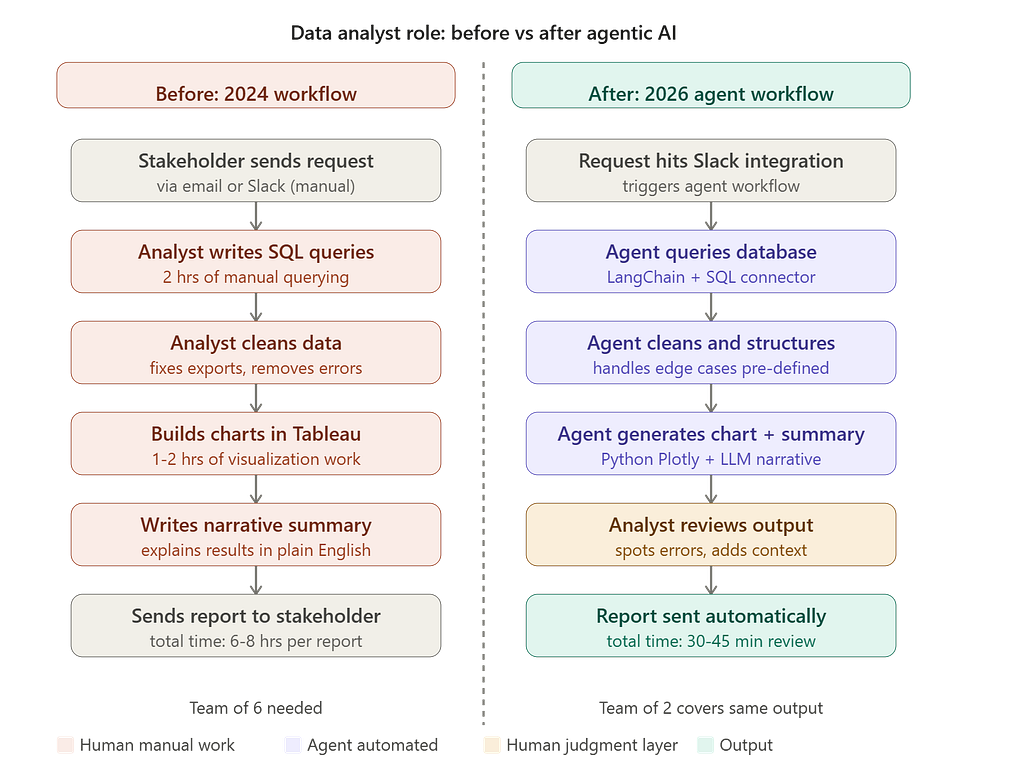
Data analysts. The old workflow: receive a stakeholder question, write SQL, clean the export, build the chart in Tableau, write the narrative, send the report. Eight hours. The new workflow: the agent receives the question via Slack, queries the database, handles edge cases you’ve pre-defined, generates the chart with a Python Plotly connector, writes the summary using an LLM prompt, posts the result. You review in 30 minutes. You don’t need 6 analysts anymore. You need 2 exceptional ones who catch what the agent misses.
Customer service reps. Salesforce’s deployed autonomous resolution rate: 83%. AWS Connect Health deployed 5 AI agents in healthcare in early 2026, handling 1,000 tickets simultaneously. The 17% that escalates to a human comes pre-diagnosed, with account history already pulled and a response already drafted. The human’s job has moved from “figure out and solve” to “approve or adjust one sentence.”
Legal and compliance assistants. Law firms aren’t announcing this in press releases. But document review agents are scanning contracts, flagging risk clauses, and producing summaries in minutes. First-year associate work that used to take 40 hours now takes 20 minutes. The firms aren’t firing associates. They’re accepting fewer applications. The pipeline is narrowing upstream, quietly.
Executive assistants and office coordinators. Scheduling, inbox triage, meeting notes, expense reports, travel booking. Every single one of these is automatable today with tools already on the market. The AI agent market hit $10.91 billion this year. It’s projected to reach $50.31 billion by 2030. The infrastructure is deployed and operational at tens of thousands of companies right now.
This is where 90% of people get stuck. They say “but AI makes mistakes.” It does. A 92% accurate agent handling 500 tasks a day still beats a human handling 60. Accuracy isn’t the variable. Throughput is.
Here’s the thing nobody tells you: the advice circulating on LinkedIn right now is not just incomplete. In some cases it’s genuinely dangerous.
“Learn to prompt ChatGPT.” Sure. So can every other person in your field. Knowing how to talk to a chatbot is now what knowing Microsoft Office was in 2005. It’s the entry requirement. It is not your competitive moat.
I’ve seen this mistake a hundred times. Someone spends three weeks on prompt engineering courses, posts about it on LinkedIn, and thinks they’ve future-proofed their career. They haven’t. They’ve bought themselves maybe 18 months before that skill is table stakes everywhere.
The dirty secret is that the skill gap isn’t about using AI tools at all. It’s about designing workflows where agents operate at the center. That requires systems thinking. It requires understanding what agents can and can’t reliably do. It requires judgment about when a 90% accurate agent is fine for a use case and when it’s genuinely dangerous to deploy.
Most tutorials stop here. Don’t.
And there’s a truth nobody in the “just upskill” camp wants to say: “become an AI engineer” is advice that works for maybe 10% of the workforce. The 42-year-old paralegal with 15 years of domain expertise and a mortgage cannot just “pivot to building LangChain pipelines in Python” based on a Medium post. Telling them to upskill without a specific, realistic, time-bound path is not help. It’s a way of sounding helpful while saying absolutely nothing useful.
Let me make this concrete. You’re a data analyst at a mid-size e-commerce company.
2024 version of your Monday morning: six stakeholder requests in your inbox. Two hours writing SQL. Ninety minutes cleaning a messy payment export that always has formatting quirks. Two hours in Tableau building charts. One hour writing summaries for business leaders who don’t speak data. Send. Start the next three. Repeat Wednesday and Friday.
Your value: doing the work.
2026 version: you’ve built an agent pipeline using LangChain connected to your company’s database, with a Slack integration as the intake. Stakeholders drop questions into a dedicated channel. The agent reads the intent, queries the right tables, handles edge cases you documented once and never had to touch again, generates the chart, writes the plain-English summary, and posts it back. You get a notification.
You spend Monday morning reviewing six completed reports in 45 minutes. Five are clean. One has the agent attributing a revenue drop to a marketing campaign when you know from context it was actually a payment gateway outage that got resolved the next day. You add two sentences. Approve.
Done before 9 AM.
Your value in 2026: judgment.
Here’s the part nobody puts in the article. That workflow can realistically cover the output of 3 analysts working the old way. So could your colleague’s equivalent setup. Your company no longer needs 6 data analysts. It needs 2, maybe 3, who are genuinely excellent at reviewing agent output and adding the context agents can’t replicate.
Nobody got fired. Two people found other opportunities in the past year. They weren’t replaced.
Sound familiar?
Wait, before you move on. This isn’t about whether you can learn to build that 2026 workflow. Most analysts with domain knowledge and a few months of effort can. The question is whether your company has 6 available roles for people who can, or 2.
And who gets to be one of the 2.
Here’s what actually matters in 2026. Specifically.
The people who stay indispensable aren’t the ones who know the most about AI. They’re the ones who become irreplaceable at the layer agents still can’t reach: genuine judgment built over years, stakeholder relationships that took a decade to develop, and the ability to design agent systems rather than just operate within them.
Agents are extraordinarily good at execution. They’re still unreliable at knowing when to stop. When a result technically looks correct but feels wrong to anyone who knows the business. When context matters more than what the data says. That 17% of queries that Salesforce’s system still escalates to humans isn’t random. It’s the messy, ambiguous, high-stakes edge of every workflow.
The customer who has been with the company for 12 years and is furious about one mistake. The contract clause that doesn’t fit any existing template. The report that’s numerically accurate but tells a misleading story to anyone without institutional context.
Your job isn’t to compete with agents on execution speed. You won’t win. Your job is to become the person who sits between the agent output and the decision that actually matters.
The uncomfortable question is this: in your current role, can you identify which 17% of your work falls into that category? And are you spending most of your time there?
Because if 80% of your week is still in the execution layer, most of that is already automatable. You just haven’t encountered the specific agent deployment that does it yet.
You will.
The Layoffs Are Already Happening. Your Company Just Isn’t Calling Them That. was originally published in Towards AI on Medium, where people are continuing the conversation by highlighting and responding to this story.