An analysis of the economics behind Generative AI products, exploring why initial cost estimates fall short and how businesses can plan for sustainable GenAI operations.
The question “How can a text conversation cost this much?” is now being asked more frequently by CTOs and finance teams as AI initiatives move from controlled pilots into full-scale production environments.
The misalignment stems from the fact that GenAI solutions behave differently from known application models, which users expect to have predictable, flat operating costs. Each interaction consumes compute power and storage resources, not to mention the human effort involved. What’s more, to keep the model in good shape, aspects such as quality assurance, regular data training updates, security strengthening, model monitoring, and maintenance are a must and come at a price.
What looks like a neat chatbot UI is, in fact, the tip of an operational iceberg, with not-so-obvious cost drivers beneath the surface. Teams budget for model access and infrastructure, but rarely anticipate how usage, data change, and quality requirements affect expenses in the long term.
To clarify the total GenAI development cost and help companies avoid financial surprises, we examine what happens across the product lifecycle once the GenAI system reaches production.
Illusion of Simplicity in GenAI Products
From the end user perspective, a GenAI solution looks disarmingly simple. What they see is a text box and a response that appears seconds later. Roughly said, it’s a conversation that feels professional, though.
Behind the scenes, that interaction triggers a chain of operations that looks nothing like a standard request-response flow. A single user prompt can involve using API calls, embedding generation, vector database searches, and dynamic context assembly before the model even begins inference.
A similarly multi-step flow continues after a response is generated. It has to pass through validation layers, safety filters, logging systems, and monitoring pipelines. To top it all, each step runs on separate services, often across different regions, and each consumes compute and network resources. The trick is that one action to the user is, in reality, dozens of coordinated operations happening in milliseconds.
This is where many of the hidden costs of AI originate. Not from one expensive component, but from the cumulative effect of many small processes.
Now, the most intriguing part — the economic model. It’s fundamentally new compared to any known enterprise software pricing. What is typically used in the IT services market is charging for provisioned infrastructure, licensing fees, and routine infrastructure. These costs are largely predictable and easy to govern and control.
GenAI systems, in addition to the aforementioned expenses, take into account the usage itself. Therefore, every interaction incurs a variable cost tied to prompt length and response complexity.
This is exactly why GenAI cost models appear sound in early estimates but collapse under real-world scale.
Predictable Cost of AI Organizations Can Plan For
When organizations evaluate generative AI ROI, they consider quantifiable expenses listed in budget proposals and procurement documents. They are understandable yet may still contain peculiarities that catch unprepared companies off guard once the technology is rolled out.
Infrastructure and Compute Resources
When you submit a query, neural networks containing billions of parameters process that input token by token. It’s very computationally expensive. That’s one of the main reasons every surveyed organization by IBM decided to abandon or table at least one GenAI project.
Since standard servers alone are insufficient, modern language models use specialized hardware, namely GPUs (Graphics Processing Units) or TPUs (Tensor Processing Units), to be able to perform mathematical operations in parallel. Even when teams access models through cloud APIs, they directly pay for these massive server farms running continuously in provider data centers.
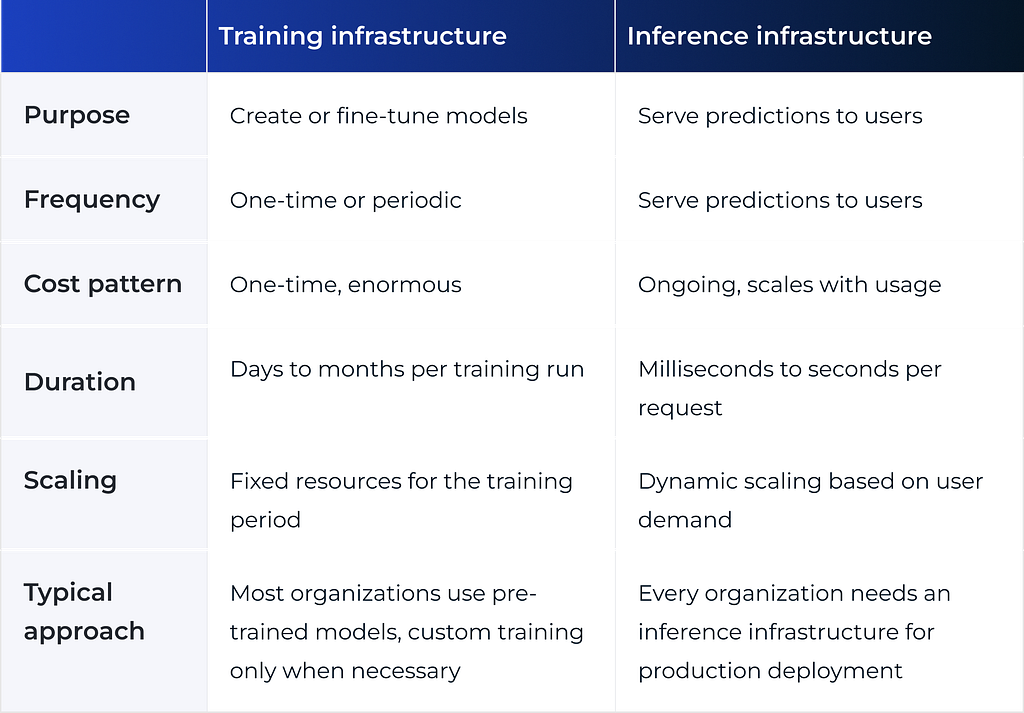
We can split the cost of AI infrastructure into two categories: model training and inference.
API usage and Model Serving Fees
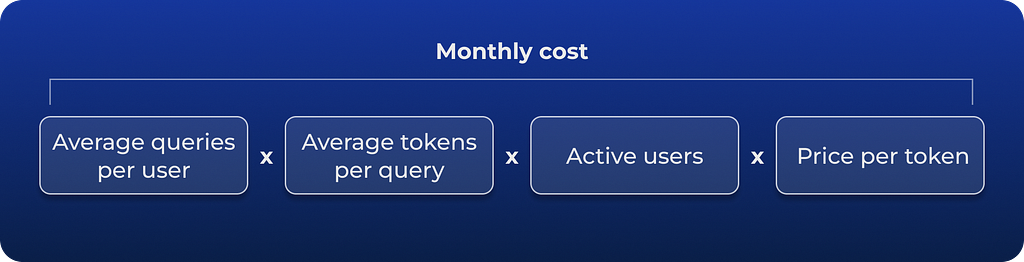
The most visible line item in generative AI pricing budgets is API charges. Some providers like OpenAI and Anthropic price their services in tokens — units of text processed during input and output. Organizations discover that per-token costs accumulate overwhelmingly quickly and generally exceed initial projections.
Other providers offer tiered pricing that rewards higher usage, as seen in Google’s Gemini offerings. While organizations processing millions of tokens monthly might pay 40-60% less per token than low-volume users, they rarely offset the exponential growth in usage, particularly for consumer-facing applications.
Storage and Database Systems
GenAI apps also need substantial storage and corresponding infrastructure:
- vector databases to store embedded knowledge as mathematical representations;
- traditional relational databases to manage user data and conversation history;
- big ERP systems to sync operational records and enterprise workflows;
- caching mechanisms to improve performance;
- backup systems to ensure reliability and disaster recovery.
Vector databases deserve special attention because they charge for query operations on top of common storage usage.
One more interesting nuance is RAG (retrieval-augmented generation) architectures, which companies are eagerly implementing to ground AI responses in internal data in a secure and more efficient way. The crux is that the RAG solutions store every document twice. Once as original text for reference and retrieval, and once as mathematical vectors for semantic search.
Find more on RAG benefits in our recent article From ChatGPT Prompting to Corporate GenAI Solution.
Initial Development and Integration
When organizations opt for generative AI development services, they expect natural development costs coming from:
- Specialized talent: ML engineers, full-stack developers, and prompt engineers at a bare minimum.
- System development: Depending on the engagement model, it might be a fixed price per project, hourly billing, or a managed delivery model.
- Integration with existing systems: Data pipeline construction to extract the necessary information from enterprise systems, proper authentication for security purposes, workflow integration, and API management.
- Testing and validation: QA resources, user acceptance testing, security levels, performance testing.
- Deployment: Production rollout, monitoring setup, and handover to internal teams, plus employee training if required.
Beneath the Interface: Hidden Costs of Using AI
While organizations carefully budget for infrastructure and API fees, the largest portion of hidden GenAI development costs surfaces only after deployment. The unpleasant part is that these operational expenses exceed visible costs by 200-300%, disrupting ROI projections and planning.
Continuous Data Pipeline
Before your GenAI app delivers the answer, data undergoes multiple transformations. Building and operating that complex data pipeline involves:
- Extracting content from dozens of enterprise sources
- Normalizing formats
- Cleaning inconsistencies and duplications
- Breaking documents into usable chunks
- Generating embeddings
- Indexing those vectors in a retrieval system
But developing a pipeline is hardly the finish line. It’s just the first step in AI product lifecycle management.
Knowledge bases quickly become stale because your company widens its product catalogs or updates its policies. So, all these changes must be synchronized with the model by reprocessing content and regenerating embeddings. Neglect this work and misleading outputs won’t be long in coming.

Returning to the topic of spending, to sustain such data workflows, you have to invest in engineering time, specialized tools, and human-in-the-loop workflows for quality control.
Monitoring and Observability Infrastructure
GenAI solutions demand much deeper visibility than basic uptime and error rates, as is the case with traditional software. It’s important to track every single API call to understand system behavior. And we not only speak of measuring whether it succeeded, but also how many tokens it consumed, how quickly it responded, and the essential output quality.
Then there is also a need to keep a close eye on AI-specific metrics, which is difficult without specialized tools. Those metrics include, but are not limited to:
- Hallucination rates
- Prompt effectiveness metrics
- Cost per interaction
- Context window utilization
- Model performance drift
High-volume applications, like the AI financial analysis we built, generate terabytes of data each month. Companies have to build dedicated infrastructure separate from production systems to store and analyze such a colossal volume of data.
Quality Assurance and Testing Systems
GenAI outputs are non-deterministic, which means the same prompt can produce different responses. Investment in automated testing is unavoidable for high-usage deployments that require running thousands of test cases and comparing outputs against expected response characteristics.
These tools also automate sample human evaluations and systematic regression testing. However, human oversight remains crucial for handling edge cases and validating consistency. Academic studies on AI QA highlight the same finding: AI implementation costs scale with model complexity and use cases.
What is important to realize is that quality assurance is needed continuously throughout production, not only in the pre-launch phase. Every prompt modification or model update should be tested for regression to prevent a sudden drop in quality. You’ll also want to avoid harmful, biased, or inappropriate responses, so validating safety regularly should be a part of day-to-day operations.
Model Maintenance and Performance Management
AI performance degrades after a while by default, a phenomenon known as model drift. That’s because too many variables, like user behavior, content domains, and others that AI considers when giving a response, evolve or change. So, being able to detect performance drops as early as possible is advantageous yet demanding, calling for user feedback collection and analysis, and comparing benchmarking against baseline performance.
There are several practices teams actively use to combat hallucinations and drift. AI performance monitoring for catching deviations from the norm and repeated model retraining are the keys to success. Careful version control in this context is paramount for controlled recovery in case of unexpected behavior.
Security and Treat Protection
GenAI is unlike any known technology, and no wonder it introduces novel security challenges. Systems should defend against prompt-injection attacks that manipulate AI behavior, jailbreak attempts that coax inappropriate responses, and data-extraction exploits targeting unauthorized access to the company’s training data. Needless to say, common threats remain in play.
Strong security infrastructure, including input filters, output validators, pattern detection, and security system monitoring, is what companies need to shield production models. The arms race between attackers discovering unpatched vulnerabilities and cybersecurity pros building protections never ceases, assuming ongoing investment in security. Particularly, companies must budget for specialized AI security tools, regular penetration testing, and security-focused engineering time.
Content Safety and Moderation
As a rule, every AI output passes through many safety checks before it reaches users. Content moderation systems screen responses for harmful language, bias, personal identifiable information, and hallucinations.
Applied at scale, moderation adds up to latency and compute usage, accompanied by operational overhead that grows linearly with traffic. Automated filters do the initial screening, but it’s human moderators who sample and review flagged output to polish policies and determine new failure patterns. Some projects, like AI copilot for greenhouse operations, demonstrate that effective domain-specific safety requires custom moderation rules in addition to generic filters.
Compliance and Governance Operations
Regulatory frameworks — GDPR in Europe, CCPA in California, AI-specific laws that are gradually taking shape across the globe mandate that organizations embed transparency into systems at the engineering level. The company should be able to trace the data used for generating the response, who accessed it, which model version produced the output, and under what conditions.
Therefore, we see audit trail systems widely used for these purposes. Meanwhile, access control systems allow companies to enforce who can view which information, and retention policies automatically archive or delete data in accordance with regulations. Compliance also entails human processes, such as legal team reviews and AI policy development by governance committees.
Expert Human Teams
Behind every properly working production GenAI system operates a team of diverse specialists:
- ML engineers to maintain models
- MLOps engineers to manage deployments
- Data engineers to sustain pipelines
- Data Scientists with AI/LLM expertise to optimize interactions and defend against misuse
Nowadays, having an in-house ML team is a luxury. Given that AI talent demand surpasses supply across key roles by a 3.2:1 ratio, companies are forced to pay a premium to scarce specialists. For comparison, AI professionals generally earn 67% more than traditional IT roles.
And that’s not all. Team members spend time researching innovative techniques and assessing new models to stay ahead of tech advancements. Thus, the cost of AI expertise stretches to employee learning and experimentation in addition to base salaries.
Technology Evolution and Adaptation
Nobody will deny that AI technology, more precisely GenAI as we know it, progresses at unprecedented speed. New models appear literally monthly, usually bringing in improved capabilities or better performance characteristics. As a result, businesses face constant pressure to reassess their technology stack. It consumes noticeable resources to test new models against existing ones and benchmark performance differences.
Adopting a newer model is never a simple swap. Migration projects demand refactoring code and retraining custom components, along with hundreds of hours spent on compatibility testing. Even when migration promises long-term efficiency gains, short-term spending increases. Organizations striving to remain competitive should include these expenses in their overall GenAI cost strategy.
Scaling Complexity and Optimization
Unfortunately, usage growth drives exponential increases in costs associated with introduced operational complications. Let’s understand why this is so. Monitoring becomes more challenging because new users exhibit different usage patterns, which require additional analysis. More users also mean more edge cases, as the system will encounter unusual combinations of inputs or languages. Finally, companies will need to perform additional tests to cover new user scenarios.
So, how to optimize the cost of generative AI for growing user demand? The Quantum team suggests combining several tactics for maximum effect.
Using model routing lets businesses direct simple queries to cheaper models and preserve more robust ones for compute-intensive tasks. Prompt optimization, which may encompass removing outdated system instructions and condensing retrieved context, helps companies consume fewer tokens per request while getting answers of the same quality. Caching is another effective method aimed at storing the most frequently accessed responses to avoid redundant API calls.
Architecting Sustainable GenAI: Economics and Long-Term Strategy
As it turns out, keeping GenAI applications economically viable in production is not easy. Even well-funded pilots can become financial liabilities. Organizations that succeed are the ones that design for cost discipline as deliberately as they design for accuracy and latency.
Sustainable AI starts with acknowledging that API bills represent only a fraction of the total AI implementation cost. As we have discussed, spending accumulates through every system layer, from data pipelines to quality assurance. If organizations account for only direct model inference expenses, they have to deal with exponentially rising costs only after scaling, when course correction becomes several times more expensive.
This is the case for AI FinOps. Using FinOps practices in GenAI projects enables teams to attribute costs to specific use cases, user segments, or business outcomes, rather than treating AI spend as shared overhead. According to the FinOps Foundation, organizations with a mature cost attribution framework are much more likely to keep cloud and AI spending within forecasted limits.
Cost-effective GenAI is as much an architectural challenge as a financial one. For example, by opting for model-agnostic designs, teams gain the ability to switch providers if one of them increases pricing or changes compliance requirements, performance, etc. Multi-provider strategies have low lock-in risk and give companies leverage when negotiating usage-based pricing. Engineering modular architectures will let companies easily replace safety filters, models, or other components without re-platforming the entire system.
The Bottom Line on the Hidden Investment in AI Excellence
That simple text box masking extraordinary complexity tells only part of the story. Behind every seamless conversation stands a myriad of processes and operational responsibilities. This is why the question “How much does artificial intelligence cost?” doesn’t have a straightforward answer.
The success of GenAI products is not defined by model sophistication alone. It’s sustained by thoughtful architecture, investment in people and processes, and relentless operational excellence, managing this complexity. The narrative positioning AI as simple or inexpensive crumbles rapidly when confronted with reality. Each hidden cost of AI revealed reflects the necessities organizations discover only through experience.
Yet these complications shouldn’t discourage investment. GenAI delivers capabilities and business value that were unthinkable just a few years ago. The complexity and cost of AI mirror the real power required to make that possible at scale.
The Hidden Operational Costs of GenAI Products: Lifecycle, Risk, and Long-Term Maintenance was originally published in Towards AI on Medium, where people are continuing the conversation by highlighting and responding to this story.