There is a cost your product team is almost certainly not tracking.
It does not appear on your engineering budget. It does not show up in your infrastructure bills. It does not get flagged in your sprint retrospectives. And yet it compounds quietly across every release, every scaling event, and every new hire — until it becomes the single most significant drag on your platform’s ability to grow.
The cost is manual intervention.
Every time a team member has to step in to make a decision the system should have made, you are paying this cost. Every escalation, every workaround, every “just ask Sarah about that” is a withdrawal from an account most teams have never even opened.
This article is about why that cost is so hard to see, how it compounds, and what it actually means to design it out of a product rather than simply tolerate it.
Why Manual Intervention Is Invisible
The reason manual intervention is so poorly tracked is that it rarely announces itself as a problem. It announces itself as helpfulness.
A senior engineer steps in to fix an edge case the system could not handle. A product manager manually approves a workflow because the automated path was unclear. A customer support agent resolves a state inconsistency that should never have been reachable. In each case, the immediate outcome is positive — the problem got solved, the customer was helped, the system kept moving.
What does not get recorded is the cost of that intervention. The time spent. The context required. The dependency that has now been created on the person who resolved it. The fact that the same situation will recur, and someone will have to intervene again.
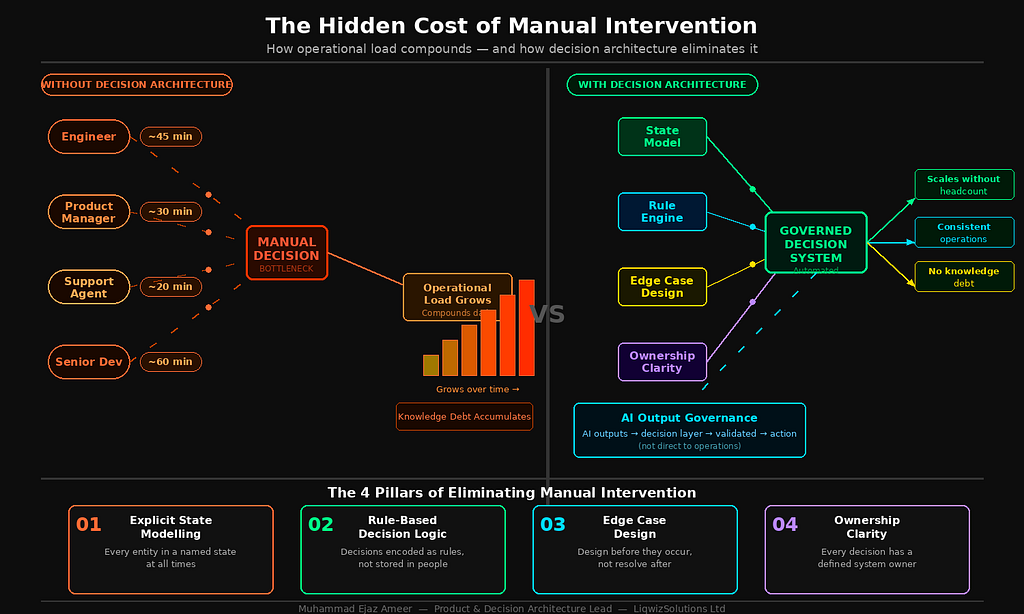
Over time, these interventions accumulate into what I call operational load — the ongoing human effort required to keep a digital product functioning correctly. Operational load is not the same as normal workload. Normal workload is the effort required to build and improve the product. Operational load is the effort required to compensate for the product’s failure to govern itself.
The distinction matters because operational load does not decrease as a product matures. In most cases, it increases — because each new feature adds new edge cases, and each new edge case creates new opportunities for the system to reach states it does not know how to handle.
How Manual Intervention Compounds
Consider a simple example. A platform has a workflow for handling booking requests. When a request comes in, it needs to be routed to the right provider, confirmed, and communicated back to the customer.
In an early version of the platform, the routing logic is straightforward enough that the system handles it automatically. But as the platform grows, edge cases emerge. Some providers operate in multiple categories. Some bookings require approval from a parent or guardian. Some requests arrive with incomplete information. The system was not designed to handle these cases explicitly, so it routes them to a human — a team member who reviews the edge case and decides what to do.
In the early days, this is manageable. There are few edge cases and experienced people available to handle them. The manual intervention is barely noticeable.
Then the platform scales. The volume of requests increases. The edge cases, which previously represented a small fraction of traffic, now represent a significant absolute number. The team members who were handling them are now spending a meaningful portion of their time on manual resolution. New team members are hired, but they lack the institutional knowledge to resolve edge cases correctly. The senior people who have that knowledge become bottlenecks.
The platform has not failed. It has simply reached the natural ceiling of a system designed to rely on people to fill its gaps. That ceiling is lower than almost every team expects — and it is reached faster than almost every team plans for.
The Real Cost, Measured
Most teams, if asked, would estimate their manual intervention costs in time. A few minutes per edge case, a few edge cases per day — it does not sound significant.
This framing misses three compounding factors.
First, the cost is not just the time of the intervention itself. It is the time to identify that intervention is needed, the time to gather context, the time to communicate the outcome, and the time lost to the interruption of whatever the team member was doing before. Research on context switching suggests that a single interruption can cost significantly more time than the interruption itself — typically measured in tens of minutes per switch.
Second, the cost scales non-linearly. As a platform grows, the volume of edge cases grows roughly in proportion to the complexity of the system — which tends to increase faster than the user base. Doubling your users does not double your edge cases. In a complex platform, it may triple or quadruple them. The human capacity to handle those edge cases does not scale at the same rate.
Third, manual intervention creates knowledge debt. Every edge case handled by a human is a decision that exists only in that person’s memory. When they leave the team, that knowledge goes with them. The next person who encounters the same edge case has to rediscover the resolution — often by making it worse first. This is a form of operational debt that is almost never measured but compounds steadily over the life of a product.
Where Manual Intervention Hides
Manual intervention concentrates in predictable places. Recognising them is the first step to addressing them.
Approval workflows. Any process that requires human sign-off before proceeding is a potential manual intervention point. Some approvals are genuinely necessary — high-value decisions, novel situations, exceptions that require judgement. But many approvals exist because the system was not designed to make the decision automatically. The question to ask is not “does this need an approval?” but “does this need a human approval, or does it need a rule?”
State ambiguity. When a record, request, or workflow can exist in an unclear or undefined state, humans are required to interpret that state and decide what to do next. This is almost always a design failure — the system was not given a complete model of the states it could encounter, so it falls back on human interpretation. Explicit state design eliminates this category of intervention almost entirely.
Edge case handling. Every edge case that produces an undefined outcome is a manual intervention waiting to happen. The typical response to edge cases is to handle them one at a time as they occur — which creates a permanent backlog of handled-but-not-designed situations. The better response is to include edge case design as a core part of workflow modelling, so that the system knows what to do before the case occurs.
Permission and routing ambiguity. When it is unclear which actor should take an action, or which path a workflow should follow, human judgement fills the gap. This is a routing design problem. Clear ownership boundaries and explicit routing rules eliminate the majority of these interventions.
AI output handling. This is a newer and increasingly significant source of manual intervention. When AI-generated outputs feed into operational workflows without a governance layer, unpredictable outputs create unpredictable states — which require human resolution. The correct architectural response is to treat AI outputs as inputs to a decision layer, not as decisions themselves.
What Designing It Out Actually Looks Like
Reducing manual intervention is not primarily a technical problem. It is a design problem — specifically, a decision architecture problem.
The goal is not to eliminate human judgement from your platform. Humans should make judgement calls on genuinely novel situations. The goal is to ensure that the routine, repeatable decisions that constitute the majority of your platform’s operational activity are made by the system, not by people.
This requires four things.
Explicit state modelling. Every workflow in your platform should have a defined set of states. Every record, request, or entity should be in a named state at all times. Transitions between states should be explicit and governed by rules. There should be no undefined states — only states that have been named, including error states and exceptional conditions.
Rule-based decision logic. Every decision your platform makes routinely should be encoded as a rule. Who can approve this? What triggers this transition? What happens when this input is invalid? These decisions should not live in someone’s head. They should be in the system.
Explicit edge case design. Edge cases should be designed before they occur, not resolved after. When modelling a workflow, the question to ask is not just “what happens in the normal case?” but “what happens when the input is incomplete, when two actors conflict, when an external service fails?” A system that knows what to do in these situations does not need human intervention to handle them.
Ownership clarity. Every decision point in your platform should have a defined owner — a system component, a role, or a defined human actor. Ambiguous ownership is the most common source of manual intervention. When nobody is sure who should act, everyone waits, and eventually a human steps in to break the deadlock.
The Compound Return on Getting This Right
The return on reducing manual intervention is not linear. It compounds in the same way that the cost compounded.
A platform that governs its own decisions does not hit the same operational ceiling. It scales without proportional increases in operational headcount. It onboards new team members faster because the institutional knowledge is in the system, not in people. It handles growth events without the operational crisis that typically accompanies them.
There is also a less obvious return. When manual intervention is reduced, the humans in your team are freed to focus on genuinely novel problems — the situations that actually require judgement, creativity, and expertise. The quality of their work improves because they are no longer spending most of their time compensating for the system’s inability to govern itself.
The platform becomes more reliable not because the people working on it are better, but because they are no longer required to substitute for the system’s missing logic.
The Discipline Behind This
Reducing manual intervention requires treating decision architecture as a first-class discipline — not a side effect of good engineering, not an afterthought to good product management, but a practice that sits between them and owns the questions both tend to leave unanswered.
Those questions are: how does the system make this decision? What are the valid states? Who owns this outcome? What happens at the edges?
They are not glamorous questions. They do not generate the excitement of a new feature or the satisfaction of a technical achievement. But the answers to them are what determine whether your platform can actually operate at scale — or whether it will always require a team of people to hold it together.
The hidden cost of manual intervention is real, it is large, and in most platforms it is entirely unnecessary. The question is not whether you can afford to address it. It is whether you can afford not to.
Muhammad Ejaz Ameer is a Product & Decision Architecture Lead working at the intersection of product logic, system behaviour design, and workflow governance. He is the founder of LiqwizSolutions Ltd. His first article, “Why System Behaviour Must Be Designed, Not Improvised,” is published on Towards AI.
The Hidden Cost of Manual Intervention in Digital Products was originally published in Towards AI on Medium, where people are continuing the conversation by highlighting and responding to this story.