Four forces are reshaping content governance faster than most platforms are prepared for. The investments being made right now in moderate infrastructure will determine who controls the internet’s most trusted spaces in the decade ahead.

By Pride Chamisa, Founder of VidSentry
Prediction is a dangerous game in technology.
The history of the industry is littered with confident forecasts that the next decade would look nothing like the last, forecasts that turned out to be simultaneously right about the direction and completely wrong about the timeline, the mechanism, and the specific winners and losers.
I want to be careful about that.
What I am going to argue here is not a prediction about specific technologies or specific companies. It is an argument about the structural forces that are already in motion (regulatory, commercial, demographic, and competitive) that will reshape digital safety and content governance over the next five years in ways that most platforms have not fully priced into their infrastructure investment decisions.
The platforms that understand these forces and build accordingly will occupy the most defensible positions in the content ecosystem of 2030.
The ones that do not will be making expensive reactive investments in five years that they could be making affordable proactive ones in today.
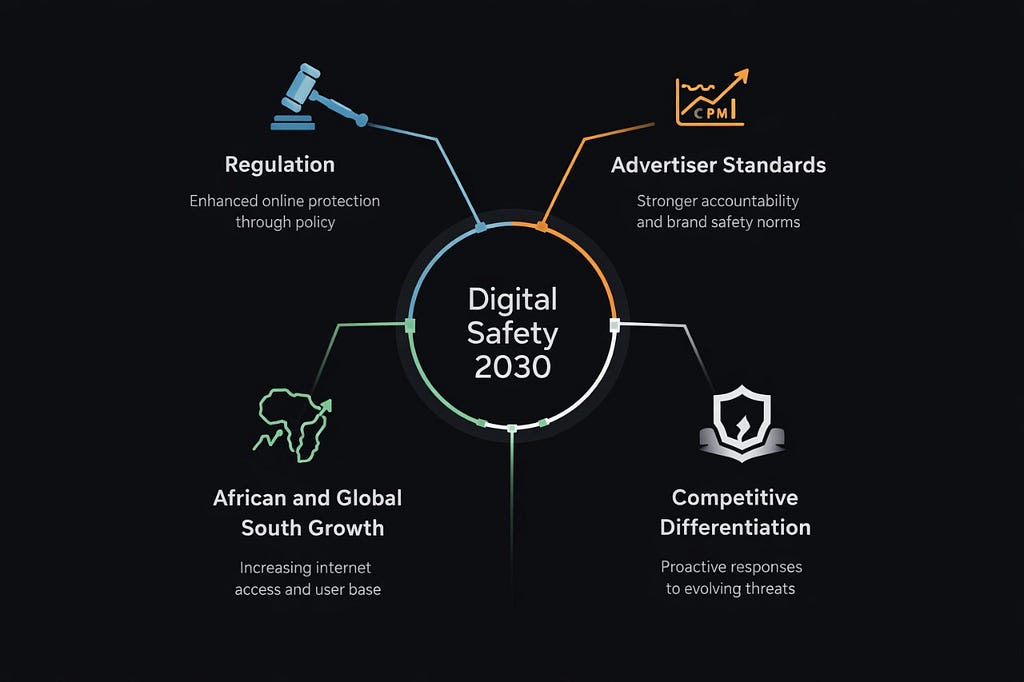
Force 1: Regulation Will Make Moderation Quality a Legal Requirement
This is the force that is furthest along and most underestimated in its eventual impact.
The EU AI Act is in force. It places specific, enforceable obligations on high-risk AI systems, and automated content moderation at scale qualifies. The obligations include transparency requirements, human oversight provisions, accuracy standards, and documentation requirements that go significantly beyond what most current moderation systems can satisfy.
The EU Digital Services Act is operational and its enforcement provisions are active. Very Large Online Platforms face annual independent audits of their risk management and moderation systems. The audit trail requirements alone demand a level of moderation decision documentation that context-blind automated systems are structurally incapable of producing.
In African markets, the regulatory trajectory is identical in direction if earlier in development. South Africa’s POPIA has been enforceable since 2021 and its application to automated decision-making in content governance is increasingly being tested. Nigeria’s NDPR, Kenya’s Data Protection Act, and the broader AU Data Policy Framework are developing enforcement infrastructure with explicit attention to the governance of AI systems.
By 2030, the regulatory landscape for automated content moderation will look nothing like it does today. Platforms that cannot demonstrate accurate, fair, culturally informed, and auditable moderation decisions will not be operating across major markets by choice. They will be operating under consent decrees, paying significant fines, or not operating at all.
The platforms building moderation infrastructure that meets 2030 regulatory standards today are not over-investing. They are building the compliance moat that their competitors will spend five years scrambling to replicate.
Force 2: Advertisers Will Price Moderation Quality Into Their Spending Decisions
As argued in detail in the previous piece in this series, the advertiser community is developing significantly more sophisticated expectations around moderation transparency and accuracy than the traditional brand safety conversation has required.
The shift is structural and it is accelerating.
Brand safety has historically been a content adjacency problem. Keep advertising away from harmful content. The tools for this (keyword blocklists, category exclusions, contextual targeting) are mature and widely deployed.
The next phase of brand safety is a governance quality problem. Demonstrate that the platform’s moderation infrastructure is accurate, fair, and culturally intelligent across the specific markets and demographics where advertising spend is being deployed.
This shift is being driven by three converging pressures.
The first is growing awareness of AI bias and discriminatory automated enforcement among the journalists and policy researchers whose coverage shapes advertiser risk perception. Stories about content moderation failures (wrongful bans on African creators, culturally blind enforcement on regional content, systematic suppression of minority language communities) are increasingly reaching mainstream business and marketing press.
The second is the emergence of moderation transparency as a procurement criterion. The leading edge of the advertising agency holding group community is beginning to include moderation quality questions in platform RFP processes. That leading edge becomes mainstream with a two to three year lag.
The third is regulatory. The same DSA audit requirements that apply to platforms apply indirectly to the brands advertising on those platforms, brands that cannot demonstrate they conducted adequate due diligence on the governance practices of their media partners face increasing exposure in jurisdictions where AI governance requirements extend to the advertiser relationship.
By 2030, moderation quality will be a line item in premium advertising negotiations the way brand safety technology is today.
The platforms that can demonstrate disaggregated false positive rates by language, region, and content category will command premium CPMs. The ones that cannot will be excluded from the campaigns that matter most commercially.
Force 3: African and Global South Audiences Will Drive the Next Decade of Platform Growth
This is the force that receives the least attention in Western-centric platform strategy conversations, and the one that will prove most consequential.
The demographic reality of the next decade of internet growth is not in North America or Europe. It is in Africa, Southeast Asia, and Latin America. The billion-plus users being added to the global internet over the next ten years will come overwhelmingly from these markets. The creators producing the content that will define the cultural conversation of the 2030s are already building audiences in Lagos, Nairobi, Accra, Jakarta, and São Paulo.
For platforms, this demographic reality creates a direct, urgent business case for moderation infrastructure that actually works for these communities.
A platform whose moderation system produces disproportionate false positives against African-language content, misreads cultural visual signals from African markets, and cannot handle the code-switching that characterises urban African communication is not positioned to serve the users driving the next decade of global growth.
It is positioned to lose them, to platforms that were built, from the beginning, with the understanding that African and Global South users are not an edge case to be accommodated but a primary audience to be served.
The creator economy dimension of this shift is equally significant. African creators are building audiences that are growing faster, engaging more deeply, and crossing cultural boundaries more effectively than many Western platform incumbents recognise. The platforms that retain these creators (by building moderation infrastructure that understands and protects rather than misidentifies and suppresses their content) will own the audience relationships that define the streaming and social landscape of 2030.
A moderation system that works for a Yoruba-speaking creator in Lagos is not a niche capability. It is the capability that determines which platforms own the most valuable creator relationships in the decade’s fastest-growing market.
Force 4: Moderation Infrastructure Will Become a Competitive Differentiator
This is the prediction I am most confident about and the one that represents the most significant strategic reframe for platforms currently treating moderation as a cost center.
Today, moderation is defensive infrastructure. Platforms invest in it to avoid harm, satisfy regulators, and manage the operational costs of enforcement. The investment decision is framed around risk mitigation, not competitive advantage.
By 2030, the platforms that got this right early will have converted their moderation infrastructure into a genuine competitive moat — a structural advantage that attracts creators, commands advertiser premiums, satisfies regulators efficiently, and builds audience trust in ways that are difficult and expensive for competitors to replicate.
The mechanism of this conversion is straightforward.
Creators increasingly understand, or will increasingly understand, that the platform whose moderation system treats their content fairly is the platform worth building on. A creator who has experienced wrongful enforcement on one platform and accurate, culturally intelligent moderation on another does not need a sophisticated analysis to make the right decision. They move their audience to the platform that understands them.
Audiences, as argued above, are developing moderation literacy. They are beginning to understand and care about how the platforms they spend time on govern content, particularly in African markets where the failures of context-blind systems have been most visible. Trust built through demonstrably fair moderation is stickier than trust built through content investment or product features.
Advertisers, as the regulatory and brand safety dynamics mature, will formalise moderation quality as a platform selection criterion. The platforms with the strongest, most transparent, most culturally intelligent moderation infrastructure will win the advertising relationships that cannot be bought through audience size alone.
Regulators will, through the enforcement actions of the next five years, concentrate the compliance cost burden on platforms that did not invest early in meeting emerging standards. The platforms that built ahead of those standards will face lower ongoing compliance costs and less regulatory friction than competitors who are building reactively.
Each of these audiences (creators, advertisers, users, regulators) is moving in the same direction. The platform that is well-positioned for all four simultaneously is the one that treated moderation infrastructure as a strategic investment rather than a defensive cost.
What 2030 Looks Like for the Platforms That Got It Right
I want to paint a specific picture of what the competitive landscape looks like in 2030 for platforms that made the right moderation infrastructure investments in the years leading up to it.
These platforms will have creator bases that are more diverse, more culturally rich, and more globally distributed than their competitors, because creators in African and Global South markets built their audiences there rather than on platforms whose systems could not understand or protect their content.
They will have advertising relationships characterised by premium CPMs and long-term commitments, because advertisers chose to consolidate spend on platforms that could demonstrate moderation quality, cultural intelligence, and regulatory compliance in the markets where growth was happening.
They will face moderation-related regulatory action at lower frequency and lower cost than competitors, because the systems they built in the early 2020s were designed to meet the regulatory standards that the mid-2020s enforcement wave established as table stakes.
And they will have something harder to quantify but more durable than any of the above: audience trust.
Trust built through years of moderation decisions that were fair, culturally informed, and transparent. Trust that survived the controversies that damaged competitors whose context-blind systems generated governance failures at exactly the moments of highest visibility. Trust that converts into the kind of deep platform loyalty that no marketing budget can replicate.

The Investment Decision That Determines Everything
The decision that separates the platforms of 2030 from the ones still struggling to catch up is not a decision that gets made in 2030.
It is being made right now.
Every platform, broadcaster, and telco making infrastructure investment decisions today is either building toward the 2030 competitive landscape that the four forces above are creating, or building away from it.
The moderation infrastructure that satisfies 2030 regulatory requirements, earns 2030 advertiser trust, serves 2030 African and Global South audiences, and builds 2030 creator loyalty is not a future product. It is what responsible, context-aware, culturally intelligent moderation infrastructure looks like today.
The platforms that recognise that will build it today, when it is still a proactive investment.
The ones that do not will build it in 2028, when it is a reactive necessity.
The future of the internet is video. The future of video is African and Global South creators, advertisers, and audiences. And the future of serving that future, safely and successfully, is moderation infrastructure that was built for it.
The window for proactive investment is open.
It will not stay open indefinitely.
Next in this series: From thesis to product: how my work on multimodal deep learning for medical AI directly shaped the architecture of what we are building at VidSentry, and what the two fields have taught each other.
Pride Chamisa is the founder of VidSentry, an AI-powered video moderation platform built to understand global context and African nuance. He writes about AI safety, the future of platform governance, and building technology from the African continent for a global stage.
Connect on LinkedIn
The Future of Digital Safety in 2030, And the Platforms That Will Win It was originally published in Towards AI on Medium, where people are continuing the conversation by highlighting and responding to this story.