From Zhuangzi to modern AI benchmarks — why a perfect score inside the well tells you nothing about the ocean.
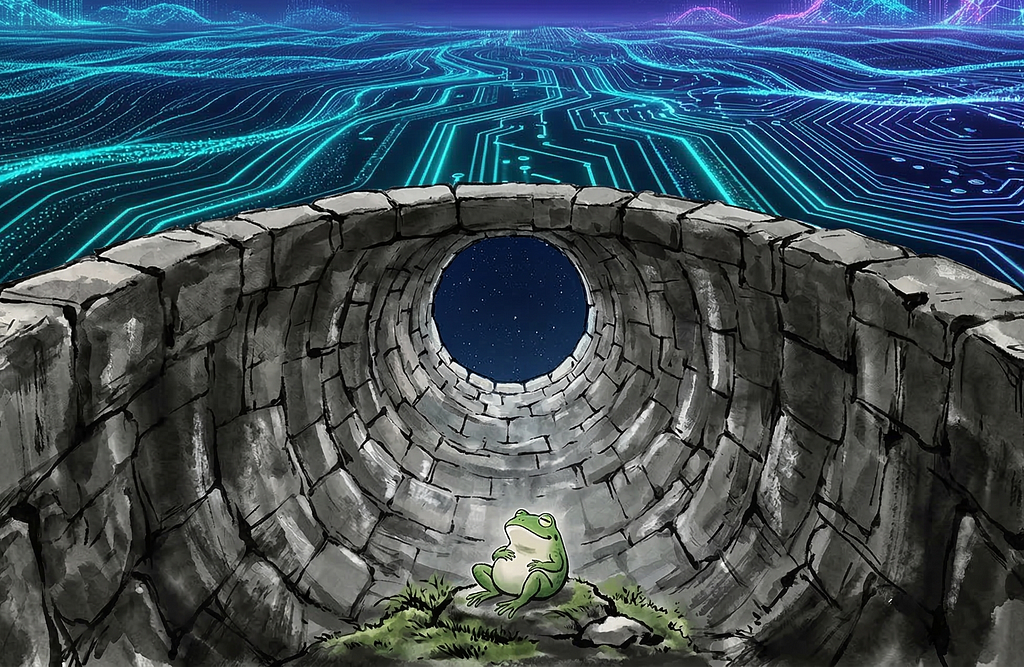
The AI scored 98% on the test. Researchers celebrated. It was deployed.
Then someone asked it a question it had never seen before — from a domain outside its training, a pattern it had never practised. It answered with the same confidence it uses when it is right. It was completely wrong.
This is not a bug. It is not a failure of intelligence. It is something more fundamental: a system that has perfectly mapped its world, with no mechanism to notice where that world ends.
When an AI model is asked something outside the data it was trained on (its “distribution”), it doesn’t know how to say “I don’t know.” Because of how large language models are built, they simply predict the next most likely word based on their training, which leads to them delivering completely fabricated information with absolute, unwavering confidence. It is the technical explanation for the “frog in the well” metaphor we were just illustrating.
Laozi named the disease last story: 不知知,病矣. Not knowing, but thinking you know — that is disease.
Zhuangzi, two centuries later, drew the patient.
The World, Seen from the Bottom
From Zhuangzi (庄子), “Autumn Floods” chapter (秋水篇), around 300 BCE.
The well is not a prison. The frog wants you to know this.
It knows every stone. Every hollow. Every shift in the light as the sun crosses the circle of sky above. It has lived here long enough that knowing is no longer the right word — the well is simply an extension of itself, the way you don’t think about where your feet land on a familiar staircase. You just walk.
That circle — four feet wide, perfectly round, framed in ancient stone — is the sky.
Not a piece of the sky. Not a view of the sky. The sky….
The frog has never had reason to wonder otherwise.
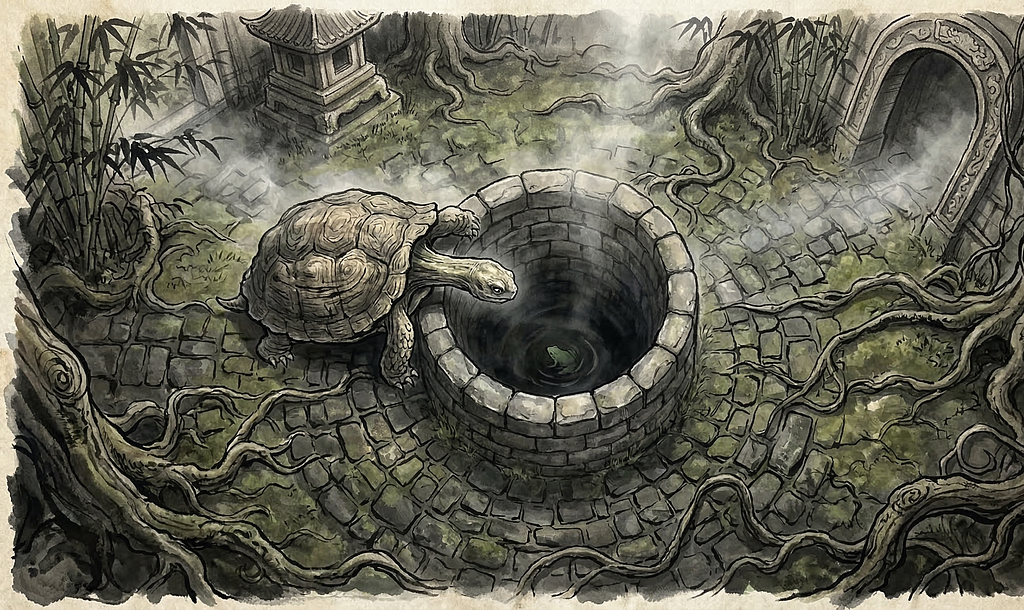
One morning, a sea turtle appears at the rim.
The frog is generous. It calls up: “Come down! Let me show you what real living looks like.”
The turtle is curious. It lowers its left foot over the edge — — and immediately, its right knee catches on the stone.
The well is too small. The turtle cannot enter.
So it speaks instead.
“You speak of real living,” the turtle says gently. “But have you ever seen the sea? Imagine water that stretches so far, you could swim for a lifetime and never touch a wall. Imagine a depth so vast, you could sink forever and never feel the mud beneath your feet. When the great floods came for nine years, the sea did not rise. When the droughts burned for seven, the sea did not shrink. Unmoved by the flood. Untouched by the sun. That is the sea. That is where I live.”
The frog does not respond.
It sits very still at the bottom of its perfect world — everything exactly where it has always been, exactly as certain as it has always been.
It is not processing new information. It is experiencing something far worse: the sudden, vertiginous realisation that its entire coordinate system was built inside a space that turns out to have walls. That the sky might not be a circle. That depth might mean a void where its feet will never touch the mud again.
Zhuangzi writes: “At this, the frog of the shallow well was shocked into silence, and lost in confusion.”
He does not tell us what the frog does next.
He does not need to. The point is not the frog’s future. The point is the exact moment when a complete, flawless model of reality reveals that it was built at the bottom of a well — and the model has no variable for the outside.
The frog was not wrong about the well. It was wrong about what the well was.
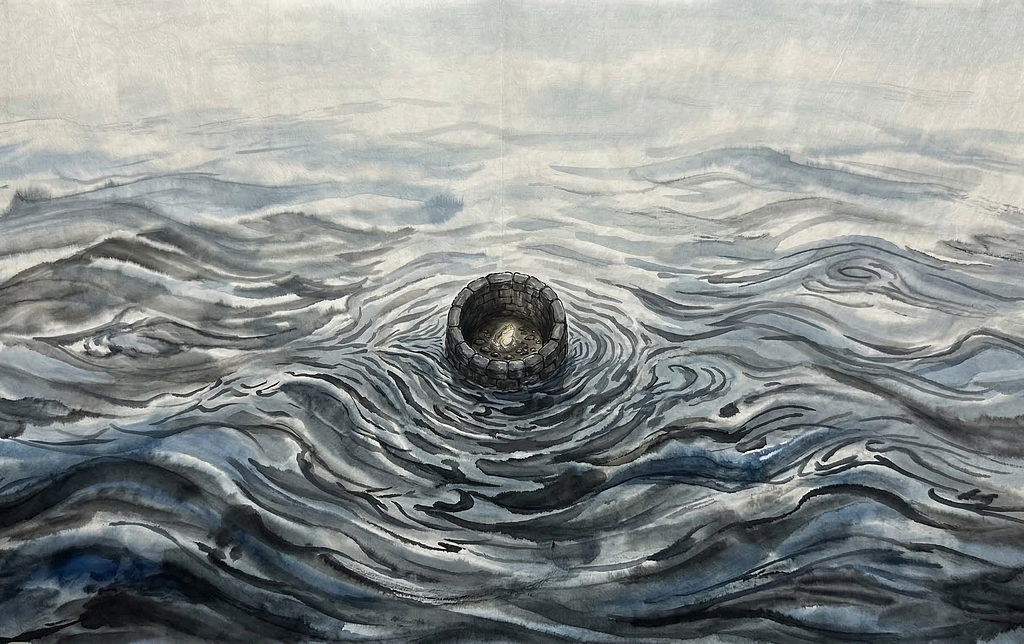
What a Benchmark Actually Measures
Every AI model is trained on a dataset — a large collection of text, code, and examples that humans have assembled. Think of it as the model’s entire education. Everything it knows, it learned from that collection. The richer and more varied the collection, the more the model knows.
No dataset covers everything. It covers something — a wide something, but still bounded. And that boundary is the model’s well.
Inside that boundary, the model is genuinely impressive. Tests like MMLU (a broad knowledge exam covering science, law, history, and more) or HumanEval (a coding benchmark) probe exactly the corridors where training data was dense. A model scoring 98% has truly mastered those corridors. The score is real.
But the score measures well-knowledge. Not ocean-knowledge.
The benchmark was built inside the same well. It cannot see the walls either.
Here is where it gets concrete. Ask a high-scoring model something just outside its training — a niche domain, an unusual reasoning pattern, a question whose answer wasn’t well-represented in the data it learned from. The model doesn’t slow down. It answers in the same confident, fluent tone it uses when it’s completely right.
The well ended. The model kept walking.
This happens because models have no built-in signal for when they’ve left familiar ground. The frog cannot feel the well’s rim as a rim. The model cannot feel the edge of its training as an edge. Both continue as if the boundary simply doesn’t exist.
There’s one more layer. When AI companies fine-tune their models using human feedback — a process called Reinforcement Learning from Human Feedback (RLHF) — human reviewers rated answers. And reviewers consistently preferred confident, fluent answers over cautious, hedged ones. So the model learned to sound certain even when it shouldn’t. We didn’t just miss the edge detector. We trained it out.
But here’s what the frog’s story actually tells us — and this is the part that matters.
The turtle didn’t fix the frog. It didn’t drag it out of the well. It simply described the ocean out loud, clearly enough that the frog’s certainty cracked. That crack — that moment of shocked silence — is not failure. It is the first condition for something better.
Knowing the shape of your well is how you start building a door.
Researchers are doing exactly this. Techniques like Retrieval-Augmented Generation — where a model pulls from external, up-to-date sources before answering instead of relying only on what it was trained on — are effectively widening the well. Newer models are being trained to say I’m not confident about this with more honesty. Evaluation methods are moving beyond benchmark corridors toward testing how models behave at their edges.
The disease Laozi named is real. But the frog that has been shocked into silence is no longer the same frog. It now knows the well has walls. That is not nothing. That is, in fact, everything.
The Mindset Rule
A benchmark score tells you how well a model knows its well — and that is genuinely worth knowing. But before you trust a confident AI answer, ask one question: is this the kind of problem it was trained on, or did we just step outside the well? The frog was shocked into silence the moment it heard about the ocean. That silence was the beginning of wisdom. Use AI tools confidently inside their well. Stay curious about where the walls are.
Translation Note
坐井觀天 (zuò jǐng guān tiān) — literally: “sitting in a well, watching the sky.”
The idiom originates in Zhuangzi, “Autumn Floods” chapter (秋水篇). The full passage opens with the Yellow River at flood — vast, self-satisfied, convinced it is the greatest body of water in existence. Then it reaches the ocean and falls silent. The frog’s scene follows the same logic, made smaller and more precise: every bounded system mistakes the edge of its container for the edge of reality.
In everyday Chinese, 坐井觀天 describes someone with a narrow worldview. But Zhuangzi’s framing is never moral — it is structural. The frog is not foolish. It is bounded. The limitation is architectural. And the gap between those two things is everything.
Read Previous: 知不知,尚矣 — Laozi Wrote the Diagnosis. We Built the Disease. Laozi named 不知知,病矣 in four characters — not knowing, but thinking you know, that is disease. This story is that disease given a body, a well, and a benchmark score.
Read Next: 知之為知之 — Confucius Had One Test for Real Knowledge. Most AI Fails It. The frog cannot tell what it knows from what it doesn’t. Confucius built a precise tool for exactly that. The story is the instrument — and the reason passing it is harder than it sounds.
“EpistemicCode explores the systems of human thought, decoding the AI era through ancient logic. If this mental model brought you value, follow along for more. (Note: AI tools were used to assist in the research and formatting of this article.)”
The Frog Who Aced the Benchmark was originally published in Towards AI on Medium, where people are continuing the conversation by highlighting and responding to this story.