A grounded exploration of the point where artificial reasoning scales beyond human capacity — and what that means for all of us
There’s a thought experiment that keeps AI researchers up at night.
It doesn’t involve robots taking over the world or a rogue superintelligence locking humans out of the internet. It’s far more subtle — and in many ways, far more interesting.
What happens the moment a machine doesn’t just process information faster than us, but genuinely reasons better?
Not in one narrow domain like chess or protein folding. But across the broad, messy, contextual landscape of human thought — the kind of reasoning that involves intuition, analogy, uncertainty, and wisdom.
That moment — hypothetical today, but approaching faster than most people realise — is what some researchers are calling the Cognitive Singularity.
And it’s worth thinking carefully about what it actually means.
First, Let’s Be Precise About What “Reasoning” Even Is
We throw the word around constantly, but human reasoning is a remarkably strange thing.
It’s not purely logical. We use heuristics, gut feelings, analogies, and past experiences. We reason under uncertainty, often without complete information. We change our minds. We make brilliant leaps that no formal algorithm could predict — and we also fall for embarrassingly simple cognitive biases.
Cognitive computing aims to capture this complexity. Unlike traditional computing — which executes deterministic, pre-programmed instructions — cognitive systems are designed to learn, adapt, and reason in ways that resemble human thought.
The field draws from machine learning, neuroscience, psychology, linguistics, and computer science. Its goal isn’t just computation. It’s cognition.
And the gap between those two things is enormous.
Where Machines Already Beat Us (And It’s More Than You Think)
Let’s be honest about the scorecard so far.
AI systems have surpassed humans in ways that would have seemed impossible just a decade ago:
- Chess, Go, and complex strategy games — not just winning, but inventing strategies humans had never conceived
- Medical imaging — detecting cancers in radiology scans with greater accuracy than trained specialists
- Protein structure prediction — AlphaFold solved a 50-year-old grand challenge in biology almost overnight
- Mathematical reasoning — AI models are now solving competition-level math problems that stump PhD students
- Code generation — writing, debugging, and optimising software faster than most professional developers
In 2025, reasoning-focused AI models began dominating benchmarks at PhD-level science (GPQA), mathematical olympiad problems (AIME), and real-world software engineering tasks — domains that were considered firmly human territory just a few years ago.
But here’s the critical distinction that the headlines often miss:
Performing well on a benchmark is not the same as reasoning.
Benchmarks measure narrow, well-defined slices of cognition. True human reasoning is something messier, richer, and far harder to pin down.
The Three Kinds of Reasoning — And Where the Gap Remains
To understand what the Cognitive Singularity actually means, we need to separate reasoning into its key types:
1. Formal / Logical Reasoning
“If A then B. A is true. Therefore B.”
Machines have largely conquered this. Given structured inputs and clear rules, AI systems are extraordinarily reliable — often more so than humans, who get tired, distracted, or emotionally swayed.
2. Analogical Reasoning
“This situation is like that one I encountered before.”
This is harder. It requires abstracting patterns across domains — recognising that a problem in biology resembles a problem in economics, or that a negotiation tactic from history applies to a modern business dispute.
Humans are remarkably good at this. Cognitive AI systems are getting better, but remain inconsistent. They can find surface-level similarities, but deep structural analogy — the kind Einstein used when he imagined riding a beam of light — remains elusive.
3. Common Sense and Contextual Reasoning
“Of course you don’t bring an umbrella to a swimming pool.”
This is where machines still genuinely struggle. Common sense reasoning requires an implicit, embodied understanding of the world — physics, social norms, cause and effect, human motivation — that humans absorb naturally through lived experience.
An AI can ace a bar exam but remain confused by a three-year-old’s riddle. That gap tells you something profound about the nature of cognition.
So What Would a Cognitive Singularity Actually Look Like?
Let’s be clear: this is not the same as the Technological Singularity popularised by Ray Kurzweil — the idea of a runaway superintelligence that recursively improves itself into incomprehensibility.
The Cognitive Singularity is more specific and more near-term. It refers to the threshold where machines outperform humans not just at narrow tasks, but at general reasoning at scale — the ability to take novel problems in unfamiliar domains and work through them with better judgment, more consistency, and deeper insight than any human expert.
Imagine a system that can:
- Read all of existing medical literature and reason across it to propose treatments no single doctor could synthesise
- Analyse a legal dispute by understanding not just statutes, but intent, precedent, ethics, and social context
- Navigate a complex geopolitical negotiation by modelling human psychology, historical patterns, and second-order consequences simultaneously
We’re not there yet. But the trajectory is not gradual — it’s exponential.
The Uncomfortable Question: What Makes Human Reasoning Special?
Here’s where it gets philosophically interesting.
Part of what makes human reasoning valuable is precisely its limitations. We reason under uncertainty. We make decisions with incomplete information. We balance logic with emotion, self-interest with ethics, short-term thinking with long-term vision.
Some researchers argue that machines will always lack something essential: embodied experience. Human cognition is shaped by having a body — by hunger, fear, desire, pleasure, and mortality. These aren’t bugs in our reasoning; they’re features. They give us stakes. They give us wisdom that pure computation cannot replicate.
There’s also the question of metacognition — thinking about thinking. Humans don’t just reason; we evaluate our own reasoning, notice when we’re being irrational, and correct course. Current AI systems remain limited here, often confidently wrong in ways a reflective human would catch.
And then there’s creativity — the ability to produce genuinely novel ideas, not just recombinations of existing ones. The jury is still out on whether machines can truly innovate or whether they’re extraordinarily sophisticated remixers.

Why “Reasoning at Scale” Changes Everything
Even if machines never achieve human-level reasoning in all its dimensions, there’s a more practical and immediate concern: reasoning at scale.
A single brilliant human expert can reason through one problem at a time. A cognitive system can reason through millions simultaneously, consistently, without fatigue, ego, or bias (at least in theory).
This asymmetry is staggering.
Think about what happens when every regulatory decision, scientific hypothesis, legal argument, and policy proposal passes through a cognitive reasoning layer that is faster, broader, and more consistent than any human team. The implications ripple through:
- Science — research cycles compress from decades to months
- Education — learning becomes infinitely personalised and adaptive
- Governance — policy analysis becomes real-time and evidence-grounded
- Healthcare — diagnosis and treatment become proactive rather than reactive
- Creative industries — the boundary between tool and collaborator dissolves entirely
This isn’t science fiction. Pieces of this are already happening. The question is what it means for human agency when reasoning — the thing we’ve always considered our most distinctly human capacity — becomes commoditised.
What We Should Actually Be Worried About
The Cognitive Singularity isn’t primarily a safety threat in the Hollywood sense. The more pressing concerns are subtler:
Epistemic dependence — If we outsource reasoning to machines, do we lose the muscle? Just as GPS has eroded our ability to navigate without it, cognitive tools may erode our capacity for independent, critical thought.
The alignment of values, not just objectives — A cognitive system optimised to reason efficiently may arrive at conclusions that are technically correct but deeply wrong from a human values perspective. Reasoning without wisdom is dangerous.
Concentration of power — Access to powerful cognitive systems won’t be equally distributed. Those who control the best reasoning infrastructure will hold a kind of intellectual leverage that makes previous technological advantages look modest.
The illusion of understanding — As AI explanations become more fluent and persuasive, it becomes harder to distinguish genuine insight from sophisticated pattern-matching. We may start trusting machines not because they’re right, but because they sound right.
The Path Forward: Cognitive Partnership, Not Competition
The framing of “machines vs. humans” at reasoning is ultimately the wrong lens.
The more productive question is: how do we build cognitive systems that amplify human reasoning rather than replace it?
This means designing AI that:
- Makes its reasoning transparent and auditable, not just its conclusions
- Surfaces uncertainty honestly rather than projecting false confidence
- Supports human metacognition — helping us think better about our own thinking
- Preserves human agency in high-stakes decisions even when AI recommendations are available
The goal of cognitive computing, at its best, isn’t to make human reasoning obsolete. It’s to extend what’s possible — to give individuals and institutions access to reasoning capacity that was previously the exclusive domain of the world’s most gifted minds.
The Evidence Is Already Piling Up
This isn’t speculation. The numbers from the last two years tell a story that’s hard to ignore.
The ARC-AGI Benchmark — Fluid Intelligence Tested
The ARC-AGI benchmark was designed by AI researcher François Chollet to test fluid intelligence — the ability to solve novel problems using minimal prior knowledge, the same way humans do. For years, it was considered AI-proof.
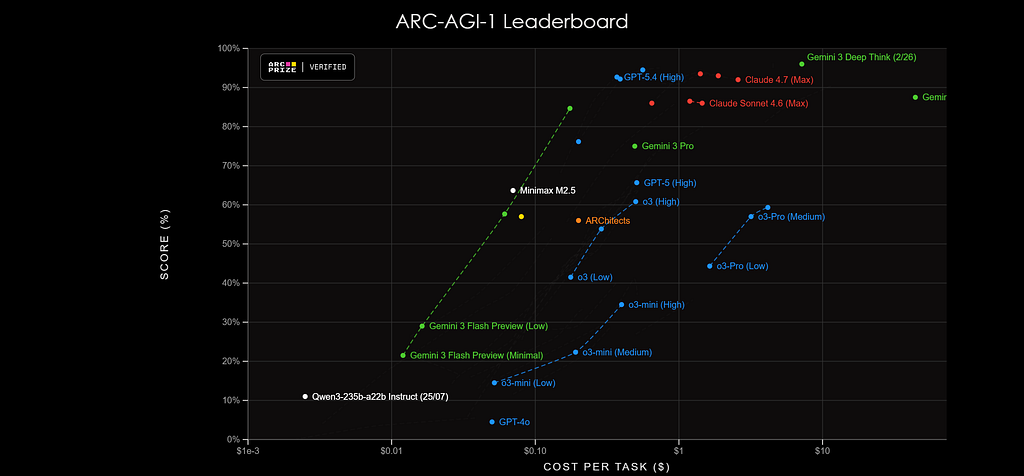
The verified ARC-AGI-1 leaderboard tells a different story now. Gemini 3 Deep Think leads at approximately 96% — but what’s striking isn’t just the top score, it’s the curve. GPT-4o, which not long ago represented the state of the art, sits near the bottom of the chart at roughly 0–5%. The entire leaderboard compressed upward in the span of a single year.
Even more telling is the cost-vs-performance axis. Claude Sonnet 4.6 and Claude 4.7 are hitting the 85–93% range at a fraction of the cost of earlier high-compute configurations. Reasoning at human-level fluid intelligence is not just getting better — it’s getting cheaper.
For context, this benchmark took four years to go from 0% with GPT-3 to barely 5% with GPT-4o. It then leapfrogged past the human baseline within one more year. That is not a gradual curve. That is a step change.
PhD-Level Reasoning — No Longer a Safe Harbour
OpenAI’s o3 achieved 87.7% on GPQA Diamond — a benchmark of PhD-level science questions across biology, chemistry, and physics. The o4-mini model scored 98.4% on AIME 2025, the high-school mathematics olympiad that trips up most human competitors. These aren’t easy multiple-choice tests. They require multi-step reasoning, domain knowledge, and the ability to catch your own errors.
From Benchmarks to Real-World Reasoning
A 2025 study using a naturalistic reasoning benchmark — the Watson & Holmes detective game — tested AI models against real human participants over nine months. The results were stark: AI performance rose from the lower quartile of human performance to approximately the top 5% in that same window. Not on a curated test — on open-ended, narrative-driven reasoning under uncertainty.
Meanwhile, Stanford’s 2025 AI Index reported that o1 scored 74.4% on an International Mathematical Olympiad qualifying exam, compared to GPT-4o’s 9.3% — a 8x improvement driven purely by teaching the model to reason step by step rather than just predict the next token.
What the Experts of AI Are Saying
The people who built these systems are themselves divided — and that division is more informative than any single opinion.
Geoffrey Hinton — 2024 Nobel Prize winner in Physics and one of the architects of modern deep learning — estimates that superintelligence could emerge within five to twenty years. He has warned publicly about the emergence of “digital beings that think in much the same way as we do and that are a lot smarter than us,” and has called for urgent international cooperation on AI safety. He left Google specifically so he could speak freely about these concerns.
Yann LeCun — Chief AI Scientist at Meta — takes a sharply different view. He argues that current AI systems still fundamentally lack what he calls a “world model” — an embodied understanding of physical reality that animals develop through direct experience. His pointed assessment: AI systems today “still lack the general common sense of a cat.” LeCun predicts a new AI revolution within three to five years, but driven by world-model architectures — not the language models dominating headlines today.
The tension between these two positions is itself illuminating. Hinton says the reasoning is already deeply impressive and the risks are real and near. LeCun says the reasoning is brittle and fundamentally limited without grounding in the physical world. Both are right about different slices of the problem — and that’s precisely what makes the Cognitive Singularity such a nuanced and consequential question.
What’s notable is that neither of them is saying “don’t worry, we’re nowhere close.” The debate is about how and when, not whether.
A Closing Thought
The Cognitive Singularity, if and when it arrives, won’t announce itself with a dramatic moment. There won’t be a headline that reads: “Machine Outreasons Humanity.”
It will be gradual, domain by domain, context by context. One day we’ll realise that the reasoning we’re most proud of — the creative leaps, the ethical judgments, the wisdom accumulated over a lifetime — is something machines can perform too, perhaps better, perhaps differently.
That moment isn’t a cause for despair. But it does demand that we think carefully — right now, while we still have the luxury of doing so on our own terms — about what reasoning is for.
Because the point of cognition was never computation. It was always understanding. And understanding, ultimately, is in service of living well.
The machines are getting smarter. The question is whether we’re getting wiser.
If this made you think — or disagree — drop a comment below. The best reasoning happens in conversation.
Tags: Cognitive Computing · Artificial Intelligence · Machine Learning · Future of AI · Technology · Philosophy of Mind
The Cognitive Singularity: What Happens When Machines Outlearn Humans at Reasoning? was originally published in Towards AI on Medium, where people are continuing the conversation by highlighting and responding to this story.