Cursor’s moat was never the architecture. The leak just made that impossible to ignore.

On March 31, 2026, 512,000 lines of Claude Code’s source code hit the public internet. Within hours, developer Twitter had catalogued every unreleased feature. KAIROS, the always-on background agent. Dream, the self-healing memory system. Coordinator Mode, where one Claude spawns and manages multiple parallel workers.
Cursor’s Slack channels, presumably, had a very interesting morning.
But here is the thing most coverage missed:
The leak did not expose Cursor’s weakness. It exposed Cursor’s strategy.
And that strategy is more interesting than anyone is giving it credit for.
What Cursor Actually Is
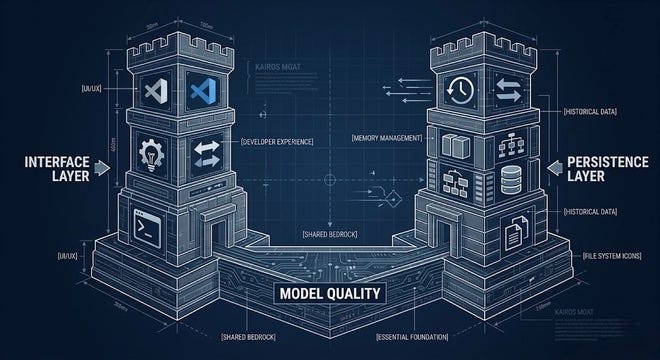
Cursor is not an AI company in the way Anthropic is. It is, at its core, a bet on the interface layer.
The company raised $2.3 billion at a $29.3 billion valuation in November 2025. It crossed $500 million ARR by mid-2025, used by over half the Fortune 500. Its Composer 2 model, built on Kimi K2.5 with custom reinforcement learning, scored 61.3 on CursorBench and 73.7 on SWE-bench Multilingual.
But here is the detail that tells you everything about Cursor’s actual thesis:
Cursor’s best experience runs on Claude models.
On SWE-bench Verified, Claude Opus 4.6 scores 80.8% and Gemini 3.1 Pro scores 80.6%. Cursor routes through both. The tool that competes with Anthropic’s CLI runs on Anthropic’s model.
That is not a contradiction. It is a deliberate bet.
Cursor’s argument has always been: the model is a commodity layer, the interface is the moat. Autocomplete that achieves a 72% acceptance rate via the Supermaven engine they acquired. Multi-file editing that feels native. An IDE that thinks in agent-first terms, not chat-first terms. The developer never leaves their environment. That is worth $29 billion to the market because it is worth 8 hours a day to the developer.
The leak did not challenge that thesis. It confirmed it.
What the Leak Actually Revealed About the Gap
The most technically significant discovery in the Claude Code source is not KAIROS or the Buddy System. It is the three-layer memory architecture.
At the core is MEMORY.md, a lightweight index of approximately 150 characters per line that stays permanently in context. It does not store data. It stores locations. Actual project knowledge is distributed across topic files fetched on demand. Raw transcripts are never fully reloaded but can be searched for specific identifiers. The agent treats its own memory as a hint requiring verification against the actual codebase, not as ground truth.
The autoDream system runs as a forked subagent during idle periods, requiring three gates to trigger: 24 hours since last consolidation, at least 5 new sessions, and a consolidation lock to prevent concurrent runs. It merges duplicate observations, removes logical contradictions, and converts vague signals into verified facts.
This is the thing Cursor does not have.
Not because Cursor’s engineers could not build it. Because Cursor’s architecture is IDE-native, which means it operates within session boundaries by design. The Dream system works precisely because Claude Code operates at the filesystem level, maintaining context that persists across sessions, across days, across the arc of a project.
These are different product philosophies, not a capability gap.
Cursor built a smarter editor. Anthropic built a persistent colleague. The leak just confirmed how far apart those visions actually are.
KAIROS Is the Real Question

The feature that should give Cursor’s product team genuine pause is not memory consolidation. It is KAIROS.
KAIROS is Anthropic’s always-on background agent, mentioned over 150 times in the leaked source. When active, it maintains append-only daily log files, receives periodic <tick> prompts to decide whether to act or stay quiet, and operates under a 15-second blocking budget. Hence, it never disrupts the developer's active work. It gets tools that regular Claude Code does not have: SendUserFile, PushNotification, and SubscribePR.
The vision is not subtle. KAIROS is Claude Code, transforming from a tool you invoke into a colleague that is always present. It watches your repo overnight. It files a pull request while you sleep. You wake up to problems it identified and suggested fixes for. You approve or reject. The agent keeps moving.
That is a fundamentally different relationship between developer and AI than anything Cursor has shipped.
Cursor’s Composer agents are impressive. But they operate within your active session. You are still in the driver’s seat, directing each change. KAIROS assumes you are not there. It assumes the agent can be trusted to determine what is worth doing without being told.
That requires a different trust model. A different permission architecture. A different product philosophy.
And now, thanks to a misconfigured .npmignore, every detail of how Anthropic built it is permanently public.
What Cursor Does With This
Here is where the framing shifts.
The natural read of the leak is: Cursor now has Anthropic’s roadmap. They can see KAIROS coming. They can build their own version before Anthropic ships it.
But that reading misunderstands what makes KAIROS hard.
The source code shows the orchestration logic. The tick system. The daily logs. The subagent architecture. What it does not show is the
model quality required to make an always-on agency trustworthy.
KAIROS is not hard to build. It is hard to build well. An always-on agent that proactively acts on your codebase without being told needs judgment that does not hallucinate, does not over-reach, and does not create more problems than it solves. That judgment comes from the underlying model, not the harness.
Cursor routes through Claude models. If Cursor ships a KAIROS equivalent, it will also need to route through Claude models or a comparable frontier model to make the judgment quality acceptable. Which means Cursor is not really competing with Anthropic’s architecture. It is competing with Anthropic’s model.
The moat was never the CLI. The moat was always Claude. The leak just made the CLI irrelevant as a differentiator.
The Honest Competition That Emerges
The Claude Code leak forces a cleaner competitive frame than anyone was using before.
Cursor’s actual bet: The developer’s environment is the moat. 8 hours a day of IDE-native, autocomplete-first, session-bound interaction is more valuable than terminal-native autonomy for most developers most of the time. A 72% autocomplete acceptance rate is a productivity multiplier that no amount of background agent sophistication matches for daily coding work.
Anthropic’s actual bet: The project’s timeline is the moat. Persistent memory across sessions, proactive overnight action, and KAIROS-level always-on presence turn Claude Code from a tool into a team member. That is a different value proposition than faster autocomplete.
The developer stack that emerges: Most professional developers in 2026 use 2.3 tools on average. The most common pattern is Cursor for daily editing plus Claude Code for complex tasks. These tools are not competing for the same hour. They are competing for different parts of the workflow.
The leak did not change that. It confirmed it.
Cursor should ship faster autocomplete and better Composer agents. Anthropic should ship KAIROS. The market is large enough for both.
What the leak actually did was remove the pretense that either company’s CLI architecture was a secret. Now, everyone knows what Anthropic built. Now Cursor knows exactly what it is not. And that is a more honest competition than the one that existed before March 31.
The interface layer versus the persistence layer. Pick your moat.
The Claude Code Leak Didn’t Hurt Cursor. It Forced a More Honest Competition. was originally published in Towards AI on Medium, where people are continuing the conversation by highlighting and responding to this story.