Part 1 of 2 — An engineering view of how LLMs, physics-informed ML, and numerical solvers can work together without pretending that AI guarantees physical correctness.
LLMs can produce fluent explanations of thermodynamics, fluid mechanics, and control theory. The concern, from an engineering perspective, is not whether an answer sounds correct. The concern is whether it satisfies conservation laws, boundary conditions, and operational constraints. Ask a general-purpose LLM to predict the pressure drop across a pipe given real boundary conditions and specific fluid parameters. Not describe the concept, but compute a physically valid answer. The output may be confident and well-formatted. It may also be wrong in ways that are difficult to detect without a reference solver.
This is not a failure of scale or data quality. It is a structural limitation: standard LLMs are trained to predict the next token. Physics is governed by differential equations that must hold everywhere in a domain, not just in regions well-represented by the training distribution.
Physics-informed AI systems are an emerging research direction that addresses this gap by combining LLM reasoning with solvers, physics-based loss terms, and structured numerical outputs. To be precise upfront: these are not hard constraints that guarantee correctness. They are inductive biases, soft penalties and architectural choices that make physically plausible outputs more likely within the training regime. Outside it, violations remain possible.
This article is Part 1 of a two-part series for ML engineers. Part 1 covers the foundations, the three main architectural approaches, and a concrete applied example. Part 2 will go deeper on training dynamics, weight scheduling for physics losses, and production deployment patterns.
Working Definition Physics-informed AI refers to hybrid systems that combine learning-based models with physics-based structure via loss penalties, constrained optimizers, and solver integration to bias predictions toward physically plausible behavior. These methods reduce, but do not eliminate, physical violations. They are inductive biases, not correctness certificates.
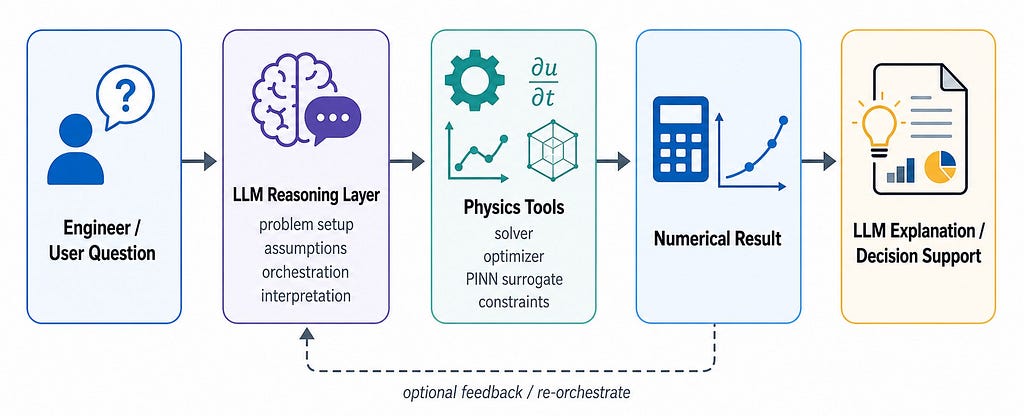
From an engineering standpoint, the most useful role for LLMs in physics-heavy systems is not replacing solvers. It is helping connect problem descriptions, model setup, simulation workflows, and result interpretation into a coherent reasoning layer. The solver stays. The LLM earns its place around it.
The Core Problem: LLMs Don’t Know They’re Wrong
Consider a standard transformer trained on scientific literature. It has read thousands of papers on thermodynamics. It can write about the first and second laws eloquently. But internally, there is no mechanism that enforces those laws. The model has no loss gradient that punishes energy non-conservation. It learned thermodynamics the same way it learned song lyrics, as a statistical pattern over tokens. This creates a dangerous failure mode: confident, fluent, physically wrong outputs.
For applications like data center cooling optimization, structural health monitoring, climate modeling, or drug discovery, domains where LLMs are increasingly being deployed, this is not a minor inconvenience. It is a fundamental reliability problem.
What Physics-Informed Neural Networks Taught Us
Before PI-LLMs, there were Physics-Informed Neural Networks (PINNs), introduced by Raissi, Perdikaris, and Karniadakis in 2019. The core idea was elegant: Instead of training a neural network purely on data loss, add a physics residual loss, a term that penalizes the network whenever its outputs violate a governing PDE (partial differential equation). For a system governed by PDE F(u, x, t) = 0, the total loss becomes:
import torch
import torch.nn as nn

class PINN(nn.Module):
    def __init__(self, layers):
        super().__init__()

        modules = []
        for i in range(len(layers) - 2):
            modules.append(nn.Linear(layers[i], layers[i + 1]))
            modules.append(nn.Tanh())

        modules.append(nn.Linear(layers[-2], layers[-1]))
        self.net = nn.Sequential(*modules)

    def forward(self, x, t):
        return self.net(torch.cat([x, t], dim=1))


def physics_loss(model, x, t):
    # Enforce 1D heat equation: du/dt - alpha * d²u/dx² = 0
    x.requires_grad_(True); t.requires_grad_(True)
    u = model(x, t)
    u_t = torch.autograd.grad(u, t, grad_outputs=torch.ones_like(u), create_graph=True)[0]
    u_x = torch.autograd.grad(u, x, grad_outputs=torch.ones_like(u), create_graph=True)[0]
    u_xx = torch.autograd.grad(u_x, x, grad_outputs=torch.ones_like(u_x), create_graph=True)[0]
    return torch.mean((u_t - 0.01 * u_xx) ** 2)


def total_loss(model, x_data, t_data, u_true, x_phys, t_phys, lambda_phys=1.0):
    loss_data = torch.mean((model(x_data, t_data) - u_true) ** 2)
    loss_phys = physics_loss(model, x_phys, t_phys)
    return loss_data + lambda_phys * loss_phys
The physics residual is evaluated not just at training points, but at collocation points, arbitrary locations in the domain where the PDE must hold. This forces the model to generalize consistently even where it has no data. Penalty-based physics biasing is the philosophical ancestor of everything that follows.
From PINNs to Physics-Informed AI Systems: Bridging the Gap
PINNs work well for well-defined PDEs with known governing equations on small, focused domains. But real-world systems are messier, and this is where language models enter the picture. To be precise about terminology: “Physics-Informed LLMs” as a named, standardized class does not yet exist the way PINNs do. What does exist, and is actively being researched, are hybrid systems that pair LLM reasoning with physics-based components. NVIDIA’s PhysicsNeMo framework is a strong real-world example of physics-informed AI infrastructure, though it is broader than LLM-specific work and covers neural operators, PINNs, and multi-physics surrogate models. Calling it an “LLM framework” would be inaccurate.
One concrete early example of a genuine PI-LLM system: PE-GPT (Lin et al., 2024), a custom LLM for power converter modulation design that combines in-context learning with tiered physics-informed neural networks to guide users toward valid modulation parameters through dialogue. It is narrow in scope, but it is real, it is published, and it illustrates exactly what this hybrid architecture looks like in practice. Similarly, GPT-PINN (Chen & Koohy, 2024) extends generative pre-training toward parametric PDE solving, a meaningful step toward models that reason over physics problem families rather than single instances.
The practical framing: LLMs handle the language-physics interface, translating natural language problem descriptions, orchestrating solver calls, and interpreting results. Physics components handle the math. Neither does the other’s job well alone.
There are three active directions for building these hybrid systems:
Approach 1: Physics-Penalized Fine-Tuning
The most practical near-term approach. Take a pretrained LLM and fine-tune it with an augmented loss that includes physics residuals evaluated against the model’s numerical outputs. The physics penalty steers the output distribution; it does not lock it.
Note: All code snippets in this article are illustrative. They show the architectural pattern, not a production-ready implementation.
from transformers import AutoModelForCausalLM, AutoTokenizer
import torch

model_name = "mistralai/Mistral-7B-Instruct-v0.2"
tokenizer = AutoTokenizer.from_pretrained(model_name)
model = AutoModelForCausalLM.from_pretrained(model_name, torch_dtype=torch.float16)

def extract_numerical_output(text):
    # Regex parsing breaks gradient flow.
    # A real implementation needs a differentiable numerical head.
    import re
    results = {}

    for name in ["energy_in", "energy_out"]:
        match = re.search(fr'{name}[:\s]+([0-9.]+)', text.lower())
        if match:
            results[name] = torch.tensor(float(match.group(1)))

    return results


def physics_consistency_penalty(predictions: dict) -> torch.Tensor:
    # E_in - E_out - dE_stored/dt = 0, simplified
    penalty = torch.zeros(1, requires_grad=True)

    if 'energy_in' in predictions and 'energy_out' in predictions:
        energy_residual = predictions['energy_in'] - predictions['energy_out']
        penalty = penalty + torch.mean(energy_residual ** 2)

    return penalty


def physics_augmented_loss(lm_loss, model_output_text, lambda_physics=0.1):
    predictions = extract_numerical_output(model_output_text)
    phys_penalty = physics_consistency_penalty(predictions)
    return lm_loss + lambda_physics * phys_penalty
The challenge here is the differentiability gap. Standard LLM outputs are discrete tokens, not differentiable tensors. The most principled solution emerging in research is the hybrid latent space approach: rather than backpropagating through string outputs, the LLM generates a latent embedding passed directly to a differentiable physics head. The loss is computed on the head’s numerical output, and gradients flow back into the transformer blocks, effectively teaching the attention mechanism to attend to features that reduce PDE residuals. In practice, solutions include:
- Hybrid latent with differentiable physics head: most principled; gradient flows back into transformer weights via the numerical head
- Structured output fine-tuning: forcing the model to output JSON with numerical fields that can be evaluated against physics constraints
- Soft prompting: keeping the language model frozen and training only a physics-aware prefix
- Auxiliary regression heads: adding a numerical prediction head alongside the language head
Approach 2: Retrieval-Augmented Physics (RAP) — The Most Realistic Today
Instead of baking physics into weights, augment inference with a physics solver as a tool call. The LLM acts as a reasoning orchestrator; the solver provides numerically grounded answers. This is arguably the most production-viable approach right now, because physics correctness comes from the solver, not from the LLM’s weights, and is therefore not subject to hallucination or distribution shift.
import numpy as np

def poiseuille_pipe_flow(mu, dp_dx, diameter, n_points=100):
    """
    Analytical Poiseuille flow profile for steady, fully developed,
    laminar flow in a circular pipe.
    """
    r = np.linspace(0, diameter / 2, n_points)
    R = diameter / 2
    u = (1 / (4 * mu)) * (-dp_dx) * (R**2 - r**2)
    return r, u


def physics_tool_call(query: str) -> str:
    """
    Physics solver exposed to LLM via function calling.
    LLM decides when to invoke this based on query type.
    """
    params = parse_physics_query(query)

    if params['type'] == 'pipe_flow':
        r, u = poiseuille_pipe_flow(
            mu=params['viscosity'],
            dp_dx=params['pressure_gradient'],
            diameter=params['pipe_diameter']
        )
        return f"Velocity profile computed. Max velocity: {u.max():.4f} m/s at centerline."

    return "Physics solver: unsupported query type."


physics_tool_schema = {
    "name": "physics_solver",
    "description": "Calls a physics solver for supported equation types when numerical grounding is required.",
    "parameters": {
        "type": "object",
        "properties": {
            "query": {"type": "string", "description": "Physical problem description with numerical parameters"},
            "equation_type": {"type": "string", "enum": ["heat", "fluid", "structural", "electromagnetic"]}
        },
        "required": ["query", "equation_type"]
    }
}
This approach has a meaningful reliability advantage: the answer is grounded in an explicit solver, which makes it more reliable when the assumptions, equations, parameters, and boundary conditions are valid. The LLM handles language understanding, problem decomposition, and result interpretation. The solver handles the math. Physics correctness is bounded by the validity of the model inputs, not by the LLM’s weights.
Applied to Autonomous Drone Control
Consider a last-mile delivery drone operating in a real urban environment: variable wind, dynamic obstacles, battery constraints, and a physics model that was never trained on every possible gust profile it will encounter. The question is not whether the onboard AI has read fluid dynamics papers. The question is whether its decisions respect the equations of motion when it matters.
This is the gap physics-informed hybrid systems are designed to address, and where a pure LLM-only approach breaks down structurally, not just occasionally. Recent work by Ni & Qureshi (2024) on physics-informed neural motion planning formalizes this intuition, embedding physics-driven objective functions directly into neural motion planners to handle kinematic constraints under dynamic uncertainty.
The Real Control Stack
First, let’s be accurate about what serious UAV autonomy actually looks like. PID controllers, the classic intro textbook approach, are insufficient for aggressive flight envelopes, payload variation, and wind disturbance rejection at the level Amazon Prime Air or Wing operate. The real stack is distributed across layers that operate at very different timescales:
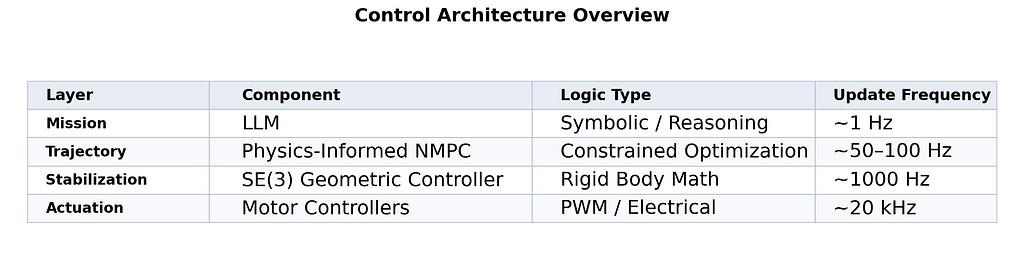
Each layer has a distinct job and operates at a frequency that reflects its physical reality. The LLM does not touch motor commands. The NMPC does not understand that the customer address changed. The separation is deliberate and important, and the frequency gap between layers tells you exactly why.
Where Physics-Informed Learning Enters
The weakest link in this stack is the dynamics model inside the NMPC. NMPC optimizes control inputs over a receding horizon by repeatedly solving:
minimize Σ [ state_cost(x_k) + input_cost(u_k) ]
subject to x_{k+1} = f(x_k, u_k) ← dynamics model
u_min ≤ u_k ≤ u_max ← actuator limits
collision constraints
The function f(x, u), the drone’s dynamics model, is where physics-informed neural networks become genuinely useful. First-principles rigid body dynamics handle the bulk of the physics cleanly. But rotor aerodynamics, blade-vortex interactions, and ground effect are notoriously difficult to model from first principles alone. A PINN-based surrogate learns the residual between the first-principles model and real flight data, while being penalized for violating the equations it is supposed to approximate.
import torch
import torch.nn as nn

class DroneRigidBodyResidual(nn.Module):
    """Learns aerodynamic residuals (rotor wake, blade-vortex interaction,
    ground effect) not captured by first-principles rigid body equations."""
    def __init__(self, state_dim=12, action_dim=4, hidden=128):
        super().__init__()
        self.net = nn.Sequential(
            nn.Linear(state_dim + action_dim, hidden), nn.SiLU(),
            nn.Linear(hidden, hidden), nn.SiLU(),
            nn.Linear(hidden, state_dim)
        )

    def forward(self, state, action):
        return self.net(torch.cat([state, action], dim=-1))


def newton_euler_residual_loss(model, states, actions):
    """Toy example: penalize one simplified rotational consistency term."""
    Ixx, Iyy, Izz = 0.0142, 0.0142, 0.0284
    p, q, r = states[:, 9], states[:, 10], states[:, 11]
    gyro_x = (Iyy - Izz) * q * r
    residual = model(states, actions)
    alpha_x_pred = residual[:, 9]
    return torch.mean((alpha_x_pred - gyro_x / Ixx) ** 2)


def boundary_condition_loss(model, states, actions):
    # placeholder — enforce domain-specific constraints here e.g. rotor speed limits
    return torch.zeros(1)


def total_surrogate_loss(model, states, actions, next_states,
                          w_data=1.0, w_phys=0.5, w_bc=0.1):
    """
    L_total = w_data*L_data + w_phys*L_phys + w_bc*L_bc
    w_phys too high → trivial solution (velocities collapse to zero)
    w_phys too low  → physics bias becomes ineffective
    Target: the Pareto front between data fidelity and physical consistency.
    """
    data_loss = torch.mean((model(states, actions) - (next_states - states)) ** 2)
    phys_loss = newton_euler_residual_loss(model, states, actions)
    bc_loss = boundary_condition_loss(model, states, actions)
    return w_data * data_loss + w_phys * phys_loss + w_bc * bc_loss
What the LLM Actually Does
The LLM operates at mission level, not control level. When the wind gust hits and NMPC signals a trajectory deviation, the LLM reasons over:
- Current battery state vs. revised flight path energy cost
- Whether to abort delivery, hover and wait, or replan to a closer drop point
- Customer-facing communication if delivery is delayed
- Logging a structured incident report for fleet operations
This is language, context, and decision-making under uncertainty, exactly what LLMs are good at. The NMPC handles the physics. The geometric controller handles attitude. The PINN surrogate makes the dynamics model more accurate in conditions where first-principles equations are incomplete.
None of these components do the other’s job. That separation is the architecture, and the frequency table above shows exactly why it has to be that way.
What This Is NOT
Before the limitations, one explicit boundary worth drawing. Physics-informed AI does not replace solvers, guarantee physical correctness, or eliminate the need for domain expertise. If your application requires certified safety guarantees, such as flight control certification, structural load sign-off, or medical device approval, you still need traditional validated methods. These hybrid systems live in the gap between brittle heuristics and full-blown simulation, where reasoning speed, adaptability, and physical plausibility matter more than bit-exact solutions. Know which side of that line your problem sits on before committing to this approach.
Current Limitations (Current Limitations and Practical Risks)
Physics-informed AI systems are not production-ready for most high-stakes use cases. A critical point upfront: a physics-penalized model can still violate physics, especially outside its training distribution, when the wrong PDE is chosen, when collocation sampling is poor, or when weight tuning is miscalibrated. Treat these methods as strong inductive biases, not correctness guarantees.
1. Differentiability bottleneck. Physics losses require differentiable outputs. Discrete token generation breaks the gradient chain. Hybrid latent spaces and auxiliary heads are workarounds, not complete solutions.
2. The OOD trap. Physics penalty terms improve generalization within the training regime, but if the system encounters a regime where the underlying PDE changes, laminar flow becoming turbulent, subsonic becoming transonic, stable flight becoming a vortex ring state, the “informed” part of the model may actually create a false sense of security. The model has learned to be confident in a physics that no longer applies.
3. PDE selection is domain-specific. You need deep physics expertise to choose the right governing equations. Wrong constraints are worse than no constraints. They bias the model toward the wrong physics with high confidence.
4. Computational cost of higher-order derivatives. Evaluating the Jacobian required for first-order PDEs already adds overhead. For second-order PDEs like the heat equation, which requires the Hessian, expect 2x to 4x VRAM usage during training compared to standard fine-tuning. This directly affects what you can train on a given hardware budget.
5. Collocation point sampling is non-trivial. Where you enforce physics in the domain matters enormously. Active learning methods, like those used in adaptive PINNs, are needed for complex geometries and high-dimensional state spaces.
Where This Is Going
The research frontier is moving fast:
- Neural Operators (FNO, DeepONet) are being integrated with transformer backbones to learn solution operators for entire PDE families, not just specific instances
- SymbolicGPT-style models that jointly reason in natural language and symbolic math are narrowing the gap between LLM and CAS (computer algebra system)
- Sobolev Training, which penalizes not just the value residual but its derivatives, is gaining traction as a way to ensure the model’s learned slope matches physical reality, not just its point predictions
- Multi-physics foundation models trained on coupled thermal-fluid-structural data are beginning to appear in research preprints
The end state is not an LLM that memorized physics textbooks. It is a hybrid system where physical laws are load-bearing walls in the architecture, not decorative wallpaper, and where the probability of a physically impossible recommendation is systematically lower than in a pure language model. That is a meaningful engineering improvement. It is not the same as correctness.
Getting Started
From my own engineering perspective, the practical question is rarely whether AI can replace the solver. It is whether AI can help set up the problem faster, choose reasonable assumptions, interpret results, or detect when the workflow is leaving its valid operating region. That framing leads to much better system design than asking the LLM to do physics directly. If you want to experiment today:
- Start with PINNs: the DeepXDE is the fastest on-ramp
- Try RAP first: wrap a physics solver (FEniCS, OpenFOAM, SciPy) as a tool call for your LLM
- Fine-tune on structured outputs: force your LLM to output JSON with numerical fields you can evaluate against physics constraints
- Read the foundational papers: Raissi et al. (2017, 2019), Karniadakis et al. (2021 Nature Reviews)
- Read the emerging PI-LLM papers: PE-GPT (Lin et al., 2024), GPT-PINN (Chen & Koohy, 2024), Physics-Informed Neural Motion Planning (Ni & Qureshi, 2024)
- Explore: NVIDIA PhysicsNeMo, broad physics-informed AI infrastructure, not LLM-specific but highly relevant for understanding the production landscape
The practical question is where these systems can add value today, and where traditional solvers and validated models must remain the authority. That line is not fixed. It moves as the tooling matures. Knowing where it sits in your domain is the first engineering decision to make.
Coming in Part 2
Part 2 will go deeper on the practical side, specifically how to tune physics loss weights during training, and how RAP-style architectures look in a real inference pipeline. Less theory, more implementation detail.
Physics-Informed AI: Why LLMs Need Solvers, Constraints, and Physical Laws was originally published in Towards AI on Medium, where people are continuing the conversation by highlighting and responding to this story.