An unfortunate trait on TPoT is intellectual snobbery.
“Read what’s Lindy,” they might sniff. “I don’t read anything published post-WW2.”
Examples abound: Read papers, not pop science. Scroll Tech Twitter, not TikTok.
One subtle form of snobbery has to do with a science-of-learning concept called “active recall.”
Here’s how it goes:
- “Most people are studying ineffectively.
- One example of ineffective study is passive review, where you simply re-read the material, hoping to absorb it through some hand-wavey osmosis.
- This is easy and real learning is difficult so obviously it was too good to be true, you dolt.
- The better way to learn is ✨ active recall ✨ using ✨spaced repetition✨ systems like Anki, wherein:
- You force yourself to reconstruct the concept from scratch, rather than simply re-reading it,
- You review easy concepts less and hard concepts more (the opposite of what you’re tempted to do),
- The software will prompt you to remember each flashcard just before you forget it, an algorithm based on studies that show how long it takes for us to forget new information”
That’s fine – if you have specific, complex cognitive tasks to undertake (e.g. med school exams).
But most of us aren’t aspiring MDs. Most of us just want our lives to be a bit better without spending hours a week to get that benefit. We want the 80/20, or even the 64/4.
Most importantly: we’re busy, lazy, or tired. We don’t have the willpower for a new habit.
Making habits easy to do is one of the cornerstones of habit creation. That’s why I’m here to defend passive review.
I’ll explain:
- What passive review looks like for me
- Why I think it’s underrated
What passive review looks like for me
After my most recent breakup, I slept over at a friend’s place. They helped me deal with the initial shock, the way that only my friends in tech would – cocktails at night, tech stack recommendations in the morning.
Their simplest recommendation was to install a Readwise widget on my iPhone home screen.
I already use Readwise (an app that lets you store your highlights & notes from what you read on any website/device). My friend suggested an add-on – drag the Readwise widget to the top of my home screen:
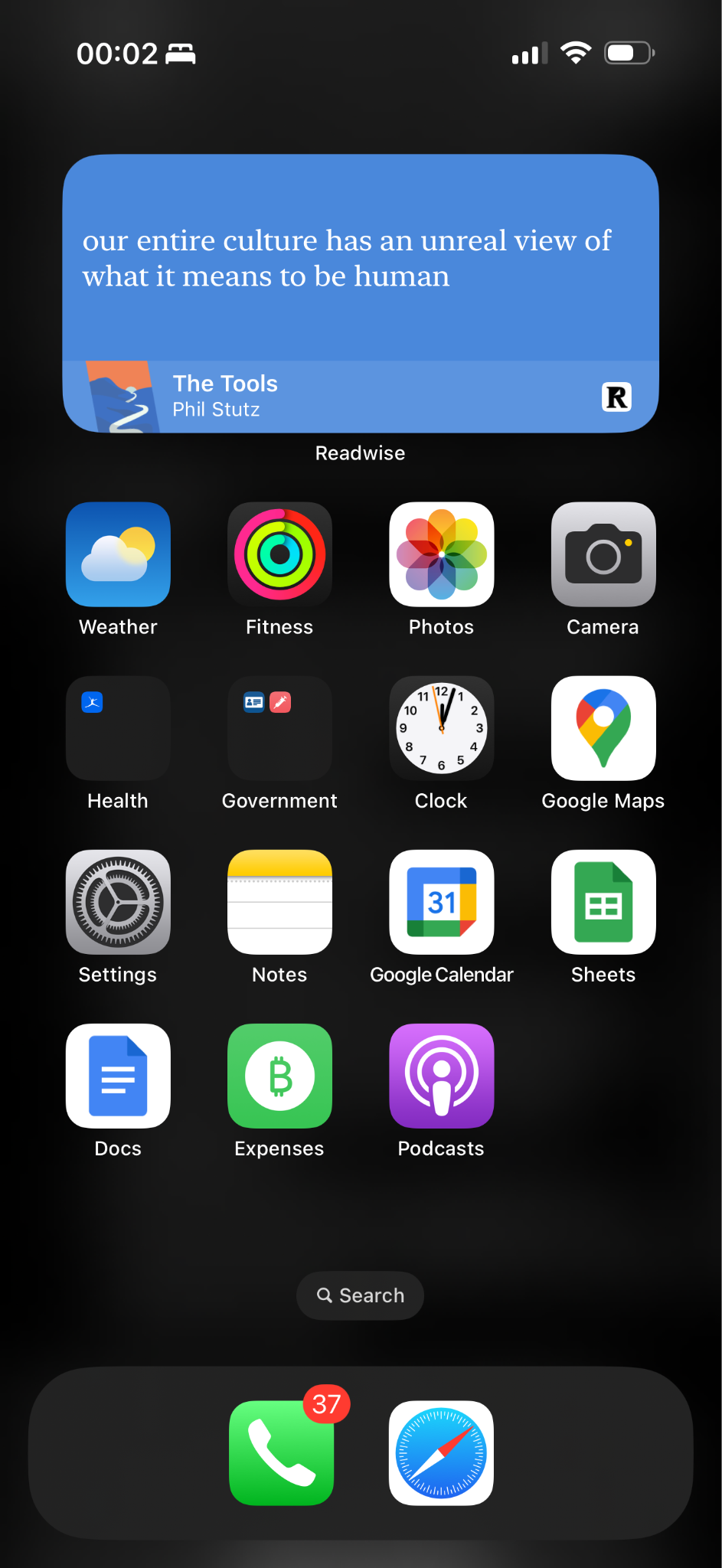
The widget displays a new quote every time you unlock your phone.
I already have a snippet from my favourite essay on my lock screen. This was a natural extension of that – snippets from everything I’d ever put into Readwise, cycled through and displayed with no effort from me.
Almost instantly, I saw the value of it.
Every time I used my phone, I saw a fresh quote from something I’d read in the past. I’m a bit of a self-help bitch 💅, so a lot of these were motivational quotes and the like.
And I did notice a small-but-appreciable boost in mood and motivation. I think about these quotes and ideas more. I feel more optimistic. I literally feel like I have extra consciousness to use in pursuit of my goals.
Why I think passive review is underrated
To be clear, I'm not arguing that passive review ought to supplant active recall in all contexts. Like I said, if you have a specific task you're training for (e.g. language exam), then active recall just makes sense.
If, however, you don't have a looming skill evaluation coming up, passive review can be a simple and literally free (in terms of effort) boost to your experience of life. Simply by encouraging you to consume positive content that you've already bookmarked.
Sounds mundane. (And it kinda is).
But this is extra powerful because it’s so easy.
Most new habits require some effort to keep up, even once the habit is established.
This requires literally no effort. Your eyes are naturally drawn to the top of the screen, because you’re curious about the new quote that’s rendered (and because it changes colour each time). It takes more effort to not do the habit.
It’s quite literally a free lunch.
Discuss