
I Passed the DP-600 Fabric Analytics Engineer Exam — Here’s My Honest Study Plan (With What I’d Skip)
Six weeks, two failed practice runs, one embarrassingly wrong assumption about what the exam actually tests, and the exact study approach that finally got me there. No sponsored course recommendations. No affiliate links. Just what actually worked.
The first time I sat a proper DP-600 practice exam, I scored 58%.
The passing threshold is 700 out of 1000 — roughly 70%. I was not close.
What made that score particularly uncomfortable was that I’d been working in Microsoft Fabric for over a year at that point. I wasn’t a beginner. I was using Lakehouse, Notebooks, Pipelines, and Power BI Direct Lake mode in production. I knew this stuff. Or so I’d told myself.
What that practice score taught me — painfully, efficiently — was the gap between knowing how to use a platform and knowing how to explain it at the conceptual level the exam requires. Those are genuinely different skills. And if you walk into the DP-600 assuming that practical experience alone will carry you, you will get an uncomfortable surprise somewhere around question 14.
I passed on my first official attempt with a score in the low 800s. This article is exactly how I got there — what I studied, what I skipped, what I’d do differently, and the four or five specific things that mattered more than everything else combined.
First: What the DP-600 Actually Is (And Who It’s For)
Before we get into the study plan, I want to be clear about what this exam actually tests — because most of the study guides I found online described it at a level of abstraction that wasn’t useful.
The DP-600 certifies you as a Microsoft Fabric Analytics Engineer Associate. In practice, this means the exam tests your ability to:
- Design and implement Lakehouse and Data Warehouse solutions in Fabric
- Ingest, transform and model data using Pipelines, Dataflows Gen2, and Notebooks
- Design semantic models and optimize DAX
- Implement security, row-level security, and workspace governance
- Monitor, troubleshoot, and optimize Fabric workloads
The exam is 40–60 questions, multiple choice and scenario-based, with a time limit of 100 minutes. Microsoft has stated the approximate skill area weightings as:
- Implement and manage a Fabric analytics solution: ~35%
- Ingest and transform data: ~25%
- Implement and manage semantic models: ~20%
- Explore and analyze data: ~20%
I’m telling you those percentages because I initially ignored them and spent roughly equal time on all areas. That was wrong. The first category — implementing and managing the overall Fabric solution — is the heaviest section and the one most people under-prepare for because it feels abstract compared to the hands-on work of building pipelines.
The Six Weeks Before I Passed
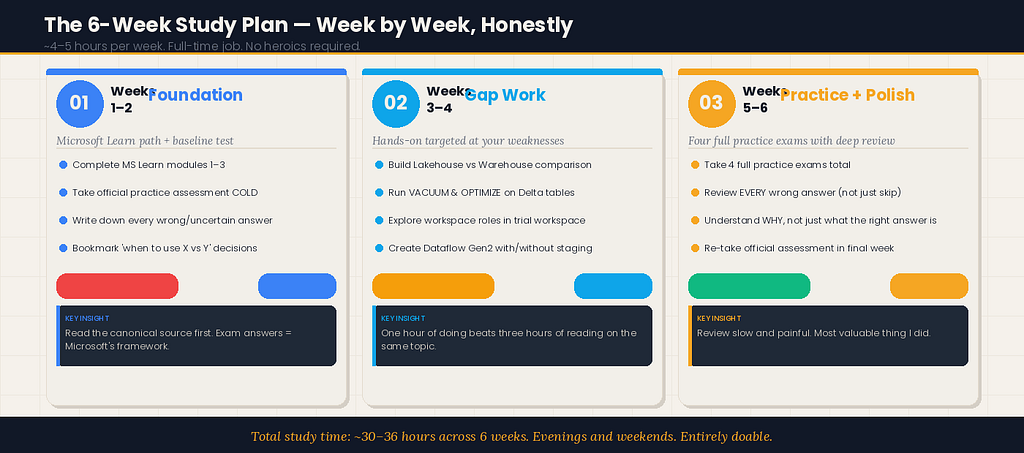
I’ll be honest about the timeline because it sets realistic expectations: I studied seriously for six weeks. Not intensively every single day — maybe four to five focused hours per week, more in the final two weeks. I have a full-time job and this was a side project, not a sprint.
Here’s roughly how those six weeks broke down.
Weeks 1–2: Understanding the landscape
I started with Microsoft Learn. Not because it’s the most exciting content in the world — it isn’t — but because it’s the source of truth for what the exam considers correct. The exam is written by Microsoft. Microsoft Learn is written by Microsoft. When there’s a conceptual question about how something should work in Fabric, the answer Microsoft wants is the one on their own documentation platform, not the workaround you’ve been using in production.
I went through the official DP-600 learning path on Microsoft Learn: learn.microsoft.com/credentials/certifications/fabric-analytics-engineer-associate. I didn’t read every word of every module — I read the sections I was unfamiliar with, skimmed the things I knew well, and bookmarked anything that described an architectural decision or a “when to use X vs Y” choice. Those decision frameworks are exam gold.
Weeks 3–4: Hands-on work on specific weak areas
After the first practice exam that scored 58%, I did a gap analysis. Where did I lose points? It was brutally obvious:
- Lakehouse vs Warehouse decisions — I kept confusing when you’d use one versus the other, especially around T-SQL DML support and query performance
- Delta table management — VACUUM, OPTIMIZE, and the difference between managed and unmanaged tables. I’d used Delta tables extensively but never thought carefully about the underlying maintenance operations
- Workspace governance and capacity — This whole domain felt abstract to me because my day-to-day work doesn’t involve admin decisions. I had to basically learn it from scratch
- Dataflows Gen2 specifics — I’d used them but hadn’t thought about query folding in a structured way or about the specific staging options
For weeks 3 and 4, I built specific small Fabric projects targeting exactly these gaps. Not reading. Doing. I created a warehouse, wrote T-SQL DML against it, and compared the experience to the Lakehouse T-SQL endpoint. I ran VACUUM and OPTIMIZE on Delta tables and watched what happened. I built a Dataflow Gen2 with and without staging and compared the behavior.
This hands-on gap work was the most time-efficient thing I did. An hour of doing beats three hours of reading about the same topic, every time.
Weeks 5–6: Practice exams and structured review
In the final two weeks, I did four full practice exams:
- The official Microsoft practice assessment (free on the certification page)
- Two paid practice exam sets from a third-party provider I won’t name because I can’t verify their current accuracy
- My own custom set of questions I’d built from bookmarks and notes throughout weeks 1–4
I didn’t just take practice exams — I reviewed every single wrong answer. Not to memorize the correct answer, but to understand why I got it wrong. Was it a knowledge gap? A misread of the question? An assumption I was making that didn’t match Microsoft’s framework?
That review process was slow and slightly painful. It was also the most valuable studying I did.
The Topics That Mattered More Than Everything Else
If I had to condense six weeks into the five things that carried the most exam weight, these would be them.
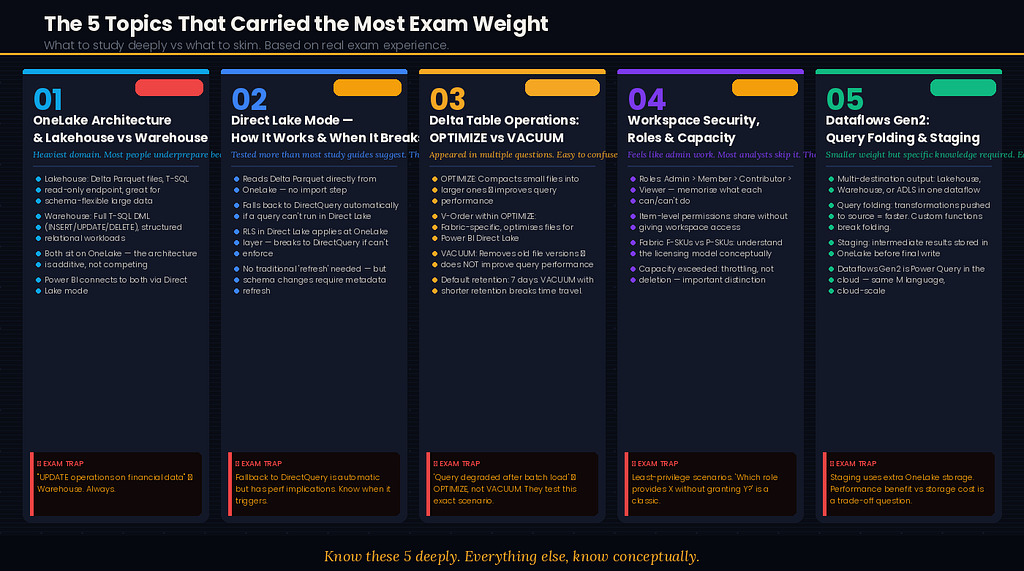
1. OneLake architecture and the difference between Lakehouse and Warehouse
This came up constantly. The conceptual framework you need:
- Lakehouse: Stores data as Delta Parquet files in OneLake. You can read via T-SQL (read-only) through the SQL analytics endpoint. Full DML requires Spark/PySpark or Notebooks. Great for large-scale, schema-flexible data. Power BI connects in Direct Lake mode.
- Warehouse: Full T-SQL support including INSERT, UPDATE, DELETE. Better for structured, relational workloads where you need DML. Also sits on OneLake. Power BI can connect via Direct Lake or DirectQuery.
The exam loves scenario questions: “A team of SQL developers needs to perform UPDATE operations on financial data. Which Fabric item should they use?” The answer is Warehouse. Knowing when each is appropriate — in Microsoft’s framework, not just in your own experience — is worth understanding deeply.
2. Direct Lake mode — how it works and when it breaks down
This was tested more than I expected. The key concepts:
- Direct Lake reads Delta Parquet files directly from OneLake without importing into Power BI’s engine
- It requires the semantic model to connect to a Lakehouse or Warehouse
- Fallback to DirectQuery: If Direct Lake can’t complete a query (for example, if the query requires capabilities not supported in Direct Lake), it automatically falls back to DirectQuery mode. This has performance implications.
- Framing: The exam asks about this fallback behaviour. Know that it exists, when it triggers, and what the performance difference is.
- Scheduled refresh doesn’t work the same way — Direct Lake doesn’t need data refresh since it reads live from OneLake, but the semantic model metadata does need refreshing when table schemas change.
3. Delta table operations: OPTIMIZE and VACUUM
These came up in multiple questions and I had to learn them from scratch.
- OPTIMIZE: Compacts small Delta Parquet files into larger ones. Improves query performance. Can be run manually or scheduled. The V-Order optimisation within OPTIMIZE is specific to Microsoft Fabric and produces files optimised for Power BI Direct Lake reads.
- VACUUM: Removes old file versions from the Delta log. By default, Delta keeps 7 days of file history (the retention threshold). Running VACUUM with a shorter retention period removes files that could be used for time-travel queries.
- The exam trap: VACUUM does not improve query performance — that’s OPTIMIZE’s job. If a question asks how to improve query speed on a Lakehouse table, the answer is OPTIMIZE, not VACUUM. I got this wrong twice in practice.
4. Workspace security, roles, and capacity
This whole domain felt like admin work to me, and I resisted studying it. The exam did not care about my feelings.
Key things to know:
- Workspace roles: Admin, Member, Contributor, Viewer — and specifically what each can and cannot do. The exam asks about least-privilege scenarios.
- Item-level permissions: Separate from workspace roles. You can share individual items (semantic models, reports, Lakehouses) without giving workspace access.
- Row-Level Security in Direct Lake mode: RLS behaves differently in Direct Lake vs Import mode. In Direct Lake, RLS is applied at the OneLake layer, not the Power BI layer. If RLS is configured in the semantic model and Direct Lake can’t enforce it, it falls back to DirectQuery.
- Fabric capacity: The difference between F-SKUs and P-SKUs, what a Fabric trial workspace gives you vs a licensed workspace, and what happens when capacity is exceeded (throttling, not deletion).
5. Dataflows Gen2 and query folding
- Dataflows Gen2 can write output to multiple destinations: Lakehouse, Warehouse, or Azure Data Lake Storage. This multi-destination feature is tested.
- Query folding: When Power Query transformations can be pushed back to the source query, the transformation runs at the source database rather than in memory. Folding is more efficient. Not all transformations fold — custom functions and certain data type operations often break folding.
- Staging in Dataflows Gen2: Enabling staging stores intermediate results in OneLake before writing to the final destination. This can improve performance for large dataflows but uses additional OneLake storage.
What I’d Skip (Or Deprioritize)
This section is the one I wish someone had written for me. Not everything in the DP-600 learning path is equally important.
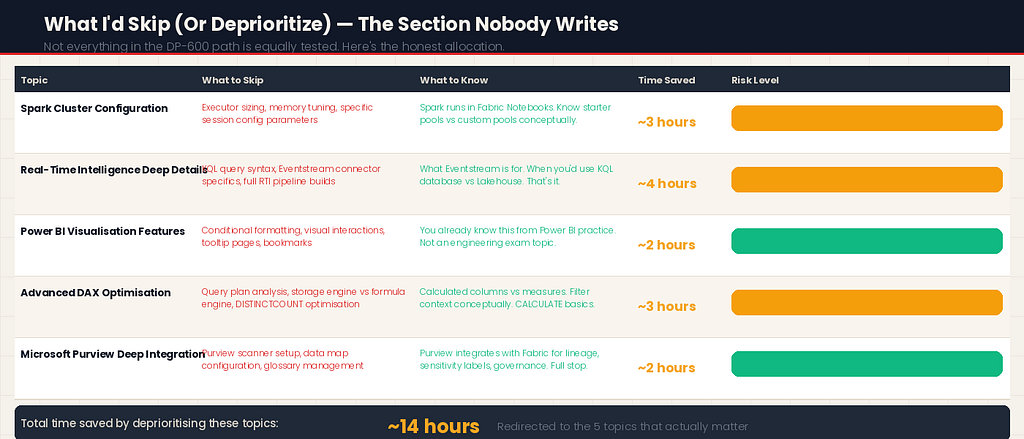
Spark cluster configuration details: The exam doesn’t go deep on Spark session configuration, executor sizing, or memory tuning. Know that Spark runs in Fabric Notebooks. Know the concept of Spark pools and starter pools. Don’t memorise specific configuration parameters.
Real-Time Intelligence deep details: Eventstream, KQL databases, and real-time analytics are in scope, but the questions are conceptual rather than implementation-heavy. Know what these tools are for and when you’d use them. Don’t build a full real-time pipeline to study for this section.
Power BI visualisation-specific features: Conditional formatting, visual interactions, tooltip pages — these are Power BI Desktop skills, not Fabric engineering skills. The DP-600 is an engineering exam. If you’re already a Power BI practitioner, you know this stuff. If you’re not, it won’t come up enough to justify deep study.
Advanced DAX optimisation: Know what DAX is, know the difference between calculated columns and measures, understand filter context conceptually. You don’t need to write complex CALCULATE expressions or debug query plans for this exam — that’s PL-300 territory.
Purview governance integration: It’s mentioned in the syllabus. It appears in maybe one or two questions in practice exams. Understand that Microsoft Purview integrates with Fabric for data governance, data lineage, and sensitivity labels. Don’t go deeper than that.
The One Thing Nobody Told Me About the Exam Format
Here’s something that took me by surprise and cost me time in the early practice rounds.
Many DP-600 questions are scenario-based with multiple valid-sounding answers. The question won’t just test whether you know what VACUUM does. It will give you a realistic scenario — “A data engineer notices that query performance on a Delta table has degraded after a large batch load. Which action should they take first?” — with four answers that are all plausible. VACUUM, OPTIMIZE, rebuild the table, increase Spark capacity.
The correct answer is OPTIMIZE. But to know that confidently, you need to understand not just what each operation does but when to apply it in a realistic context.
This scenario-first questioning style means that memorising definitions is not enough. You need to understand the reasoning behind when and why you’d make each architectural or operational choice. The exam is testing analytical judgment, not recall.
My study technique for this: whenever I learned about a feature or operation, I asked myself “what scenario would make me reach for this, and what would make me reach for something else instead?” That framing made a significant difference to how I retained information.
The Resources I Actually Used
Free:
- Microsoft Learn DP-600 path — The official foundation. Read it first, not as a substitute for other learning but as the canonical source for how Microsoft conceptualises each topic.
- Official Microsoft practice assessment — Free on the certification page. Take it before you do anything else to get a baseline score, then again in your final week. The questions are real-exam quality.
- Fabric documentation on Microsoft Learn — For specific topics I needed to go deep on (Delta table operations, Direct Lake fallback behaviour, workspace roles), the actual product documentation was more useful than any course.
- Microsoft Fabric YouTube channel — Particularly the “Fabric Explained” series and the session recordings from FabCon. Watching real engineers explain architectural decisions helped more than reading the same concepts.
Paid (honest assessment):
- I bought one paid practice exam set. It was useful for volume — more questions to practice on — but some answers were outdated or used Microsoft terminology loosely. I’d use paid practice exams as a supplement, not a primary source. If an answer from a third-party practice exam conflicts with what Microsoft Learn says, trust Microsoft Learn.
What I’d add if I were doing it again:
- The Fabric Community forum — Real practitioners asking real questions about architecture decisions. Invaluable for understanding where the conceptual boundaries are.
- The DP-600 study guide PDF — Microsoft publishes a detailed skills outline document. Print it. Read it on day one. Every major topic on the exam is listed there.
My Actual Study Schedule
For anyone who wants a week-by-week template, here’s exactly what I did:
Week 1: Complete Microsoft Learn path modules 1–3 (Fabric fundamentals, Lakehouse, Warehouse). Take the free official practice assessment cold. Write down every question I got wrong or wasn’t confident on.
Week 2: Complete Microsoft Learn modules 4–6 (Pipelines, Dataflows Gen2, Notebooks). Start a personal “exam notes” document with concise summaries of key concepts in my own words.
Week 3: Hands-on gap work targeting my week 1 practice exam weaknesses. Build a real Lakehouse, run Delta table operations, explore workspace roles in a trial workspace.
Week 4: Complete Microsoft Learn modules 7–9 (Semantic models, Direct Lake, security). Take a full practice exam. Review every wrong answer with the Microsoft Learn documentation open.
Week 5: Focus entirely on weak areas identified from week 4 practice exam. No new topics — only deepening existing knowledge gaps. Take another practice exam at the end of the week.
Week 6: Light review of exam notes document. Take the official practice assessment again. Rest two days before the real exam. Don’t cram.
The Day of the Exam
I sat mine online through Pearson VUE, proctored from home. A few practical things worth knowing:
Clear your desk entirely. Not “mostly clear.” Entirely. The proctor will ask you to pan your camera around the room. Anything on your desk that isn’t your testing materials will cause a delay or disqualification.
Read every question twice. The scenario questions are long. On my first pass I sometimes read the scenario, skimmed the question, and jumped to the answers — and found I’d answered the wrong question. Slow down. Read the actual question being asked, not the scenario summary.
Flag and move. If you’re not sure, mark it for review and move on. I flagged about 12 questions on my first pass and had 18 minutes to revisit them at the end. That time pressure is exactly why you shouldn’t linger.
The exam is 100 minutes for 40–60 questions. That’s roughly 1.5–2.5 minutes per question. You have more time than you think. Don’t rush.
The Score Report and What It Actually Means
I passed with a score in the low 800s — comfortably above the 700 threshold, not perfectly at the top.
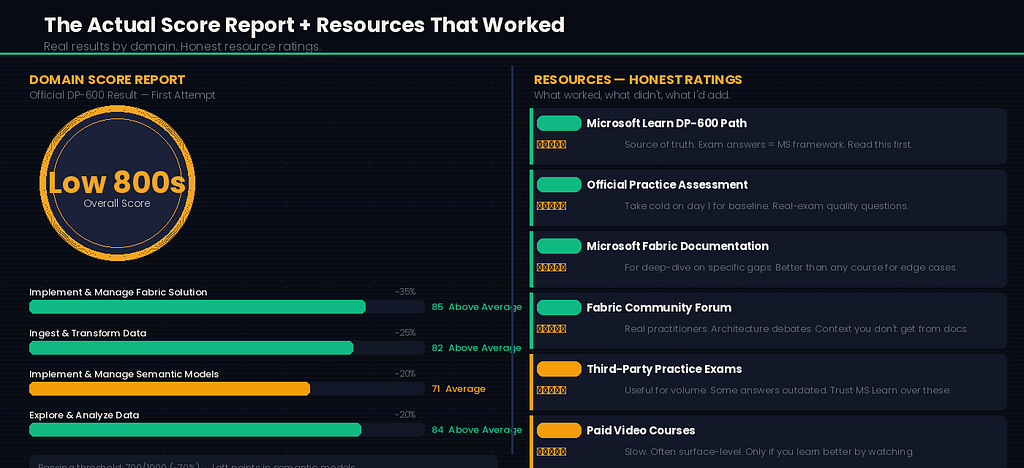
My score report showed my performance by domain, and it was useful:
- Implement and manage a Fabric analytics solution: Above average
- Ingest and transform data: Above average
- Implement and manage semantic models: Average
- Explore and analyze data: Above average
The semantic model domain is where I left points on the table — specifically around DAX performance concepts and semantic model deployment pipelines. If I were studying again, I’d spend another few hours on those specific sub-topics.
What the Certification Actually Got Me
I want to be honest about this because I think people sometimes overstate what a certification does for your career.
It didn’t immediately get me a promotion or a pay rise. It didn’t transform my standing at my current company overnight.
What it did:
It gave me a structured reason to fill the gaps in my practical knowledge. The six weeks of study surfaced conceptual weaknesses I’d been papering over with workarounds. I now understand why certain architectural decisions are made, not just how to implement them. That depth shows up in how I talk about solutions with stakeholders and how confidently I make design decisions.
It gave me a credential that signals the depth of my commitment to the platform to people who don’t know me. For job applications, for client conversations, for credibility with technical colleagues from outside the Fabric ecosystem — it works. It’s a proof point.
And honestly? It gave me a thing I finished. Somewhere between keeping the lights on and building new features and managing stakeholder expectations, it’s easy to feel like you never complete anything. I passed an exam. I earned a credential. That small, complete, documented achievement matters more to me than I expected it to.
The DP-600 is not the hardest Microsoft exam. It’s not trivial either — especially if, like me, you walk in confident from practical experience and discover that confidence and exam-readiness are different things.
Study the conceptual framework, not just the implementation. Know when to use what and why. Fill your gaps before the exam, not during it.
And please, for your sake: learn the difference between OPTIMIZE and VACUUM before you sit down.
I Passed the DP-600 Fabric Analytics Engineer Exam — Here’s My Honest Study Plan (With What I’d… was originally published in Towards AI on Medium, where people are continuing the conversation by highlighting and responding to this story.