The biggest bottleneck in deploying agents isn’t reasoning quality — it’s error accumulation. Here’s the architecture that fixes it.

Your multi-agent pipeline passed every demo you ran. In production, it silently accumulated three bad decisions by step four, and the final output was confidently, fluently wrong. You didn’t catch it because there was no signal to catch — just a clean-looking result at the end of a chain.
This is the defining failure mode of production agentic systems in 2026. The fix isn’t a better base model. It’s a verification layer — and building it correctly requires understanding four distinct patterns, when each one breaks, and a counterintuitive economics insight that most teams miss entirely.
TL;DR
- A single LLM can’t reliably verify its own outputs — the structural reasons for this are well understood.
- Four verification architectures have emerged: output scoring (LLM-as-Judge), Reflexion loops, adversarial debate, and process verification (step-by-step).
- Each has a specific failure mode. Picking the wrong one will cost you in latency, cost, or correctness.
- The key insight: your verifier doesn’t need to be your most expensive model. Smaller models verify better than they generate — and this changes the economics dramatically.
- LangGraph is the reference implementation: its conditional edges map directly to the retry-vs-pass decision at the heart of every verification loop.
Why a Model Can’t Reliably Check Its Own Work
Ask an LLM to verify its own output, and it will often agree with itself — not because it has checked carefully, but because it is structurally predisposed to. This isn’t a capability gap that better prompting can fix.
The core issue is that a single model acting as its own generator, evaluator, and critic tends to reproduce the same reasoning structure across iterations, with little meaningful correction. If the model reasoned incorrectly the first time, the same representational biases that produced the error are present when it re-evaluates. Research studying single-agent Reflexion found that self-reflections tend to repeat earlier misconceptions rather than introduce new reasoning paths — particularly on difficult examples.
This is why multi-agent verification works where self-correction often doesn’t. A second agent with a different role, context, or even a different persona, brings a genuinely different reasoning path to the same output. Diversity is the mechanism.
There’s also an important architectural distinction most teams miss. Traditional evaluation looks only at final outputs. But for agents running extended sequences of actions — research workflows, coding assistants, multi-step planners — focusing solely on the end result misses where things went wrong. By the time you evaluate the final answer, the root cause three steps back is invisible. This gap drove the development of process verification: evaluating each step, not just the terminal state.
The Four Verification Patterns
Here’s a breakdown of each pattern, with honest tradeoffs.
Pattern 1: Output Scoring (LLM-as-Judge)
The simplest verification architecture. A separate LLM evaluates the solver’s output against a structured rubric and returns a score. If the score clears a threshold, the output passes. Below threshold, the solver retries.
from langchain_anthropic import ChatAnthropic
from langchain_core.prompts import ChatPromptTemplate
judge_llm = ChatAnthropic(model="claude-haiku-4-5")  # Small model, lower cost
JUDGE_PROMPT = ChatPromptTemplate.from_messages([
    ("system", """You are a strict quality judge. Evaluate the response below on:
- Factual accuracy (0-10)
- Completeness (0-10)
- Logical consistency (0-10)
Respond ONLY with JSON: {"score": <average>, "reason": "<one sentence>"}"""),
    ("human", "Task: {task}\n\nResponse to evaluate:\n{response}")
])
def judge_output(task: str, response: str) -> dict:
    chain = JUDGE_PROMPT | judge_llm
    result = chain.invoke({"task": task, "response": response})
    import json
    return json.loads(result.content)
# Usage
verdict = judge_output(
    task="Summarize the key risks in this contract",
    response=solver_output
)
# {"score": 6.3, "reason": "Missing indemnification clause analysis"}
Where it works: High-volume pipelines where you need a cheap, fast gate. Customer support triage, document classification, code review at scale.
Where it breaks: A single LLM judge carries inherent biases — preferring certain writing styles or content types — and represents only one perspective. Studies show GPT-4’s judgments correlate strongly with human preferences in aggregate, but diverge significantly on edge cases. Confident hallucinations often score well because the judge is also susceptible to fluency bias.
Pattern 2: Reflexion (Self-Critique Loop)
Reflexion (Shinn et al., 2023) adds a structured self-critique step between attempts. The solver generates a response, a critic produces verbal feedback, and the solver retries with that feedback in context.
from langgraph.graph import StateGraph, END
from typing import TypedDict, Annotated
import operator

class AgentState(TypedDict):
    task: str
    attempts: Annotated[list, operator.add]
    reflections: Annotated[list, operator.add]
    current_output: str
    iteration: int
    passed: bool
def solver_node(state: AgentState) -> AgentState:
    context = ""
    if state["reflections"]:
        context = f"\n\nPrevious attempt failed. Feedback:\n{state['reflections'][-1]}\nTry again."
    response = solver_llm.invoke(state["task"] + context)
    return {
        "current_output": response.content,
        "attempts": [response.content],
        "iteration": state["iteration"] + 1
    }
def reflexion_node(state: AgentState) -> AgentState:
    critique_prompt = f"""
Task: {state['task']}
Response: {state['current_output']}
Identify specific errors. Be concise and actionable.
"""
    critique = critic_llm.invoke(critique_prompt)
    score = judge_output(state["task"], state["current_output"])
    return {
        "reflections": [critique.content],
        "passed": score["score"] >= 7.5
    }
def should_retry(state: AgentState) -> str:
    if state["passed"] or state["iteration"] >= 3:
        return END
    return "solver"
graph = StateGraph(AgentState)
graph.add_node("solver", solver_node)
graph.add_node("reflexion", reflexion_node)
graph.add_edge("solver", "reflexion")
graph.add_conditional_edges("reflexion", should_retry, {"solver": "solver", END: END})
graph.set_entry_point("solver")
app = graph.compile()
Where it works: Tasks with clear correctness criteria where the model can meaningfully improve given feedback — coding problems, factual Q&A, structured data extraction.
Where it breaks: On hard examples, loops diverge: after two or three rounds of conflicting self-feedback, the model oscillates rather than converges. Multi-Agent Reflexion (MAR) addresses this by replacing the single self-reflecting model with multiple persona-guided critics and a separate judge — improving HumanEval pass@1 from 76.4 to 82.6, precisely by breaking the single-agent echo chamber.
Pattern 3: Adversarial Debate
Two agents with different personas independently propose answers, critique each other’s reasoning, and a judge synthesizes into a final verdict.
Solver Agent A──┐
                ├──▶Debate Round ──▶Critique Exchange ──▶Judge ──▶Final Output
Solver Agent B──┘
def debate_round(task: str, answer_a: str, answer_b: str) -> dict:
    critique_a = critic_a_llm.invoke(
        f"Critique this answer to '{task}':\n{answer_b}\nFind specific flaws."
    )
    critique_b = critic_b_llm.invoke(
        f"Critique this answer to '{task}':\n{answer_a}\nFind specific flaws."
    )
    synthesis = judge_llm.invoke(f"""
Task: {task}
Answer A: {answer_a}
Answer B: {answer_b}
Critique of A: {critique_b.content}
Critique of B: {critique_a.content}
Synthesize the best answer, incorporating valid critiques from both sides.
""")
    return {"final": synthesis.content}
Where it works: High-stakes decisions with no single ground truth — strategy recommendations, legal analysis, complex research synthesis. Structured disagreement consistently improves factual accuracy on hard reasoning tasks.
Where it breaks: Latency and cost. Two parallel solver calls, two critique calls, one judge call — minimum 5x the inference cost of a single agent. For pipelines with sub-second SLAs, debate is off the table. It also fails when both agents share training blind spots and converge on the same wrong answer.
Pattern 4: Process Verification (Step-by-Step)
The most architecturally significant pattern for complex agents. Instead of verifying the final output, a verifier checks each step of the execution trace before it propagates downstream.
This matters because the final answer isn’t always where the bug is. A research agent that mis-queries a database at step 2 produces a fluent, well-formatted answer at step 6 that is simply wrong. Output scoring at the end catches the symptom; process verification catches the cause.
class ProcessVerifier:
    def __init__(self, verifier_llm):
        self.verifier = verifier_llm
        self.step_history = []

    def verify_step(self, step_number: int, step_description: str,
                    step_output: str, overall_goal: str) -> dict:
        prompt = f"""
Overall goal: {overall_goal}
Steps completed so far: {self.step_history}Step {step_number}: {step_description}
Output: {step_output}
Does this step:
1. Correctly accomplish what it intended?
2. Remain consistent with previous steps?
3. Move toward the overall goal?
JSON only: {{"valid": true/false, "issue": "<if invalid, one sentence>", "confidence": 0-1}}
"""
        result = self.verifier.invoke(prompt)
        import json
        verdict = json.loads(result.content)
        if verdict["valid"]:
            self.step_history.append(f"Step {step_number}: {step_description} → ✓")
        return verdict
Where it works: Long-horizon research agents, multi-file code refactors, and planning agents that decompose into sub-tasks. Catching errors at the step level dramatically reduces compounding failures in extended workflows.
Where it breaks: Cost scales linearly with workflow depth. A 10-step pipeline adds 10 verification calls. This is only economically viable when the cost of a wrong final answer exceeds the verification overhead — true for enterprise workflows, rarely true for lightweight automation.
The Cost Insight Nobody Mentions
Here’s the counterintuitive finding that changes the economics of all four patterns: your verifier doesn’t need to be your most expensive model.
Verification is a fundamentally easier task than generation. Generating a correct multi-step research synthesis requires broad knowledge, creativity, and synthesis. Checking whether a specific step output is logically consistent with the previous one requires focused, narrow reasoning. These have different capability thresholds.
Research on agent evaluation finds that a smaller model used as a dedicated verifier — with a well-crafted rubric — consistently outperforms a larger model asked to check its own work ad hoc. One multi-agent research system from ICLR 2026 deliberately used a different model for evaluation than for execution to reduce self-evaluation bias. The keyword is different, not necessarily larger.
In practice: if your solver is Claude Sonnet, your judge can often be Claude Haiku at roughly 10x lower cost per token. The cost difference between Sonnet-judges-Sonnet and Sonnet-judged-by-Haiku across 10,000 calls per day is significant enough to make or break the business case for verification entirely.
Approximate cost comparison (1,000 solver calls, ~500 tokens output each):
Pattern                          | Pairing                 | Est. extra cost
---------------------------------|-------------------------|------------------
No verification                  | Sonnet only             | $0
Output scoring (1 judge call)    | Sonnet + Haiku judge    | ~$0.40
Output scoring (1 judge call)    | Sonnet + Sonnet judge   | ~$4.50
Reflexion (avg 1.8 retries)      | Sonnet + Haiku judge    | ~$1.20
Process verification (5 steps)   | Sonnet + Haiku verifier | ~$2.00
Adversarial debate               | Sonnet×2 + Haiku judge  | ~$9.50
A Reference Architecture in LangGraph
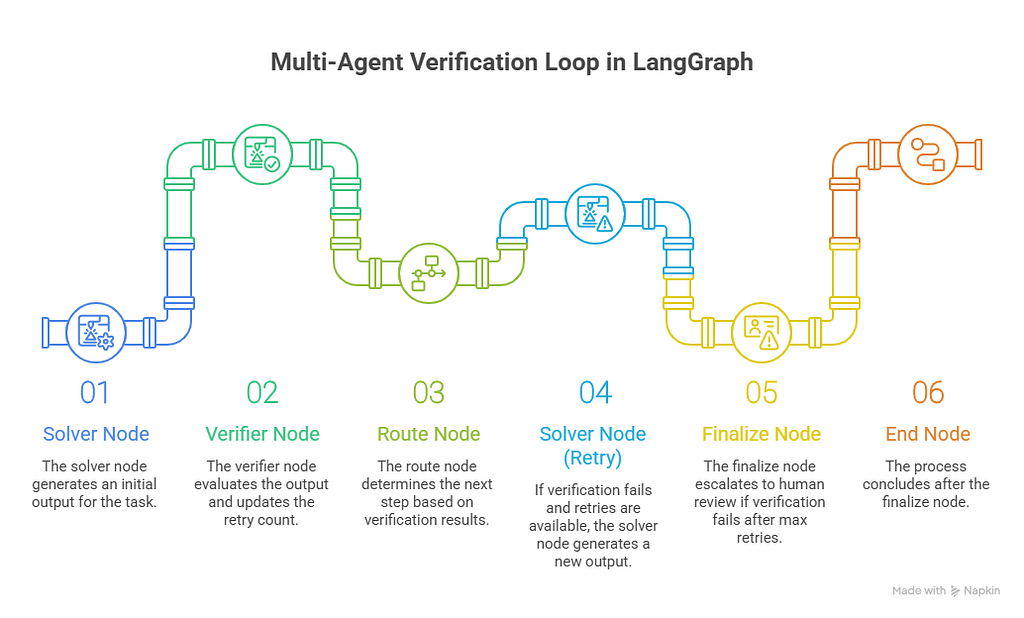
LangGraph’s conditional edges map directly to the solver → verify → retry-or-pass decision at the heart of every verification loop.
from langgraph.graph import StateGraph, END
from typing import TypedDict

class PipelineState(TypedDict):
    task: str
    output: str
    verification_result: dict
    retry_count: int
    max_retries: int
def solver(state: PipelineState) -> PipelineState:
    response = solver_llm.invoke(state["task"])
    return {"output": response.content}
def verifier(state: PipelineState) -> PipelineState:
    result = judge_output(state["task"], state["output"])
    return {
        "verification_result": result,
        "retry_count": state["retry_count"] + 1
    }
def route(state: PipelineState) -> str:
    passed = state["verification_result"]["score"] >= 7.5
    max_hit = state["retry_count"] >= state["max_retries"]
    if passed or max_hit:
        return "finalize"
    return "solver"
def finalize(state: PipelineState) -> PipelineState:
    # Escalate to human review if still failing after max retries
    if state["verification_result"]["score"] < 7.5:
        flag_for_human_review(state)
    return state
graph = StateGraph(PipelineState)
graph.add_node("solver", solver)
graph.add_node("verifier", verifier)
graph.add_node("finalize", finalize)
graph.set_entry_point("solver")
graph.add_edge("solver", "verifier")
graph.add_conditional_edges("verifier", route, {
    "solver": "solver",
    "finalize": "finalize"
})
graph.add_edge("finalize", END)
app = graph.compile()
Three non-negotiable design decisions in production: set a hard max_retries cap (3 is a sensible default), log every verification result for offline drift analysis, and always route to human review when max retries are exhausted rather than silently passing a low-score output.
Gotchas Nobody Tells You
Judges are biased toward fluency over correctness. LLM judges consistently score confident, well-structured prose higher than it deserves — even when the content is wrong. A hallucination in professional language will outscore a correct but awkward answer. Counter this with explicit rubric items for factual specificity and grounding, and periodically spot-check verdicts against human evaluation. Never assume your judge is well-calibrated without data.
Reflexion loops don’t converge on hard problems. If the solver genuinely can’t solve the task — ambiguous requirements, out-of-distribution knowledge, capability ceiling — a Reflexion loop won’t converge. It will burn max_retries, failing slightly differently each time. Track your retry distributions in production. Regular max_retry hits on a specific task type are a signal to reroute to a specialist tool or human, not to increase the cap.
Shared model family blind spots undermine independence. The independence assumption behind multi-agent verification breaks down when solver and judge share training data, RLHF preferences, and systematic gaps. For highest-stakes pipelines, use models from different providers for solver and judge. Actual diversity requires actually different models.
Conclusion
Verification isn’t optional in production agentic systems in 2026. It’s the line between a compelling demo and a reliably deployed product. Error accumulation in multi-step pipelines is silent, confident, and structural — and no amount of solver capability improvement eliminates it, because the problem is architectural, not a model quality issue.
The patterns are now mature. LangGraph makes verification loops straightforward to wire. And the economics are workable once you internalize that your judge can be a fraction of the cost of your solver.
The question isn’t whether to add a verification layer. It’s which pattern fits your error tolerance, your SLA, and the blast radius of a wrong output in your domain. Process verification catches root causes but costs more. Output scoring is cheap but misses compounding errors. Adversarial debate surfaces the deepest gaps but demands the most infrastructure.
Choose accordingly. And stop shipping agent pipelines without a judge.
How Multi-Agent Self-Verification Actually Works (And Why It Changes Everything for Production AI) was originally published in Towards AI on Medium, where people are continuing the conversation by highlighting and responding to this story.