The Great Workforce Boomerang: Why AI Is Eating Jobs — and Spitting Them Back Out Differently
The robots aren’t coming for your job. They’re coming for your tasks, your team structure, and your definition of “work.” Here’s what actually happens when the hype meets the office floor.
Sebastian Siemiatkowski thought he had cracked the code.
In 2024, the CEO of Klarna, the Swedish fintech unicorn, made a decision that sent shockwaves through boardrooms from Stockholm to San Francisco. He replaced 700 customer service workers with an AI assistant built on OpenAI’s technology. The bot handled two-thirds of all customer queries. Operating costs plummeted. Headcount dropped 22%. Investors loved it. Ahead of the company’s U.S. IPO, the narrative was irresistible: AI had made human customer service obsolete.
Then, quietly, the boomerang came back.
By mid-2025, customer satisfaction scores had tanked. Complex billing disputes turned into endless loops of robotic frustration. Repeat contact rates soared. Users churned. Siemiatkowski, once the face of AI-driven efficiency, admitted to Bloomberg what few tech CEOs were willing to say out loud: “We focused too much on efficiency and cost. The result was lower quality, and that’s not sustainable.” Klarna began rehiring — not just customer agents, but reassigning engineers and marketers to support roles. The company that fired humans to impress algorithms suddenly discovered that, in a world drowning in AI, “nothing will be as valuable as humans.”
Klarna’s reversal is not a failure of AI. It is a preview of the next decade.
By 2030, artificial intelligence will not simply eliminate jobs or create them. It will perform something far more disorienting: it will dissolve the familiar architecture of work itself — tasks, teams, hierarchies, and careers — and reassemble them into shapes we are only beginning to understand. The question is no longer whether AI will change how we work. It is whether we will shape that change, or be shaped by it.
The Real Story Is Not Replacement. It’s Restructuring.
If you read the headlines, the math looks terrifying. Goldman Sachs estimates that AI could automate tasks equivalent to 300 million full-time jobs globally . McKinsey projects that 47% of U.S. jobs contain tasks highly automatable with current technology . In early 2026, Goldman’s economists found that AI substitution was wiping out roughly 25,000 jobs per month in the U.S., with Gen Z absorbing the worst of the displacement . The World Economic Forum’s latest Future of Jobs Report predicts 92 million jobs will be displaced by 2030 — though, crucially, it also forecasts 170 million new ones created, for a net gain of 78 million .
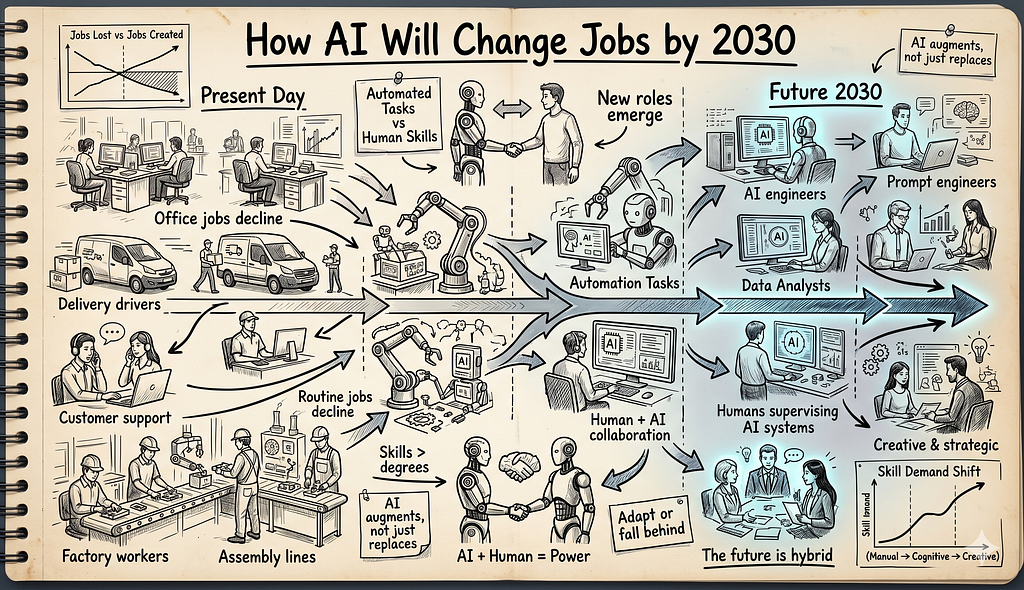
But these numbers obscure the texture of what is actually happening. AI is rarely firing people in one clean sweep. Instead, it is performing what labor economists call task-level disaggregation — unbundling jobs into their constituent parts, automating the predictable slices, and leaving humans with the messy, creative, and relational fragments.
Consider the legal industry. Harvey, an AI platform built specifically for law firms, does not replace lawyers. It devours the tasks that junior associates once spent their nights on: contract review, due diligence, regulatory research. According to Harvey’s own research, 82% of in-house legal teams now report increased capacity without adding headcount . The work still gets done. The workers doing it have simply been compressed. A job that once required three junior attorneys and a paralegal now requires one senior lawyer overseeing an AI agent. The headcount vanishes not through dramatic layoffs, but through quiet attrition and frozen hiring.
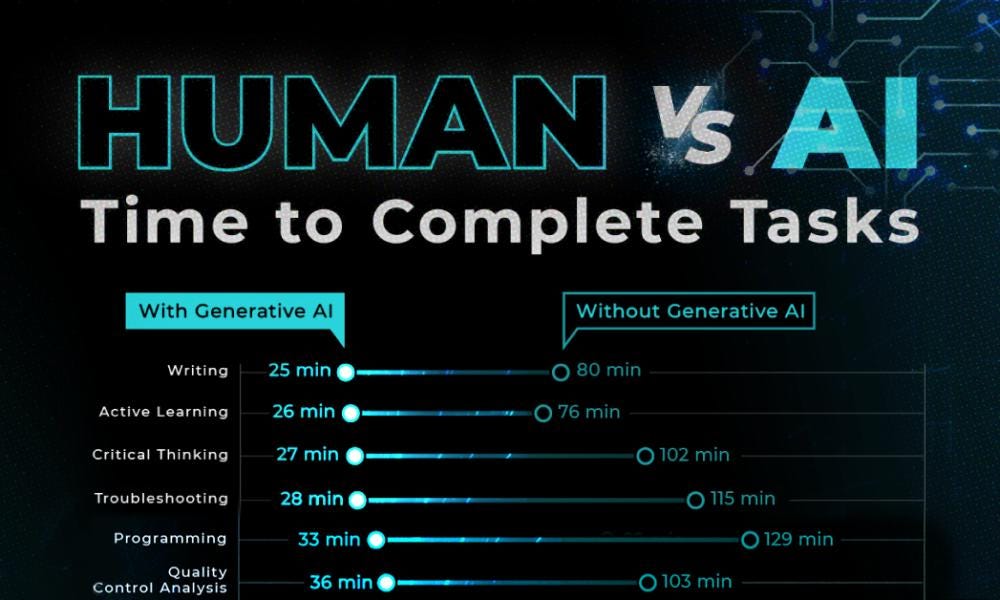
This is the pattern repeating across knowledge work. McKinsey’s analysis suggests that while 63% of knowledge-work tasks can be partially automated, only about 5% of jobs can be fully automated today . The more likely scenario is what McKinsey calls “augmentation with compression” — workers spend 30% to 40% less time on routine tasks, either absorbing higher-value work or watching their departments slowly shrink around them .
The distinction matters because it changes how you should think about your own career. Your risk is not determined by your job title. It is determined by the task composition of your daily work. Two marketing managers can hold identical titles and face wildly different fates. One who spends 70% of her day compiling performance reports and scheduling social posts is highly exposed. Another who spends 70% of his time on brand strategy, stakeholder negotiation, and creative direction is not. AI does not fire people. It fires tasks — and the people who cannot separate themselves from those tasks get caught in the crossfire.
The Agentic Workforce: When Your Colleague Is Code
To understand where this is heading by 2030, you need to understand the shift from “copilots” to “agents.”
For the past few years, AI tools have mostly assisted humans. GitHub Copilot suggested code; ChatGPT drafted emails; Microsoft’s Copilot summarized meetings. These were reactive tools — waiting for prompts, augmenting human effort. But in 2025 and 2026, the technology crossed into something more autonomous: agentic AI.
Agentic AI does not wait for instructions. It is given a goal, formulates a plan, and executes across systems with minimal human oversight. At Prosus, the global tech investment firm, employees have built over 26,000 specialized AI agents — not as IT experiments, but as operational infrastructure . One agent, used by over 200 account managers at iFood (a Prosus portfolio company), automates restaurant performance reporting equivalent to the work of 40 full-time employees . Another allows any non-technical employee to query corporate data in natural language, effectively democratizing the role of data analyst.
Salesforce has branded this layer “Agentforce,” explicitly marketing a “digital workforce” where humans and automated agents collaborate to achieve outcomes . Cisco predicts that by 2026, “agentic AI will leverage data from Wi-Fi, sensors, and connected devices to make real-time adjustments” in physical workplaces — dimming lights, powering down unused spaces, and reallocating office resources without a human facilities manager lifting a finger .
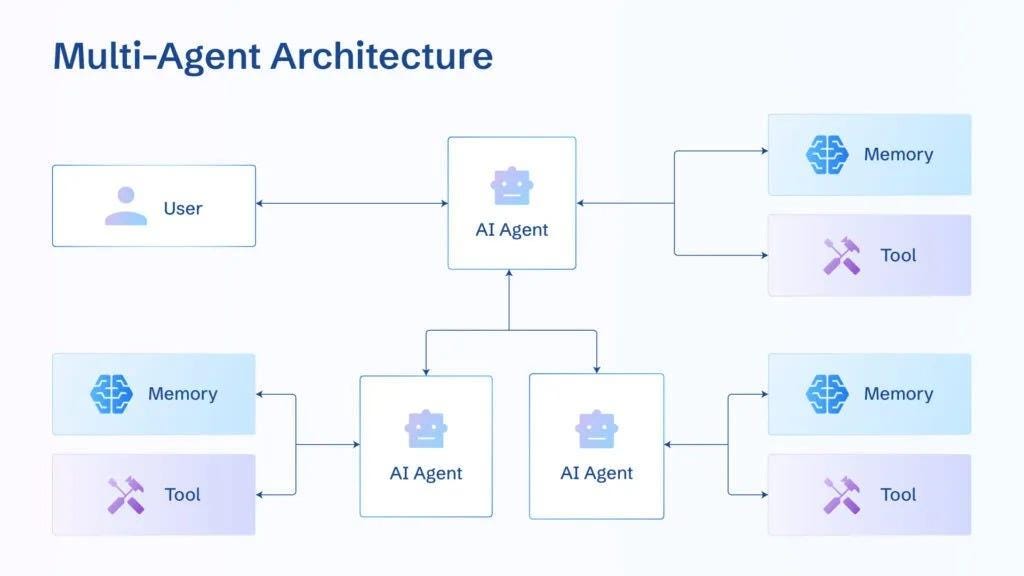
This is not science fiction. It is already live in insurance claims processing. One multi-agent system launched in 2025 employs seven specialized AI agents — Planner, Cyber, Coverage, Weather, Fraud, Payout, and Audit — to process claims autonomously, cutting processing time by 80% . The human role is no longer execution. It is exception-handling, governance, and final sign-off.
By 2030, the most competitive companies will not be those with the best AI tools. They will be those with the best human-AI organizational design. The question will not be “Can we automate this?” but “What is the optimal division of labor between human judgment and machine execution?”
Case Studies: The Winners, Losers, and the Confused
The Cautionary Tale: Klarna’s Reversal
Klarna remains the most instructive case study because it followed the naive playbook to its logical conclusion: replace humans, cut costs, celebrate margins. The result was a 30% IPO pop followed by a quality crisis. By reassigning engineers to customer support and adopting an “Uber-style” flexible human workforce, Klarna acknowledged a truth that pure efficiency metrics hide: some interactions carry relational value that cannot be captured in a ticket-resolution rate .
Gartner’s research now suggests that half of companies making AI-driven cuts will be rehiring by 2027 . The “Klarna boomerang” is becoming an industry pattern. AI excels at volume; humans excel at value-at-risk. The companies that win will be those that deploy AI for the former and reserve the latter for people.
The Legal Industry: Harvey and the Disappearing Associate
Law has long been considered a fortress of human expertise. It is now ground zero for AI compression. Harvey’s platform is used by more than half of the world’s largest law firms, and its impact is structural: faster delivery, higher quality, and — critically — no need to hire additional junior staff . In-house legal teams report that AI is helping them “reimagine collaboration with their law firms,” which is corporate speak for doing more work internally and sending less to billable associates .
The result is a thinning of the legal profession’s middle layer. Senior partners remain indispensable for strategy and client relationships. Paralegals and AI handle document review. But the path from junior associate to partner — once paved with long hours of grunt work that trained you to spot anomalies — is eroding. By 2030, law firms may resemble hourglasses: heavy at the top with strategic thinkers, heavy at the bottom with AI oversight and compliance roles, and narrow in the middle where routine associate work once lived.
The Corporate Pivot: IBM’s Hourglass Strategy
IBM offers a glimpse of how legacy enterprises are navigating this transition. In late 2025, the company trimmed its global workforce by a low single-digit percentage — roughly thousands of roles — as it sharpened its focus on software and AI infrastructure . Yet simultaneously, IBM announced plans to triple entry-level hiring in the U.S., specifically for customer engagement and AI management roles .
This is workforce restructuring in real time: fewer mid-career generalists in declining business lines, more junior “AI generalists” who can orchestrate agents and manage human-AI workflows. PwC has predicted this explicitly: the rise of the “AI generalist” who understands enough about multiple domains to oversee specialized agents, while senior professionals focus on strategy and innovation . The knowledge workforce of 2030 may look less like a pyramid and more like an hourglass — or, for frontline work, a diamond, where entry-level roles are automated and mid-level oversight roles expand .
The Reskilling Gambit: Walmart’s 2.1 Million-Person Bet
Walmart, the largest private employer in the U.S., provides the most ambitious counter-narrative to displacement. Despite revenue growth, the company expects to keep its global workforce flat at 2.1 million employees through 2028, using AI to absorb the labor that would normally accompany expansion . It has eliminated roughly 1,500 corporate roles in technology and e-commerce, even as it invests over $500 million in robotic systems and launches one of the largest corporate AI training efforts in history .
The curriculum is pragmatic: supply chain forecasting, inventory management, AI-powered customer service tools. But the subtext is existential. Walmart is effectively betting that it is cheaper to reskill a warehouse worker into an “agent builder” or AI overseer than to hire new technical talent in a scarce market. Whether this is empowerment or a euphemism for managed obsolescence depends on whether the training translates into real mobility — or merely prepares workers to operate the machines that will eventually replace them .
Industry by Industry: Who Gets Hit, and Who Gets Hired
The impact is not uniform. It fractures along sectoral lines in ways that defy simple “blue collar vs. white collar” narratives.
Financial Services and Insurance: These sectors face among the highest automation exposure, with Goldman Sachs and McKinsey estimating 48% to 54% of tasks automatable by 2027 . JPMorgan Chase is automating routine banking tasks, with CEO Jamie Dimon warning that AI will dominate repetitive analytical work within 15 years . BlackRock is already streamlining back-office functions with AI . The winners here will not be the analysts who model faster, but those who can interpret model outputs, manage client relationships, and navigate regulatory ambiguity.
Customer Service: This is the sector where the Klarna drama is playing out in real time across dozens of companies. AI can handle tier-one queries — order status, returns, FAQs — with ruthless efficiency. But complex billing disputes, fraud reports, and emotional complaints degrade sharply without human empathy . By 2030, customer service will likely bifurcate: a small army of AI agents handling volume, and a highly trained, well-compensated human elite handling escalation and retention.
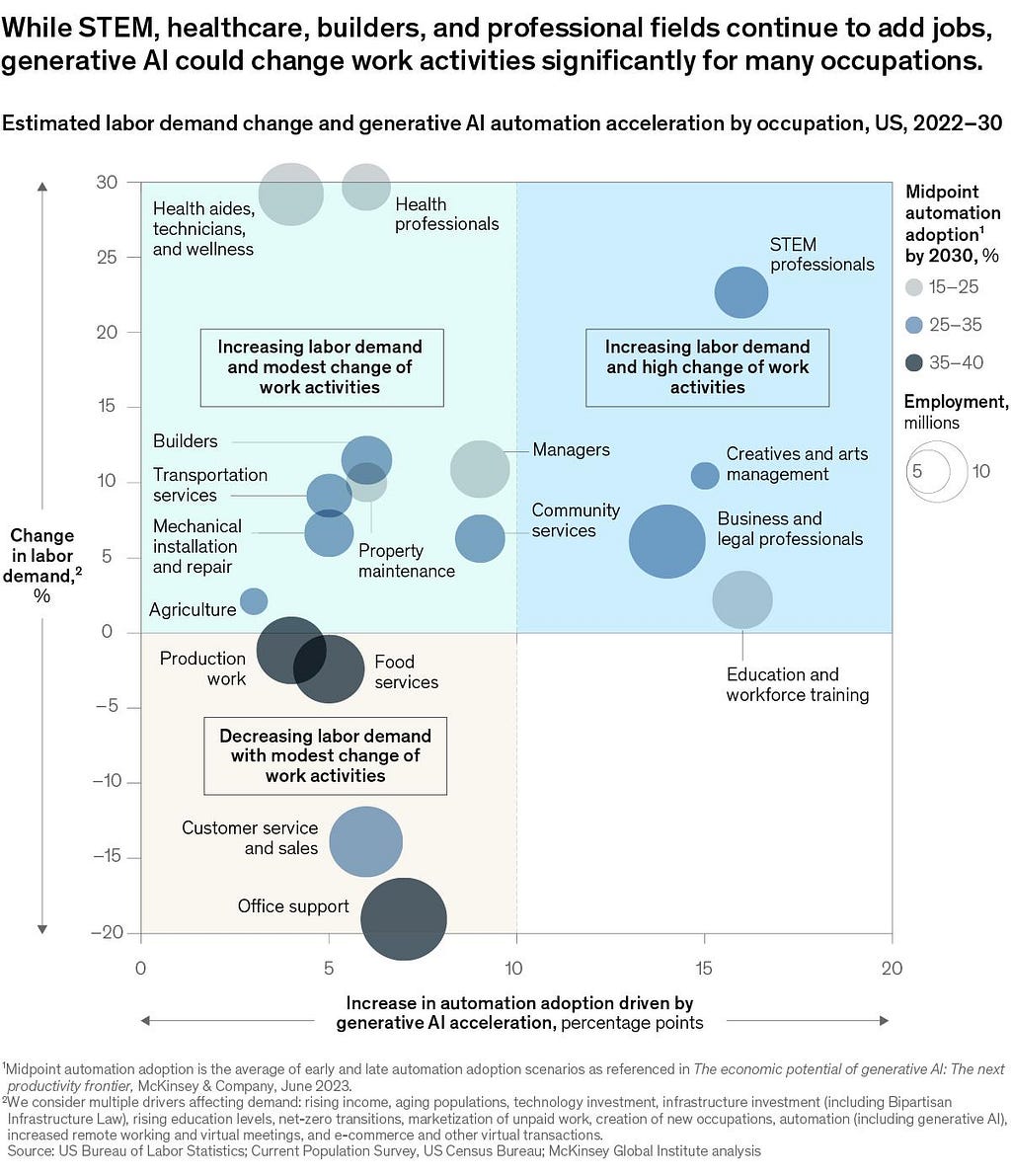
Software Development: Perhaps the most paradoxical sector. GitHub Copilot and autonomous coding agents can now generate, test, and debug code from natural language prompts . The WEF predicts 40% of programming tasks could be automated by 2040 . Yet demand for software developers is projected to grow 57% over the next five years . The explanation is that AI is lowering the barrier to building software, which increases the total volume of software being built, which increases demand for the human architects who can design systems, validate AI-generated code, and translate business needs into technical requirements. The coder who simply translates specs into syntax is endangered. The engineer who acts as a systems architect and AI orchestrator is indispensable.
Healthcare: AI’s impact here is surgical — literally and figuratively. Diagnostic imaging, drug discovery, and administrative coding are being rapidly automated. A Lancet study estimates 25% of medical administrative tasks could vanish by 2035 . But patient-facing care — nursing, therapy, social work — remains stubbornly human. The Indeed Hiring Lab’s “GenAI Skill Transformation Index” classifies patient care as “minimal transformation,” meaning human performance will remain largely unchanged because the work requires physical presence and psychological nuance that models cannot replicate . By 2030, healthcare will likely see massive growth in care jobs even as back-office roles evaporate.
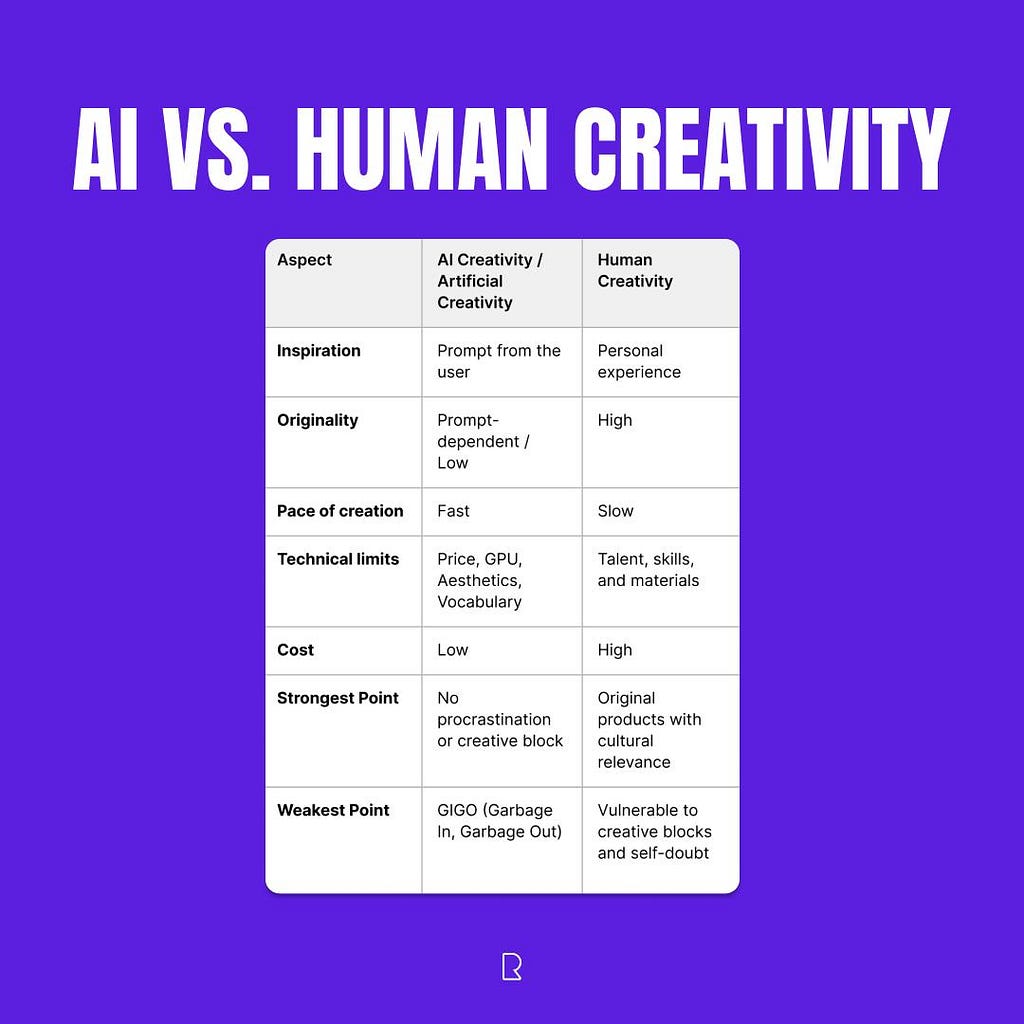
Creative Industries: Graphic design, copywriting, and basic content creation face significant disruption. The WEF now lists graphic designers among the fastest-declining roles, as generative AI reshapes creative labor markets . But as hedge fund manager Bill Ackman noted, human creativity in storytelling and high art will endure longer than commoditized content production . The dividing line is taste and curation. AI can generate infinite variations. A human creative director who knows which variation resonates, and why, becomes more valuable — not less.
Four Futures: The Scenarios That Will Decide 2030
The World Economic Forum, in its 2026 white paper Four Futures for Jobs in the New Economy, mapped four plausible scenarios based on two variables: the pace of AI advancement, and the level of workforce readiness .
In “Supercharged Progress,” AI capabilities explode while workers reskill rapidly. Productivity soars, inequality narrows, and the net job gain of 78 million is realized equitably.
In “The Age of Displacement,” AI advances faster than education and policy can adapt. Wage polarization spikes. The 59% of workers who need reskilling by 2030 do not receive it, and the 11 in that group who are “unlikely to receive it” become a permanent underclass of economically redundant labor .
In “The Co-Pilot Economy,” AI capabilities grow incrementally, giving societies time to adapt. Humans and machines collaborate in stable, hybrid workflows. This is the Klarna lesson applied at scale: AI handles scale, humans handle stakes.
In “Stalled Progress,” both AI advancement and workforce readiness falter, leading to a lost decade of low productivity and social frustration.
Which future arrives depends on choices being made now. Currently, 86% of employers expect AI to transform their business by 2030, yet only 50% of employees say they have received adequate reskilling support . That gap — between organizational ambition and individual preparation — is where the risk lives.
The Skills That Survive — and the New Ones That Matter
If you are trying to navigate this as an individual, the research points toward a clear, if uncomfortable, conclusion: the most protected workers are not those who know the most about AI. They are those who combine analytical depth with social intelligence.
The WEF identifies analytical thinking, resilience, leadership, and creative thinking as the enduring human core skills . Meanwhile, the fastest-growing technical skills are AI and big data literacy, fintech engineering, and cybersecurity . The jobs growing fastest — AI and machine learning specialists, data analysts, renewable energy engineers, nursing professionals, and secondary school teachers — share a common thread: they either build the machines, or they do what machines cannot .
But the most important new skill may be one that does not yet appear on standard lists: agent orchestration. By 2030, millions of workers will not be executing tasks directly. They will be managing fleets of AI agents, setting goals, validating outputs, and intervening when edge cases arise. PwC calls this the “AI generalist” — someone who understands enough about finance, or marketing, or operations to direct specialized agents toward business outcomes . This is the white-collar equivalent of the forklift operator who does not lift boxes, but moves more boxes than ever by operating machinery.
Key Takeaways
- AI automates tasks, not jobs. Only 5% of jobs can be fully automated today. The real risk is task compression, where routine work evaporates and roles shrink through attrition rather than mass layoffs .
- The “Klarna boomerang” is real. Companies that replace humans entirely for cost savings often face quality crises that force rehiring. The sustainable model is hybrid: AI for volume, humans for complexity and relationships .
- The workforce is restructuring, not just shrinking. IBM is cutting mid-level roles while tripling entry-level hiring in AI management . Walmart is holding headcount flat while investing half a billion dollars in automation and reskilling .
- Agentic AI changes the org chart. By 2030, “agent orchestration” will be a core skill. Companies like Prosus already run tens of thousands of AI agents as operational infrastructure, creating capacity equivalent to thousands of human workers .
- Reskilling is the great differentiator. Fifty-nine of every 100 workers will need reskilling by 2030. Eleven of them will likely not get it, putting over 120 million workers at medium-term risk of redundancy . The individual imperative is clear: learn to work with AI, or compete against it.
- Sectors diverge wildly. Financial services and customer support face the fastest task automation. Healthcare, education, and skilled trades face the slowest. Creative work bifurcates into commoditized generation and high-end curation .
- The net job numbers are positive, but the transition is brutal. WEF projections show a net gain of 78 million jobs by 2030 . However, the timing mismatch means displaced workers may lack the skills for newly created roles without massive, sustained investment in transition support.
Conclusion: The Human Premium
In 2026, we are past the point of debating whether AI will change work. The algorithms are already here, embedded in legal review, customer service queues, code repositories, and warehouse floors. By 2030, they will be invisible infrastructure — like electricity, like the internet — powering an economy that moves at machine speed but still, for now, serves human needs.
The question left to us is not technological. It is organizational, educational, and deeply human.
Klarna’s Sebastian Siemiatkowski learned the hard way that efficiency without quality is just a slower form of failure. The companies that thrive between now and 2030 will be those that learn this lesson proactively: AI is extraordinary at answers, but still terrible at judgment. It is brilliant at scale, but blind to context. It can process a million complaints, but it cannot look a frustrated customer in the eye and say, with genuine understanding, “I will fix this.”
That gap — between computation and care, between optimization and meaning — is where the jobs of 2030 will live. Not in opposition to AI, but adjacent to it. Not doing what machines do faster, but doing what machines cannot do at all.
The future belongs to the orchestrators, the translators, the strategists, and the caregivers. The ones who know when to defer to the algorithm, and when to override it. The ones who understand that the most valuable human skill in an age of artificial intelligence is not speed or knowledge. It is knowing the difference between what can be automated, and what should remain human.
The robots are not coming for your job. They are coming for your routine. Whether that leaves you with more meaningful work, or no work at all, depends on what you choose to build in the space they clear.
How AI Will Change Jobs by 2030 was originally published in Towards AI on Medium, where people are continuing the conversation by highlighting and responding to this story.