Skills in Chrome, Gemini agents, NotebookLM Canvas, a robot that reads gauges, and a system that scores how well you collaborate. Google didn’t ship one big thing. It shipped infrastructure.
There was no single Google announcement this week that dominated the conversation. That’s actually the point.
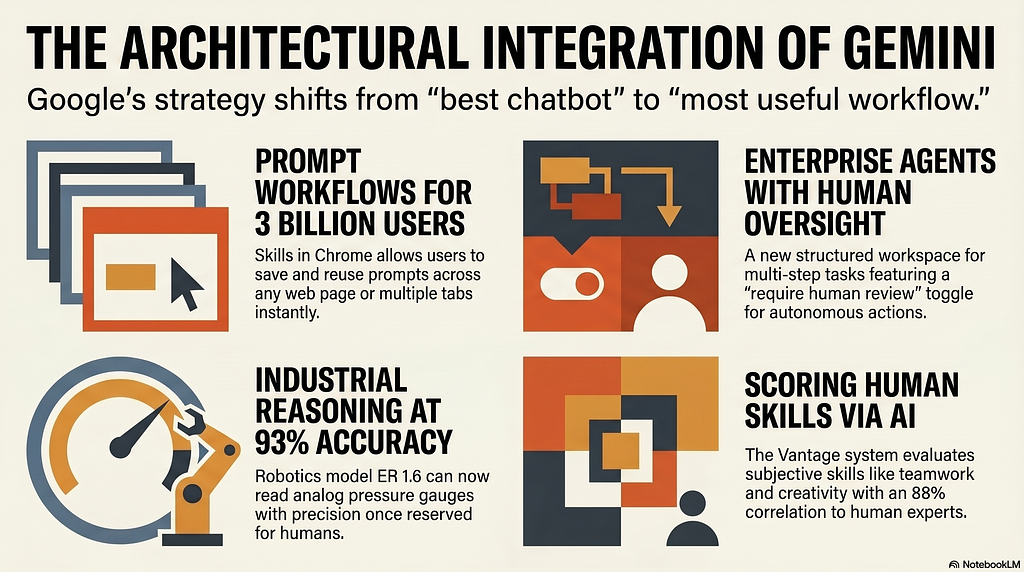
In the span of a few days, Google pushed Gemini deeper into Chrome’s UI, tested an agent workspace inside Gemini Enterprise, gave NotebookLM a visual layer and live connectors, upgraded its robotics reasoning model to read industrial gauges at 93% accuracy, and published research on scoring human skills like teamwork and critical thinking using LLMs. None of these is a flagship model launch. All of them are infrastructure decisions — and infrastructure decisions are what determine who wins in five years, not five months.
Here’s what actually happened and why each piece matters.
Skills in Chrome: prompt management for everyone
Google introduced Skills in Chrome — a feature that allows users to save and reuse their favorite AI prompts, which can run across different web pages without having to type them in again.
The mechanic is clean. You write a prompt in the Gemini sidebar, it works well, and you save it. Next time you’re on a relevant page, you type a slash or hit the plus button, select your skill, and it runs. Skills run on the current web page being viewed, along with any additional tabs that have been selected simultaneously.
The technical frame for what this is: prompt templating at the browser level. Engineers building LLM pipelines have been managing prompt libraries in code for years. Google just gave a consumer UI version of that idea to anyone with Chrome. Google has released more than 50 Skills through a new prompt library, covering tasks like summarizing YouTube videos, picking gifts, and calculating nutritional macros in recipes.
The multi-tab capability is the part that changes the use case meaningfully. Open five product pages, trigger a comparison skill, and get the output across all five simultaneously. That’s a workflow that previously required either manual copy-paste or a developer building a scraping pipeline. Now it’s a single click.
Skills are closer to bookmarked prompts than agent instructions in the developer sense — they let users save and replay a prompt, not orchestrate multi-step workflows. That’s an honest constraint worth naming. This isn’t agentic automation; it’s prompt reuse with good UX. The confirmation gates for sensitive actions — sending email, adding calendar events — reflect that Google is being deliberate about where the human stays in the loop.
The competitive framing matters here, too. Microsoft and Perplexity have both embedded similar features in their browsers. OpenAI doesn’t yet support such shortcuts in its Atlas browser. Google’s advantage isn’t the feature — it’s the distribution. Chrome runs on over 3 billion devices. Rolling Skills out to that installed base, with no paid subscription required, is a different kind of reach than any competitor can match on day one.
Gemini Enterprise agent tab: what a serious workflow AI looks like
Less public, more significant: Google is testing a dedicated agent tab inside Gemini Enterprise. The interface is different in kind from a chat window. You get a structured workspace — goal, agents, connected apps, files, and a “require human review” toggle — that looks less like a chatbot and more like a task management system for AI agents.
The architecture is clearly borrowing from systems like Anthropic’s Claude Cowork: define a goal, give the model access to tools and files, let it execute across multiple steps. The “require human review” toggle is the tell. Google is preparing for agents that can take real actions at the desktop level — not just answer questions — and building the approval layer in before users need it.
The speculation around a Gemini desktop app, combined with the Skills rollout in Chrome and the Enterprise agent tab, starts to look like three components of the same product being built in public, piece by piece. Skills handles persistent browsing workflows. The agent tab handles multi-step enterprise tasks. A future desktop app handles everything that happens off the browser. You can see the shape of what Google is building without needing to see the finished product.

NotebookLM Canvas and connectors: from document tool to research layer
NotebookLM has been the quiet success story of Google’s AI product lineup. Canvas is the upgrade that turns it from a document analysis tool into something with a visual output layer — timelines, interactive pages, lightweight visualizers built from source material rather than just summaries of it.
The connectors feature is the more structurally important change. NotebookLM has been limited to manually uploaded sources. With connectors, it starts pulling from external services — Google’s own ecosystem first, but with broader integrations clearly signaled. That’s the difference between “a tool that analyzes what you give it” and “a research layer that stays connected to live data.”
Auto-labeling using Gemini itself — the system organizing your sources automatically as you add them — solves the scaling problem that emerges when you have dozens of documents in a project. Navigation friction is often a bigger barrier than the analysis itself. Removing it automatically matters more than it sounds.
Gemini Robotics ER 1.6: when AI reads a pressure gauge at 93%
The robotics update is the most practically impressive thing Google shipped this week, and it got the least coverage.
The architecture context: Google’s robotics system uses two models. The VLA model (Vision-Language-Action) controls the robot’s physical movements. The ER model (Embodied Reasoning) is the strategic layer — it understands the environment, plans tasks, and decides what needs to happen next. ER 1.6 enhances spatial reasoning and multi-view understanding, enabling robots to understand their environments with unprecedented precision.
The new capability that made this release significant: instrument reading. Developed in collaboration with Boston Dynamics, this enables robots to read complex gauges and sight glasses. Boston Dynamics’ Spot robot can visit instruments throughout a facility, capture images, and have ER 1.6 interpret them.
This is harder than it sounds. A pressure gauge isn’t a QR code. Reading a gauge requires precisely perceiving the needle position, tick marks, container boundaries, unit labels, and — for multi-needle gauges — combining multiple readings that represent different decimal places. Perspective distortion from the camera angle adds another layer of complexity.
The numbers tell a clear story: ER 1.5 hit a 23% success rate on instrument reading. Gemini 3.0 Flash reached 67%. ER 1.6 reaches 86%. ER 1.6 with agentic vision enabled reaches 93%.
Agentic vision is how it gets there: the model zooms into images, uses pointing and code execution to estimate proportions and intervals, and applies world knowledge to interpret the result. It reasons about what it sees, generates code to calculate the reading, and verifies its own output before reporting.
The industrial application is immediate. Boston Dynamics’ Orbit AIVI-Learning product, running on Spot, is already deployed in facilities for inspections — monitoring conveyor belt damage, sight glass levels, gauge readings, and 5S compliance audits. The Gemini-powered version went live for all enrolled customers in early April. This isn’t a demo — it’s deployed.
The facility inspection use case is a good proxy for where industrial robotics AI is going: not robots that replace human workers in assembly lines, but robots that do the patrol and monitoring tasks that currently require humans to walk scheduled routes, read analog instruments, and manually log values. Those tasks are dangerous in some environments, time-consuming in all of them, and almost perfectly suited for a reasoning model that can physically navigate and visually interpret.
Vantage: scoring teamwork with LLMs
The most conceptually unusual thing Google published this week: a research system for evaluating human skills that standardized tests can’t measure — collaboration, creativity, conflict resolution, critical thinking.
The core idea is an executive LLM. Instead of running multiple independent AI agents in a conversation, one model controls all AI participants and has access to a scoring rubric. If the system wants to evaluate conflict resolution, it introduces disagreement through one AI persona and maintains that conflict until the human responds. It actively steers the conversation to surface the specific skill being tested.
The results from 188 participants, 373 conversations: for project management, conversation-level information rates reached 92.4%. For conflict resolution, 85%. Creativity scoring on real student work produced a Pearson correlation of 0.88 with human expert scores — remarkably high for a subjective evaluation.
The practical application that most people will care about: this is a credible path to AI-assisted hiring evaluation, educational assessment, and performance review that goes beyond what’s measurable by tests or structured interviews. Whether that’s exciting or alarming probably depends on your relationship with the concept of being evaluated by an AI that’s been instructed to introduce conflict and see how you respond.
The research angle is also notable: LLM simulation of participants at different skill levels allowed them to test and refine the system before running expensive human studies. That’s a genuinely useful methodological advance — using AI to pre-validate assessment systems before deploying them on humans.
The pattern across all five
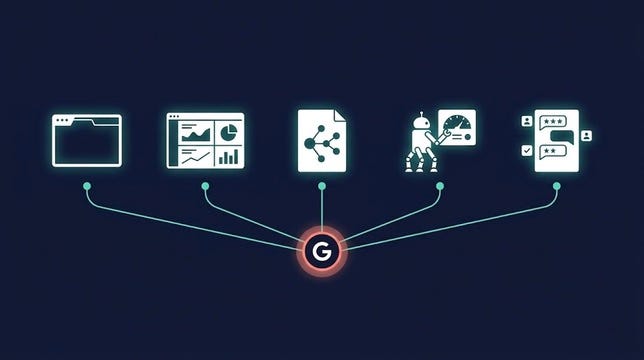
Chrome Skills — friction reduction for AI workflows at consumer scale. Gemini Enterprise agent tab — multi-step task execution with approval gates. NotebookLM Canvas and connectors — research layer with visual output and live data. Robotics ER 1.6 — physical AI that can reason about industrial environments. Vantage — AI-assisted evaluation of skills that resist quantification.
None of these is flashy. All of them are the kind of moves that look obvious in retrospect and strategic in real time. Google isn’t trying to win a single benchmark or dominate a single category. It’s weaving Gemini into every surface it controls — the browser, the enterprise workspace, research tools, physical robots, and now assessment systems — and making each one incrementally more autonomous.
The AI race gets covered as a series of model releases. The actual competition is happening here, in the infrastructure layer, where the company that owns the surface owns the relationship.
Google Quietly Rewired How AI Fits Into Everything This Week was originally published in Towards AI on Medium, where people are continuing the conversation by highlighting and responding to this story.