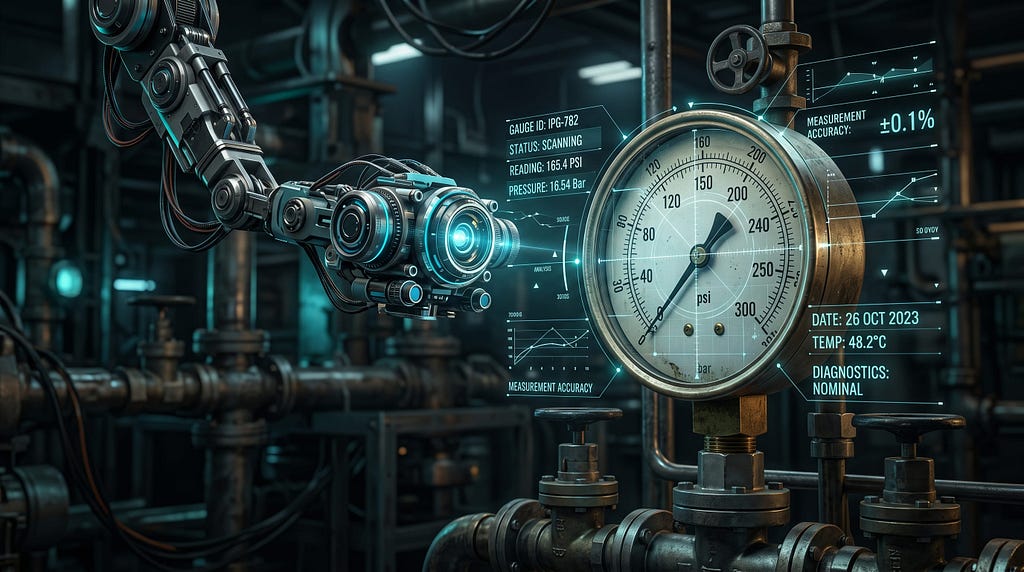
Google DeepMind’s latest robotics AI doesn’t just see the world — it reasons about it. From reading industrial gauges to counting objects with sub-tick precision, ER 1.6 is the model that makes robots actually useful in factories.
Most AI announcements focus on chatbots getting smarter. This one is about robots getting eyes — real, reasoning eyes that can look at a pressure gauge in a chemical plant and tell you the reading down to sub-tick accuracy.
On April 14, 2026, Google DeepMind released Gemini Robotics-ER 1.6, a significant upgrade to the “embodied reasoning” model that serves as the brain behind the next generation of physical robots. The headline capability: instrument reading — the ability for robots to interpret complex industrial gauges, sight glasses, and digital readouts. This isn’t a lab demo. It came directly from Boston Dynamics asking Google to solve a real problem their Spot robot faces every day in facility inspections.
I’ve been tracking the Gemini Robotics family since the original ER model launched in early 2025, and this update represents a shift from academic benchmarks to industrial deployment. When Boston Dynamics — the company whose robots navigate warehouses and inspect power plants — tells you they need a specific AI capability, and DeepMind builds it within one model generation, that’s a signal worth paying attention to.
Quick Answer: Gemini Robotics-ER 1.6 is Google DeepMind’s latest embodied reasoning model for robots, featuring enhanced spatial reasoning, multi-view understanding, and a new instrument reading capability developed with Boston Dynamics. Available today via the Gemini API and Google AI Studio, it acts as the “high-level brain” for robots, enabling them to perceive, reason, plan, and call external tools autonomously.
TL;DR — What You’ll Learn:
- ER 1.6 introduces instrument reading — robots can now interpret pressure gauges, level indicators, and digital readouts with sub-tick precision
- The capability was developed through direct collaboration with Boston Dynamics for Spot robot facility inspections
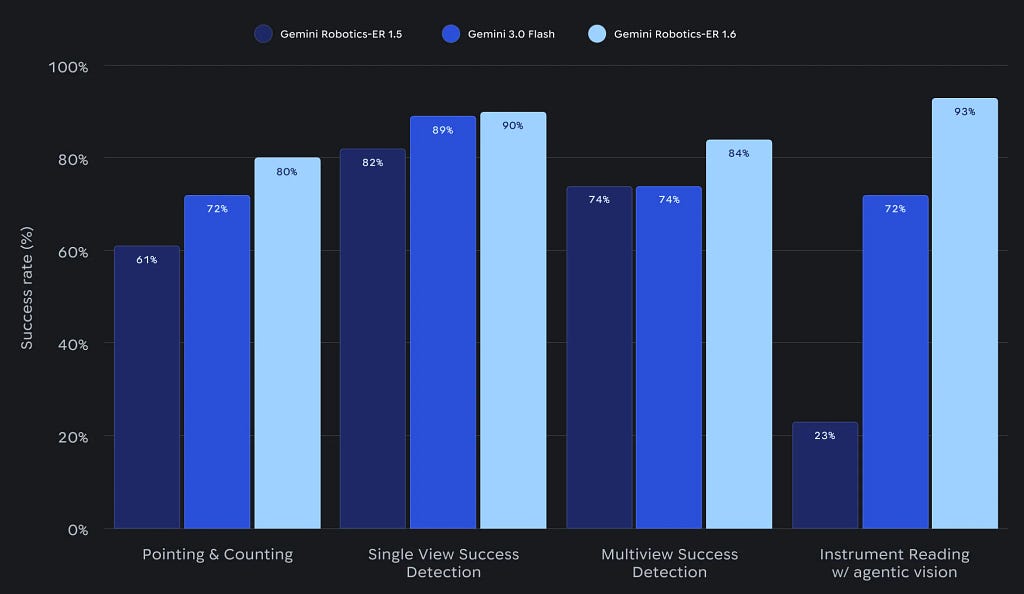
- Significant improvements in pointing, counting, success detection, and multi-view spatial reasoning over ER 1.5
- The model is available now to all developers via Gemini API and Google AI Studio (not gated)
- ER 1.6 is Google’s safest robotics model to date, with near-zero violation rates on adversarial safety tests
Table of Contents
- What Is Gemini Robotics-ER 1.6?
- What’s New: Instrument Reading and Enhanced Spatial Reasoning
- The Boston Dynamics Connection
- How Does ER 1.6 Actually Work?
- ER 1.6 vs ER 1.5 vs Gemini 3.0 Flash: What Changed?
- Why This Matters for Industrial Robotics
- How to Start Building With ER 1.6 Today
- FAQ
- Key Takeaways
What Is Gemini Robotics-ER 1.6?
Gemini Robotics-ER 1.6 is Google DeepMind’s updated embodied reasoning model — the “thinking layer” that gives robots the ability to understand their physical environment, plan actions, and make decisions. ER stands for “Embodied Reasoning,” which means the model specializes in the kind of spatial, physical, and contextual understanding that robots need to operate in the real world.
Crucially, ER 1.6 doesn’t directly control robot limbs or motors. Instead, it acts as a high-level reasoning model that sits on top of lower-level controllers. It processes camera feeds, understands what it sees, creates plans, and then calls external tools — including Vision-Language-Action (VLA) models, Google Search, or any third-party user-defined functions — to execute tasks. Think of it as the brain that tells the arms what to do.
The model launched today (April 14, 2026) and is immediately available to all developers via the Gemini API and Google AI Studio. DeepMind is also sharing a developer Colab notebook with examples of how to configure the model and prompt it for embodied reasoning tasks. This is not a gated preview — anyone with API access can start building.
ER 1.6 builds on the Gemini Robotics model family that DeepMind introduced in March 2025. The previous version, ER 1.5, established state-of-the-art performance across 15 robotics benchmarks and was already being used by trusted testers including Boston Dynamics, Agile Robots, Agility Robotics, and Enchanted Tools.
Key Insight: ER 1.6 isn’t a chatbot upgrade — it’s the reasoning engine that makes physical robots intelligent. And unlike most frontier AI releases, it’s available to every developer today.
What’s New: Instrument Reading and Enhanced Spatial Reasoning
The biggest addition in ER 1.6 is a capability called instrument reading — the ability for robots to visually interpret complex analog and digital instruments and extract precise numerical readings.
This means a robot equipped with ER 1.6 can look at a circular pressure gauge with tiny tick marks, identify the needle position relative to the scale, and report the exact reading — down to sub-tick accuracy. It can do the same for vertical level indicators (like sight glasses in chemical processing), temperature gauges, and modern digital readouts.
The technical complexity here is underappreciated. Reading an analog gauge requires the model to simultaneously perceive the needle angle, identify the scale markings, understand the measurement unit, interpret which direction “higher” goes, and calculate the value using geometric reasoning. ER 1.6 handles this by using pointing as an intermediate step — it first identifies salient points on the gauge (the needle tip, the scale endpoints, the tick marks), then performs mathematical operations on those points to derive the reading.
Beyond instrument reading, ER 1.6 improves on three core capabilities:
Pointing precision: The model generates more accurate 2D points for object detection, grasp planning, and spatial relationship reasoning. It can handle complex prompts like “point to every object small enough to fit inside the blue cup” — which requires both object recognition and relative size comparison.
Counting accuracy: ER 1.6 uses pointed intermediate steps to count items in scenes more reliably — a historically difficult task for vision models.
Success detection: The model can assess whether a robotic action was completed successfully by analyzing before-and-after visual states — critical for autonomous multi-step task loops where the robot needs to know when to move on.
Key Insight: Instrument reading sounds niche — until you realize that every factory, power plant, and data center in the world has hundreds of analog gauges that humans currently read by walking around with clipboards.
The Boston Dynamics Connection
The instrument reading capability didn’t emerge from a research paper. It emerged from a real customer need.
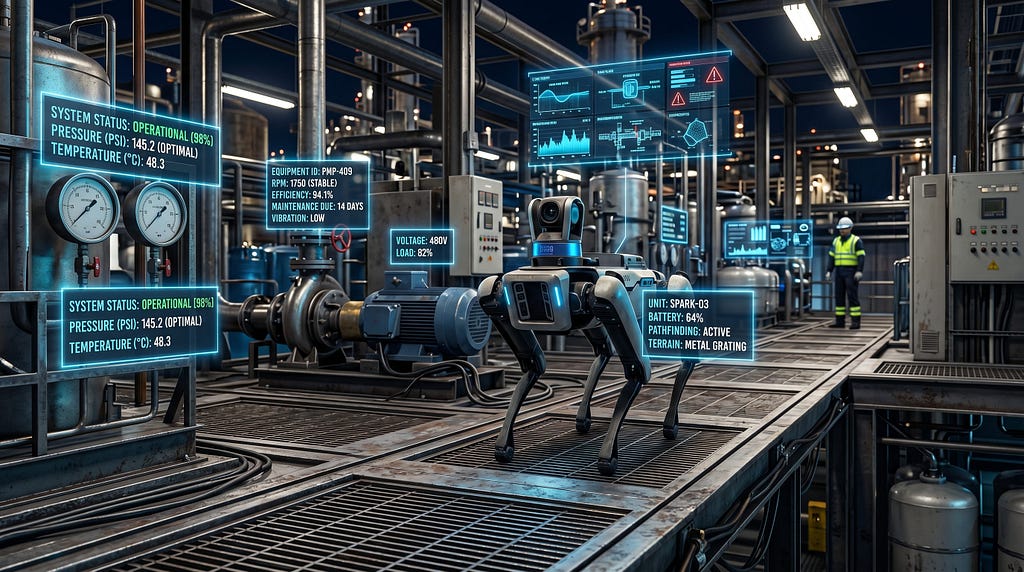
Boston Dynamics makes Spot — the quadruped robot that’s already deployed in industrial facilities worldwide for inspection tasks. Spot walks through oil refineries, chemical plants, data centers, and manufacturing floors, capturing images and data that humans used to collect manually.
The problem: industrial facilities contain hundreds of analog instruments — pressure gauges, temperature dials, flow meters, sight glasses — that require constant monitoring. Spot can photograph these instruments easily. But interpreting those photographs — converting a needle position on a gauge into a usable numerical reading — required either human review or specialized computer vision models trained for each gauge type.
ER 1.6 solves this with a single general-purpose model. According to DeepMind’s blog, the instrument reading capability was “a use case we discovered through close collaboration with our partner, Boston Dynamics.” The model can interpret circular pressure gauges, vertical level indicators, and digital readouts without being specifically trained for each instrument type.
For anyone building industrial robotics applications, this is the feature that shifts ER 1.6 from “interesting research” to “deploy now.” Facility inspection is one of the largest commercial robotics markets, and gauge reading has been one of its most persistent pain points.
Key Insight: Boston Dynamics didn’t just test ER 1.6 — they shaped its roadmap. When the biggest robotics company in the world tells DeepMind what to build next, the result is a capability that maps directly to real-world revenue.
How Does ER 1.6 Actually Work?
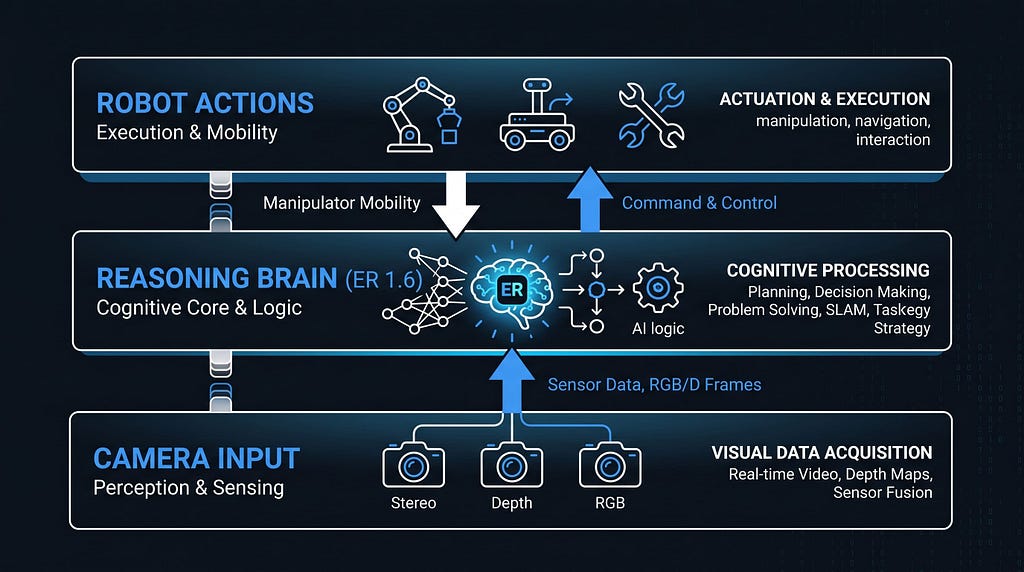
The architecture is elegantly modular. ER 1.6 operates as a high-level reasoning layer that integrates with lower-level systems through tool calling. Here’s the stack:
Input: Camera feeds (single image, multi-view, or video), audio, and natural language prompts from a user or orchestration system.
Reasoning: ER 1.6 processes the visual input and applies spatial reasoning — identifying objects, understanding their relationships, estimating sizes and distances, planning trajectories, and assessing whether actions are feasible and safe.
Output options: The model can return structured data (2D coordinates, bounding boxes, JSON-formatted plans), generate code to control robot APIs, or call external tools. Those tools can include VLA models for motor control, Google Search for real-time information, or any developer-defined function.
Safety layer: ER 1.6 includes built-in checks for physical safety constraints. It reasons about gripper limitations (“don’t pick up objects heavier than 20kg”), material constraints (“don’t handle liquids”), and workspace boundaries. DeepMind calls it their “safest robotics model to date,” with near-zero violation rates on adversarial safety tests and improved compliance with Gemini safety policies on spatial reasoning tasks.
Thinking budget: Developers can adjust a “thinking budget” parameter that controls the latency-accuracy tradeoff. Simple spatial tasks (like object detection) work well with a small budget. Complex tasks (like instrument reading or weight estimation) benefit from a larger budget. This gives developers fine-grained control over real-time responsiveness.
For developers, the practical starting point is the Gemini API. You send an image (or video) with a natural language prompt, and ER 1.6 returns structured reasoning outputs. The developer Colab that DeepMind released today includes examples for pointing, counting, instrument reading, and task planning.
If you’re exploring the broader AI robotics and developer tools ecosystem, I maintain an awesome-genai-toolkit on GitHub that catalogs tools across the full stack — from foundation models to deployment frameworks.
Key Insight: ER 1.6’s power comes from its modularity — it doesn’t try to be the entire robot. It’s the brain that connects to whatever body and tools the developer provides.
ER 1.6 vs ER 1.5 vs Gemini 3.0 Flash: What Changed?
DeepMind’s benchmark results show clear improvements across the board:
Instrument reading (new capability): Only available in ER 1.6. Evaluations were run with agentic vision enabled. ER 1.5 doesn’t support this capability. Gemini 3.0 Flash can attempt it but with significantly lower accuracy.
Pointing accuracy: ER 1.6 shows significant improvement over both ER 1.5 and Gemini 3.0 Flash. The model generates more precise 2D points and handles complex relational prompts (like identifying the smallest object in a set) more reliably.
Counting: ER 1.6 uses points as intermediate reasoning steps for counting — a technique that improves reliability over both previous versions, which tended to lose count on cluttered scenes.
Success detection: Improved ability to determine whether a robot has successfully completed a task by comparing visual states — critical for autonomous operation loops.
Safety compliance: ER 1.6 demonstrates superior compliance with safety policies on adversarial spatial reasoning tasks compared to all previous generations. It makes safer decisions about which objects can be manipulated under physical constraints.
What didn’t change: ER 1.6 is still a reasoning model, not an action model. It doesn’t directly move robot arms — that’s the job of the VLA model (Gemini Robotics 1.5) or third-party controllers. The architecture remains the same: ER reasons, VLA acts.
The practical difference for developers: if you’re already using ER 1.5, upgrading to 1.6 is a model name change in your API call. The input/output format is compatible. The new instrument reading capability requires agentic vision to be enabled.
Key Insight: ER 1.6 isn’t a new architecture — it’s a meaningful capability upgrade within the same modular system. For developers already on ER 1.5, the migration path is trivial.
Why This Matters for Industrial Robotics
The robotics AI market is at an inflection point. According to Gartner, 40% of enterprise applications will include AI agents by end of 2026. NVIDIA’s GTC 2026 was dominated by physical AI frameworks. And the global industrial robotics market is projected to exceed $80 billion by 2028.
But there’s been a persistent gap between “AI robots that demo well in labs” and “AI robots that work reliably in factories.” The gap isn’t about intelligence — it’s about perception and reasoning in messy, real-world environments where lighting changes, objects aren’t perfectly placed, and instruments have scratched faces and faded markings.
ER 1.6 addresses this gap in three specific ways:
Instrument reading eliminates a human bottleneck. Facility inspections currently require humans to walk routes and record gauge readings — or require specialized computer vision models trained per gauge type. ER 1.6 replaces both with a single general-purpose model.
Multi-view understanding handles real-world complexity. Factories aren’t controlled lab environments. ER 1.6’s enhanced spatial reasoning handles multiple camera angles, occluded objects, and cluttered scenes.
Safety-first design enables deployment confidence. Industrial robots operate around humans and hazardous materials. ER 1.6’s built-in safety constraints (payload limits, material restrictions, workspace boundaries) address the compliance requirements that have historically slowed robotics deployment.
The broader competitive landscape is heating up. NVIDIA’s NeMoCLAW and OpenCLAW frameworks dominated GTC 2026. Amazon’s robotics division is expanding aggressively. Tesla’s Optimus humanoid program is accelerating. But Google DeepMind, through the Gemini Robotics family and the Boston Dynamics partnership, has a unique advantage: the same company that builds the foundation model also collaborates directly with the leading robotics hardware company.
Key Insight: The winner in industrial robotics AI won’t be the company with the smartest model — it’ll be the company that solves specific, boring, high-value problems like reading pressure gauges at scale.
How to Start Building With ER 1.6 Today
ER 1.6 is available immediately. Here’s how to get started:
Access: Gemini API or Google AI Studio. No waitlist, no trusted tester program — open developer access.
Model name: gemini-robotics-er-1.6-preview
Developer resources: Google has published a Colab notebook with configuration examples and prompting patterns for pointing, counting, instrument reading, and task orchestration.
Key parameters: Adjust the thinking budget for your use case — low budget for fast spatial tasks, higher budget for complex reasoning like instrument reading or trajectory planning.
Integration pattern: Send image/video + natural language prompt → receive structured spatial reasoning output (JSON coordinates, plans, or generated code) → pass to your robot’s control layer.
Compatible platforms: ER 1.6 works across robot form factors — from bi-arm platforms like ALOHA, to humanoids like Apptronik’s Apollo, to quadrupeds like Boston Dynamics’ Spot. The reasoning layer is embodiment-agnostic.
For teams already using ER 1.5, the upgrade is straightforward — same API, same output format, new model version. Enable agentic vision for the instrument reading capability.
Key Insight: Unlike most frontier AI releases that start with gated access, ER 1.6 is available to every developer today. Google is betting on ecosystem adoption speed over exclusivity.
Frequently Asked Questions
What is Gemini Robotics-ER 1.6?
Gemini Robotics-ER 1.6 is Google DeepMind’s latest embodied reasoning model for robotics, released April 14, 2026. It acts as a high-level “brain” for robots, providing spatial reasoning, task planning, and instrument reading capabilities. It processes visual input and natural language to generate structured outputs that control lower-level robot systems.
What is instrument reading in ER 1.6?
Instrument reading is ER 1.6’s new ability to visually interpret analog and digital instruments — pressure gauges, level indicators, temperature dials, and digital readouts — and extract precise numerical values. The capability was developed with Boston Dynamics for industrial facility inspection using Spot robots.
How does ER 1.6 differ from ER 1.5?
ER 1.6 adds instrument reading (not available in 1.5), improves pointing accuracy, counting reliability, and success detection, and introduces enhanced multi-view spatial reasoning. It’s also DeepMind’s safest robotics model to date with improved adversarial safety compliance. The API format is backward-compatible.
Is ER 1.6 available to all developers?
Yes. ER 1.6 launched today and is immediately available via the Gemini API and Google AI Studio with no waitlist. DeepMind published a developer Colab with example configurations and prompting patterns. The model name is gemini-robotics-er-1.6-preview.
Does ER 1.6 directly control robots?
No. ER 1.6 is a reasoning model, not an action model. It perceives, reasons, and plans — then calls external tools (VLA models, robot APIs, or user-defined functions) to execute physical actions. This modular architecture allows it to work across different robot platforms.
Which robots work with ER 1.6?
ER 1.6 is embodiment-agnostic. It works with bi-arm platforms (ALOHA, Bi-arm Franka), humanoid robots (Apptronik Apollo), quadrupeds (Boston Dynamics Spot), and any robot with camera input and a controllable API.
How does ER 1.6 handle safety?
ER 1.6 includes built-in physical safety constraints — gripper payload limits, material restrictions (e.g., “don’t handle liquids”), and workspace boundary awareness. It demonstrates near-zero violation rates on adversarial safety tests and integrates with traditional robot safety controllers for collision avoidance and force limitation.
Is Gemini Robotics-ER 1.6 free to use?
ER 1.6 is available through the Gemini API with standard pricing. Google AI Studio provides a free tier for experimentation. For production deployments, standard Gemini API pricing applies based on input/output token usage.
Key Takeaways
- Gemini Robotics-ER 1.6 launched today (April 14, 2026) with a major new capability: instrument reading for industrial gauges, developed directly with Boston Dynamics.
- Available to all developers now via Gemini API and Google AI Studio — no waitlist, no gated access, with a developer Colab for quick start.
- Significant improvements in pointing accuracy, counting, success detection, and multi-view spatial reasoning over both ER 1.5 and Gemini 3.0 Flash.
- The Boston Dynamics partnership shaped the roadmap — instrument reading solves a real-world problem Spot robots face daily in facility inspections.
- Safest robotics model to date with near-zero violation rates on adversarial tests and built-in physical safety constraints.
- Modular architecture means universal compatibility — works across bi-arm platforms, humanoids, quadrupeds, and any robot with camera input.
- Industrial robotics is the immediate use case — gauge reading, facility inspection, and quality control are where this model creates deployment-ready value.
If you’re building with robotics AI or following the embodied intelligence space, give this a clap and drop a comment — what’s the first thing you’d build with ER 1.6? I respond to every comment. Follow me for weekly analysis on AI tools, robotics, and developer frameworks.
About the Author
Shubh is an AI-focused writer and developer covering the open-source AI ecosystem, developer tools, and frontier AI research on Medium. He maintains the awesome-genai-toolkit on GitHub — a curated resource for AI tools and frameworks. Follow for technical deep dives on the AI developments that matter for builders.
All claims verified against Google DeepMind’s official blog post, Gemini API documentation, and DeepMind model pages. Last updated: April 14, 2026.
Gemini Robotics-ER 1.6: Boston Dynamics’ Secret Weapon Just Went Public was originally published in Towards AI on Medium, where people are continuing the conversation by highlighting and responding to this story.