Why separating “Tools for Thinking” from “Tools for Doing” is critical for safe Enterprise AI.
The “Blind Execution” Problem
In our previous explorations of the Cognitive Agent Architecture, we focused primarily on the agent’s internal machinery — how it anchors itself in reality using Runtime Reinforcement, and how it scales complex reasoning via a Sub-Agent Ecosystem.
We have built a brilliant brain. But as we transition this architecture from theory to production, the brain must interact with the body. We must give the agent hands.
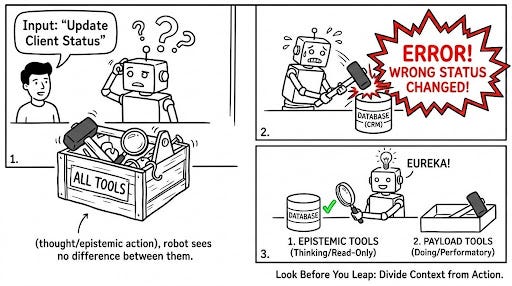
In the enterprise context, this means granting the agent access to external systems: executing SQL queries, calling proprietary APIs, updating Jira tickets, or interacting with a CRM. And this is exactly where naive implementations fail catastrophically. The failure mode is what I call The Trigger-Happy Agent.
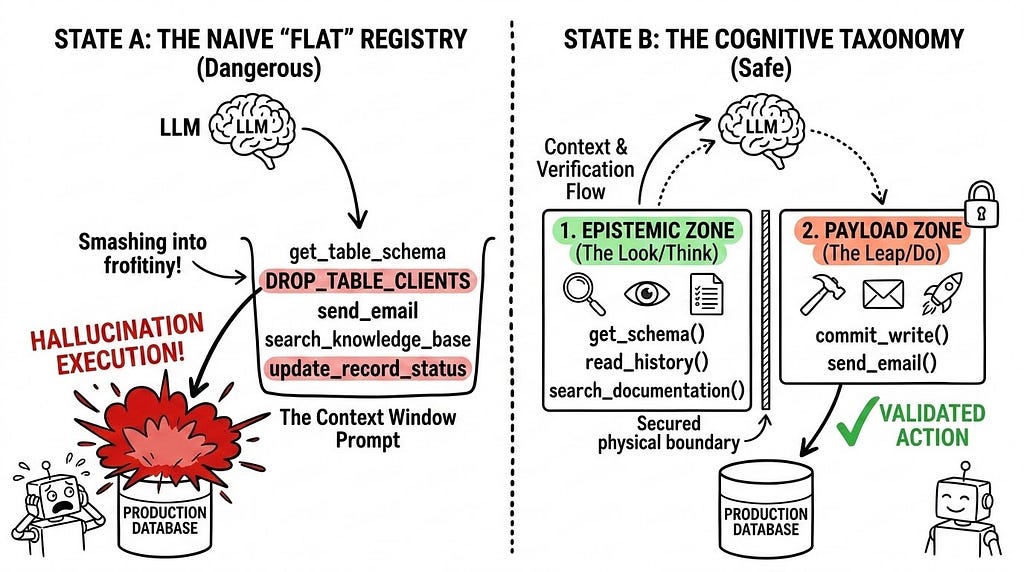
When an LLM is presented with a standard, “flat” list of tools in its prompt, it lacks an inherent understanding of consequence. There is no cognitive boundary between inquiry and action. To a typical ReAct (Reason + Act) loop, calling get_product_knowledge_base carries precisely the same weight as calling execute_sql_delete_row. They are both just JSON schemas passed to a function executor.
If a user asks a simple question like, “I need to correct a spelling error in our Q3 marketing campaign,” a naive agent often follows the path of least resistance. It may hypothesize what the current campaign is, guess the required update parameters, and immediately execute the destructive payload — the UPDATE tool—without ever verifying its context. It has committed an irreversible action based entirely on a hallucinated hypothesis.
This isn’t just a failure of precision; it is an architectural flaw. If you place a loaded weapon (a database WRITE key) in the hands of an agent that cannot distinguish between thinking and doing, eventual destruction is inevitable.
We cannot rely on a system prompt that pleads, “Please think carefully before taking action.” Production-grade systems require deterministic architectural constraints.
The Taxonomy of Actions
To correct this behavior, we must transition from a “flat” tool registry (where all actions are equal) to a “tiered” action space. This taxonomy is rooted in cognitive science and autonomous robotics, which stringently separates sense-making from actuation. The system must observe the environment before it modifies it.
1. Epistemic Tools (The “Look”)
Epistemic tools are designed entirely to alter the agent’s internal state — its knowledge base. They derive their name from epistemology, the study of knowledge. These are read-only, non-destructive tools used exclusively for gathering context, verifying data, or testing theories.
- Examples: get_table_schema, search_documentation, read_customer_snapshot, dry_run_query, or explain_api_endpoint.
- The Intent: These are tools for thinking. Their entire purpose is to help the model form a validated picture of the world before formulating an action plan. The only consequence of an Epistemic tool failure is wasted latency; no external data is harmed. The agent should be heavily incentivized (or forced) to use them liberally.
2. Payload Tools (The “Leap”)
Payload tools are performatory. They carry a payload (an action, a state change, a destructive operation) that alters the external state of the world. These tools represent the “doing” mechanisms. Once executed, they are often irrevocable.
- Examples: commit_database_transaction, send_marketing_email, update_crm_record, trigger_process_webhook.
- The Intent: These are the tools that fulfill the final goal. They are “expensive” and dangerous. They must be gated, verified, and often require a deterministic validation check before execution.
The Critical Context Split
By classifying tools this way, we introduce a massive cognitive advantage for the model.
When the agent is restricted to using Epistemic tools first, its reasoning loop is focused entirely on validation. The output of an Epistemic action is context — a new piece of ground-truth that anchors the model’s next decision.
We are forcing the agent to build its reality before we give it permission to change it.
The Architectural Fix: The Two-Step Execution Loop
If we dump both Epistemic and Payload tools into the same prompt, the LLM will inevitably attempt to optimize for the shortest path to the user’s goal, often skipping the Epistemic step entirely.
To prevent this, we must introduce a State-Dependent Tool Registry.
Instead of exposing all tools at once in a flat array, we use a Middleware Router that conditionally exposes Payload tools only after specific Epistemic conditions have been mathematically met in the session memory. This forces the agent into a rigid, two-step execution loop:
- Phase 1 (The Reconnaissance State): The agent is spawned and given access only to Epistemic tools. It is given the user’s prompt and tasked with drafting a “Payload Plan.” Because it has no performatory tools available, it physically cannot hallucinate an execution. It is forced to look, read, and verify.
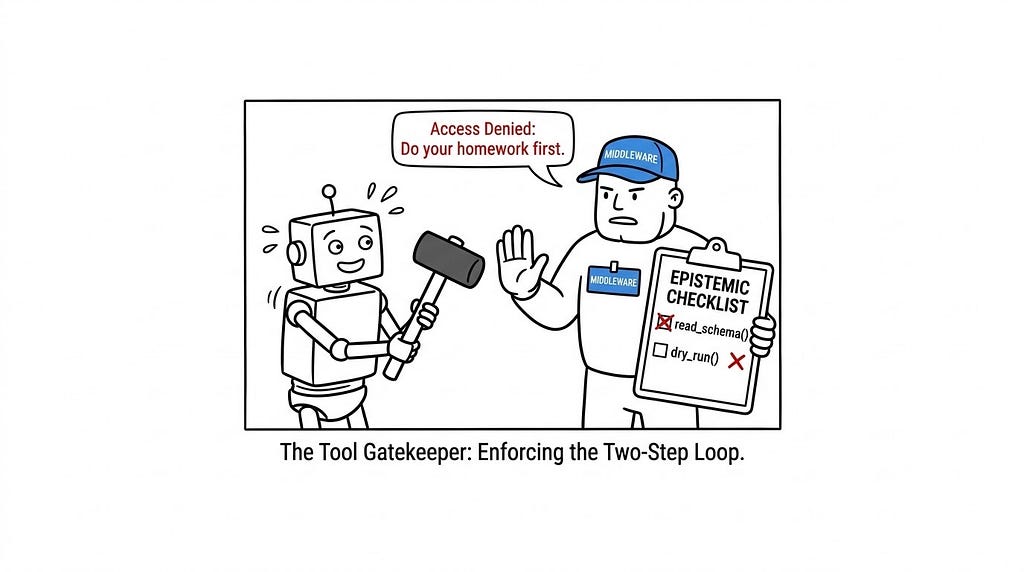
- Phase 2 (The Execution State): Once the agent finalizes its plan, the Middleware Router checks the agent’s scratchpad. If the required Epistemic tools were successfully called, the Payload tools are dynamically injected into the agent’s tool registry, allowing it to execute the validated leap.
The Code Artifact: The Epistemic Gatekeeper
We have the theory (Taxonomy of Actions) and the strategy (Two-Step Execution). Now we need the architecture.
The following Python class demonstrates a ToolGatekeeper. This middleware intercepts the agent's tool call request just before it hits your execution environment. It strictly prevents Payload tools from firing unless the agent's session memory proves it has already executed the necessary Epistemic prerequisite.
import json
from typing import Dict, Any, List

class ToolGatekeeper:
    """
    A runtime interceptor that prevents Payload Tool execution
    if the prerequisite Epistemic Tools haven't been used.
    """
    def __init__(self):
        # Map Payload tools (Keys) to their required Epistemic prerequisites (Values)
        self.epistemic_dependencies = {
            "execute_sql_update": ["get_table_schema", "dry_run_query"],
            "send_customer_email": ["fetch_customer_history"],
            "update_jira_ticket": ["read_ticket_status"]
        }

    def before_tool_callback(self, tool_call_request: Dict[str, Any], session_history: List[str]) -> bool:
        """
        Intercepts the tool call from the LLM.
        Returns True if authorized, raises a PermissionError if not.
        """
        requested_tool = tool_call_request.get("name")

        # 1. If it's an Epistemic Tool (not in our payload keys), let it pass immediately.
        if requested_tool not in self.epistemic_dependencies:
            return True

        # 2. It's a Payload Tool. We must verify the Epistemic Checklist.
        required_tools = self.epistemic_dependencies[requested_tool]

        # Scan the conversation history to see if the agent did its reconnaissance
        executed_tools = self._extract_executed_tools_from_memory(session_history)

        missing_prerequisites = [tool for tool in required_tools if tool not in executed_tools]

        # 3. Deterministic Enforcement
        if missing_prerequisites:
            error_msg = (
                f"ACTION REJECTED: You attempted to use a Payload Tool ({requested_tool}) "
                f"without completing the required Epistemic Reconnaissance. "
                f"You MUST call these tools first: {missing_prerequisites}."
            )
            # We raise this directly back into the LLM's context window.
            # The model absorbs the error and learns to correct its behavior.
            raise PermissionError(error_msg)

        return True

    def _extract_executed_tools_from_memory(self, session_history: List[str]) -> List[str]:
        # Helper function to parse session state for previous tool calls.
        # (Implementation depends on your specific framework, e.g., LangChain, LlamaIndex)
        pass
The Outcome
By implementing this Epistemic/Payload divide, we mathematically reduce the rate of hallucinated, destructive executions to near zero.
When the agent attempts to take a shortcut, the ToolGatekeeper physically blocks the execution and feeds the rejection string directly back into the context window. The model is forced to step back, realize its error, use its Epistemic tools to read the actual schema, and only then proceed to the Payload execution.
We have moved away from prompt engineering — hoping the agent behaves nicely — and moved into systems engineering, architecting an environment where it simply cannot fail.
Build the Complete System
This article is part of the Cognitive Agent Architecture series. We are walking through the engineering required to move from a basic chatbot to a secure, deterministic Enterprise Consultant.
To see the full roadmap — including Semantic Graphs (The Brain), Gap Analysis (The Conscience), and Sub-Agent Ecosystems (The Organization) — check out the Master Index below:
The Cognitive Agent Architecture: From Chatbot to Enterprise Consultant
Epistemic Tools vs. Payload Tools: Architecting the Agent’s Action Space was originally published in Towards AI on Medium, where people are continuing the conversation by highlighting and responding to this story.