Imagine we’re building a research agent that analyzes the latest developments in generative AI and delivers a weekly summary report. After running for several minutes and consuming thousands of tokens across multiple sources, it produces a confident output.
While reviewing the report, stakeholders identified a major flaw: several key claims in the report are based on outdated 2024 benchmarks, presented as current 2026 insights. The agent didn’t just make a retrieval error — it allowed bad data to propagate through its reasoning chain because it had no mechanism to isolate context or recover from an early mistake.
In traditional agent workflows, this kind of error is costly. Typical options to address the issue includes —
- restart the entire run and waste all prior computation,
- manually patch the output and risk introducing new inconsistencies, or
- ship the flawed result and hope the issue doesn’t surface again.
What if we could do something fundamentally better —
pause the workflow at the point of failure, go back to an earlier state in the execution graph, inject a precise correction (“ignore all sources before 2025”), and let the agent continue from that exact checkpoint instead of starting over?
That capability is exactly what we explored by building a research coordinator agent using Deepagents on top of LangGraph. By combining structured subagent delegation for clean context isolation with LangGraph’s checkpointing and time-travel capabilities, the system transforms a full restart into targeted, stateful recovery.
In this article, I’ll break down the architecture, show how an intentional mix of outdated and current sources creates realistic failure modes, and demonstrate how checkpoint forking fundamentally changes the way we debug and recover from agent errors.
Why Most Agents Fail in Real Workflows
Traditional agents operate on a “straight-line” logic. While this works for basic tool-calling, multi-step research exposes four critical breaking points:
- Context pollution: The agent’s memory gets bloated with irrelevant details from previous steps.
- The Domino Effect: A single bad retrieval or hallucination early in the process poisons everything that follows.
- The “All-or-Nothing” Trap: When something goes wrong at Step 4 of a 10-step workflow, the only practical option is to throw everything away and start over.
- Debugging difficulty: Understanding exactly where and why the agent went wrong is often opaque.
We need something fundamentally better — an architecture that could plan effectively, delegate intelligently, maintain clean context, and recover gracefully when things inevitably go wrong.
The Solution: Persistence and Forking
Instead of treating agent execution as a one-way linear chain, we need to treat it as a versioned, stateful history.
By moving away from linear chains toward a stateful graph, we gain three pillars of reliability that traditional “stateless” agents simply don’t have:
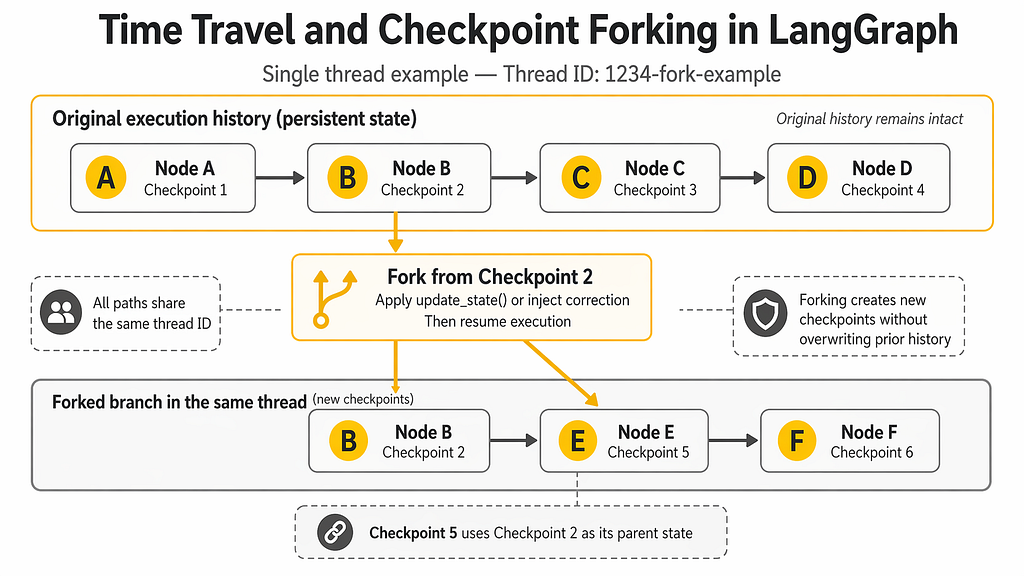
- Persistence: Every action — every variable, memory, and scheduled next step — is automatically saved as an immutable checkpoint.
- Threads: Each execution session lives under a unique thread_id that maintains a complete, versioned history of all checkpoints for that run.
- Checkpoint Forking: The ability to “time travel” to any past state, inject a surgical correction, and branch the execution forward without losing prior work.
Discovering Deepagents + LangGraph
This is exactly where the combination of Deepagents + LangGraph shines. While LangGraph provides the low-level primitives — persistence, threads, and checkpoint forking — turning those into a production-grade system usually requires heavy boilerplate.
Deepagents acts as a lightweight, opinionated harness — essentially a pre-configured toolkit — built directly on top of LangGraph. It provides the high-level abstractions that make these advanced features practical to use:
- Built-in Planning: Tools like write_todos to keep the coordinator agent focused.
- Virtual Filesystem: A dedicated space for managing intermediate notes and research outputs.
- Subagent Isolation: Native support for specialized subagents that prevent context from leaking.
- Seamless Integration: Full access to LangGraph’s time-travel capabilities without the manual setup.
Together, these tools allowed us to implement a clean Coordinator Pattern. The main agent focuses purely on orchestrating and delegating, while the underlying system handles the heavy lifting of state recovery.
Project Overview: The Research Coordinator Agent
Instead of building yet another monolithic agent overloaded with tools, we chose a strict Coordinator Pattern.
In this design, the main agent has zero custom tools. Its only responsibilities are high-level orchestration:
- Planning: Creating a structured roadmap using write_todos.
- Delegation: Routing subtasks to specialized subagents using the built-in task() tool.
This separation of concerns ensures the coordinator never suffers from context bloat. It stays focused on the big picture while specialized agents handle the detailed work.
Architecture: Coordinator + Specialized Subagents
We implemented two focused subagents:
- research-specialist: Responsible for searching the knowledge base and returning structured findings.
- fact-checker: Responsible for validating claims and explicitly flagging outdated or inconsistent information.
We deliberately seeded the knowledge base with a realistic mix of correct 2025–2026 documents and some outdated 2024 ones. This created intentional failure scenarios where the agent could make mistakes — and then correct them through time-travel.
The coordinator breaks down the user query into todos and delegates each task to the most appropriate subagent. Thanks to strong context isolation, each subagent only sees the information relevant to its role.
How Subagent Delegation Works
Here’s the core code for defining the subagents and creating the coordinator agent:
from deepagents import create_deep_agent
from langgraph.checkpoint.memory import MemorySaver
from langchain_openai import ChatOpenAI

# Define specialized subagents
research_subagent = {
    "name": "research-specialist",
    "description": "Focused agent for retrieving and structuring information from the knowledge base.",
    "prompt": (
        "You are a precise research specialist. Gather accurate, structured findings "
        "from the knowledge base. Return only relevant information."
    ),
    "tools": ["search_knowledge_base"]
}

fact_checker_subagent = {
    "name": "fact-checker",
    "description": "Specialized agent for validating claims and detecting outdated content.",
    "prompt": (
        "You are a rigorous fact-checker. Always verify dates and flag any information "
        "from 2024 or earlier as outdated."
    ),
    "tools": ["search_knowledge_base"]
}

# Create the deep agent (coordinator)
agent = create_deep_agent(
    model=ChatOpenAI(model="gpt-4o", temperature=0),
    tools=[],                                      # Coordinator has no direct tools
    system_prompt=(
        "You are a Research Coordinator. Plan every task using todos and delegate "
        "all research and fact-checking exclusively to your subagents."
    ),
    subagents=[research_subagent, fact_checker_subagent],
    interrupt_on={"write_file": True},
    checkpointer=MemorySaver(),
)
(Simplified for clarity. The full, production-ready version with detailed prompts and modular structure is in src/agents/coordinator.py and src/agents/subagents.py in the repository.)
By giving the coordinator no direct tools, we forced it to act purely as an orchestrator. This pattern significantly improves maintainability and makes debugging much clearer.
The Real Magic: Time-Travel Debugging & Checkpoint Forking
This is where the theory of stateful graphs becomes a tangible superpower. Because LangGraph snapshots every state, we don’t have to watch helplessly as a run fails. If the agent produces a report based on 2024 data, we can “rewind the tape.”
First, we inspect the thread’s history to find the exact moment the 2024 data was introduced:
states = list(agent.get_state_history(config))

for i, snapshot in enumerate(states):
    print(f"Step {i}: {snapshot.metadata.get('step')} | Next: {snapshot.next}")
Once we identify the “point of infection,” we perform a Checkpoint Fork. We don’t just retry the prompt; we jump back to that specific moment in time and inject a surgical correction.
fork_config = {
    "configurable": {
        "thread_id": thread_id,
        "checkpoint_id": chosen_checkpoint_id
    }
}

correction = "IMPORTANT: Only use sources from 2025 or later. Ignore any 2024 documents."

forked_result = agent.invoke(
    {"messages": [HumanMessage(content=correction)]},
    config=fork_config
)
(Simplified for clarity. The full time-travel logic is in demos/time_travel.py.)
The agent resumes exactly from the chosen checkpoint, incorporates the new instruction, re-delegates if necessary, and produces a corrected final report. This “time-travel” capability turns debugging from a frustrating process into a controlled and repeatable one.
Visualizing the Recovery: The Streamlit Demo
To make these concepts truly interactive, we built a Streamlit dashboard that brings the “undo” button to life. It hides the complexity of checkpoint IDs and thread history behind a clean, intuitive interface where you can:
- Observe in Real Time: Watch the coordinator break down a query into todos and delegate tasks to the research-specialist and fact-checker subagents.
- Time Travel: Browse the full state history, select any past checkpoint, apply a targeted correction, and instantly see the agent fork a new, successful execution path.
This demo makes the power of checkpoint forking feel tangible — you can intentionally trigger a failure and recover from it in seconds.
Key Lessons & Production Tips
- Restricting the coordinator to planning and delegation (zero custom tools) is highly effective at preventing context bloat.
- Subagent isolation is one of the best defenses against polluted context and cascading errors.
- Time-travel debugging changes how we think about agent reliability — it gives us a true “undo” button. In production, we rarely scan checkpoints manually. Instead, we combine strategic interrupts (e.g. after the fact-checker), automated flagging by subagents, and simple review UIs so humans (or a supervisor agent) can quickly approve, edit, or fork from the right checkpoint.
- Start with MemorySaver during development. For production, switch to PostgresSaver (or any persistent checkpointer) and implement regular checkpoint pruning to keep storage under control.
- Beyond debugging, persistence and checkpoint forking unlock powerful patterns: safely resuming long-running agents after interruptions, running parallel experiment branches (A/B testing corrections), and implementing safe rollback mechanisms in production workflows.
Conclusion
Deepagents on top of LangGraph offers a practical way to build long-running agents that are not only capable, but also recoverable. By combining coordinator-based delegation with persistent execution state and checkpoint forking, the system moves away from fragile straight-line workflows and toward something much closer to a production-ready operating model.
The most important takeaway is that long-running agent reliability is not just a prompting problem. It is an execution problem. Once an agent runs across multiple stages, tools, and intermediate artifacts, we need state, isolation, and recovery mechanisms to keep the system trustworthy. That is what makes this pattern valuable.
If you are building research agents, complex RAG systems, or any workflow where failures can emerge late and reruns are costly, this approach is worth exploring. It does not eliminate the need for better retrieval or validation, but it gives us something many agent systems still lack: a disciplined way to recover from mistakes without discarding everything that came before them.
The complete code and interactive Streamlit demo are available in the repository: → smnomaan/deepagents-research-coordinator
Deepagents on LangGraph: Debugging Long-Running AI Agents with Time-Travel was originally published in Towards AI on Medium, where people are continuing the conversation by highlighting and responding to this story.