The recent introduction of Agent Skills by Anthropic caught my attention — not because of what it claimed, but because of what it implied.
At first glance, the idea seems almost trivial:
Give LLM a folder of instructions and it becomes more capable.
But that immediately raises a deeper question.
If we’ve always experienced that no single agentic architecture can solve every problem, then how does this approach suddenly enable domain expertise, structured workflows, and reuse across tasks?
There has to be something more going on beneath the surface.
Curious to understand this better, I turned to an open-source implementation — DeepAgents, a package built on top of LangGraph. Unlike closed systems, this gave me a chance to actually trace how “skills” are used in practice
What Are Agent Skills — And Why Do They Matter?
Before diving into the system itself, it’s important to understand what skills actually are!
According to the official definition, Agent Skills are a lightweight, open format for extending AI agent capabilities with specialized knowledge and workflows.
In practice, this is surprisingly simple.
You provide the model with a folder that contains:
- a SKILL.md file
- and optionally, supporting scripts or documentation
The SKILL.md acts as the brain of the skill—it encodes domain-specific workflows that guide the model step-by-step toward solving a problem.
And this simple abstraction solves three fundamental limitations of vanilla LLMs:
- Domain Expertise
You can inject highly specific knowledge and structured workflows into the system. - Repeatable Workflows
The agent doesn’t “wing it” every time — it follows consistent steps for multi-stage problems. - Cross-Agent Reuse
Skills are portable. Share the folder, and another agent instantly gains the same capability.
🔍 Why this works (subtle but important)
What makes this powerful is not just the format — but the idea that:
We are no longer relying purely on model weights for intelligence, but augmenting them with structured, external reasoning artifacts.
And that’s where things start to get interesting…
Progressive Disclosure: The Hidden Trick
To make this concrete, let’s look at what a skill actually looks like in practice.
Here’s a real example from a DeepAgents setup built on top of LangGraph:
---
name: langgraph-docs
description: Use this skill for requests related to LangGraph in order to fetch relevant documentation to provide accurate, up-to-date guidance.
---
At the top, we have a simple YAML block — just a name and a description.
Nothing fancy. No embeddings. No fine-tuning.
And yet, this tiny piece plays a critical role.
Below that, the skill expands into actual instructions:
# langgraph-docs

## Overview

This skill explains how to access LangGraph Python documentation to help answer questions and guide implementation.

## Instructions

### 1. Fetch the Documentation Index

Use the fetch_url tool to read the following URL:
https://docs.langchain.com/llms.txt

This provides a structured list of all available documentation with descriptions.

### 2. Select Relevant Documentation

Based on the question, identify 2-4 most relevant documentation URLs from the index. Prioritize:

- Specific how-to guides for implementation questions
- Core concept pages for understanding questions
- Tutorials for end-to-end examples
- Reference docs for API details

### 3. Fetch Selected Documentation

Use the fetch_url tool to read the selected documentation URLs.

### 4. Provide Accurate Guidance

After reading the documentation, complete the user's request.
🧠 Here’s the interesting part
The agent does not read this entire file upfront.
Instead, it first looks only at the YAML frontmatter:
- name
- description
Based on that, it decides:
“Is this skill relevant to the user’s query?”
Only if the answer is yes, it proceeds to read the full file.
This pattern is called progressive disclosure.
And it’s a subtle but powerful idea:
- You don’t overload the model with all possible knowledge
- You let it select first, then expand context only when needed
👉 This is how skills scale without blowing up the context window.
🚧 But this raises a bigger question
So far, what we’ve seen is just:
- a folder
- a markdown file
- some instructions
That alone shouldn’t be enough to:
- break down complex problems
- execute multi-step workflows
- manage memory
- or coordinate multiple tasks
Yet… it works.
Which means the real intelligence is not just in the skill —
it’s in the system that uses the skill.
🔍 Peeking Under the Hood: DeepAgents + LangGraph
To understand that system, I looked into DeepAgents, an open-source package built on top of LangGraph.
What it reveals is that skills are just one layer in a much larger architecture.
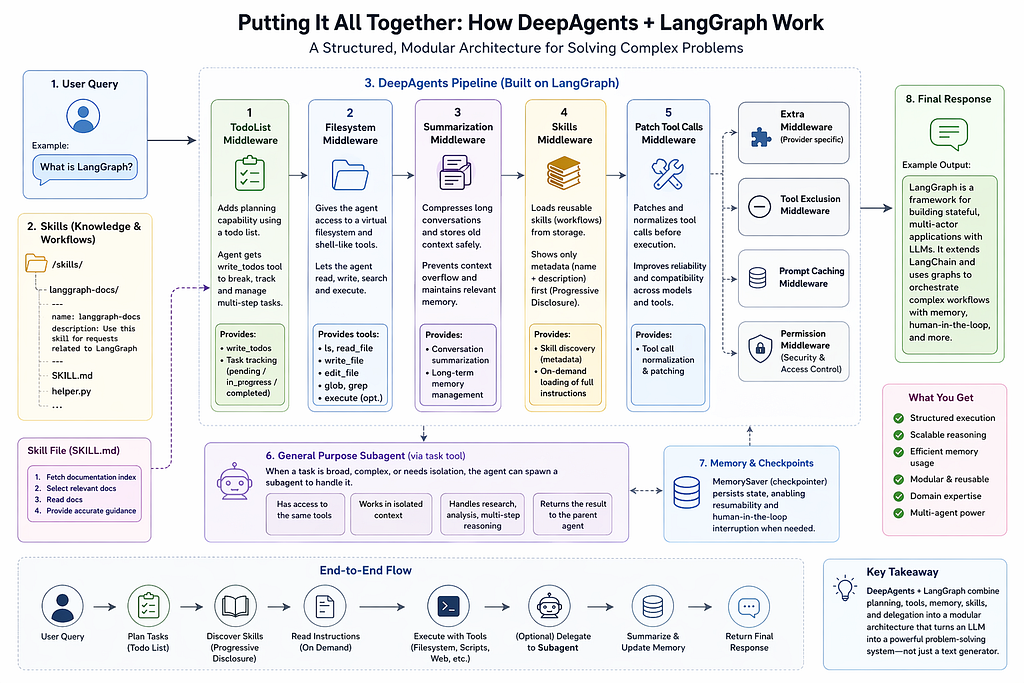
Under the hood, DeepAgents combines multiple mechanisms:
- A todo-list based planner that breaks problems into smaller steps
- A tool-driven execution layer that can read files, run code, and fetch data
- A general-purpose subagent system that can delegate complex tasks
- And a memory layer combined with a summarization tool that keeps context under control
Together, these create something much more interesting than a single agent.
They create a structured reasoning system.
💡 Why this matters
This is the key shift:
We are moving from “LLMs that answer questions”
to “systems that execute workflows”
- Skills provide what to do
- The system decides when and how to do it
And that distinction is everything.
Now let’s move from concepts to something more concrete.
Here’s a minimal example of how an agent is created using DeepAgents:
from deepagents import create_deep_agent
from langgraph.checkpoint.memory import MemorySaver
from deepagents.backends.filesystem import FilesystemBackend

# Checkpointer is REQUIRED for human-in-the-loop
checkpointer = MemorySaver()

agent = create_deep_agent(
    model="google_genai:gemini-3.1-pro-preview",
    backend=FilesystemBackend(root_dir="/Users/user/{project}"),
    skills=["/Users/user/{project}/skills/"],
    interrupt_on={
        "write_file": True,  # Default: approve, edit, reject
        "read_file": False,  # No interrupts needed
        "edit_file": True    # Default: approve, edit, reject
    },
    checkpointer=checkpointer,  # Required!
)

result = agent.invoke(
    {
        "messages": [
            {
                "role": "user",
                "content": "What is langgraph?",
            }
        ]
    },
    config={"configurable": {"thread_id": "12345"}},
)
At first glance, this looks deceptively simple.
You pass:
- a model
- a backend
- a path to skills
…and you get an “intelligent agent”.
But this is where things gets even more interesting.
Because this function is not just creating an agent —
it is assembling an entire architecture.
🧠 What’s actually happening under the hood?
If you dig into create_deep_agent, you’ll find something like this:
    gp_middleware: list[AgentMiddleware[Any, Any, Any]] = [
        TodoListMiddleware(),
        FilesystemMiddleware(
            backend=backend,
            custom_tool_descriptions=_profile.tool_description_overrides,
        ),
        create_summarization_middleware(model, backend),
        PatchToolCallsMiddleware(),
    ]
    if skills is not None:
        gp_middleware.append(SkillsMiddleware(backend=backend, sources=skills))

    # Add provider-specific middleware, if any
    gp_middleware.extend(_resolve_extra_middleware(_profile))

    # Strip excluded tools after all tool-injecting middleware has run
    if _profile.excluded_tools:
        gp_middleware.append(_ToolExclusionMiddleware(excluded=_profile.excluded_tools))
    # Prompt caching is unconditional: "ignore" silently skips non-Anthropic models
    gp_middleware.append(AnthropicPromptCachingMiddleware(unsupported_model_behavior="ignore"))

    # Permissions must be last so they see all tools from prior middleware
    if permissions:
        gp_middleware.append(_PermissionMiddleware(rules=permissions, backend=backend))

    general_purpose_spec: SubAgent = {  # ty: ignore[missing-typed-dict-key]
        **GENERAL_PURPOSE_SUBAGENT,
        "model": model,
        "tools": _tools or [],
        "middleware": gp_middleware,
This is the real story.
👉 The agent is not a single model call.
👉 It is a pipeline of middleware layers.
Each layer adds a specific capability.
🔍 Let’s break this down (this is the core insight)
1. Planning Layer — TodoListMiddleware
This is one of the most underrated pieces.
It gives the agent a write_todos tool to:
- break problems into steps
- track progress
- move systematically
If you think about it, this is exactly how humans handle complexity.
We don’t solve problems in one shot.
We create a plan.
This middleware forces the agent to do the same.
2. Execution Layer — FilesystemMiddleware
This is where the agent becomes actionable.
It introduces tools like:
- read_file
- write_file
- edit_file
- grep, glob
- even execute
Now the agent is no longer just “thinking” —
👉 it can interact with its environment
This is also how skills become real:
- Skill says: “read this file, run this script”
- Agent actually does it using these tools
3. Memory Layer — Summarization
Long conversations break LLMs.
This middleware solves that by:
- compressing old context
- storing it externally
- keeping only what’s relevant
So the agent can scale beyond context limits.
4. Knowledge Layer — SkillsMiddleware
This is where your earlier “skills folder” comes into play.
What this middleware does is subtle but powerful:
- It exposes only skill metadata (name + description)
- Lets the agent decide relevance
- Loads full instructions only when needed
That’s the progressive disclosure we saw earlier.
Notice something important:
👉 It does NOT create tools. Agent can use read_file.
👉 It does NOT execute anything automatically
It simply guides the agent’s decisions
🤯 The missing piece: delegation
After all this, there’s still one more layer that explains how complex problems are handled.
DeepAgents introduces a general-purpose subagent as a tool.
Instead of solving everything in one thread, the agent can:
- spawn a new agent
- give it a focused task
- receive only the final result
Think of it like this:
Instead of thinking harder…
the system splits thinking into multiple isolated workers
This has huge advantages:
- cleaner reasoning
- reduced context overload
- better scalability
Putting It All Together (System Flow)
What This Changes About How We Think About AI
What started as a simple curiosity about Anthropic’s skills leads to a much deeper realization.
Skills alone are not the breakthrough.
They are just one piece of a larger idea.
The real shift is this:
We are no longer building smarter models
We are building better systems around models
When you look closely at implementations like DeepAgents on top of LangGraph, a pattern emerges:
- Planning is externalized (todo lists)
- Knowledge is modular (skills)
- Execution is tool-driven
- Memory is managed
- Work is delegated (subagents)
Individually, none of these are new.
But together, they create something powerful:
A system that behaves less like a chatbot…
and more like a structured problem solver
This also explains something subtle but important:
Anthropic didn’t just introduce a feature.
They introduced a design philosophy.
Few Skills Repository
- GitHub - anthropics/skills: Public repository for Agent Skills
- GitHub - VoltAgent/awesome-agent-skills: A curated collection of 1000+ agent skills from official dev teams and the community, compatible with Claude Code, Codex, Gemini CLI, Cursor, and more.
- GitHub - anthropics/knowledge-work-plugins: Open source repository of plugins primarily intended for knowledge workers to use in Claude Cowork
Deconstructing Agent Skills: A LangGraph Deep Dive was originally published in Towards AI on Medium, where people are continuing the conversation by highlighting and responding to this story.