Why You Can’t Afford Dirty Data. Data scrubbing helps by systematically finding and correcting flawed data, ensuring that businesses work with trustworthy information they can confidently use.
Introduction
Here’s a startling statistic: 73% of company data goes unanalyzed, often because of poor quality. In today’s data-driven world, this isn’t just wasteful — it’s dangerous. Bad data leads to misguided decisions, operational inefficiencies, and missed opportunities.
Enter data scrubbing: your first line of defense against unreliable information.
Data Scrubbing
Data scrubbing (also called data cleansing) is the meticulous process of detecting and correcting corrupt, inaccurate, or inconsistent records in your datasets. Think of it as a quality control checkpoint for your information — ensuring that what flows through your business systems is accurate, complete, and actionable.
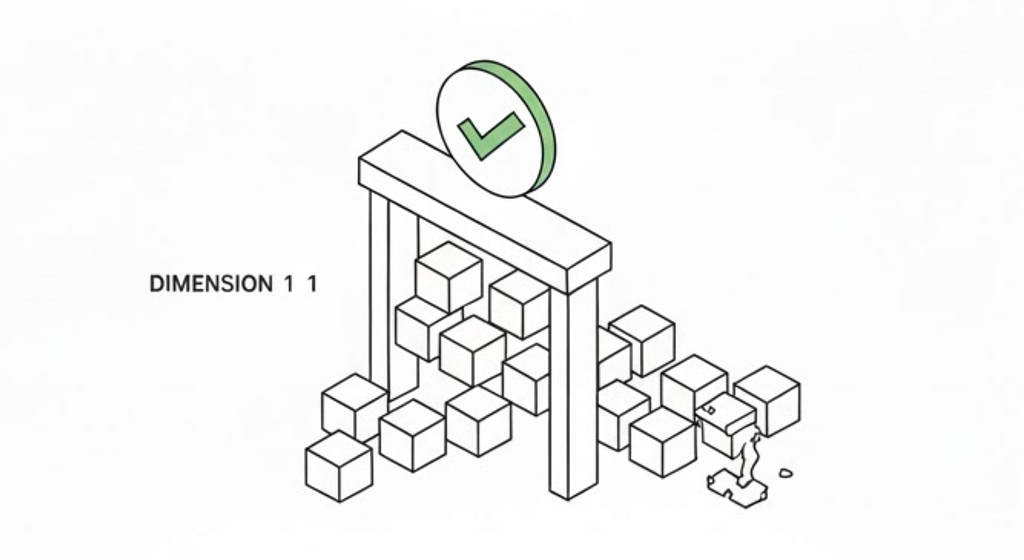
The process goes far beyond simple spell-checking. It involves:
- Identifying anomalies and outliers
- Correcting errors and inconsistencies
- Removing duplicate entries
- Standardizing formats
- Filling in missing information
- Validating data against trusted sources
The Cost of Skipping This Step
Before we dive deeper, consider what happens when you don’t scrub your data:
- Poor decision-making: Executives make strategic choices based on flawed information
- Wasted resources: Teams spend hours tracking down errors instead of analyzing insights
- Compliance risks: Regulatory violations from inaccurate data handling
- Customer frustration: Wrong contact information, duplicate communications, personalization failures
- Competitive disadvantage: While you’re cleaning up messes, competitors are moving forward with clean data
Data Scrubbing vs. Data Cleaning vs. Data Cleansing: What’s the Difference?
These terms are often used interchangeably, but there are subtle distinctions worth understanding:
Data Cleaning
The basic process of removing obvious errors and inconsistencies — duplicates, incomplete entries, and formatting issues. It’s surface-level maintenance.
Data Cleansing
A broader approach that includes standardization, validation, and enrichment. It not only removes errors but improves overall data quality and usability.
Data Scrubbing
The most comprehensive process, incorporating validation, reconciliation, and in-depth analysis using algorithms and complex checks. It’s about ensuring accuracy and consistency at the deepest level.
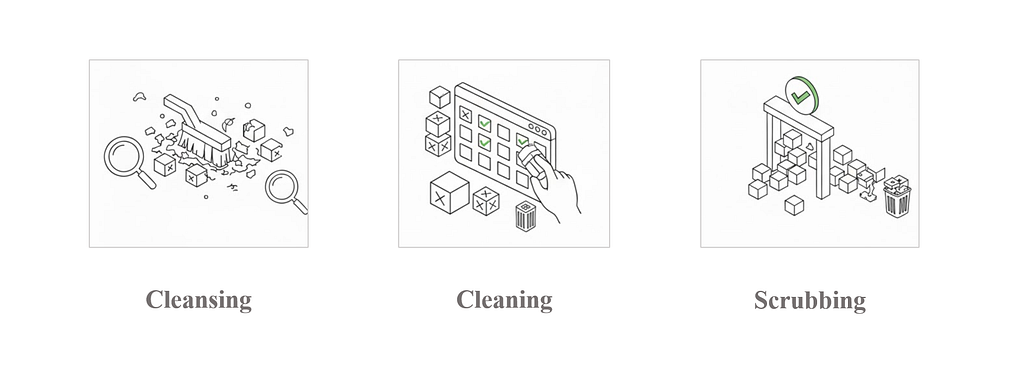
The bottom line: While cleaning is reactive, scrubbing is proactive. Scrubbing anticipates problems before they cascade through your systems.
The Core Techniques of Data Scrubbing
1. Error Detection and Correction
Advanced algorithms identify anomalies — unexpected values, outliers, or patterns that don’t fit. Once detected, errors are systematically corrected or flagged for human review.
2. Data Validation
Every piece of data is checked against predefined rules. Email addresses must follow proper format. Phone numbers must have the right number of digits. Dates must fall within logical ranges.
3. Data Standardization
Converting everything to consistent formats is crucial. All dates become YYYY-MM-DD. All temperatures convert to Celsius. All currency converts to one standard. This uniformity enables accurate analysis.
4. De-duplication
Sophisticated matching algorithms identify duplicate records — even when they’re not exact matches. Then you decide: merge the duplicates into one master record or purge redundant entries.
5. Data Enrichment
Sometimes cleaning isn’t enough. Enrichment adds value by incorporating additional relevant information from external sources — demographic data, geographic information, or industry classifications.
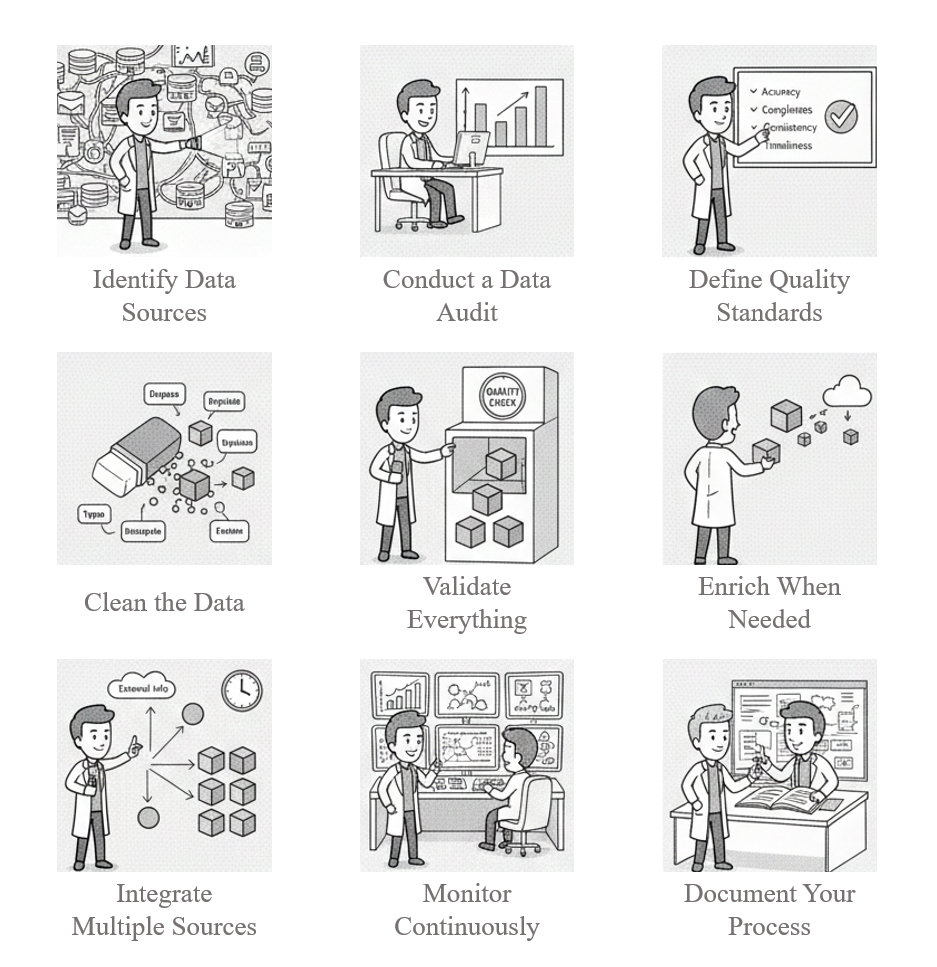
The 9-Step Data Scrubbing Process
Here’s how to implement data scrubbing systematically:
Step 1: Identify Data Sources
Map out where your data comes from — databases, spreadsheets, APIs, manual entries. Each source may require different scrubbing approaches.
Step 2: Conduct a Data Audit
Use data profiling tools to assess current quality. What percentage is incomplete? How many duplicates exist? Where are the inconsistencies?
Step 3: Define Quality Standards
What does “good data” mean for your organization? Set clear benchmarks for accuracy, completeness, consistency, and timeliness.
Step 4: Clean the Data
This is where the work happens — fixing typos, aligning formats, removing duplicates, addressing missing values.
Step 5: Validate Everything
Ensure the cleaned data conforms to your quality standards. Automated validation catches what human eyes might miss.
Step 6: Enrich When Needed
Add context and depth by incorporating relevant external information.
Step 7: Integrate Multiple Sources
Combine data from different origins into a unified, cohesive view.
Step 8: Monitor Continuously
Data scrubbing isn’t one-and-done. Implement ongoing monitoring to maintain quality as new data flows in.
Step 9: Document Your Process
Record techniques used, challenges faced, and improvements made. This becomes your playbook for future efforts.
Real-World Data Scrubbing Examples
Let’s make this concrete with practical examples:
- E-commerce company: Scrubs customer addresses to standardize formatting, correct zip codes, and validate deliverability before shipping
- Healthcare provider: Scrubs patient records to eliminate duplicates, standardize medical codes, and ensure regulatory compliance
- Marketing agency: Scrubs email lists to remove invalid addresses, fix typos, and merge duplicate contacts
- Financial institution: Scrubs transaction data to detect anomalies, validate amounts, and flag potential fraud
The Transformative Benefits
When done right, data scrubbing delivers powerful advantages:
1. Enhanced Accuracy
Clean data means reliable insights. No more decisions based on flawed information.
2. Increased Efficiency
Teams stop wasting time on data cleanup and focus on analysis and strategy.
3. Better Decision-Making
Trust your data, trust your decisions. Clean data enables confident strategic planning.
4. Compliance and Risk Management
Meet regulatory requirements and avoid costly legal issues from data handling errors.
5. Improved Customer Relationships
Accurate customer data enables personalization, better service, and stronger loyalty.
6. Cost Savings
While scrubbing requires investment, the long-term savings from avoiding errors and inefficiencies are substantial.
7. Competitive Advantage
Clean data delivers faster, more accurate insights — keeping you ahead of competitors still drowning in dirty data.
Common Challenges (and How to Overcome Them)
Challenge 1: Volume and Complexity
- Solution: Implement automated scrubbing tools that can handle large datasets efficiently.
Challenge 2: Multiple Data Sources
- Solution: Establish standardized integration protocols and use middleware to harmonize data from diverse systems.
Challenge 3: Maintaining Quality Over Time
- Solution: Build continuous monitoring into your workflows rather than treating scrubbing as a one-time project.
Challenge 4: Balancing Automation and Human Oversight
- Solution: Use automation for routine tasks but maintain human review for complex judgment calls.
Tools and Technologies
Modern data scrubbing leverages powerful tools:
- Data profiling software: Assesses data quality automatically
- ETL platforms: Extract, transform, and load data with built-in scrubbing capabilities
- Machine learning algorithms: Detect patterns and anomalies human reviewers might miss
- Validation engines: Apply complex rules to ensure data integrity
- Master data management systems: Maintain single sources of truth across the organization
Action Plan for Data Scrubbing
Are you ready to implement data scrubbing? Here’s your roadmap:
- Start small: Choose one critical dataset and scrub it thoroughly
- Measure impact: Track improvements in accuracy, efficiency, and decision quality
- Build buy-in: Share success stories to gain organizational support
- Scale gradually: Expand to additional datasets systematically
- Establish governance: Create policies and standards for ongoing data quality
- Invest in tools: Acquire technology that automates and accelerates the process
- Train your team: Ensure everyone understands why clean data matters and how to maintain it
Okay, this was the theory part. Let me take you to a code-based journey. I prepared an intelligent document management system that demonstrates real-time data reduction techniques including deduplication, compression, and intelligent tiering. Click here and reach to the repository I created for you.

Conclusion
In the age of big data and AI, the quality of your data directly determines the quality of your outcomes. Data scrubbing isn’t just a technical necessity — it’s a strategic imperative. Organizations that embrace rigorous data scrubbing gain clearer insights, make better decisions, and outperform competitors. Those that neglect it struggle with unreliable information, wasted resources, and missed opportunities. The question isn’t whether you can afford to scrub your data. It’s whether you can afford not to.
Data Scrubbing was originally published in Towards AI on Medium, where people are continuing the conversation by highlighting and responding to this story.