More data doesn’t always mean better insights. In fact, excessive data storage can cripple your operations, inflate costs, and slow down decision-making.

Introduction
In today’s data-driven world, organizations are drowning in information. Every transaction, customer interaction, and operational process generates data — terabytes upon terabytes of it. But here’s the paradox: more data doesn’t always mean better insights. In fact, excessive data storage can cripple your operations, inflate costs, and slow down decision-making.
Enter data reduction — a strategic approach to managing data volume without sacrificing the information you actually need.
Data Reduction?
Data reduction is the process of deliberately limiting the amount of data your organization stores by eliminating redundancy, optimizing storage patterns, and removing unnecessary information. Think of it as Marie Kondo for your data infrastructure — keeping what serves you and letting go of the rest.

But here’s a crucial distinction: data reduction is not about losing information. It’s about storing data more intelligently. When done correctly, you can reassemble your reduced data to its original form without any loss of critical information.
Data reduction differs from simple data deduplication (removing duplicate copies) because it encompasses multiple strategies including deduplication, compression, consolidation, and more sophisticated techniques that we’ll explore.
Why Should Care About Data Reduction?
1. Massive Cost Savings
Storage isn’t free. Whether you’re using cloud infrastructure or on-premises data centers, every gigabyte costs money. By reducing data volume, organizations can slash storage costs significantly — sometimes by 50% or more.
2. Faster AI and Analytics
Cleaner, more compact data means faster processing. Machine learning models train quicker, analytics queries return results sooner, and your data scientists spend less time waiting and more time discovering insights.
3. Improved System Performance
Less data to move around means faster backups, quicker disaster recovery, and more responsive applications. Your entire IT infrastructure becomes more efficient.
4. Better Data Quality
The data reduction process often involves cleaning and preprocessing data, which means you end up with higher-quality information that’s more reliable for decision-making.
The Two Perspectives: Macro and Micro
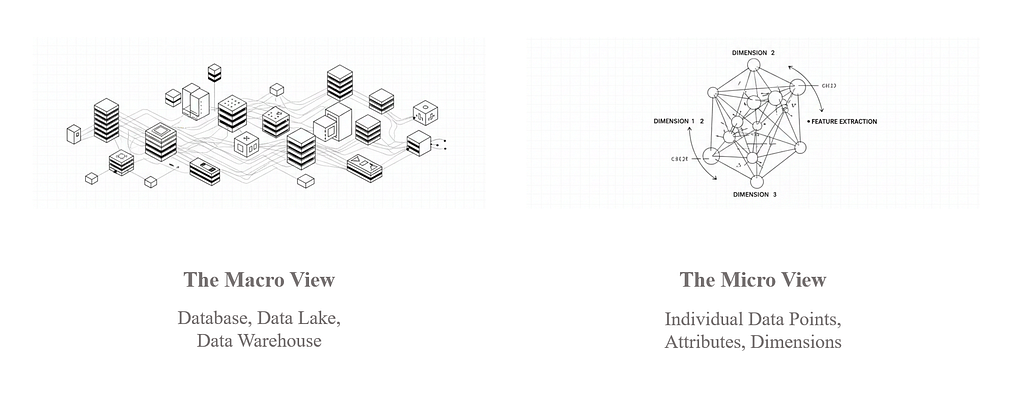
Understanding data reduction requires thinking about data from two angles:
The Macro View: This is data as we typically discuss it — databases, data lakes, petabytes of customer information. At this level, we’re concerned with overall storage volumes and organizational strategy.
The Micro View: Here, we’re looking at individual data points, their attributes, and physical dimensions. This is where data science becomes critical, dealing with concepts like dimensionality and feature extraction.
Most effective data reduction strategies operate at both levels simultaneously.
Key Data Reduction Techniques
1. Dimensionality Reduction
Imagine a customer record with 100 attributes (name, address, purchase history, browsing behavior, etc.). Not all of these attributes are equally valuable for every analysis. Dimensionality reduction identifies and eliminates redundant or less important features while preserving the essential information.
Common methods include:
- Principal Component Analysis (PCA): Transforms large variable sets into smaller ones while retaining most information
- Feature Extraction: Converts original data into numeric features optimized for machine learning
- Wavelet Transform: Particularly useful for image compression
The key benefit? Less “noise” in your data and better visualization capabilities.
2. Numerosity Reduction
Instead of storing every single data point, numerosity reduction represents data in a more compact format using models.
Parametric approaches (like regression models) focus on model parameters rather than storing all the raw data. If you can describe your data with an equation, you don’t need to store every point.
Non-parametric approaches (like histograms) organize data into bins and ranges, providing a compressed representation that’s still useful for analysis.
3. Data Cube Aggregation
Data cubes are multidimensional structures that organize information across different dimensions (time, location, product category, etc.). By aggregating data into these cubes, you create a container specifically optimized for analytical queries while reducing overall storage needs.
Think of it like organizing a massive library: instead of scattering books randomly, you create a structured system where related information lives together.
4. Data Compression
This is the most familiar form of data reduction. Compression reduces file sizes through encoding techniques:
Lossless Compression: The original data can be perfectly reconstructed. Think ZIP files for documents.
Lossy Compression: Some information is sacrificed for greater compression. Think JPEG images — they’re smaller, but not identical to the original.
5. Data Discretization
This technique converts continuous data into discrete intervals. For example, instead of storing exact customer ages (27, 31, 45, etc.), you might group them into ranges (25–34, 35–44, 45–54). This reduces storage while maintaining analytical utility.
6. Data Preprocessing
Before reduction can happen effectively, data often needs cleaning. This includes:
- Converting analog data to digital formats
- Normalizing values through binning
- Removing errors and inconsistencies
- Ensuring data integrity
The Data Reduction Process
Implementing data reduction isn’t a one-time project — it’s an ongoing strategy. Here’s how to approach it:
Step 1: Assess Your Current State
Audit your data storage to understand what you have, where it lives, and how much of it is truly necessary.
Step 2: Identify Redundancies
Look for duplicate data, obsolete information, and datasets that are no longer relevant to business operations.
Step 3: Choose Your Methods
Select the appropriate reduction techniques based on your data types and business needs. You’ll likely use multiple methods.
Step 4: Implement Gradually
Start with non-critical data to test your processes before applying them to mission-critical information.
Step 5: Monitor and Optimize
Continuously measure the impact on storage costs, system performance, and data accessibility.

Common Misconceptions About Data Reduction
- Myth #1: “We’ll lose important information.”
Reality: Properly executed data reduction maintains information integrity. It’s about smarter storage, not blind deletion.
- Myth #2: “It’s too complex for our team.”
Reality: Many data reduction techniques can be automated with modern tools. You don’t need a PhD in data science to get started.
- Myth #3: “Our data is special and can’t be reduced.”
Reality: Every organization has opportunities for data reduction. The techniques simply need to be tailored to your specific context.
Real-World Impact
Organizations implementing comprehensive data reduction strategies report:
- 40–70% reductions in storage costs
- 2–5x faster query performance
- Improved disaster recovery times
- Enhanced compliance with data retention policies
- More efficient use of cloud resources
The Role of AI in Data Reduction
Modern AI and machine learning technologies are making data reduction more sophisticated and automated. AI can identify patterns in data usage, predict which data will be valuable in the future, and automatically apply the most appropriate reduction techniques.
As your organization’s AI capabilities grow, properly reduced data becomes even more valuable — it’s easier to move, faster to process, and more efficient to analyze.
Okay, this was the theory part. Let me take you to a code-based journey. I prepared an intelligent document management system that demonstrates real-time data reduction techniques including deduplication, compression, and intelligent tiering. Click here and reach to the repository I created for you.

Conclusion
Data reduction isn’t just a technical exercise — it’s a strategic imperative. As data volumes continue to explode and organizations become more dependent on real-time analytics, the ability to efficiently manage data will separate leaders from laggards.
Data Reduction was originally published in Towards AI on Medium, where people are continuing the conversation by highlighting and responding to this story.