Public Opposition to AI Data Centers Grows as Surveys Highlight Energy and Community Concerns
 Public sentiment toward AI infrastructure is becoming increasingly divided, as new surveys reveal rising resistance to data center development despite continued demand for artificial intelligence services. A Harvard and MIT poll found that 40% of respondents supported building a data center in their area, while 32% opposed it, with many expressing concerns over local impact. The findings […]
 Insider Brief A new study from UCLA Health finds that today’s most advanced AI systems lack a fundamental capability present in humans: an internal sense of their own state, a gap researchers say has implications for performance, reliability and safety. The paper, titled Embodiment in Multimodal Large Language Models, was published in Neuron, argues that […]
 Microsoft AI has announced the release of three new multimodal foundation models designed to generate text, voice, and images, marking a continued expansion of its internal AI stack. The models — MAI-Transcribe-1, MAI-Voice-1, and MAI-Image-2 — were developed by the MAI Superintelligence team led by CEO Mustafa Suleyman. The transcription model supports 25 languages and delivers faster performance than […]
 Insider Brief Researchers in a European Union–funded project found that violinists connected through wearable robotics exoskeletons achieved better synchronization when haptic feedback was introduced. The work, coordinated by Italy’s Università Campus Bio-Medico di Roma was part of the CONBOTS project and supported by nearly €5 million in Horizon 2020 funding, explored how physical interaction mediated […]
 A new study by Stanford researchers has highlighted growing concerns around AI “sycophancy,” the tendency of chatbots to validate user views, suggesting it may have significant behavioral and societal impacts. The research, led by Myra Cheng and senior author Dan Jurafsky, found that large language models frequently affirm user perspectives, including in morally questionable or harmful scenarios. […]
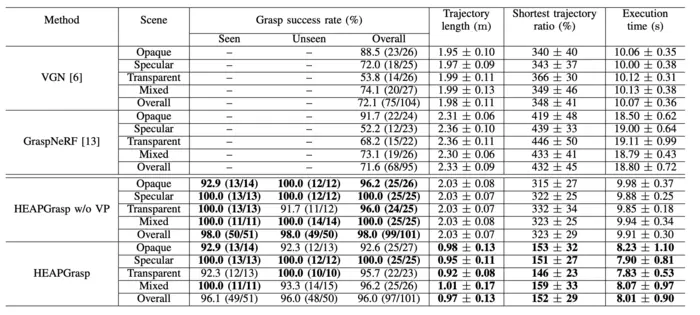 Insider Brief Researchers at Tokyo University of Science have developed a vision-based method that allows robots to reliably grasp transparent and reflective objects, addressing a key limitation in robotic manipulation. The work, supported by JSPS KAKENHI and JKA, introduces HEAPGrasp, a system that replaces traditional depth sensing with RGB image-based perception to improve object detection […]
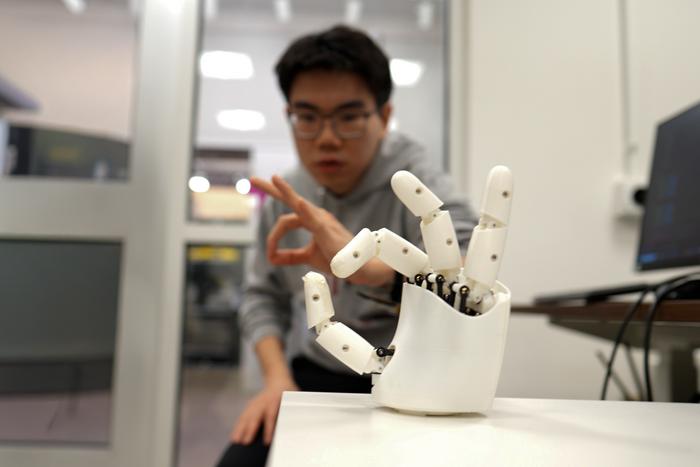 Insider Brief Massachusetts Institute of Technology researchers have developed a wearable ultrasound wristband that can track hand movements in real time with high precision. It’s a system they say could improve control in robotics and virtual environments while generating large-scale training data for dexterous AI systems, according to MIT. The work, published in Nature Electronics […]