Introduction
Customer support has long existed as an essential extension of software products — a structured function designed to assist users when the product experience encounters friction.
Over time, organizations have invested heavily in scaling this function. Global support teams, layered escalation models, knowledge bases, and service-level agreements have evolved to ensure that customer issues are resolved with speed and consistency. Despite these advancements, the underlying operating model has remained largely unchanged: when a problem occurs, resolution is orchestrated outside the product.
The emergence of AI has begun to reshape this landscape. Intelligent agents are now capable of interpreting user queries, retrieving relevant knowledge, and accelerating response times. For many organizations, this represents a meaningful step forward in improving support efficiency and scalability.
Yet, even as AI becomes more capable, its application remains largely confined to optimizing the existing model.
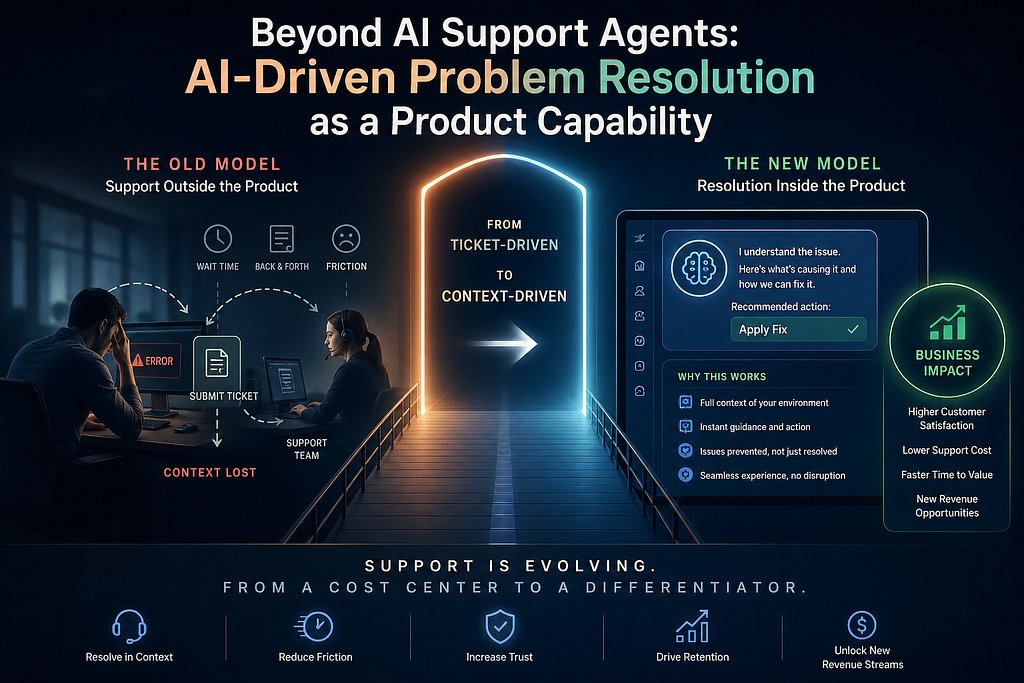
This raises a more fundamental question:
What if problem resolution is not merely a support function to be improved, but a capability that can be designed directly into the product itself?
The Current Trajectory: AI as an Efficiency Layer
The current wave of AI adoption in customer support is centered on operational optimization.
Organizations are deploying AI agents within centralized support systems to automate triage, respond to common queries, and assist human agents with contextual recommendations. These systems leverage documentation, historical tickets, and predefined workflows to deliver faster and more consistent outcomes.
The impact is tangible. Response times are reduced. Support costs are optimized. Customer interactions become more predictable.
However, the structural model remains intact.
The customer journey continues to follow a familiar sequence: an issue arises, the user disengages from the product experience, and support is engaged as a separate process. AI accelerates this journey, but it does not fundamentally alter it.
In this context, AI acts as an efficiency layer — improving performance without redefining the system.
The Structural Constraint: Distance from Context
A significant limitation of centralized AI support lies in its distance from the environment in which problems actually occur.
In real-world enterprise systems, issues rarely exist in isolation. They are shaped by a combination of factors, including customer-specific configurations, unique workflows, integration dependencies, and variations in data and usage patterns. These contextual elements are often the determining factor in both the occurrence of an issue and its resolution.
Centralized support systems, even when augmented with AI, rely on generalized knowledge. They are effective in addressing standardized and repeatable scenarios but are inherently constrained when resolution depends on localized context.
The further a problem is from standardized behavior, the more it depends on context — and the less effective a distant support layer becomes.
Reframing the Problem: From Function to Capability
Recognizing the importance of context leads to a shift in perspective.
Rather than continuing to optimize support as an external function, organizations can begin to view problem resolution as an intrinsic product capability — one that is embedded directly into the user experience.
This reframing changes the role of AI.
Instead of acting solely as an assistant to support teams, AI becomes an enabler of in-product intelligence, operating at the point where problems emerge.
This is not a marginal improvement. It represents a structural shift in how products are designed, experienced, and supported.
Embedding AI-Driven Resolution into the Product
Embedding AI into the product experience involves integrating an intelligent layer that operates in close proximity to user interactions and system states.
Such a capability would:
- Continuously interpret how the product is being used in a specific environment
- Understand customer-specific configurations and workflows
- Leverage documentation, historical issue patterns, and known resolutions
- Provide context-aware guidance at the moment a user encounters friction
Importantly, this intelligence is not limited to passive assistance. With clearly defined permissions and governance, it can enable action by guiding users through configuration changes, highlighting inconsistencies, and recommending corrective steps.
The objective is not to replicate the entire support function within the product. Instead, it is to resolve a meaningful share of issues at the point of occurrence — particularly those that are repetitive, configuration-driven, or context-dependent.
Implications for Customer Experience
When problem resolution is embedded into the product, the nature of the user experience changes in a fundamental way.
Users are no longer required to disengage from their workflow to seek assistance. Instead, they are supported in real time, within the context of their specific environment and task. This reduces friction, shortens resolution cycles, and increases confidence in using the product.
Over time, the product begins to behave less like a static tool and more like an adaptive system — one that not only enables tasks but actively assists in overcoming obstacles.
This shift has implications not only for usability, but also for adoption, retention, and overall customer satisfaction.
Organizational Impact: Redefining the Role of Support
As products become more capable of resolving issues internally, the role of support within the organization evolves.
A significant portion of support demand — particularly repetitive and context-driven issues — can be absorbed by the product itself. This reduces the volume of incoming cases while increasing the relative complexity of those that remain.
Support teams transition from high-volume, transaction-oriented work to handling nuanced, high-impact scenarios that require human judgment and expertise.
This reallocation of effort allows organizations to apply human capability more strategically, focusing on areas where it delivers the greatest value.
From Cost Center to Value Driver: The Revenue Dimension
Discussions around AI in support are often framed in terms of cost reduction and operational efficiency. While these benefits are important, they do not fully capture the strategic potential of embedding AI-driven resolution into the product.
When problem resolution becomes part of the product experience, it evolves into a customer-facing capability. This creates opportunities to reposition it not just as an internal efficiency lever, but as a component of the product’s value proposition.
Organizations can begin to explore:
- Premium product tiers that include advanced in-product assistance
- Enterprise-grade capabilities for automation, guidance, and self-resolution
- Differentiated offerings that position the product as more intelligent and self-sufficient
In this model, support is no longer solely a cost center. It becomes a lever for differentiation and, potentially, a source of incremental revenue.
Continuous Learning and Contextual Adaptation
The effectiveness of an embedded AI capability depends on its ability to evolve alongside the product and its users.
It must continuously learn from product changes, historical resolution patterns, and customer-specific interactions. At the same time, this learning must be governed to ensure that knowledge is applied accurately and contextually.
Not all solutions are universally applicable. What works in one environment may not translate to another. The system must therefore be capable of interpreting data with contextual precision rather than relying on generalized assumptions.
The long-term value of such a capability lies not only in the accumulation of knowledge, but in its ability to apply that knowledge appropriately within specific contexts.
Execution Considerations
Transitioning to an AI-driven, in-product resolution model requires deliberate design and sustained investment.
Key considerations include deep integration with product architecture, alignment with evolving interfaces and configurations, robust permission models, and mechanisms for validation and continuous improvement.
This is not a feature-level enhancement that can be layered onto an existing system. It is a foundational capability that must be built and evolved with the same rigor as the product itself.
Executive Lens: Questions Worth Carrying Forward
As AI continues to improve support efficiency, a more fundamental shift may be underway — one that challenges where problem resolution should exist.
- If a meaningful share of support demand is predictable, why does it still live outside the product?
The persistence of external support may reflect design boundaries rather than necessity. - Are we scaling a function that the product itself could progressively absorb?
Efficiency gains may be masking an opportunity for structural simplification. - What would change if resolution became part of the interaction, not a follow-up process?
The boundary between using the product and being supported by it may no longer need to exist. - If AI operates at the point of use, does support remain a cost center — or become part of the product’s commercial value?
The answer has implications for pricing, positioning, and differentiation. - As products become more self-resolving, where does human expertise create the most leverage?
The shift is unlikely to remove support, but it will redefine where it matters.
Conclusion
AI support agents have already demonstrated their value in improving the efficiency and scalability of customer support functions. However, their current application largely reinforces an existing model rather than redefining it.
The next phase of evolution lies in shifting problem resolution closer to where it matters most — within the product itself.
By embedding AI-driven intelligence into the product experience, organizations can reduce dependency on external support, enhance customer experience, and create new avenues for differentiation and revenue.
This represents a meaningful shift:
from optimizing support as a function, to designing resolution as a product capability.
Closing Thought
The long-term impact of AI in this space may not be measured by how efficiently support teams operate, but by how effectively products eliminate the need for support in the first place
Beyond AI Support Agents: AI-Driven Problem Resolution as a Product Capability was originally published in Towards AI on Medium, where people are continuing the conversation by highlighting and responding to this story.