I left Poe roughly a year ago over the memory problem. Here’s why the May 25 deadline matters, and the alternatives I’d actually recommend.
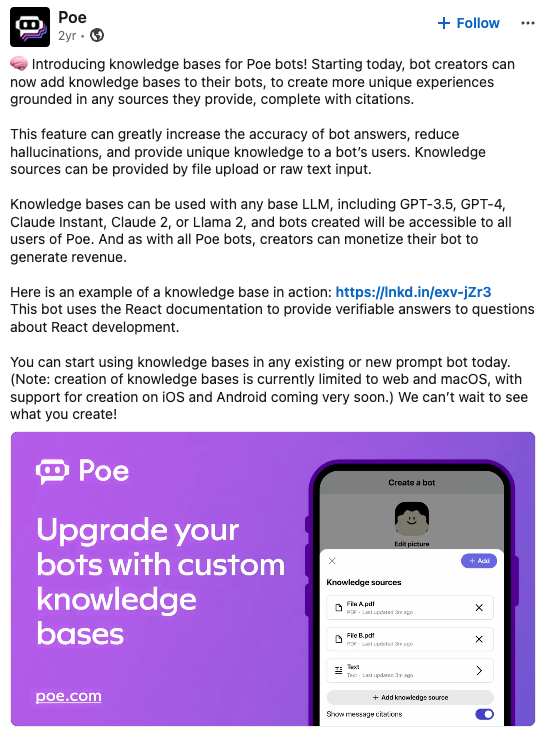
Poe is shutting down the Knowledge Base.
The email was sent last week. The gist is that on May 25, 2026, every file ever uploaded to a KB gets permanently deleted, and bots that depended on one are now just prompts with no documents behind them. The official line is that “context windows are bigger now, so you don’t really need this anymore”.
I’ll be honest. When I read that, I laughed.
Not because it’s funny. Because I left Poe over a year ago for exactly the problem this email is pretending doesn’t exist. And this announcement is going to send a lot of people looking for a replacement, most of whom might look in the wrong direction.
So this is a guide, partly. The Poe alternatives I’d actually recommend in 2026, sorted by what you were really using Poe for. But it’s also the story of why I left, because that context matters for which alternative you should pick.
Why I started on Poe in the first place
Poe was my first real multi-model setup. This was back when “use multiple AI models” still felt like an early-adopter thing. I’d been frustrated bouncing between ChatGPT and Claude in different browser tabs, copying my prompts back and forth, paying two subscriptions to compare two answers.
Poe solved the surface-level version of that. One subscription, dozens of models, and the way it actually worked was: a bot per model, a new chat per question. Want to ask Claude something? Open a new chat with the Claude bot. Want GPT’s take? New chat, GPT bot. There was a multi-bot mode where you could mention a second model inside a thread, but I almost never used it in practice, and from the Reddit threads it sounds like most people didn't either. The point was just that all the models were in one place. For maybe six months, that was enough.
Then I started running into the wall.
The wall was memory, not models
The thing nobody warns you about when you go multi-model is that switching the model is the easy part. The hard part is everything that should travel with the conversation.
I’d build up context with one bot. Set up a system prompt, upload some reference files, work through a problem for an hour. Then I’d want to ask Claude the same thing. New chat. Empty context. Re-upload the files. Re-explain who I am and what I’m working on. Re-paste the constraints.
Every model switch was a soft restart. Multi-model in name, single-model in practice, because nobody had the patience to rebuild context four times.
The Knowledge Base helped a little. You could attach documents to a bot and it would read from them. But the bot itself still didn’t remember anything between conversations. Open a new chat with the same bot tomorrow, and you’re back to square one on what you actually talked about. KB stored documents, not experience.
That’s the gap that eventually pushed me out. I didn’t want a smarter document store attached to a forgetful bot. I wanted a setup that actually accumulated.
Why “bigger context windows” is a non-answer
Before I get into where I went, I want to address Poe’s framing, because it’s going to mislead a lot of people.
The official explanation is that context windows are large enough now that you can just paste your reference material directly into the system prompt. Problem solved.
I think this is genuinely confused, or being deliberately vague, because context is not memory.
A 200K context window means I can paste my entire world bible into one chat. Cool. What about the next chat? And the one after that? And what about when I want a different bot to read the same world bible without me copy-pasting 80,000 words into it?
The Knowledge Base wasn’t valuable because it stored a lot of text. It was valuable because it was persistent and shared. Those are properties of a workspace, not properties of a context window. Pretending the second replaces the first is a sleight of hand.
I don’t blame Poe for picking a direction. I blame them for the framing. Just say “we’re focusing on being a model router and the workspace stuff isn’t our priority anymore”. That’s a fine business decision. The “you don’t need this anyway, context windows are bigger” line is what bothers me, because a lot of people will read that and assume their problem is solved when it isn’t.
After the obligatory week of “I’ll just build my own”
I tried a few things. Built my own thing with Claude API and a vector DB for about a week before remembering I have a job. Looked at a bunch of options, landed on a few that actually work depending on what you need.
The Poe alternatives I’d actually consider in 2026
Here’s the honest breakdown based on what I tried and what I’ve seen others use.
For model-switching without the baggage
TypingMind is the cleanest option if all you ever wanted was access to multiple models without paying separate subscriptions. BYOK (bring your own API key), no workspace features, no memory system. It’s what Poe arguably should have stayed as. I used it for a few months and it’s solid for quick comparisons.
ChatHub is similar, browser-based, lets you query multiple models side by side. Good for one-off comparisons, less useful for ongoing projects.
For research and citations
If your real use case was research with sources, the KB on Poe was always a weird fit for that anyway. Perplexity is closer to what you actually wanted. It’s built around search and citations from the ground up. I use it for fact-checking and quick research, though it’s not trying to be a workspace.
For persistent workspace and memory
This is where I ended up spending most of my time. After trying a few options, I landed on HaloMate. The core difference is the separation between persona and workspace. Files live in a shared Project, memory accumulates per persona (they call them Mates), and multiple personas can read from the same files without re-uploading.
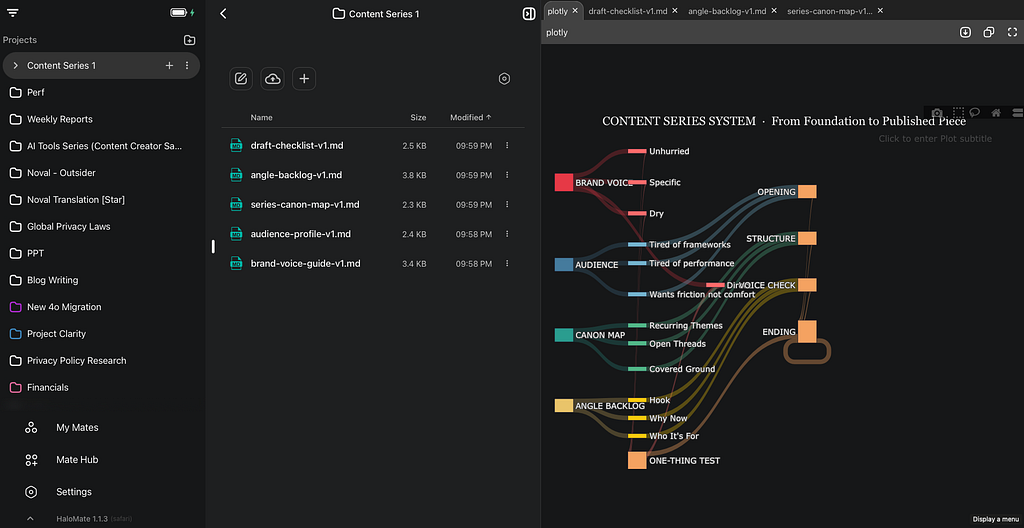
It took maybe an afternoon to get used to coming from Poe. The mental model is different: instead of “bot with documents attached”, it’s “workspace that multiple personalities can access”. Whether that matters to you depends on whether you were hitting the same wall I was.
For custom bot publishing
If you were building and sharing custom bots with specific personas, I don’t have a great answer. That part of Poe is genuinely hard to replicate elsewhere right now. OpenRouter lets you access models via API and could be a backend for something custom, but it’s not a consumer product. If you know a good option here, drop it in the comments.
What to do this week, regardless of where you go
Two things, and the first one is non-negotiable.
Back up your files now. Open each bot’s edit page, download every source file, put them somewhere you control. Even if you decide to stay on Poe and just use prompt-stuffing from now on, you want your originals. After May 25, there’s no recovery.
Test the migration before you commit. Pick one bot. One Knowledge Base. Recreate the setup somewhere else and see if your actual workflow survives. Better to find out the migration broke something on April 30 than on May 26.
I’m not writing this to dunk on Poe. They got me into multi-model AI in the first place, and a year ago they were still the easiest way in. But products move in directions, and sometimes the direction stops matching what you needed them for.
The deprecation email is doing the work of telling you that, in plain language, even if the framing is dressed up. May 25 is the actual deadline. Take it seriously, and don’t wait to find out where you’re going next.
Best Poe Alternatives in 2026: What to Do Before the Knowledge Base Shuts Down was originally published in Towards AI on Medium, where people are continuing the conversation by highlighting and responding to this story.