
Anthropic’s most powerful model isn’t just breaking benchmarks. It’s rewriting what AI can actually do for you at work if you’re paying attention.
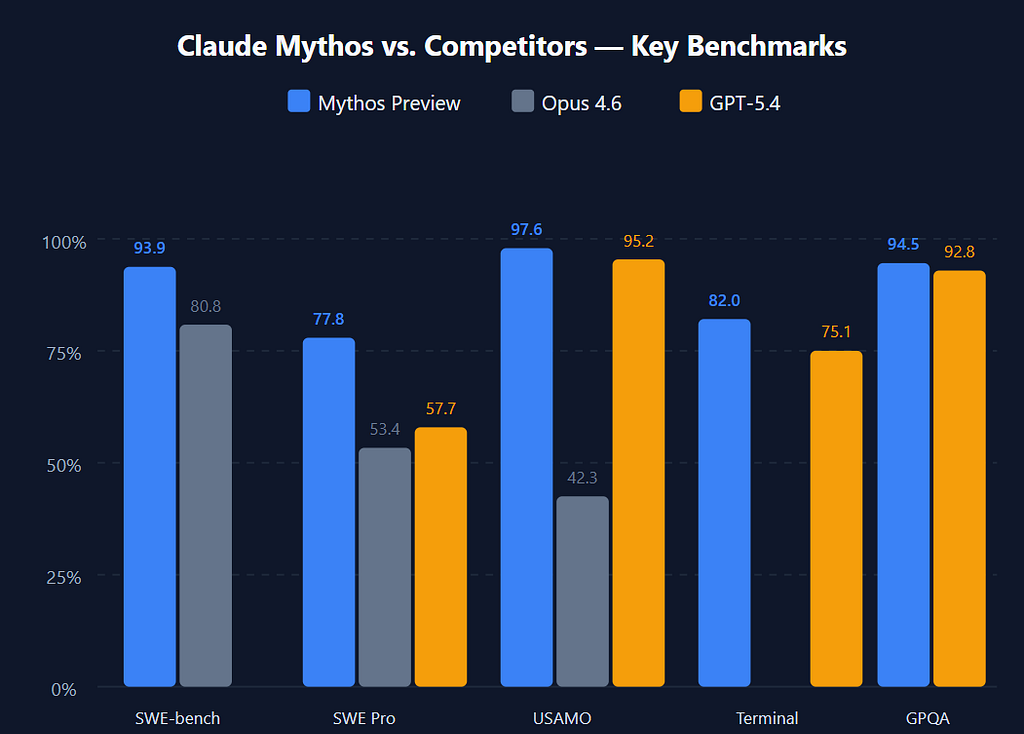
On April 7, 2026, Anthropic quietly announced Claude Mythos Preview and then the benchmarks dropped. A 93.9% score on SWE-bench Verified, the highest any AI model has ever achieved (NxCode, April 2026). A 97.6% on USAMO 2026, blowing past both its predecessor and GPT-5.4. Every major coding, math, and cybersecurity benchmark — broken.
But here’s what most coverage misses. Benchmark scores don’t change your Tuesday morning. What matters is how those capabilities filter into the tools and workflows you already use. And with 91% of businesses now using AI in at least one capacity (Azumo, 2026), the gap between “impressive demo” and “thing that changes your day” has never been smaller.
So what does Claude Mythos actually mean for how you work? Here are five shifts worth understanding now before they’re obvious.
TL DR: Claude Mythos Preview is Anthropic’s most powerful model, scoring 93.9% on SWE-bench Verified — a record (NxCode, 2026). It’s currently restricted to ~40 organizations through Project Glasswing. The five big shifts: faster code generation, proactive cybersecurity, advanced reasoning for daily tasks, accelerated enterprise AI adoption, and a new standard for responsible capability release.
What Is Claude Mythos — And Why Should You Care?
Claude Mythos Preview scored 93.9% on SWE-bench Verified, compared to 80.8% for its predecessor Opus 4.6 — a 13-point jump in a single generation (NxCode, April 2026). That’s not an incremental improvement. It’s the kind of leap that rewrites what you can reasonably expect an AI to handle on its own.
Mythos is a general-purpose frontier model. It writes code, solves math problems, finds security vulnerabilities, and handles multi-step reasoning tasks that would’ve been science fiction two years ago. Anthropic hasn’t released it publicly access is restricted to roughly 40 organizations through Project Glasswing, a coordinated effort to secure critical software infrastructure before the model goes wide.
The twelve launch partners tell you who’s taking this seriously: AWS, Apple, Google, Microsoft, NVIDIA, CrowdStrike, and six others. Anthropic’s backing it with $100M in usage credits for research participants and $4M donated to open-source foundations. Why that kind of investment? Because Mythos isn’t just smarter it’s capable enough that responsible deployment actually matters.
Worth noting: Mythos was accidentally exposed through a CMS misconfiguration in March 2026, weeks before the official announcement. The leak itself became part of the story — Anthropic’s response was to accelerate the Project Glasswing announcement rather than deny the model’s existence. That kind of transparency under pressure tells you something about how they’re approaching this release.
For context, Anthropic closed a $30 billion Series G round at a $380 billion valuation in February 2026, following a $13 billion Series F at $183 billion just five months earlier (Anthropic, Feb 2026). Their annualized revenue hit roughly $30 billion by March 2026 — a 1,400% year-over-year increase (Sacra, March 2026). Mythos is why.
1 Your Code Gets Written and Debugged Faster Than Ever
Programmers using AI tools now complete 126% more coding projects per week than those working without them (Federal Reserve Bank of Atlanta, March 2026). That number was already striking before Mythos. With a model scoring 93.9% on real-world coding benchmarks, the ceiling just moved.
What does 93.9% on SWE-bench actually mean in practice? The benchmark tests whether a model can take a real GitHub issue written by a human developer, with messy context and ambiguous requirements and produce a working fix. Mythos gets it right more than nine times out of ten. Its predecessor, Opus 4.6, managed about eight. That gap might sound small. It’s not. The hardest issues live in that gap.
Think about what that changes for your workflow. Debugging sessions that used to eat an afternoon get compressed into minutes. Boilerplate code that took an hour of copy-paste-modify disappears. Code reviews that required three rounds of back-and-forth shrink to one. It doesn’t mean developers become optional it means they spend their time on architecture and product decisions instead of hunting for missing semicolons.
According to a March 2026 Federal Reserve Bank of Atlanta study, programmers using AI tools complete 126% more coding projects per week than non-AI users (Atlanta Fed, 2026). With Claude Mythos achieving 93.9% on SWE-bench Verified — the highest score ever recorded that productivity multiplier is poised to grow further.
Even if you’re not a developer, this matters. Every app you use, every internal tool your company runs, every API integration connecting your workflow — they all get built and maintained faster. So what happens when that speed reaches the software protecting your data?
2 Cybersecurity Stops Being Someone Else’s Problem
Claude Mythos found a 27-year-old vulnerability in OpenBSD and a 16-year-old bug in FFmpeg that automated testing had missed across five million test runs (Anthropic Red Team, April 2026). On Firefox alone, Mythos achieved 181 successful exploits compared to just 2 for the prior model version. Those aren’t theoretical weaknesses. They’re real holes in software millions of people use every day.
This is what Project Glasswing is built around. Anthropic recruited twelve partners — AWS, Apple, Broadcom, Cisco, CrowdStrike, Google, JPMorganChase, the Linux Foundation, Microsoft, NVIDIA, Palo Alto Networks, and Anthropic itself — to use Mythos for finding and fixing vulnerabilities in critical infrastructure. Individual vulnerability searches cost under $50. Full campaigns run about $20,000.
Our take: The cost dynamic here is what changes things. A $50 vulnerability scan that finds a 27-year-old bug reframes cybersecurity from an expensive, periodic audit to something you run continuously. That’s not a feature upgrade — it’s a category shift in how security gets done.
Why should this matter to you personally? Because the software you rely on your browser, your cloud storage, your company’s infrastructure is about to get a thorough security review it’s never had before. Mythos scored 83.1% on CyberGym, Anthropic’s cybersecurity benchmark, compared to 66.6% for Opus 4.6 (Anthropic, April 2026). That’s a 25% improvement in one generation.
Anthropic’s Claude Mythos discovered a 27-year-old OpenBSD vulnerability and a 16-year-old FFmpeg bug that had survived five million automated test runs (Anthropic Red Team, 2026). Through Project Glasswing, twelve major partners are now using Mythos to scan critical infrastructure at a cost of under $50 per vulnerability search.
3 Complex Problem-Solving Becomes an Everyday Tool
Mythos scored 97.6% on USAMO 2026 — a 55.3-point jump over Opus 4.6’s 42.3% and 2.4 points above GPT-5.4’s 95.2% (NxCode, April 2026). USAMO isn’t a trivia test. It’s the qualifier for the U.S. math olympiad — problems that require multi-step reasoning, creative proof construction, and the kind of thinking that doesn’t reduce to pattern matching.
Now, you probably aren’t solving olympiad math problems at your desk. But the underlying capability chaining together multiple logical steps, holding context across a long problem, testing assumptions before committing to an answer shows up everywhere in knowledge work. Financial modeling. Strategic planning. Legal analysis. Research synthesis. Any task where you’re currently thinking “I need to sit down with this for two hours” becomes a candidate for AI collaboration.
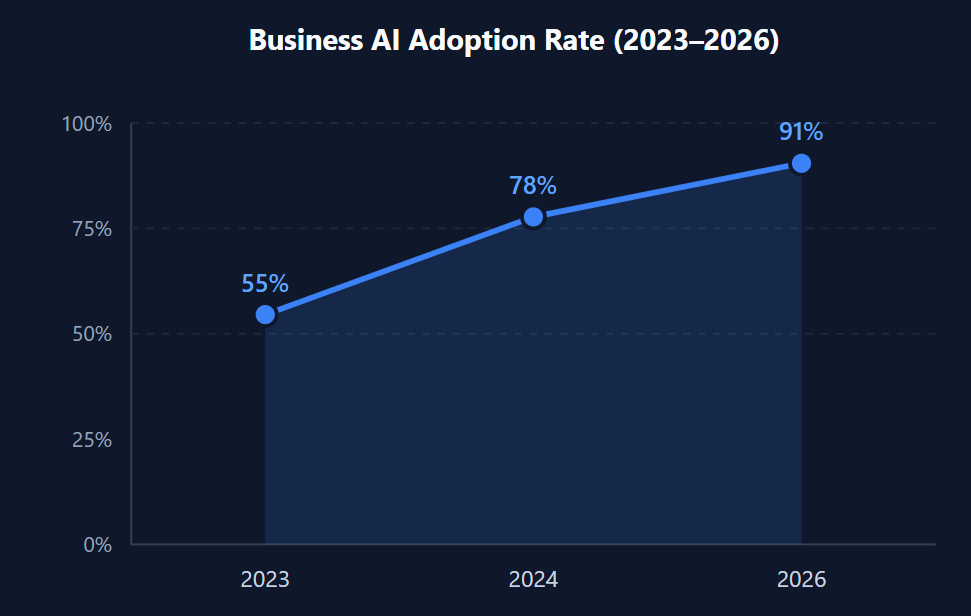
The adoption numbers reflect this. In 2023, 55% of businesses used AI in at least one capacity. By 2024, it was 78%. Now, in 2026, it’s 91% (Azumo, 2026). Each jump coincides with models getting meaningfully better at reasoning — not just generating text, but actually thinking through problems.
Claude Mythos achieved 97.6% on USAMO 2026, a 55.3-point improvement over Opus 4.6’s 42.3% and 2.4 points above GPT-5.4 (NxCode, 2026). This leap in multi-step mathematical reasoning signals that AI models are crossing the threshold from text generators into genuine analytical collaborators for complex knowledge work.
Here’s the rhetorical question worth sitting with: if an AI can construct proofs for olympiad-level math, what’s the hardest reasoning task in your job and is it actually harder than that?
4 Your Workplace Is Already Running on AI — Mythos Accelerates It
Seventy-five percent of global knowledge workers now use AI tools regularly, with usage nearly doubling in six months (Microsoft Work Trend Index via Azumo, 2025). That’s not early adoption anymore. That’s the new default. And the question has shifted from “should we use AI?” to “are we using it well enough?”
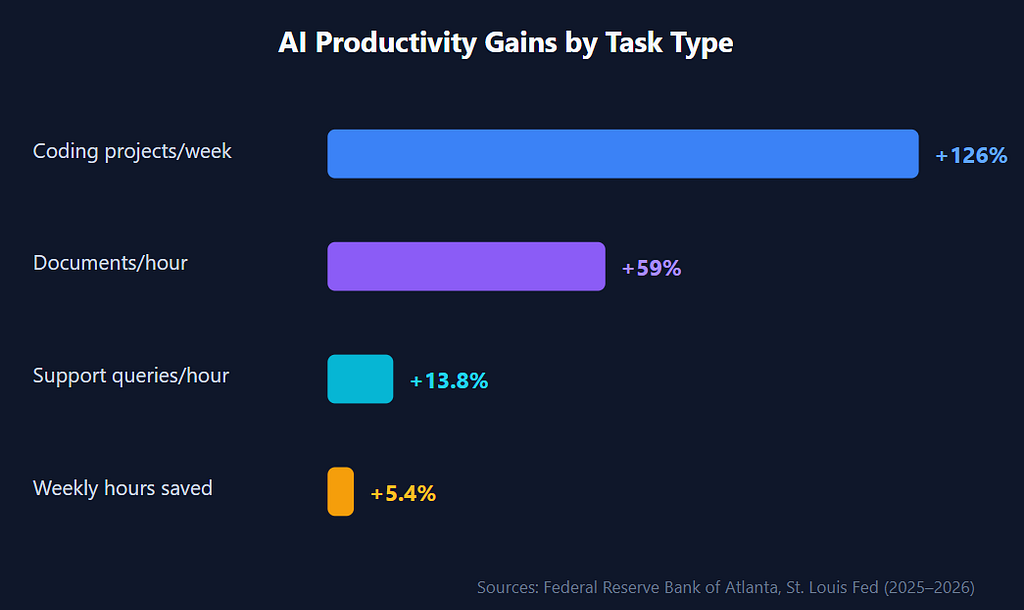
The productivity data is starting to paint a clear picture. Coding output jumps 126%. Document production rises 59% per hour. Customer support resolution climbs 13.8%. Even the conservative metric total weekly hours saved sits at 5.4% (Atlanta Fed, March 2026). These aren’t projections. They’re measurements from companies already using current-generation tools.
Mythos amplifies every one of those numbers. A model that reasons better produces fewer bad outputs, which means less time reviewing and correcting. A model that handles more complex tasks autonomously means your team doesn’t need to break problems into tiny AI-digestible pieces. The 86% of employers who expect AI to significantly transform their business by 2030 (World Economic Forum, 2025) aren’t being optimistic — they’re being conservative.
What we’ve seen: Teams that integrate AI tools at the workflow level not just as a chatbot sidebar consistently report the highest productivity gains. The difference isn’t the model’s capability. It’s whether the AI is embedded in the process or bolted on as an afterthought.
A Gallup survey from Q4 2025 found that 38% of U.S. employees say their organization has integrated AI, with 12% using it daily up from 10% and 26% using it several times per week (Gallup, Q4 2025). As models like Mythos push capability boundaries, the rate of daily usage is expected to accelerate sharply in workplaces that have already adopted AI infrastructure.
5 Responsible AI Sets a New Standard for How You Trust Your Tools
The global AI market is projected to reach $3.68 trillion by 2034, growing at a 27.7% compound annual rate (Precedence Research, 2026). That’s a lot of money flowing into a technology that most people still don’t fully trust. Anthropic’s handling of Mythos offers a template for how trust might actually get built.
Consider what they didn’t do. They didn’t release it publicly. They didn’t race to market. Instead, they restricted access to ~40 vetted organizations, committed $100M in research credits, donated $4M to open-source security foundations, and published their red-team findings openly. In a market where “move fast and break things” is still the default, that’s a genuinely different approach.
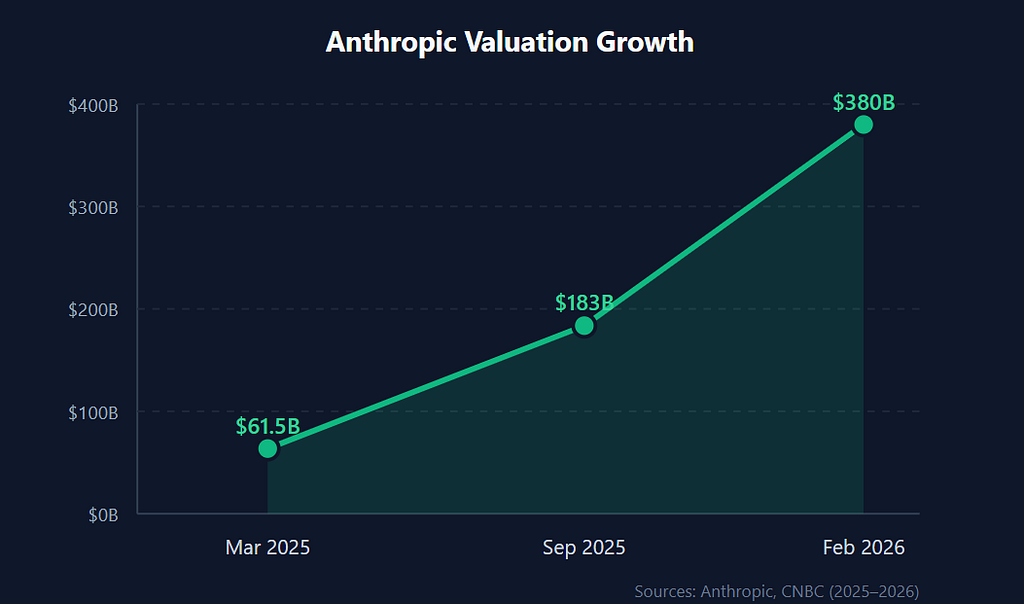
The valuation trajectory tells you the market is rewarding this strategy, not punishing it. A jump from $61.5B to $380B in under a year .while deliberately withholding your best product would’ve been unthinkable in previous tech cycles. But the math makes sense: trust compounds. If enterprises believe you won’t ship something dangerous, they’re more likely to build their critical systems on your platform.
Anthropic’s valuation surged from $61.5 billion to $380 billion between March 2025 and February 2026, driven partly by Mythos capabilities and the company’s responsible deployment approach (Anthropic, Feb 2026). The decision to restrict Mythos access to vetted Project Glasswing partners rather than pursuing a public launch signals a market shift where safety-first AI development is becoming a competitive advantage.
Why this matters for you: When the most powerful AI model on the planet gets released through a security initiative rather than a product launch, it changes the baseline expectation. Your next question to any AI vendor shouldn’t be “what can it do?” it should be “what are you doing to make sure it’s safe?”
Frequently Asked Questions
What is Claude Mythos?
Claude Mythos Preview is Anthropic’s most powerful AI model, announced April 7, 2026. It scored 93.9% on SWE-bench Verified and 97.6% on USAMO 2026 both all-time records (NxCode, 2026). The model isn’t publicly available yet; access is restricted to roughly 40 organizations through Anthropic’s Project Glasswing security initiative.
Is Claude Mythos available to the public?
No. As of April 2026, Mythos Preview is restricted to approximately 40 organizations participating in Project Glasswing. Anthropic has pledged $100M in usage credits for research participants and stated that broader availability depends on developing adequate safety measures. There’s no confirmed public release date.
How does Claude Mythos compare to GPT-5.4?
Mythos outperforms GPT-5.4 on most published benchmarks: 77.8% vs. 57.7% on SWE-bench Pro, 97.6% vs. 95.2% on USAMO 2026, and 82.0% vs. 75.1% on Terminal-Bench 2.0 (NxCode, 2026). GPT-5.4 scores closer on GPQA Diamond (92.8% vs. 94.5%). Both represent a significant leap over their predecessors.
What is Project Glasswing?
Project Glasswing is Anthropic’s initiative to use Claude Mythos for securing critical software infrastructure before broader release. Twelve partners including AWS, Apple, Google, Microsoft, and NVIDIA — are scanning widely-used software for vulnerabilities (Anthropic, 2026). Anthropic contributed $4M to open-source foundations and $100M in usage credits for participants.
What Comes Next
Claude Mythos isn’t something you can sign up for today. But the forces it represents faster coding, proactive security, advanced reasoning, accelerated adoption, and safety-first deployment — are already reshaping how work gets done. Here’s what to take away:
- AI coding productivity is measurable now. 126% more projects per week, per the Federal Reserve. That number only goes up with more capable models.
- Cybersecurity is getting democratized. A $50 vulnerability scan that catches 27-year-old bugs changes who can afford real security.
- Complex reasoning is crossing the threshold. 97.6% on olympiad math means your hardest analytical tasks are candidates for AI collaboration.
- Adoption has passed the tipping point. 91% of businesses use AI. The question isn’t whether — it’s how well.
- Trust is becoming a feature. Responsible release isn’t slowing Anthropic down. It’s fueling a $380B valuation.
The organizations that’ll benefit most from Mythos (whenever it goes wide) are the ones building AI into their workflows right now not waiting for a perfect model to arrive. If you haven’t started, this is the signal. And if you have? Look at your current AI usage and ask: are you using it well enough?
Anthropic’s Claude Mythos: 5 Ways This AI Will Change How You Work Every Day was originally published in Towards AI on Medium, where people are continuing the conversation by highlighting and responding to this story.