Introduction
I enjoy reading about people. Not individuals, but rather cultures, empires, kinship groups, etc. I'm fascinated by the emergent properties of multi-person systems. This post is born out of love for my favorite book: "Stone Age Economics" by Marshall Sahlins. In this text Sahlins elaborates on the economic life of hunter-gatherer and simple agricultural societies which exist today, extrapolating this into the past. He touches on many different points, but the one this post will focus on is the concept of debt and gift-economies as the progenitor to our modern economic system.
If you were taught the Smithian notion of the historical existence of barter economies, I'm sorry to say that you were taught wrong, or at least were taught a long while back. To quote Humphrey, Caroline. 1985. "Barter and Economic Disintegration.":
"No example of a barter economy,pure and simple,has ever been described,let alone the emergence from it of money;all available ethnography suggests that there never has been such a thing."
If the idea of traders exchanging goods in a marketplace without currency is mostly a fiction, then what *did* come before currency? In short, the gift economy: a system of mentally tabulated debts sourced from gift-giving over a small social network. Imagine you and a few friends are transported back in time. You get up, dust yourself off, and see no buildings, no roads, no crowds of people. Rather, it's simply wilderness. How should you and your friends survive and distribute resources?
You could grab something nearby, say a shiny quartz pebble and say to your friends:
"Okay, this is our currency. If you want something from me give me quartz pebbles in payment and I'll do the same for you."
But why bother? You only have a finite number of friends, and it's pretty simple to keep track of who's doing their fair share in making sure your small band survives. If you notice one of your friends napping while the rest of you are off hunting you will make note that this friend isn't a reliable partner, and you'll be less inclined to rely on this person and in turn will presumably share less of what you have with them.
This is the principle of the gift economy. Those who contribute to the small social band are more likely to later receive contributions from the social band. People keep a mental tabulation on who has contributed to their survival, resulting in this person pouring more of their resources into those who have successfully contributed. This is the progenitor to currency, not barter
I propose this principle extends into modern times, just not on the scale of entire economy. Rather gift economics form a social medium for which people interact with each other. Gift economics isn't just to be applied to ancient peoples, but modern peoples as well. In my opinion this is the fabric that binds society together at the molecular level, forming the small social groups we are all a part of.
Admittedly I base this on the anecdotal evidence of engaging with people under the premise of gift exchange for the last few years. Since reading "Stone Age Economics", whenever I find myself in a new situation with new people, I pick out the person I'd most like to get along with and give them a 'gift'. This could be anything
- A favor
- Candy
- Caffeinated Beverages
- Instant Ramen
- etc
As long as someone doesn't despise the sight of me, I can usually get them to be my friend with a simple unprompted gesture of goodwill. I'd estimate that I also get a return gift ~90% of the time.
A Model of A Gift Economy
There are already plenty of models for modelling social structures, usually based around the 'hypergraph', i.e. a collection of smaller social groups within the larger structure. [https://arxiv.org/abs/2102.06825][https://arxiv.org/abs/2203.12189][ https://arxiv.org/abs/2408.13336]
In this post we will take a different approach. Instead of considering fixed or even dynamic hypergraphs, we will instead produce the hypergraph as an emergent property by assuming a probability distribution over the space of all hyperedges. There is a tradeoff with this approach however, as with a fixed hypergraph you can scale the number of people/nodes quite high. But with our framework, studying social groups first not people, there is a significant computational bottleneck when trying to scale the number of people: a result of combinatorial explosion.
Here's the github repo:
[ https://github.com/orthogonaltohumanity/gift_econ_sim/tree/main ]
Assume you have
Then we uniformly sample an agent. Then sample a group
and then for
And that's it. You can vary the '2' if you want but we keep it fixed for our simulations. This is an area for future work.
Results
We take 7 agents starting with a uniform choice distribution over social groups and iterate the model for 10,000 timesteps. The following image is a scatter plot of social groups plotted by their average opinion vs the sum of gifts which have been given/taken from the group.

Notice how only a few social structures are active at any given time. If we restrict the social groups we look at to those with average probability across agents greater than
This is what the emergent social structures look like represented as a hypergraph.

I recently read Samuel Arbesman’s "The Life-Spans of Empires", a short paper fitting an exponential distribution to the distribution of empire lifespans. His result was very striking, as the exponential distribution fit very well to his 41 empire examples as shown below.

After an hour of staring at the above hypergraph gif I realized the same logic could be applied to our social groups. We could ask:
- Whats the distribution of timespans between different hypergraph configurations, i.e. whats the decay rate of the composition of society as a whole?
- Whats the distribution of lifetimes of single hyperedges, i.e. whats the decay rate of social groups?
So we plot and get:

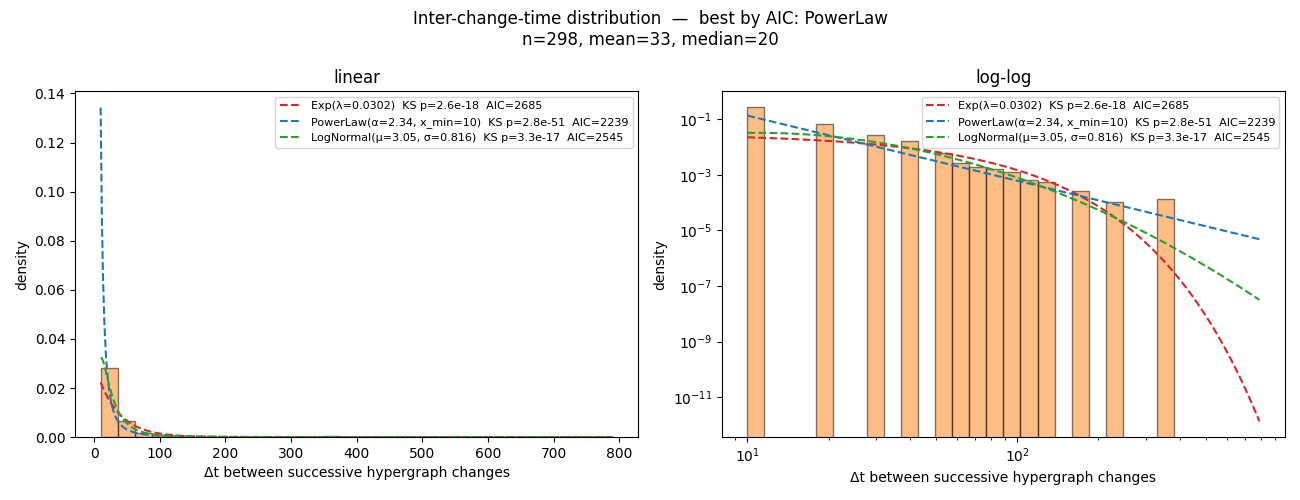
Linear on the log-log so it's a power law. Not the same result as Arbesman. However 41 is a small sample size. We can do better. It was at this point I turned to Opus 4.7 and asked it to find a larger dataset, which it did in Cliopatria: "a comprehensive open-source geospatial dataset of worldwide polities from 3400BCE to 2024CE". We can discard the geospatial aspect and focus only on lifetimes. What result do we get when we vibe-code an expansion to Arbesman's original work? [https://github.com/orthogonaltohumanity/culture_lifetimes]

Not exponential! Rather the data best fits a log-normal distribution better than either power or exponential distributions. This suggests societal changes happen due to some kind of series of multiplicative factors, rather than a constant hazard rate. This data contrasts with both Arbesman's original paper and our model, and this may be due to any number of factors
- Arbesman specifically looks at "large empires" while the Cliopatria dataset is polities in general.
- We are working with small social groups, not cultures in general
- We only use 7 agents. Real cultures consist of more than 7 people.
Conclusion
There is more work to be done of course. Larger simulations, better analysis, more complex interaction options etc. I'm not sure if I'll continue this or not as I tend to be a bit distractable, but I think I have enough interest in this project to keep it going for at least a week, maybe more.
I think the next thing that should be worked on is some kind of resource constraint. Perhaps we can draw from classical economics and use the Labor Theory of Value as the baseline unit for all gifts and resources. Maybe each group (including the singletons) can have a resource pool agents can take or contribute to. I'll start working on it and we'll see what happens.
Let me know what you think, as I'd very much welcome some input. What am I missing or leaving out?
Discuss