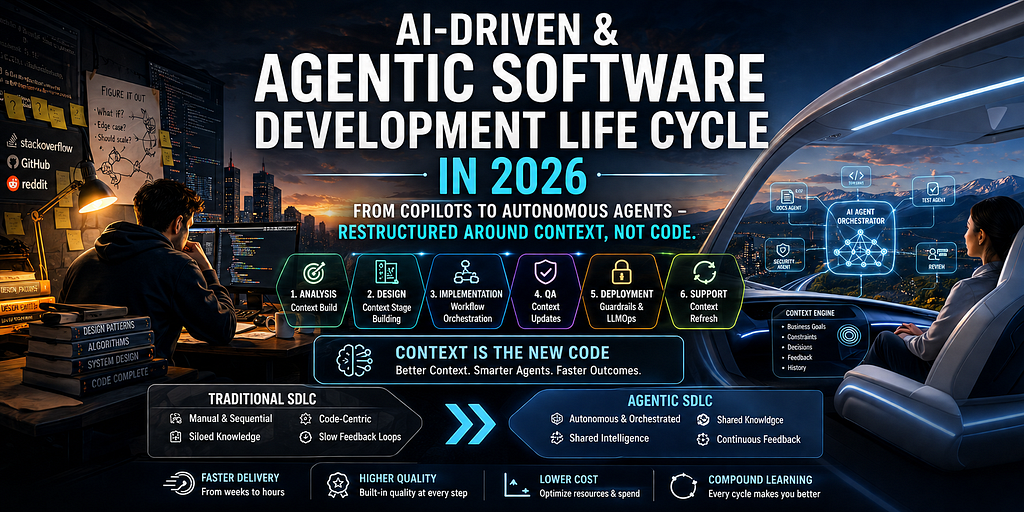
From copilots to autonomous agents — how the SDLC is being restructured around context, not code.
Part 1 — The era we are leaving
The joy of the long way round
Copiloting is not a bad approach — not by a long stretch. For many high-skilled developers, it represents a genuine leap in output, and it preserves something that matters deeply: the feeling of ownership. That sense of achievement we used to experience before around 2016–17, when solving a hard problem required thinking about it overnight, reading hundreds of articles, and falling down rabbit holes on Stack Overflow and Reddit.
The journey was the point. You landed on the wrong article, but in doing so, you discovered a completely different class of problem that other developers were wrestling with — and stumbled upon approaches you never would have thought to look for. There is no adequate way to describe this to someone who wasn’t there. If you were writing software in that era, you already know exactly what I mean.
“We are systematically missing tasks which have high expected uplift from AI — 30 to 50% of developers in our study chose not to submit tasks because they did not want to do them without AI.”
METR — Developer Productivity Study, February 2026 [2]
That quote, from one of the most rigorous independent studies on AI and developer productivity, reveals something striking: developers are not just using AI tools — they are increasingly unwilling to work without them. The shift is not gradual. It is a step change in how software gets built, and understanding it clearly is essential for anyone managing or building software teams in 2026.
Part 2 — Market reality check
The numbers behind the shift
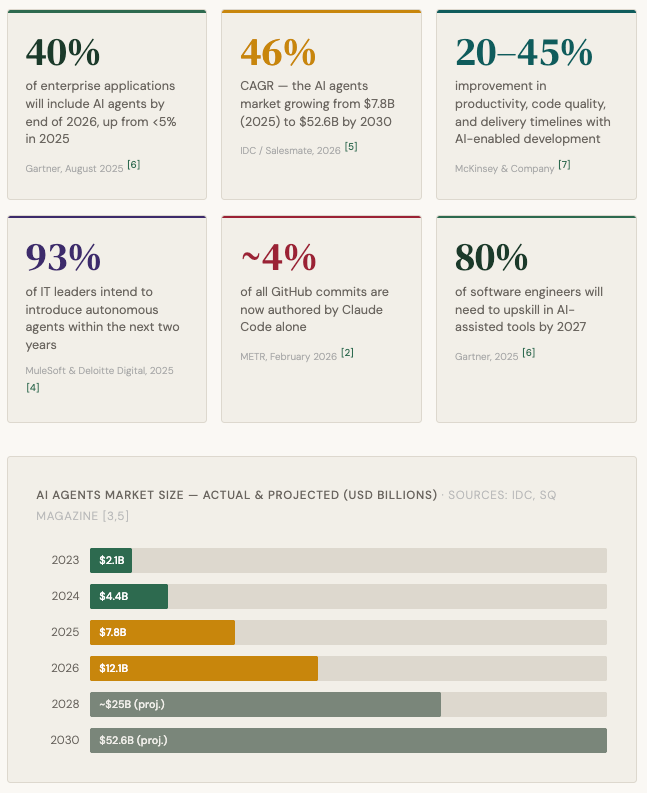
Before reframing the SDLC, it is worth anchoring the discussion in data. The agentic AI wave is not hype at this point — it is a measurable structural change visible across markets, hiring patterns, and enterprise spending.
The productivity paradox
The data on AI productivity gains contains a genuine tension worth naming clearly, because it has direct implications for how teams should be structured:
⚠ The finding that surprised everyone
METR’s rigorous July 2025 study of experienced open-source developers found that with AI tools, developers took 19% longer on tasks than without — largely due to the overhead of directing, reviewing, and correcting AI output.[2]
✓ But the follow-up matters
By early 2026, METR updated their study noting developers were increasingly refusing to participate without AI access — suggesting the 2025 number was a lower bound and the real-world uplift on appropriate tasks is substantially higher.[2]
The lesson: productivity gains from AI are task-dependent, context-dependent, and only materialise when teams have the right workflow structures around the tools. This is precisely what the Agentic SDLC is designed to provide.
The AI Productivity Paradox (Faros.ai, 2025)
A study of 22,000 developers across two years of telemetry found that while over 75% of developers now use AI coding assistants, most organisations report a disconnect: developers say they are working faster, but companies are not seeing measurable improvement in delivery velocity or business outcomes. The root cause? AI usage remains surface-level — most developers only use autocomplete. Advanced agentic capabilities remain largely untapped.[8]
Part 3 — A framework for understanding the shift
The manual car and the self-driving vehicle
The most useful thing about this shift is that you can explain the feeling of it to absolutely anyone — technical or not — with one analogy.
Think about driving a manual car versus riding in a self-driving electric vehicle. In both cases, your goal is to reach the destination. The people waiting for you on the other side genuinely do not care how you got there. What changes entirely is the experience of the journey: the manual driver feels every gear change, uses their knowledge of shortcuts and traffic patterns, and makes active decisions at every turn. The passenger in the autonomous vehicle watches the same road — but the steering wheel is moving without them.
This maps directly to where software development is heading. The business is the people waiting at the destination. They care about arrival time. They care that what you built is working, secure, and scalable. What they do not care about is whether you wrote every line yourself or orchestrated an agent to do it.
“The engineer of 2026 will spend less time writing foundational code and more time orchestrating a dynamic portfolio of AI agents, reusable components and external services.”
CIO Magazine / Lalit Wadhwa, EVP & CTO at Encora — February 2026 [1]
The important clarification: this analogy speaks to feeling, not use case. The use case difference between copiloting and fully agentic development is enormous — it is a topic that deserves its own treatment. What the analogy captures is the psychological and organisational shift, which is the harder and more urgent thing to address.
Business owners are now using AI tools to generate feature requirements faster than ever before. New ideas arrive in rapid succession — some brilliant, some half-formed, some that will never survive first contact with users. Estimating, evaluating, and planning all of this through manual effort alone — or even through copiloting — is becoming untenable. It is, to be direct about it, like bringing a knife to a gunfight. The competitive bar has been raised permanently.
Part 4 — The framework
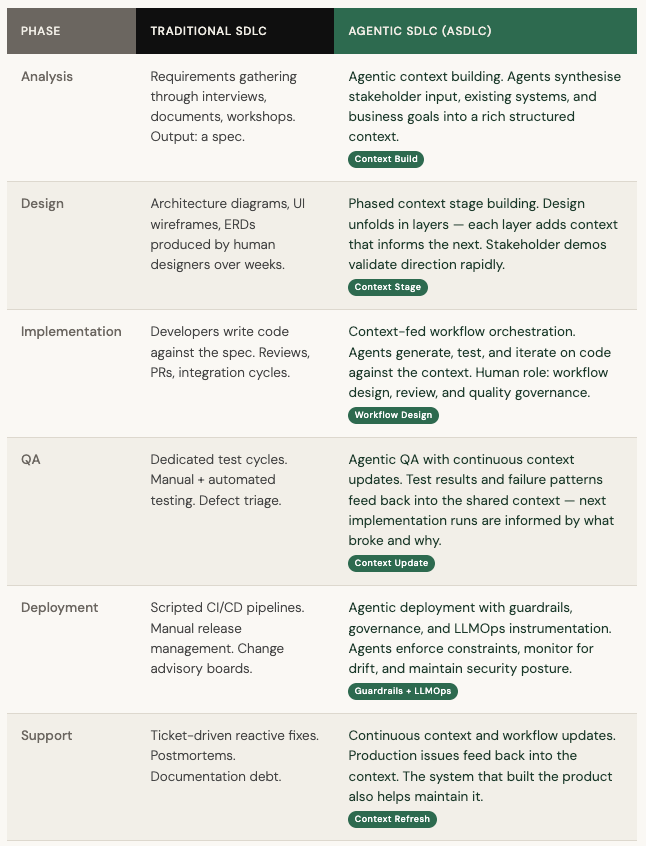
Traditional SDLC → Agentic SDLC
The traditional SDLC is a familiar sequence that has served the industry well for decades. In the Agentic SDLC, the sequence of phases remains largely the same. What changes fundamentally is what happens inside each phase, and what connects them. That connecting thread is context.
Context, in this framing, means the structured, accumulated understanding of the problem space — business goals, constraints, prior decisions, open questions, and feedback — that agents (and humans) can consume to produce coherent outputs. In the traditional SDLC, this context lived in documents, people’s heads, and institutional memory. In the ASDLC, it becomes an explicit, maintained, version-controlled artifact.
Part 5 — The mechanics
Context as the new unit of delivery
If there is one operational principle that separates teams who benefit from agentic development and those who do not, it is this: the investment you make in building and maintaining context pays compound returns at every subsequent phase. Poor context produces mediocre agent outputs regardless of model quality. Rich, structured context produces outputs that require minimal revision.
1. Agentic Analysis — Context Build
Business goals, constraints, stakeholder priorities, and open questions are synthesised into a structured context. Early demos validate direction before design begins.
Stakeholder demos | Rapid feedback | Goal decomposition | Constraint mapping
2. Agentic Design — Context Stage Building
Design is produced in phases — each phase adds a context layer that implementation agents can consume. You design just enough to build the next piece.
Phased delivery | Stakeholder validation | Architecture decisions | Context enrichment
3. Agentic Implementation — Workflow Orchestration
Agents generate, test, and iterate against the context. The human role shifts from line-by-line authorship to workflow architecture and quality governance.
Workflow design | Agent orchestration | Human-in-the-loop review | Parallel execution
4. Agentic QA — Context Updates
QA is not a gate at the end — it is a continuous feedback mechanism. Test results and failure patterns enrich the context so subsequent runs improve automatically.
Continuous feedback | Failure pattern capture | Context versioning
5. Agentic Deployment — Guardrails & LLMOps
Deployment adds a critical new layer: LLMOps instrumentation, guardrails on agent behaviour, audit trails, and governance frameworks. This is the discipline that keeps agentic systems trustworthy in production.
LLMOps | Guardrails | Governance | Observability | Security posture
6. Agentic Support — Context Refresh
Production issues flow back into the context. The agents that helped build the system also help maintain it — carrying the accumulated understanding of why decisions were made.
Living context | Continuous maintenance | Workflow evolution
Part 6 — What changes for teams
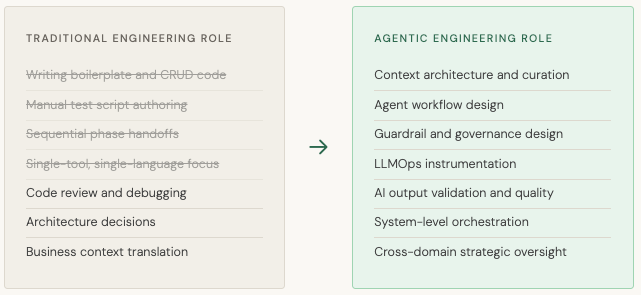
The evolving role of the engineer
The ASDLC does not eliminate the need for skilled engineers — it fundamentally reshapes what skilled engineering looks like. The Perforce CTO Anjali Arora describes this as a “shift up”: engineers move from hands-on keyboard creation to supervisory architecture.[9]
On LLMOps: the underappreciated discipline
LLMOps is emerging as a distinct and critical engineering discipline. A 2026 guide places median LLMOps engineer salaries in the US at $130,000–$280,000/year. Properly implemented LLMOps typically reduces API spend by 30–60% through caching, routing, and prompt compression. The top risk without it: silent quality degradation — outputs worsen after a model update with no alert triggered.[10] In the ASDLC, LLMOps is not optional — it is the operational foundation that makes agentic deployment trustworthy.
Microsoft CTO Kevin Scott has stated that “95% of code will be AI-generated” — while clarifying that humans will still lead authorship and design.[11] This captures the essential tension: volume of code shifts to agents, but the judgment, direction, and accountability remain human. This is not a diminishment of the engineering role — it is an elevation of it.
Part 7 — Practical operating principles
What actually works: small pieces, fast refinement, strong context
Based on the research and emerging practice patterns from teams already operating in this model, several principles stand out as consistently separating successful ASDLC implementations from failed ones:
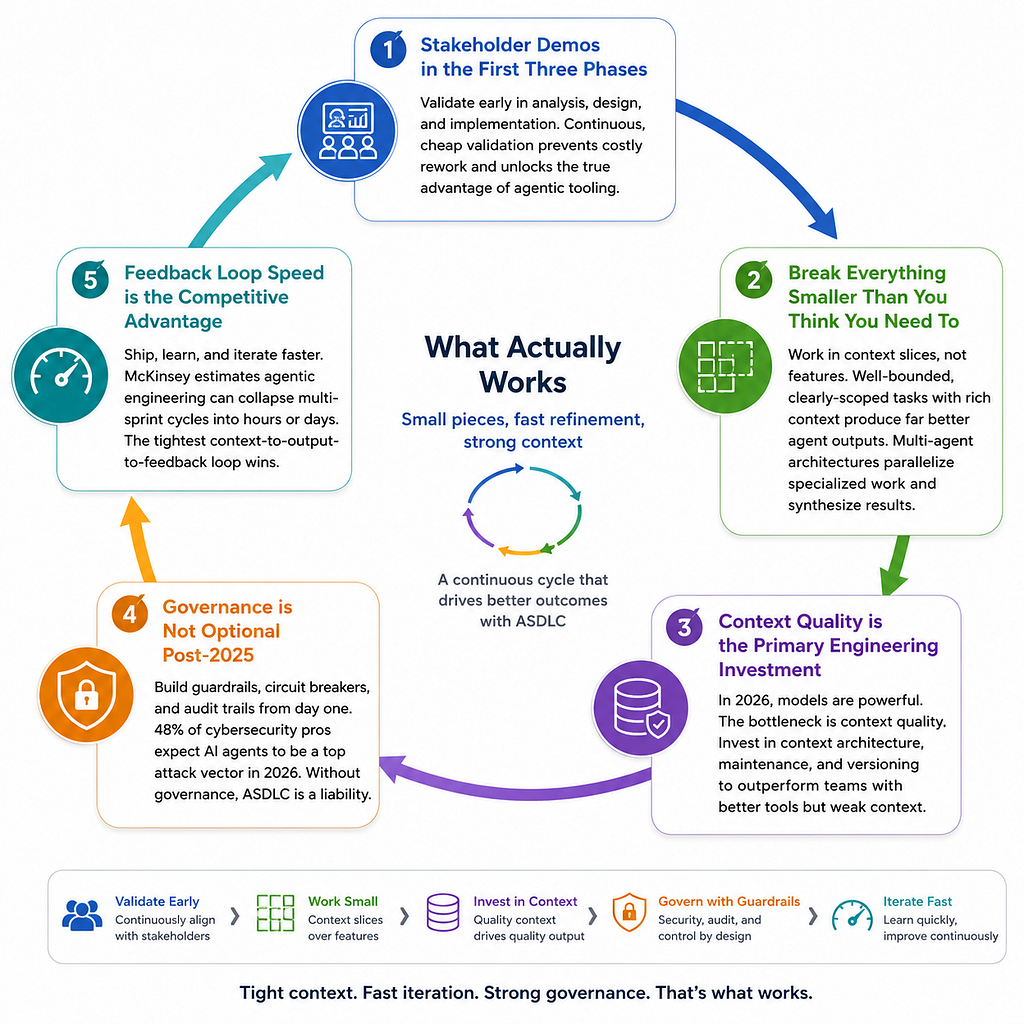
1. Stakeholder demos belong in the first three phases
Not at the end of the project — in analysis, design, and implementation. The ability to rapidly generate prototype implementations from context means that stakeholder validation can happen continuously and cheaply. Teams that defer demos to late-stage delivery are wasting the primary advantage of agentic tooling.
2. Break everything smaller than you think you need to
The unit of work in an ASDLC is a context slice, not a feature. Agents perform better on well-bounded, clearly-scoped problems with rich context than on large, vague tasks. The instinct to batch work for “efficiency” actively harms agentic output quality. Single-agent workflows process tasks through one context window — multi-agent architectures use an orchestrator to coordinate specialised agents working in parallel, each with dedicated context, then synthesise the results.[5]
3. Context quality is the primary engineering investment
The AI tools available in 2026 are powerful enough that the bottleneck is almost never model capability — it is the quality of the context fed to the model. Teams that invest in context architecture, maintenance, and versioning outperform teams with better hardware and worse context. This is a structural inversion from the traditional SDLC, where the bottleneck was always developer capacity.
4. Governance is not optional post-2025
As the CIO analysis notes, robust guardrails, circuit breakers, and comprehensive audit trails must be built in from the ground up, not retrofitted.[1] Around 48% of cybersecurity professionals expect AI agents to become a top attack vector in 2026.[3] The ASDLC that lacks governance is not just inefficient — it is a liability.
5. The feedback loop speed is the competitive advantage
McKinsey estimates that agentic engineering allows features that previously required multiple sprint cycles to be developed, validated, and released within significantly shorter timeframes.[7] The teams that will win are not those with the best individual AI tools — they are the teams that have designed the tightest context-to-output-to-feedback loop.
Conclusion
The destination hasn’t changed. The vehicle has.
The traditional SDLC is not wrong. It identified the right phases, the right concerns, and the right stakeholder relationships. What it could not anticipate was a world where the primary bottleneck shifts from developer capacity to context quality — where the art of software engineering migrates from syntax to orchestration.
The Agentic SDLC does not erase what came before. It elevates the human contribution to a higher level of abstraction: defining goals with precision, designing the workflows that agents execute, governing the outputs they produce, and maintaining the context that makes everything coherent over time.
The developers who will thrive are not those who are most comfortable with a specific framework or language. They are the ones who understand systems, can communicate intent clearly to both humans and agents, and have the judgment to know when to trust automated output and when to intervene. That is a fundamentally higher-value skill set than what the pre-2016 era rewarded — and it deserves to be recognised as such.
“While the tools and processes change, the core tenets of software engineering will not. Success critically depends on teams still having a strong understanding of fundamental software engineering principles.”
Anjali Arora, CTO, Perforce — DevPro Journal, November 2025 [9]
The destination is the same. Build systems that work for the business — secured, scalable, and reliable. The vehicle for getting there has changed permanently. The question for every engineering leader right now is not whether to adapt to this change, but how deliberately they will design for it.
References & Sources
- Wadhwa, L. (2026, February 20). How agentic AI will reshape engineering workflows in 2026. CIO Magazine. cio.com
- METR. (2026, February 24). We are changing our developer productivity experiment design. METR Blog. metr.org | See also: METR. (2025, July 10). Measuring the impact of early-2025 AI on experienced open-source developer productivity. metr.org
- SQ Magazine. (2026). AI Agent Autonomy Statistics 2026: Growth Insights. sqmagazine.co.uk
- MuleSoft & Deloitte Digital. (2025). 2025 Connectivity Benchmark Report. Referenced in: OneReach.ai. (2026). Agentic AI stats 2026: Adoption rates, ROI, & market trends. onereach.ai
- Anthropic / Augment Code. (2026). 2026 Agentic Coding Trends Report. resources.anthropic.com
- Gartner. (2025, August 26). Gartner predicts 40% of enterprise apps will feature task-specific AI agents by 2026, up from less than 5% in 2025. Gartner Press Release. gartner.com
- McKinsey & Company. (2025). Referenced in: Akraya. (2026, April). Agentic engineering in 2026: How AI-led product engineering is collapsing release cycles from weeks to hours. akraya.com
- Faros.ai. (2025, July 23). The AI Productivity Paradox Research Report — What two years of telemetry data from 22,000 developers reveals. faros.ai
- Arora, A. (quoted in) DevPro Journal. (2025, November 25). Essential 2026 skills that DevOps leaders need to prioritize. devprojournal.com
- Zedtreeo / Anita. (2026, February). LLMOps Explained: The Complete 2026 Guide to LLM Operations. zedtreeo.com
- Scott, K. (quoted in) lemon.io. (2026). Future outlook of software engineering in 2026 and beyond. lemon.io
AI-Driven & Agentic Software Development Life Cycle in 2026 was originally published in Towards AI on Medium, where people are continuing the conversation by highlighting and responding to this story.