The story of GPT-5.5 isn’t a benchmark sweep. It’s a company in code red, a 17-month gap between real models, and a price hike that signals the end of the cheap-frontier era.
For the past six months, the most expensive secret in AI lived on a private Slack channel inside OpenAI.
It was a number. Anthropic’s annualized revenue.
December 2025: $9B. By March 2026: $30B. That's not a curve. That's a wall going up.
While the public watched OpenAI ship GPT-5.1, GPT-5.2, GPT-5.3-Codex, GPT-5.4 — incremental drops every six weeks — internal sources described the company as being in Code Red since at least December.
The story everyone was telling on the outside? That OpenAI still had ChatGPT. That consumer dominance compounded. That the API race didn’t matter.
The people running OpenAI didn’t believe it.
Slack, GitLab, Cursor, Notion — every B2B integration that mattered was building on Anthropic’s stack and shipping faster than the OpenAI sales team could close. OpenAI has been in what internal sources described as a “Code Red” state since at least December 2025, watching Anthropic’s ARR sprint from $9 billion to $30 billion while its own B2B positioning eroded.
Then Claude Opus 4.7 dropped on April 16. Best generally available coding model. SWE-bench Pro at 64.3%. Three times more production task resolutions than 4.6. Same price as the previous version. The cleanest frontier upgrade in months.
For seven days, the developer migration accelerated.
Last Thursday, OpenAI hit back.

GPT-5.5 shipped on April 23, 2026. Internal codename: Spud.
Don’t let the goofy name distract you. This is the first fully retrained base model since GPT-4.5. Every model in between — GPT-5.0 through 5.4 — was a post-training iteration on the same architectural foundation.
Seventeen months between real rebuilds.
The gap tells you what was actually happening at OpenAI during the Code Red. While the public saw incremental drops every six weeks, the company was retraining the foundation. Pretraining for Spud was completed on March 24. Three weeks of safety evaluations followed. Then Anthropic's Opus 4.7 launched.
OpenAI had the response loaded. They chose to ship it exactly seven days later, when the news cycle was still focused on Claude.
That’s not a coincidence. That’s narrative warfare.
What landed wins where it counts.
Terminal-Bench 2.0 tests complex command-line workflows — planning, iteration, tool coordination. The kind of work where AI agents stop being assistants and start being workers. GPT-5.5 hits 82.7% on it.
Claude Opus 4.7 sits at 69.4%.
That’s a thirteen-point lead. The largest publicly documented gap on any frontier coding benchmark in 2026. For developers building unattended terminal agents, pipeline runners, and DevOps automation — no publicly available model is close.
But the headline benchmark isn’t the part that should keep you reading.
The part that should be is what early testers describe when they actually use the thing.
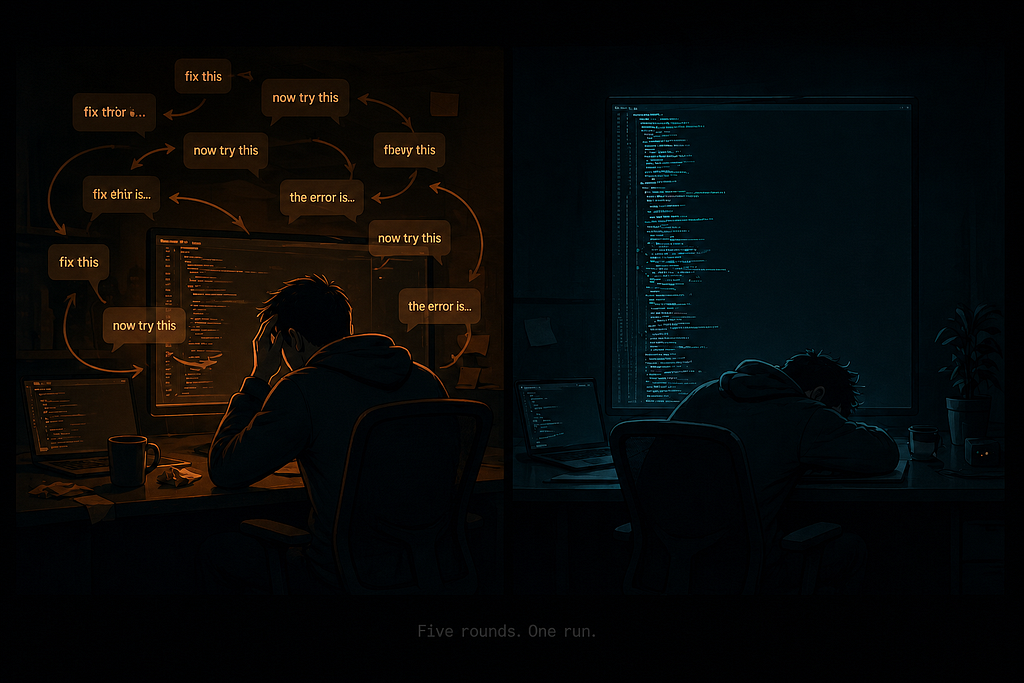
GPT-5.4 in Codex would generate code, fail, and hand me the error. GPT-5.5 in Codex generates code, fails, reads the failure, fixes it, and continues.
That’s from a developer who ran GPT-5.5 through Codex on real engineering tasks for two days. He calls it the autonomous debug cycle. "For iteration-heavy work — anything involving builds, tests, or runtime errors — this compounds savagely. A task that used to be 'five rounds of prompt/error/re-prompt' becomes one uninterrupted run."
Read that again.
Every previous generation of AI coding tools shared one pattern: the model writes, the human runs, the human reports the error, and the model fixes. Even the best agentic tools needed a human in the failure-recovery loop.
GPT-5.5 closes the loop.
That’s the difference between an assistant who helps you code and a worker who codes while you sleep.

The Codex team at OpenAI built GPT-5.5 partly using earlier versions of itself.
GPT-5.3-Codex is our first model that was instrumental in creating itself. The Codex team used early versions to debug its own training, manage its own deployment, and diagnose test results and evaluations.
By the time Spud went into preparedness evaluations, the model had already shipped through several internal generations of self-improvement loops.
Nobody else in the industry is using this development methodology publicly. The model that emerges from it has a different shape — directly tuned to the work patterns of people building agentic systems, because those people have been the customers since training time.
Ethan Mollick fed GPT-5.5 hundreds of anonymized data files from a decade of unfinished crowdfunding research. He asked it to generate a hypothesis, run sophisticated tests, and write an academic paper with a literature review.
The literature review was all real. The statistics were correct.
A decade of unwritten research turned into a publishable paper in a single Codex session.
That’s not a productivity improvement. That’s a category change.
But the part nobody is talking about is buried in the system card.
MRCR v2 measures whether a model can actually retrieve information from anywhere in a long context, not just the beginning and end. The dirty secret of long-context AI for two years has been that models effectively forget the middle of long documents.
GPT-5.4 scored 36.6% on MRCR v2 at 1M tokens.
GPT-5.5 scores 74%.
The window stayed the same. The model started using it.
For every team building on long documents — codebases, contracts, research corpora, customer interaction history — this is the upgrade that quietly changes what’s possible. The 1M context window has been a marketing number for two years.
GPT-5.5 is the first OpenAI model that might actually be a production capability.
All of which makes the price hike read very differently than it did when it was first announced.
The API price doubled — $2.50/$15 to $5/$30 per million input/output tokens.
Initial coverage read this as a margin grab. A bet that demand would be inelastic.
That framing misses the hardware story.
GPT-5.5 was co-designed, trained, and served on NVIDIA GB200 and GB300 NVL72 systems. This model genuinely required new infrastructure. The Stargate buildout, the 10-gigawatt NVIDIA commitment, the rack-scale system co-design — all of it lands in a model that costs more to serve and is being priced accordingly.
For two years, the trend was relentless price compression. Claude Sonnet 4.6 at near-Opus quality at Sonnet pricing. Gemini 3.1 Flash-Lite at $0.25 per million tokens. The expectation: frontier capability on a glide path to commodity pricing.
GPT-5.5 broke that pattern.
The implication for buyers: the next model from any major lab — Mythos, Grok 5, Gemini 3.5 — will probably arrive at premium pricing too. The cheap-frontier era just ended.
Plan accordingly.
There’s one number nobody at OpenAI wants to talk about.
Artificial Analysis flagged a hallucination rate of 86% on their independent AA-Omniscience eval.
Claude Opus 4.7: 36%. Gemini 3.1 Pro Preview: 50%.
The same training that made Spud more capable also made it more confident when it didn't know something.
For applications where being wrong is expensive — legal research, medical decision support, financial analysis — this is the caveat that should slow your adoption decision down.
For the work this model was actually built for — multi-step coding tasks, terminal automation, long-horizon engineering, the agentic workflows enterprise customers are migrating to — the shape is unambiguous.
GPQA Diamond is essentially saturated. The three frontier models all sit close to each other in terms of raw reasoning.
The race moved.
It’s no longer “which model is smartest.” It’s “which model can complete twenty hours of engineering work without supervision.”
OpenAI just shipped the first credible answer to the second question.
Sam Altman called GPT-5.5 “the last major milestone before AGI” at the San Francisco press conference on April 23, 2026.
The framing is almost certainly marketing.
But the observation underneath it isn’t. When a model can take messy, multi-step tasks and independently plan, use tools, check its work, and keep going until the task is finished , the conversation about what AI can do for enterprise work changes.
That’s the bet OpenAI just placed.
Whether it works as a Code Red response — whether it actually slows Anthropic’s ARR sprint and pulls enterprise customers back — won’t be clear for another quarter. API rollout is staggered. Enterprise procurement cycles take time. Migration from Claude back to OpenAI requires more than benchmark dominance.
But for the first time in six months, OpenAI looks like the company shipping the more capable agent rather than the company defending market share with incremental upgrades.
That’s the actual story of GPT-5.5.
The Terminal-Bench number is just the evidence.
OpenAI Was Losing the Enterprise Market for Six Months. Last Thursday, They Hit Back. was originally published in Towards AI on Medium, where people are continuing the conversation by highlighting and responding to this story.