From “set an alarm” to “take care of the house for me” — AI voice assistants are undergoing a silent but profound paradigm shift. This isn’t just a technology race; it’s a contest of ecosystem depth and scenario integration.
The End of an Era
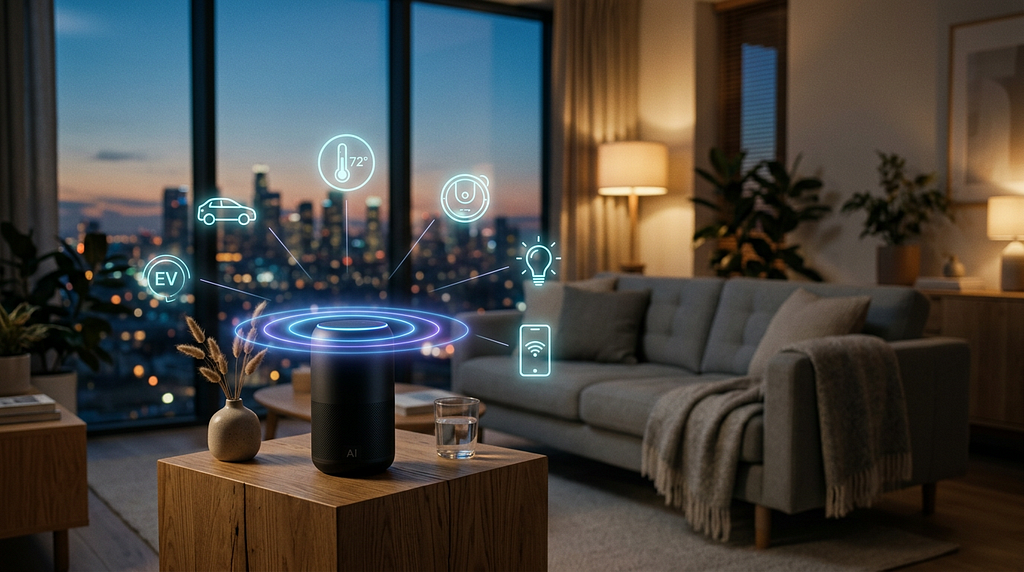
You’ve probably experienced this: you ask your smart speaker to “set an alarm for 7 AM tomorrow,” and it executes flawlessly. But then you say, “the weather looks bad tomorrow, help me adjust my travel plans,” and all it does is read you the forecast.
You try again: “Dim the living room lights, turn on the air purifier, and play some relaxing music.” Three commands in one sentence — it might only catch the last one.
This is the fundamental limitation of traditional voice assistants — they are excellent “command executors” but hardly qualify as true “assistants.” They parse keywords, but don’t grasp intent. They complete isolated actions, but can’t orchestrate a coherent task chain. And when you try to have a slightly complex multi-turn conversation, they typically forget what you said in the first turn by the time you reach the second.
According to Strategy Analytics, over 60% of daily interactions with smart speakers globally are confined to just three use cases: playing music, setting timers, and checking the weather. A device heralded as the “intelligent gateway” of the future has ended up living its life as a glorified alarm clock.
In the spring of 2026, that paradigm is finally being rewritten — not by a single company, but by an entire industry pressing the accelerator at the same time.
Xiaomi MiClaw: From “Hey Xiao Ai” to AI Steward
On March 6, 2026, Xiaomi’s technology team officially launched its self-developed on-device AI agent — Xiaomi MiClaw (nicknamed “Lobster”) — and began invite-only closed beta testing. This isn’t a routine iteration of a voice assistant. It’s an architectural leap.
Built on Xiaomi’s proprietary MiMo large language model, MiClaw is one of the first system-level AI agents deployed natively on mobile devices. The most fundamental distinction from traditional voice assistants is this: it has moved beyond “responding” to actually “doing.”
Traditional voice assistants follow a simple logic: “user issues explicit command → execute single preset action.” The Agent paradigm that MiClaw represents is fundamentally different: “understand intent → autonomous reasoning → tool invocation → closed-loop execution → experience accumulation.”
Consider a concrete scenario: you say “I’m going on a three-day business trip.” A traditional assistant might check the weather at your destination, at best. But MiClaw understands that “three-day business trip” means you’re leaving home — so it automatically adjusts your home thermostat schedule to save energy, signals the robot vacuum to run a full clean after you depart, switches the smart lock to away-security mode, marks the trip on your phone calendar, and reminds you to check that you’ve packed your power bank and ID.
Four layers of capability make this possible.
System-level integration. MiClaw isn’t an app running on top of the operating system — it’s a core component deeply embedded in Xiaomi’s HyperOS. It accesses low-level sensor data, contacts, calendars, location information, and even health and fitness data to build comprehensive contextual awareness of the user. This means it doesn’t need you to explain your needs in detail every time — it already knows your daily rhythm.
Ecosystem interconnection. The product is fully integrated with the Mijia IoT ecosystem, capable of reading status from and issuing commands to over one billion connected Mijia devices. This isn’t a glorified voice remote control — it understands the relationships between devices and can autonomously orchestrate complex cross-device scenarios. When it detects you’ve arrived home (via phone location), it can simultaneously turn on lights, start the air conditioner, disable security cameras, and trigger the rice cooker’s preset — all without you saying a word.
Self-evolution. MiClaw introduces a personality system and third-party MCP (Model Context Protocol) extensions, supporting multiple first-party assistants covering daily life, work, and photography scenarios. Critically, it possesses “meta-capabilities” such as sub-agent creation, meaning it isn’t just executing tasks — it’s learning how to execute them better. The more you use it, the better it understands you.
Personal context understanding. Unlike the “generalized capability” of generic large models, MiClaw emphasizes deep understanding of the individual user. It remembers that you prefer 26°C for your AC, that you’re allergic to cat dander and need the air purifier running frequently, and that you have a recurring video conference every Wednesday that requires Do Not Disturb mode. This “bespoke” contextual understanding is something generic voice assistants struggle to match.
While Apple’s Siri remains largely confined to “set an alarm, toggle WiFi, check the weather,” MiClaw has stepped onto an entirely different playing field. As 53AI observed, AI assistants are leaping from “conversation tools” to “ecosystem execution tools” — and MiClaw is at the forefront of this transformation.
The Data Flywheel: The Real Battlefield Behind the Voice Interface
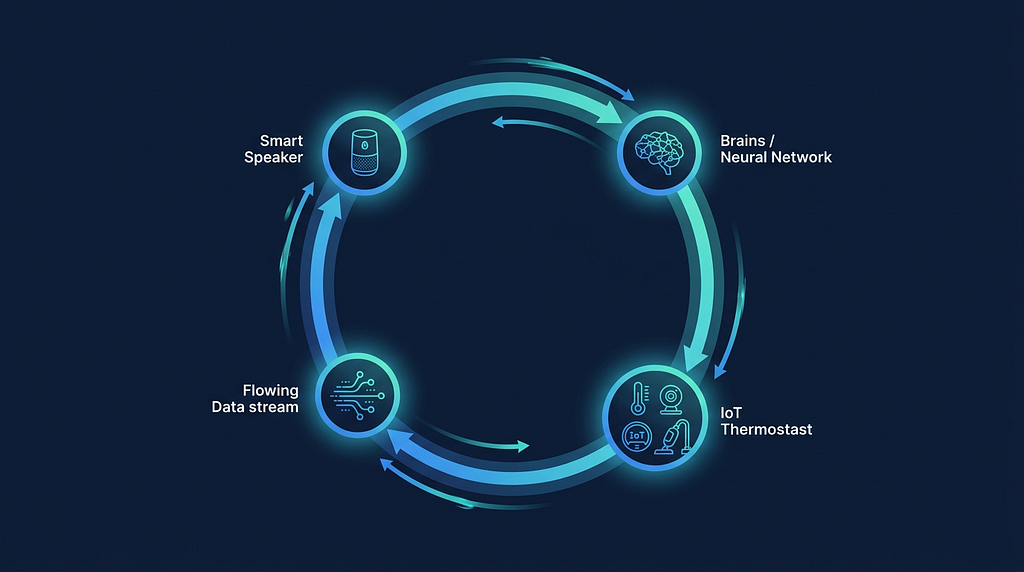
On the surface, major tech companies are fighting over an “entry point” — whoever builds the better voice assistant locks in the user. But zoom out, and the real nature of this competition becomes clear: it’s a data closed-loop war.
Xiaomi’s strategic advantage lies in its massive IoT device network. As of Q3 2025, Xiaomi’s AIoT platform connected over 1.04 billion devices globally. These devices generate daily interactions that go far beyond simple on/off commands — they produce high-value “decision trajectory data.” What scenario was the user in? What intent drove their choice? How do these choices relate to each other over time?
Understanding this concept is crucial. When you say “it’s too hot,” a traditional system records only the action: “user turned on AC.” But in an IoT context, the complete data chain looks like this — current room temperature 28°C, outdoor temperature 35°C, humidity 78%, user is in the living room, last temperature adjustment was two hours ago, user said “it’s too hot,” system set AC to 24°C, fifteen minutes later user manually adjusted to 25°C. This complete “decision trajectory” captures environmental context, user intent, executed action, and outcome feedback — far richer than a simple command log.
This data feeds back into MiMo’s training pipeline, enabling the model to more accurately understand user needs in real-world physical environments. Better models deliver better interaction experiences, which attract more users, generating more data. This is the classic flywheel effect — and with one billion devices, Xiaomi’s initial momentum is staggering.
Traditional voice data — the commands you’ve spoken to Siri — are fundamentally flat and isolated. But voice interaction data from IoT scenarios is three-dimensional and interconnected. It includes environmental context (temperature, humidity, lighting), device states (which devices are active), behavioral patterns (wake and return times), and temporal sequences. This is the gold mine for training next-generation embodied intelligence models.
From this perspective, Xiaomi isn’t merely building a better voice assistant — it’s constructing a complete intelligent system loop with voice as the entry point, IoT as the scenario, and its large model as the brain. And every interaction a user has with MiClaw injects new fuel into this loop.
Under the logic of “entry points driving data generation, interactions feeding back into model optimization,” the player who completes this closed loop first will build a moat that’s extraordinarily difficult to cross.
Huawei: The “Xiaoyi” Upgrade Under HarmonyOS
Huawei hasn’t been sitting on the sidelines.
In December 2025, at the nova 15 series and full-scenario product launch event, Huawei unveiled the new Xiaoyi Steward, formally integrating large model technology into its smart home voice interaction system. With deep reinforcement at the HarmonyOS 6 system level, Xiaoyi is no longer merely a voice frontend — it has become the AI orchestration hub of the Harmony ecosystem.
Huawei’s approach has a distinct character. Unlike Xiaomi’s consumer IoT focus, Huawei’s ecosystem emphasizes “full-scenario synergy” — seamless handoff between phones, tablets, PCs, in-car systems, and wearables through HarmonyOS’s distributed architecture. Xiaoyi’s role isn’t limited to home control; it serves as the unified interaction interface across “person-car-home-office” scenarios.
This “distributed” capability enables some uniquely powerful use cases. For instance, you tell Xiaoyi in your car, “turn on the AC before I get home” — the in-car Xiaoyi seamlessly relays the command to the Xiaoyi Steward at home. You ask Xiaoyi on your Huawei tablet at the office to “sync today’s meeting notes to the big screen at home” — and when you walk in, your Huawei Smart Screen has them ready. Devices aren’t isolated islands; they’re a unified intelligent entity threaded together by Xiaoyi.
Noteworthy is Huawei’s deep investment in voice technology itself. The Xiaoyi voice restoration feature, designed for people with speech disabilities, trains specialized voice models from real speech impediment databases. It earned dual recognition in 2025 as both an “Assistive Technology Innovation Case” and a “Technology for Disability Inclusion Application.” This depth demonstrates Huawei’s serious commitment to foundational voice AI capabilities — it’s not just building commercial products, it’s pushing the technological frontier and the social value of voice AI.
Huawei’s other trump card is its Ascend chip. On-device AI inference powered by domestic AI chips is seeing rapidly growing adoption across smart terminals. Huawei’s dual identity as both chip supplier and device manufacturer gives it a natural advantage in hardware-software co-optimization. While other companies struggle with the computational constraints of deploying large models on edge devices, Huawei can optimize inference efficiency at the chip architecture level — something pure software companies simply cannot do.
Additionally, Huawei’s deep enterprise market presence provides differentiated space for its voice AI. In B2B scenarios like smart offices, smart hotels, and smart healthcare, Huawei has far stronger channel and integration capabilities than consumer brands. Xiaoyi isn’t competing only in the living room — it’s also competing in conference rooms, hospital wards, and hotel suites.
Baidu: From Pioneer to Multimodal Leap
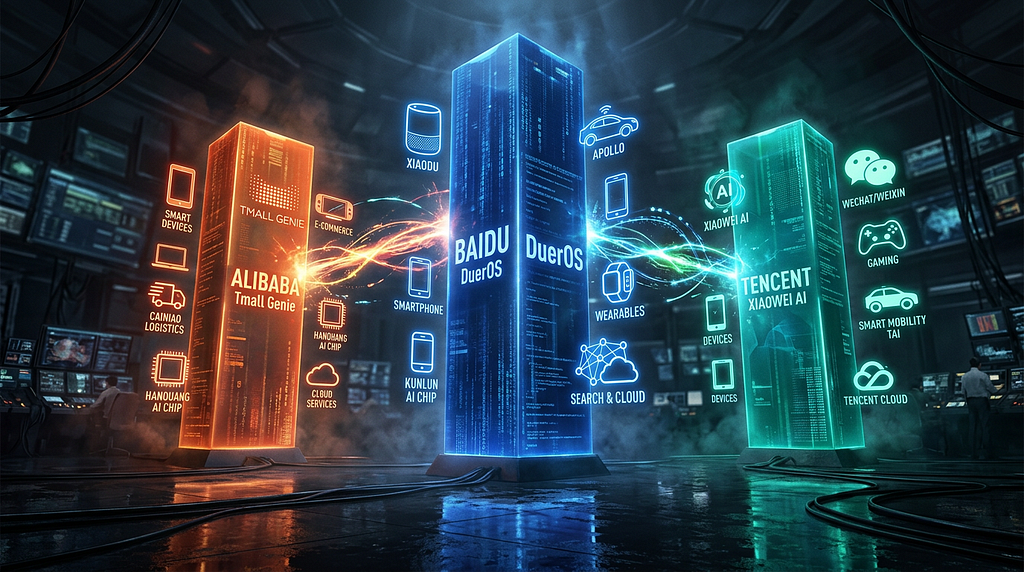
If this voice interface war has a veteran, it’s Baidu.
Xiaodu was one of the first smart speaker brands to achieve massive scale in China, with over 54 million connected proprietary devices. Baidu has nearly a decade of technology and data accumulation in voice interaction, with near-field Chinese speech recognition accuracy exceeding 98% and continuously expanding dialect support. For a long time, Xiaodu was synonymous with “smart speaker” in the Chinese market.
In November 2025, Baidu unveiled “Super Xiaodu” at Baidu World — a multimodal AI assistant built on the ERNIE large model. This represents Baidu’s most significant upgrade in voice AI. The biggest departure from previous versions: Super Xiaodu is no longer confined to voice alone. It integrates visual, auditory, and textual understanding.
What does this mean in practice? You can show a dish to a screen-equipped speaker and get detailed cooking suggestions and nutritional analysis. Display a receipt and have it extract key information for expense tracking. A child holds up a math problem, and it can read the question and guide them through the solution process rather than just giving the answer. Multimodal understanding means the voice assistant is no longer a “listen-only” entity — it finally has “eyes.”
Baidu’s differentiating advantage lies in the completeness of its AI technology stack — from PaddlePaddle (the deep learning framework) at the base, to ERNIE in the middle, to the Xiaodu application ecosystem on top. Baidu possesses full-chain capability from fundamental research to product deployment. Its search engine corpus — indexing billions of web pages and tens of billions of knowledge entities — provides a unique knowledge advantage for natural language understanding and knowledge graph construction. When you ask Xiaodu a complex knowledge question, it’s not just calling a large model — it’s also tapping into a knowledge graph that Baidu has been building for over a decade.
Xiaodu’s vertical scenario depth also deserves attention. In children’s education, Xiaodu offers purpose-built interaction modes including speech rate adjustment, content filtering, and guided learning. In elderly care, it features fall detection, medication reminders, and emergency calling. This kind of scenario depth is difficult for generalized assistants to match.
At AWE 2026 (China Appliance & Electronics World Expo), Xiaodu’s full product line was showcased, with Super Xiaodu’s multimodal capabilities stealing the show. Baidu is attempting to compensate for its hardware breadth gap with technological depth.
But Baidu’s challenges are equally clear: it lacks the smartphone as a core device entry point, and its IoT device scale trails Xiaomi by an order of magnitude (54 million vs. 1.04 billion). In the age of universal connectivity, device scale equals data scale, and data scale equals model competitiveness. Baidu needs to find a path forward that doesn’t depend entirely on device volume.
The Paradigm Shift in Voice Interaction: From Commands to Task Chains
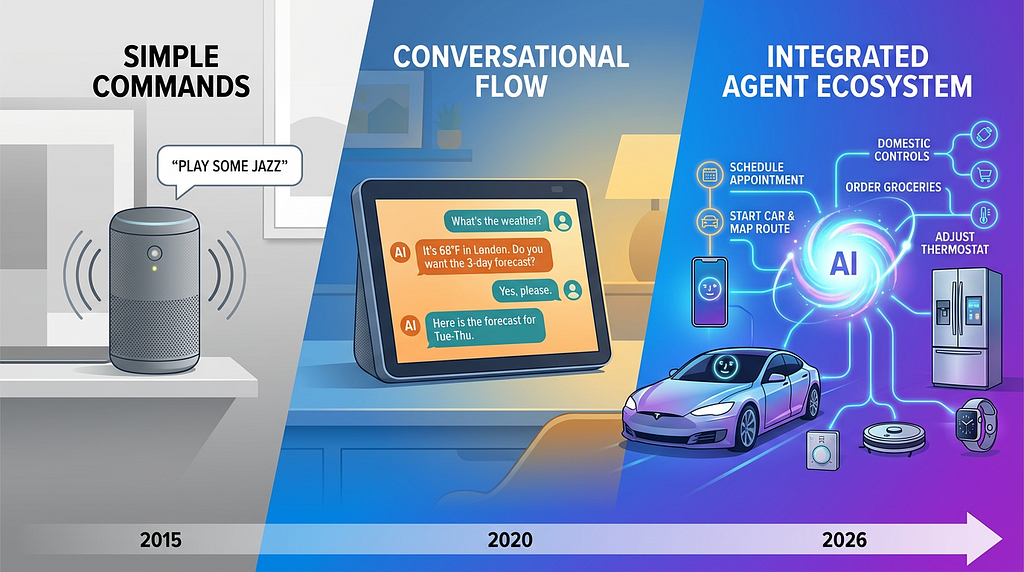
Stepping back from individual company rivalries, the more important story is the paradigm shift happening in voice interaction itself.
Phase 1: Keyword Matching (2014–2019). This was the era of Siri, the original Xiao Ai, and early Alexa. Voice assistants were essentially keyword parsers connected to preset command libraries. “Set alarm,” “play music,” “check weather” — each function required engineers to manually craft intent recognition rules and conversation flows.
The hallmark frustration of this era: users had to remember the “correct phrasing.” Saying “set an alarm for seven o’clock” worked, but “wake me up at seven tomorrow morning” might fail. The voice assistant wasn’t understanding you — it was pattern-matching you.
Phase 2: Enhanced Semantic Understanding (2019–2024). With the spread of the Transformer architecture and pretrained models, voice assistants gained genuine semantic comprehension. They could handle more complex natural language and sustain multi-turn dialogue with reasonable depth, but remained constrained by predefined Skills frameworks.
Adding new capabilities still required developers to manually build skill packages — which is why your speaker suddenly learned to track packages in 2023: it didn’t get smarter; someone wrote a “track packages” skill for it. The assistant’s capability boundary equaled the developer’s development boundary.
Phase 3: Agent-Based Execution (2025–present). The reasoning capabilities of large models have broken through the “Skills framework” ceiling. Voice assistants can now autonomously decompose tasks, select tools, and orchestrate execution chains.
MiClaw, Super Xiaodu, and the upgraded Xiaoyi are all products of this era. They no longer wait for precise commands — they interpret fuzzy intent, plan execution paths independently, and coordinate complex tasks across multiple devices and services. Crucially, when something goes wrong, they can assess the situation, adjust strategy, and find alternatives — rather than simply saying “sorry, I can’t do that.”
Here’s an example: you tell an agent-powered assistant, “help me prepare for tomorrow’s camping trip.” Its internal execution flow might look like this — check tomorrow’s weather forecast → discover rain is likely → suggest rescheduling or preparing rain gear → query nearby campsite availability → reserve a parking spot → push a camping gear checklist to your phone → set an alarm for 6 AM → charge the power bank and Bluetooth speaker overnight. That’s a complete task chain, not a single command.
The significance of this shift: voice is no longer just an “input method” for human-computer interaction — it has become the “nerve ending” connecting AI agents to the physical world. Every voice interaction is an attempt by AI to understand and intervene in the physical world.
A Global Perspective: Diverging Paths in US and Chinese Voice AI
This race isn’t confined to China. Across the Pacific, Amazon, Google, and Apple are also accelerating the large-model transformation of voice AI.
Amazon conducted a comprehensive large-model overhaul of Alexa in 2025, launching “Alexa+.” However, multiple reports indicated the upgrade yielded disappointing results — increased response latency, compatibility issues with legacy skills, and Alexa’s market share actually softening. This provides an important industry lesson: large model ≠ great product. In on-device scenarios, inference speed, power efficiency, and backward compatibility matter more than raw parameter counts.
Google leveraged its Gemini model to rebuild Google Assistant, demonstrating formidable multimodal understanding. But Google’s hardware footprint lags far behind its AI prowess — the Nest speaker line continues losing market share, positioning Google more as an “AI capability exporter” than a “scenario owner.”
Apple’s strategy has been the most conservative. Siri finally received Apple Intelligence integration in 2025, but the functional improvement fell well below market expectations. Apple’s strength lies in the security and privacy of its closed ecosystem, but in smart home coverage, HomeKit falls far short of Mijia or HarmonyOS ecosystems.
By comparison, Chinese manufacturers hold a unique advantage in depth of vertical integration. Xiaomi covers the entire chain from chips (Surge series) to operating system (HyperOS) to terminal devices (phones, speakers, appliances, vehicles) to its AI large model (MiMo). Huawei similarly spans from Ascend chips to HarmonyOS to full-scenario devices to the Pangu large model. This end-to-end vertical integration gives Chinese manufacturers a structural advantage in the competition for “AI-native devices.”
Beneath the Surface: Standards, Privacy, and Ecosystem Lock-In
Below the glossy surface of this technology race, several deeper tensions are emerging.
The standards battle. Xiaomi has adopted MCP (Model Context Protocol) — an open, industry-driven protocol for model context — to allow third-party developers to extend MiClaw’s capabilities. This echoes the App Store logic of the smartphone era — whoever defines the standard for the developer ecosystem may win the platform war. Huawei’s HarmonyOS and Baidu’s DuerOS have similar openness strategies, but no unified industry standard exists yet. This fragmentation is both a breeding ground for innovation and a risk factor for ecosystem balkanization.
Notably, Apple and Google also announced support for the Matter protocol as a unified smart home communication standard in 2025. But Matter addresses device interconnection at the protocol layer, while MCP tackles AI capability extension at the application layer — they operate at different levels of abstraction.
Privacy and data security. When AI assistants penetrate the intimate space of the home, gaining knowledge of living habits, health data, and travel patterns, data security becomes not just a technical issue but a cornerstone of commercial trust.
On-device inference — keeping data on the device — is a direction every player emphasizes. Xiaomi’s MiClaw stresses on-device deployment, Huawei leverages Ascend chips to push device-side inference, and Baidu is exploring hybrid cloud-edge architectures. But the tension between edge computing constraints and the computational demands of large models remains an unsolved problem. Running a model with billions of parameters on a smart speaker’s 7nm chip versus running it on a cloud GPU cluster produces noticeably different results. Finding the optimal balance between privacy protection and intelligence will be the core technical challenge of the next two to three years.
Ecosystem lock-in. Once a user’s entire smart home is connected to a single vendor’s ecosystem, switching costs skyrocket. Imagine: you have 50 Mijia devices at home, from light bulbs to door locks to cameras to air purifiers — would you replace them all just because Huawei released a better voice assistant? You wouldn’t. That’s the power of ecosystem lock-in.
This means early market capture carries long-term strategic significance. Xiaomi leads in IoT device scale through extreme price competitiveness (a Mijia smart bulb can cost as little as ¥29 / ~$4), Huawei leverages brand power and channel strength in the premium segment (targeting pre-furnished luxury apartments with its whole-home smart solutions), and Baidu seeks to outflank through technological openness, content ecosystem development, and vertical scenario specialization.
The Overlooked Variable: Developer Ecosystems and Third-Party Services
When discussing competition among giants, one often-overlooked but critically important variable is the developer ecosystem.
The reason smartphones disrupted feature phones wasn’t superior hardware — it was because the App Store created a platform where millions of developers competed to innovate. Voice AI competition will follow a similar logic: whoever attracts the most third-party developers to build capability extensions for their voice platform will win in the long run.
MiClaw’s adoption of MCP extensions reflects exactly this logic — by providing a standardized protocol interface, it allows third-party developers to integrate their services, data, and tools into MiClaw, dramatically expanding its capability frontier. You can envision future scenarios: a local fitness coach develops a workout guidance assistant for MiClaw, a property management company builds maintenance request and bill payment functions, or your favorite coffee shop creates a voice-ordering capability.
Baidu’s DuerOS began building its developer ecosystem as early as 2017, making it one of the earliest voice open platforms in China. Huawei’s HarmonyOS “Atomic Services” concept is also attempting to create a lightweight capability extension framework. But currently, developer engagement on voice platforms remains orders of magnitude below what the mobile internet App ecosystem achieved.
Two core factors constrain developer enthusiasm: first, the user reach efficiency of voice platforms is far lower than smartphone apps (you don’t “browse an app store” on a speaker); second, the monetization model for voice interaction scenarios remains immature (how do you complete a transaction loop in a voice conversation?). Whoever solves these two problems first holds the key to ecosystem competition.
The Longer View: From Smart Home to Embodied Intelligence
Extending the timeline three to five years, the endgame of the voice interface war may not lie in the smart home at all — but in embodied intelligence.
Once voice AI accumulates sufficient physical-world interaction data in home scenarios, it becomes a critical data source for training embodied intelligence models such as domestic robots. Understanding what a user means when they say “tidy up the living room” requires not only semantic comprehension but spatial cognition, object recognition, and motion planning — capabilities whose training depends on real-world interaction data accumulated in genuine environments.
Consider a more distant scenario: your home robot is tidying the living room and encounters an object it doesn’t recognize. It’s unsure whether it should go in the trash or be stored in a cabinet. It asks you via voice: “Should I throw away this paper bag?” The reason it knows to ask this question is that MiClaw has accumulated millions of similar scenario interactions over the past three years, training a decision pattern of “proactively ask when encountering uncertain objects.”
This may explain why Lei Jun, after the launch of the Xiaomi SU7 electric vehicle, quickly pivoted strategic focus toward on-device AI agents. Xiaomi upgraded its corporate strategy to “Human × Car × Home” in 2024. The car is a mobile IoT terminal; the home is a stationary one. MiClaw is the intelligent hub connecting these two worlds. Once this hub accumulates sufficient data and experience, it gains the foundation to “grow limbs” — evolving from a virtual voice Agent into a physical, embodied Agent.
Baidu Apollo’s autonomous driving expertise and Huawei’s in-car system deployments (HiCar) point in the same direction: AI’s next battlefield isn’t in the cloud — it’s in every physical space, in every human-machine interaction.
Robotics companies like Figure, Tesla’s Optimus, and China’s Unitree are making rapid progress in general-purpose humanoid robots. But their biggest bottleneck isn’t hardware — it’s data. Teaching a robot to understand the thousands of objects, actions, and scenarios in a home environment requires massive volumes of real-world interaction data. And who holds that data? Precisely the companies that have already deployed intelligent voice assistants and IoT devices in hundreds of millions of homes.
Closing Thoughts: Your Speaker Is Becoming the Next Gateway to AI
A comprehensive race around the voice interface is now fully underway. But this is not simply about “whose speaker is smarter” — it’s a systemic competition over who can first complete the closed loop of “large model + on-device inference + IoT data flywheel + developer ecosystem + scenario lock-in.”
Xiaomi wields one billion IoT devices and the strategic depth of its “Human × Car × Home” ecosystem, seeking to overwhelm competitors through device scale and data advantages. Huawei leverages its full-stack technical capability from chips to terminals and HarmonyOS’s distributed architecture, pursuing a premium full-scenario strategy. Baidu, armed with nearly a decade of AI technology accumulation and multimodal prowess, aims to build irreplaceability through technological depth.
The technology battle is only the first layer. What will ultimately determine the winner is ecosystem depth, scenario breadth, and whether — behind every request to “take care of the house for me” — the AI can truly understand your life.
The outcome of this race may take three to five years to become clear. But it’s already affecting you today — because that speaker in your living room is no longer just a device for playing music. It’s quietly becoming the gateway to the next generation of AI, and you are the most important starting point on that data flywheel.
The Voice Interface Endgame: When Large Language Models Meet Your Living Room was originally published in Towards AI on Medium, where people are continuing the conversation by highlighting and responding to this story.