Most businesses bolt on a translation layer and call it multilingual support. Their customers know the difference. Here’s what actually works — and why the gap between the two is bigger than most founders realize.
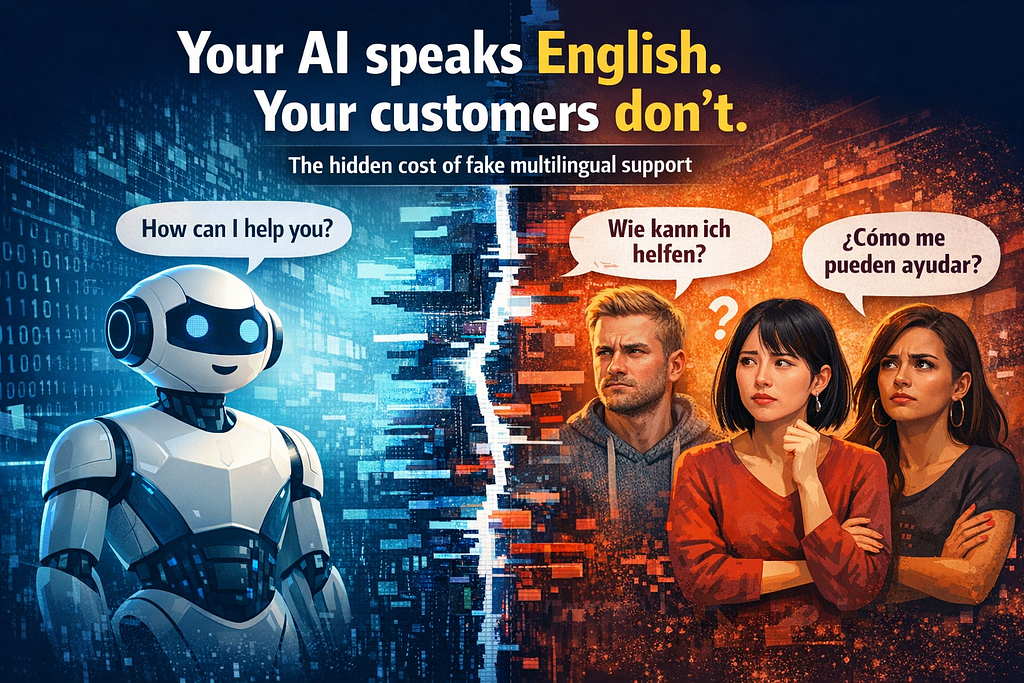
A founder I know launched into the German market last year. Strong product. Good pricing. Real demand.
Three months in, their churn rate in Germany was running almost double what it was in the US. Same product. Same on boarding. Same everything — except support.
When they finally dug into the tickets, the pattern was obvious. German customers were writing in German. The AI was responding in English. When it did respond in German, it was the kind of German that someone who learned the language from a textbook would write. Technically correct. Completely wrong.
They lost those customers not because of the product. They lost them because the support experience was quietly signaling, every single interaction: you are not our real market. You are an afterthought.
That signal is expensive. And it’s more common than most people admit.
The translation layer trap
Here’s how most businesses handle multilingual support. They take their existing English support system, plug in a translation API, and ship it. Customer writes in Spanish, the system translates to English, processes it, generates an English response, translates back to Spanish. Done.
It sounds reasonable. It almost never works the way you think it does.
The problem isn’t the translation. Modern translation tools are genuinely impressive. The problem is everything translation can’t touch: tone, register, cultural context, the difference between what someone said and what they meant.
When a French customer writes to complain, they write differently than an American customer writes to complain. Not just the words. The structure of the complaint. What they lead with. What they leave implicit. What they expect you to already understand without them having to say it. An AI trained on English customer service data doesn’t know any of this. It reads the translated text and generates a response based on patterns that have nothing to do with what the customer actually needs.
The customer receives something that is technically in French but feels completely foreign. And they notice. They always notice.
What “feeling foreign” actually costs
I want to put some numbers around this because it’s easy to dismiss as a soft concern.
Research on customer experience in non-native languages consistently shows the same thing: customers who receive support in their own language resolve issues faster, report higher satisfaction, and churn at significantly lower rates than customers who don’t. The satisfaction gap between native-language support and translated support is larger than the gap between fast support and slow support. People will wait longer for someone who actually understands them than they will accept a quick response that misses the point.
For businesses selling into multiple markets, this creates a hidden problem. Your English-market metrics look fine. Your international metrics look worse, and you spend months trying to figure out why — tweaking pricing, adjusting on boarding, running user research — when the answer was sitting in your support queue the whole time.
The German founder I mentioned earlier figured this out eventually. Once they understood the problem, the next question was how to fix it without building a multilingual support team in every market they wanted to enter. That’s where it gets interesting.
Why this problem is harder than it looks — and easier than you think
The hard part is that genuine multilingual support isn’t just a technology problem. It’s a people problem, a training problem, and a cultural competence problem, all at once.
You can’t solve it by buying better translation software. You can’t solve it by training a single AI model on customer data from forty different countries and hoping it figures out the nuances. You especially can’t solve it by asking your one Spanish-speaking team member to handle all your Latin American support on top of their actual job.
The businesses that get this right are doing something more deliberate. They’re thinking about multilingual support as a distinct operational capability, not a feature they can add on top of their existing system.
What that looks like in practice varies by company size and market footprint. But the underlying logic is consistent.
First, they separate the question of language from the question of culture. Speaking the language is table stakes. Understanding the cultural context that shapes how customers in that market think about problems, communicate frustration, and evaluate whether they’ve been helped — that’s the actual capability you’re trying to build.
A native Spanish speaker who grew up in Mexico and a native Spanish speaker who grew up in Spain are both fluent. They will handle a customer complaint from a Mexican customer and a Spanish customer very differently. Both of those differences matter. A translation layer handles neither of them.
Second, they think about coverage differently. The goal isn’t to have a human agent fluent in every language your customers speak — that’s a staffing problem with no good solution at small scale. The goal is to have the right humans handling the right conversations, with AI handling the infrastructure that makes that possible at a reasonable cost.
AI can triage incoming tickets by language, route them to the appropriate agent, surface relevant history and context, and handle the straightforward transactional requests in any language it’s been properly trained on. What AI can’t do is bring genuine cultural fluency to a complex, emotionally charged conversation with a customer who feels unheard. That still requires a person.
The businesses doing this well have built a model where AI dramatically reduces the volume of tickets that need to reach a human, which makes it economically viable to have genuinely fluent, culturally competent agents handling the interactions that actually matter.
The markets where this matters most — and where most businesses get it wrong
Not all markets are equally sensitive to language quality in support. Understanding the difference helps you prioritize where to invest.
Japan is the most demanding market I’ve seen for this. Japanese customer service culture has extremely specific norms around formality, indirectness, and the implicit acknowledgment of inconvenience. A response that would be considered warm and helpful in an American context can come across as casual to the point of disrespect in a Japanese context. AI systems trained on Western customer service data almost always get this wrong. The translation is fine. The register is completely off.
Germany and the DACH region are similarly demanding, but for different reasons. German customers tend to be more direct and more precise in how they describe problems. They expect equally direct, precise responses. Vague reassurances and generic apologies — which are standard features of a lot of AI-generated support responses — land particularly badly here. Customers read them as evasive, which makes a frustrating situation worse.
Spanish-speaking markets are complex because “Spanish-speaking” is not a monolithic category. Mexican Spanish, Argentine Spanish, and Spanish Spanish are not interchangeable in a customer service context. The vocabulary is different. The conventions are different. The tone expectations are different. A support operation that treats Latin America as a single market is making a mistake that their customers will notice even if the business doesn’t.
Southeast Asian markets — particularly Indonesia, Vietnam, and Thailand — are growing fast and have high expectations for local-language support. English proficiency varies significantly across customer demographics, and the assumption that English support will be acceptable is increasingly wrong as more customers from these markets enter the middle class and expect services that meet them where they are.
In all of these markets, the businesses with a genuine local-language capability have a significant advantage over those relying on translation layers. The gap is real, it’s measurable, and it compounds over time.
How to actually build this without a massive budget
The good news is that genuine multilingual support capability is more accessible than it used to be. The bad news is that “more accessible” still requires real thought and real investment — just not the kind that involves hiring a hundred people.
Start by understanding your actual language distribution. Pull your tickets from the last six months and tag them by language. Most businesses are surprised by what they find. You probably have more non-English volume than you think, concentrated in two or three languages rather than spread evenly across dozens.
That concentration matters because it tells you where to invest first. If 60% of your non-English volume is in Spanish and 20% is in German, those are the two languages where genuine capability will have the most impact. Start there. Don’t try to build forty-language support at once — build two languages properly and expand from there.
For those primary languages, think seriously about what “proper” means. It means agents who are genuinely fluent, not just able to get by. It means training that covers cultural context, not just vocabulary. It means AI systems that have been trained on real customer data in those languages, not just a translation layer on top of an English model.
For secondary languages — the ones that represent smaller portions of your volume — a well-implemented AI triage system can handle a significant portion of the load, with escalation to a human agent for the complex cases. The key word is well-implemented. This means training on real ticket data in each language, not relying on a generic model. It means testing the outputs before you go live, with actual native speakers. And it means having a clear escalation path that doesn’t leave customers in a loop when AI hits its limits.
The coverage question is worth addressing directly. One of the most practical advantages of the AI plus human model for multilingual support is time zone and hour coverage. Building a team of native-language agents in every market you serve is genuinely difficult — the staffing math doesn’t work for most small and mid-sized businesses. But AI that handles inbound triage and simple requests around the clock, with human agents covering business hours in each market, gives you meaningful coverage without the headcount that full 24/7 human support would require.
The strategic case for getting this right
There’s a version of this conversation that’s purely about cost and efficiency — reduce churn, improve CSAT, retain customers you’d otherwise lose. That’s real and it matters.
But the bigger opportunity is competitive positioning.
Most businesses entering new international markets under invest in localized support. They treat it as an afterthought, something to figure out once they’ve proven the market. The result is that the market they’re testing usually doesn’t get a fair test. Customers churn for support-related reasons, the business interprets this as weak demand, and they either pull back or double down on the wrong things.
The businesses that invest in genuine multilingual support capability before they need it at scale are effectively buying a cleaner signal. When your German customers churn, you want to know it’s because of the product or the pricing — not because they felt like a second-class market. That distinction is worth a lot.
Beyond the signal quality, there’s a real differentiation argument. In most categories, the quality of multilingual support among competitors is mediocre. A business that visibly, genuinely invests in meeting customers in their own language and cultural context is doing something that’s hard to copy quickly and genuinely valued by the customers who experience it.
That’s the kind of advantage that compounds. Not flashy. Not easily measured in a single quarter. But real.
Where to start
If you’re reading this and recognizing your own support operation somewhere in it, here’s the practical starting point.
Audit your non-English ticket volume this week. Find out which languages are actually showing up, how those tickets are currently being handled, and what your CSAT looks like segmented by customer language. If you don’t have that data, that’s your first problem — you’re flying blind on a dimension that’s directly affecting your retention.
Then have an honest conversation about your two or three highest-volume non-English languages. What would genuine capability in those languages actually require? What does it cost? What does it cost you not to have it?
The businesses that ask those questions seriously usually find that the math is better than they expected. The cost of genuine multilingual support, done efficiently with the right mix of AI infrastructure and human expertise, is almost always lower than the cost of the churn it prevents.
The hard part isn’t the budget. It’s deciding that your international customers deserve the same quality of experience as your domestic ones — and then actually building the system that delivers it.
Most businesses say they believe that. Fewer actually act on it.
The ones that do tend to look back on it as one of the better decisions they made.
Follow for more on the practical side of building customer operations that actually work across markets — what the data shows, what the vendors don’t tell you, and what’s actually worth your time.
Your AI Speaks English. Your Customers Don’t. Here’s What That’s Actually Costing You. was originally published in Towards AI on Medium, where people are continuing the conversation by highlighting and responding to this story.