Part of what makes a pencil a good object is that all its parts share approximately the same rotational velocity - i.e. it's a rigid body object. Part of what makes a squirrel a good object is that its parts share approximately the same genome. Part of what makes the water in a cup a good object is that its parts share approximately the same chemical composition - i.e. it mixes quickly.
General pattern: part of what makes many objects good objects (i.e. ontologically natural) is that their parts all share approximately the same <something>, given time to equilibrate.
Ideal markets are a good more-abstract example: in a market at equilibrium, all agents share the same prices, i.e. the ratios at which they trade off between (marginal amounts of) different goods are all equal. Indeed, we can view this "Law of One Price" as the defining feature of a market.
Mental Picture: One Price
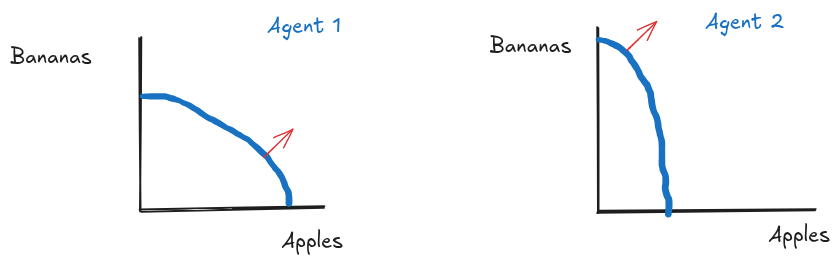
This is the classic econ-101 picture: two agents can both produce apples or bananas in various combinations. If one of the agents can tradeoff between apple vs banana production at a ratio of 2:1 and the other at 1:2, then they can produce more total apples and more total bananas by one agent producing two more apples (at the cost of one less banana), and the other producing two more bananas (at the cost of one less apple).
Roughly speaking, if each agent's "production frontier" (curve showing the number of bananas producible for each number of apples) is concave (i.e. curving downward, like the picture above), then total apple and banana production will be pareto optimal exactly when the two agents have the same marginal tradeoffs - i.e. if one of them trades off apples vs bananas at a 2:3 ratio, then the other also faces a 2:3 ratio. That's the equilibrium condition: the two face the same marginal tradeoffs. Visually, in the graphs above, those tradeoffs are represented by the red arrows perpendicular to the production frontiers. At equilibrium, the two agents each choose a point on their frontier such that the two red arrows point in the same direction.
In an efficient market, those tradeoff ratios are the relative prices of the two goods. Even absent an efficient market (even absent any trade at all, in fact), we can define "virtual prices" from the tradeoff ratios, and those virtual prices must be equal across the two "agents" in order for production to be pareto optimal. This mental model is really about pareto optimality, not about trade or markets or economics or agents.
... except...
There's a big loophole when the agents have convex production frontiers or utility functions, rather than concave. Then, their prices tend to diverge, rather than converge.
Mental Picture: The Convex Case
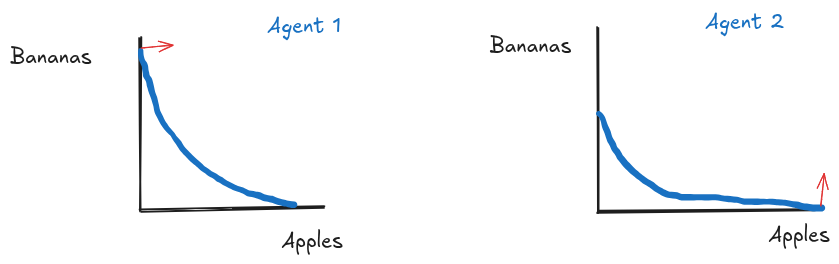
With convex frontiers, one agent is likely to specialize entirely in apples, and the other entirely in bananas. The two end up different tradeoffs, but that doesn't let them produce more total apples and more total bananas, because each has already traded off as far as they can go - the agent producing no apples can't produce any fewer apples, and the agent producing no bananas can't produce any fewer bananas.
In principle, this kind of "zero bound" solution can happen with concave or convex frontiers. But in practice, two agents with concave frontiers (the previous picture) will tend to converge in price (moving them "toward the middle", typically away from the zero bounds), while two agents with convex frontiers (this picture) will tend to diverge (pretty much always driving them toward the zero bounds eventually).
Why do agents with concave frontiers converge, while convex frontiers diverge? Well, imagine for a moment that both agents have the same frontier. If it's concave (previous picture), then if the two pick different points on the line, their average is below the frontier - so the two can do better in total by both moving to the average point. But if it's convex, then the average is above the frontier, and gets further above as the points move apart - so the two do better in total by moving away from the average.
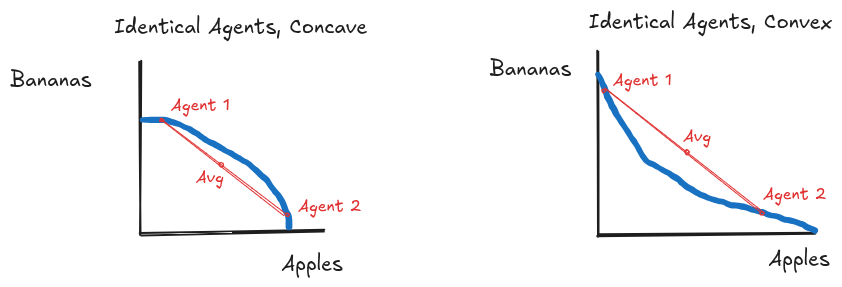
It's basically the mental picture from Jensen's Inequality.
Question: if a market is a good object insofar as the agents' prices converge... but with concave frontiers/utilities the agents' prices tend to diverge... what other good objects arise in the presence of concave frontiers/utilities?
(You might want to stop here to think on that one yourself.)
Tentative answer: clusters of similarly-specialized agents. If there's a whole bunch of agents, some of which entirely specialize in apples, and some of which entirely specialize in bananas, then we have two natural, discrete categories of agent.
Trees, for example, have parts ("agents") specialized in structural support (wood) and parts specialized in energy harvest (leaves). There is not much in-between; the parts of woody trees are pretty discretely specialized in one or the other function (or some other function, like e.g. bark), not both functions. Presumably the tree's production frontier for structural support and energy harvest is convex; otherwise the tree could get more of both by mixing the functions.
On the other hand, grass does mix the two functions: a blade of grass functions as both structural support and energy harvester simultaneously. Presumably the grass's production frontier is concave.
Zooming out a moment... there's a lot of drivers of natural ontological distinctions out there. Just look at the first paragraph of this post:
- Part of what makes a pencil a good object is that all its parts share approximately the same rotational velocity. Break the pencil in two, and we have two rigid bodies with different rotational velocities; that's a natural ontological distinction between the two broken parts.
- Part of what makes a squirrel a good object is that its parts share approximately the same genome. If the squirrel reproduces, its child's parts will all share a different genome; that's a natural ontological distinction between the two squirrels.
- Part of what makes the water in a cup a good object is that its parts share approximately the same chemical composition. Pour some oil into the cup, and we have two fluids which don't mix with each other but do mix internally; that's a natural ontological distinction between the two fluids.
Specialization is just one more phenomenon along similar lines: part of what makes a market (or coherently-optimized stuff more generally) a good object is that all its parts have the same tradeoff ratios between different "good" things. If convex production/utility drives the parts to specialize until they hit a bound, then we get a natural ontological distinction between differently-specialized parts.
So why am I writing a post about specialization specifically? What makes it a particularly interesting driver of natural ontology?
Specialization is notable because it drives natural ontological distinctions in optimized systems specifically. It's the sort of phenomenon which drives e.g. biological organisms to have distinct types of parts - like wood vs leaves on a tree. It's also the sort of phenomenon we'd expect to apply to the internals of neural nets, producing the learned internal analogues of wood vs leaves: parts of the net specialized in different functions. Specialization is the sort of phenomenon which would generate natural ontological distinctions for modelling the internals of agentic systems, and optimized systems more generally.
Acknowledgement: David Lorell isn't on this post, but this thought did bubble out of all the stuff we generally work on together.
Discuss