A conversation I’ve heard never:
Erma the enthusiast: “Sure, AI will take your job, but it doesn’t matter, because AI will make so much stuff, there will be plenty to go around.”
Norma the normie: “Well, I’m convinced!”
Is “post-scarcity” bullshit?
Yes, yes it is. That’s today’s blog.
OK, let’s dive in!
Post-scarcity
Post-scarcity.
The idea that we are about to enter an age of limitless abundance, where everyone can have their basic needs met and more… and MORE… and MORE!
It’s a compelling and captivating idea, and for many reasons. And I’m not saying it’s impossible. But is it the default outcome? And what even is this outcome we’re talking about? Is it something people actually want? Does post-scarcity not also mean “post-purpose”?
Let’s look at the basic idea of post-scarcity and the case for it before arguing against it: Economic growth has led to massive sustained increases in the standard of living for the average person. This includes, e.g. huge decreases in people suffering and dying from preventable causes like disease and hunger. If this trend continues, future people (that could be us!) will all experience levels of material wealth unimaginable today. Sadly, a lot of people still do die of preventable causes. Not everyone can afford the best medical care, let alone the nicest food, housing, etc. But it’s not just some abstract hypothetical! We’re about to make AI that can do literally all of the work for us, cheaper. And it will be smart enough to unlock advances in medicine and other technologies that would take human scientists lifetimes. In the future, when you want something, you’ll just snap your fingers, and your robot butler will instantly give it to you.
So what’s wrong with this picture? Well, we can start by going back to this thing where people still do die from preventable causes… Why exactly aren’t we preventing that? Like, I think we all agree it sucks. So why are we spending money on fancy clothes and food and cars and so on when $5000 is enough to save a person’s life? We have enough material wealth to provide everyone on the planet with a decent standard of living. Why aren’t we doing it?
In 1930, John Maynard Keynes -- one of the most famous economists of all time -- predicted that his grandkids would work just 15 hours a week. Why aren’t we doing that? Is all of this work and stuff really making us happy? Shouldn’t we be spending more time enjoying life and spending time with the people we’re close to?
These things will always be scarce.
These two questions: “Why are people still suffering in extreme poverty?” and “Why are rich people working so hard?” have two main answers:
People are competing with each other for money, power, status, etc.
People derive meaning from work.
And post-scarcity doesn’t have shit to say about this.
But economics does! “Positional goods” refer to things that function like status symbols -- you having it amounts to someone else NOT having it. That’s the point.
…or maybe it’s just an intrinsic aspect of the situation. Take land for example. There is only so much space on earth (or in the reachable universe for that matter…). If I own all of it, you own none of it. Will your robot butler bring you “the sun, the moon, and the stars”? No, sorry, those are reserved for our platinum post-scarcity members.
Here’s a list of things that are never, ever, going to be “abundant”:
Physical space
Health and longevity
Status
Security
Energy
You know, nothing that important, just (checks watch) the most fundamental things people value and need. I kinda get the feeling that if technology was going to solve this problem, maybe it would’ve by now. Keynes sure seemed to think it would.
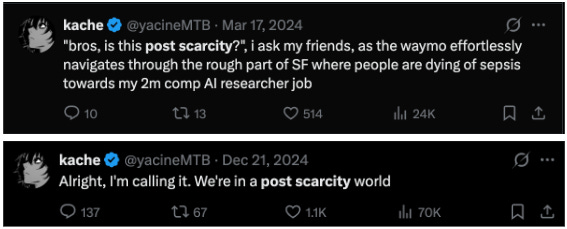
This is not the post-scarcity you’re looking for.
It’s not that I think the phrase “post-scarcity” isn’t pointing at a thing. I do believe AI and other technologies have the potential to radically improve everyone’s standard of living. It’s just… that’s far from guaranteed. And on some level, that’s never what this was all about. The meaning of life isn’t having your material needs met. People really, deeply care about things like feeling valuable and valued, and that means having purpose and status. AI robs us of the first, and doesn’t change the fundamentally scarce nature of the latter.
I think the whole idea of “post-scarcity” basically functions to bamboozle people who stand to lose their position and power in society, their access to those positional goods, due to AI. Up-and-coming members of the “permanent underclass”. The reality is, nobody actually has a plan to make this whole post-scarcity thing happen… Like, not for you personally, I mean. Obviously, shareholders of the robot butler company will be fine…
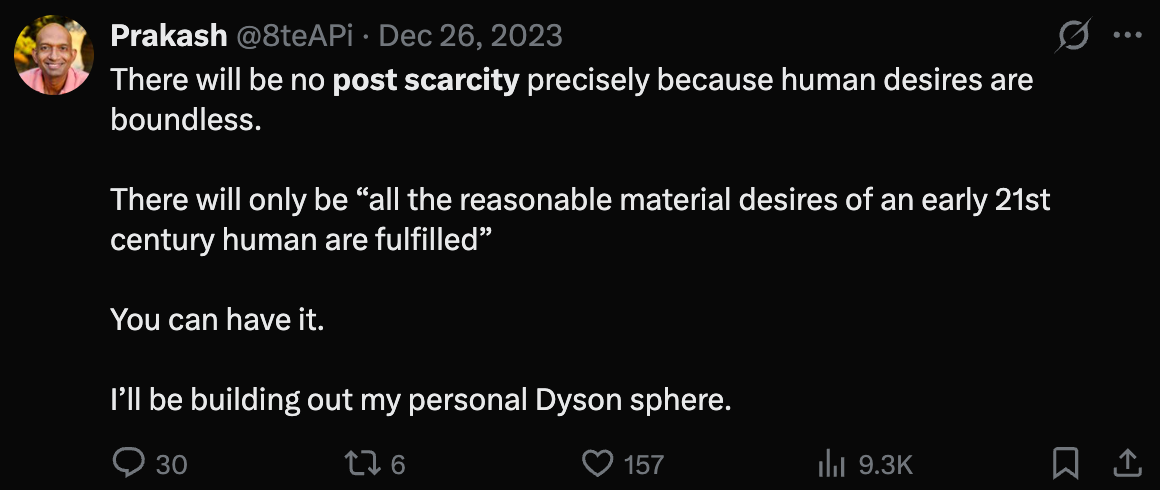
Or will they? Honestly, my money is on “no”. Because it’s not just that there’s not a plan. There’s also not even a goal. What does this post-scarcity society actually look like? Is it just like… robot butlers and cures for cancer? Are we all hanging out making art and engaging in wholesome ? Or giga-coked-out watching ultra-porn?
A friend of mine remarked that people seem to be imagining the future with AI as like “exactly like today, except AI does all of the jobs”. Like, literally, those 5 guys outside fixing the sewers? 5 robots. You, typing up a memo at your computer? Robot typing. Dr. Oz? Dr. Robot Oz.
Transhumanism
And this leads me to another way in which it’s bullshit, which is the elephant in the room, which is transhumanism. I’m sure some people really believe in the “eternal hominid kingdom” version of post-scarcity, but try pressing someone on this and likely enough, before long you’re talking cyborgs and “uploads” and “the glorious transhuman future”. Maybe us lowly humans can actually be satisfied and sated well enough if you just give us material abundance, world peace, etc. But really, the most likely AI futures (that don’t involve AI going rogue and murdering us all) involve surpassing all human limits: intelligence, life-span, and yes -- desires.
Maybe all you need to be happy is your little corner of the universe, your cabin in the woods… what a loser. The winners are over here shipping virtual cabin-maxxing experiences that you can’t even conceive of, and we just acquired your cabin.
But who are these winners? Are they living the good life? Or are they just the ones who most aggressively embraced this new technology and the new reality it brought us? Do they have any time away from the rat race? Or are they just racing ever harder and faster to keep up with the technological curve, never stopping to wonder if they lost something along the way… their “humanity”? (lame). Their ability to ever be, for even a moment, satisfied? Their ability to feel, or experience… anything at all?
The rat race isn’t going anywhere, at least not without major changes to how we organize society. Technological post-scarcity isn’t an end to it. It’s an invitation to stick your head in the sand while we turn this treadmill up to 11. And when we do finish building Real AI and automate y’all away? Shut the fuck up and enjoy your government handouts or freemium robot butlers or whatever; the winners be over here, racing to automate their feet and keeping up with the Joneses. I hear they uploaded and they only take their bodies out for social functions now. I even heard they’re just running low-res versions of themselves in those bodies and are actually using all of their energy and compute speculating on crypto-status markets…
Thanks for reading The Real AI! Subscribe for free to receive new posts and support my work.
Discuss