The 4 Multilingual Model Capabilities: How AI Speaks 100+ Languages Without Learning Each Separately
Understanding Cross-Lingual Transfer, Translation, Language Detection, and Low-Resource Languages
Introduction
You train an AI model on English text. It learns to answer questions, summarize documents, write code. Then something remarkable happens: Without any French training data, you ask it a question in French. It responds perfectly — in French. You try Japanese. Works. Swahili. Works. The model learned one language but speaks 100. The secret? Cross-lingual transfer.
This is the multilingual AI revolution. Before: Train separate models for each language (200+ models for 200 languages). After: One model handles all languages simultaneously. GPT-4 speaks 100+ languages. BLOOM trained on 46 languages performs well on 100+. mT5 trained on 101 languages transfers to 200+. The result: Global accessibility, instant translation, underrepresented languages finally included.
But here’s the paradigm shift: AI doesn’t just memorize translations — it discovers universal language patterns. Concepts like “love,” “justice,” “algorithm” align across languages in the embedding space. Grammar structures transfer (subject-verb-object patterns). Reasoning learned in English applies to Vietnamese. The insight: Languages are different surface forms of shared semantic structures.
The impact is transformative: 7 billion people speak 7,000+ languages. Traditional approach: Build AI for 10 major languages, ignore other 6,990. Multilingual approach: One model serves all languages, especially underrepresented ones. The difference between “AI only for English speakers” and “AI for everyone,” between translating with 50% accuracy and 95% accuracy, between 10 supported languages and unlimited.
This article explores four multilingual capabilities, explaining how AI breaks language barriers, when to use which approach, and how to make AI truly global.
The Core Problem: The World Speaks 7,000+ Languages
The Language Barrier Crisis
GLOBAL LANGUAGE DISTRIBUTION:
Top 10 languages: 3.2 billion speakers (46%)
Next 90 languages: 2.8 billion speakers (40%)
Remaining 6,900 languages: 1 billion speakers (14%)
AI COVERAGE (Traditional approach):
Well-supported: English, Mandarin, Spanish, French, German, Japanese
(~10 languages, 2.5 billion speakers, 36%)
Poorly-supported: Hindi, Arabic, Portuguese, Bengali, Russian
(~90 languages, 3 billion speakers, 43%)
Not supported: Other 6,900 languages
(1.5 billion speakers, 21% ignored!)
PROBLEM: 64% of world underserved!
COST OF MONOLINGUAL APPROACH:
Training cost per language: $500K - $5M
200 languages × $1M = $200M minimum

Data requirements per language:
- Pre-training: 100GB text
- Fine-tuning: 10K labeled examples
- Evaluation: 1K test cases

Availability:
- English: 1,000TB+ available
- French: 100TB available
- Swahili: 1GB available (1,000× less!)
- Quechua: 10MB available (100,000× less!)

RESOURCE DISPARITY:
High-resource (10 languages):
- Abundant training data
- Many speakers
- Economic incentive
Medium-resource (90 languages):
- Limited training data
- Many speakers
- Some economic incentive
Low-resource (6,900 languages):
- Minimal training data
- Fewer speakers
- No economic incentive
Result: 99% of languages ignored!
NEED: Multilingual models that transfer knowledge across languages
The 4 Multilingual Capabilities
┌────────────────────────────────────────────────────────────┐
│         THE 4 MULTILINGUAL MODEL CAPABILITIES               │
└────────────────────────────────────────────────────────────┘

1. CROSS-LINGUAL TRANSFER
   Learn in one language, apply to all languages

2. TRANSLATION
   Convert text between any language pairs

3. LANGUAGE DETECTION
   Identify which language text is written in

4. LOW-RESOURCE LANGUAGE SUPPORT
   Enable AI for languages with minimal data
Capability 1: Cross-Lingual Transfer — Learning Once, Applying Everywhere
What It Is
Models learn capabilities in high-resource languages (like English) and automatically transfer those capabilities to other languages without additional training.
How It Works
┌────────────────────────────────────────────────────────────┐
│              CROSS-LINGUAL TRANSFER WORKFLOW               │
└────────────────────────────────────────────────────────────┘

TRAINING PHASE (English only):
Task: Question Answering
Training data: SQuAD dataset (100K English Q&A pairs)
Example:
Context: "The Amazon rainforest covers 5.5 million km²"
Question: "How large is the Amazon rainforest?"
Answer: "5.5 million km²"

Model learns:
- Find relevant context
- Extract precise answer
- Handle various question types
Language: 100% English
Cost: $50K training
ZERO-SHOT TRANSFER (No additional training!):
Same model, different language:
French query:
Context: "La forêt amazonienne couvre 5,5 millions de km²"
Question: "Quelle est la taille de la forêt amazonienne?"
Answer: "5,5 millions de km²" ✓
Japanese query:
Context: "アマゾン熱帯雨林は550万平方キロメートルをカバーしています"
Question: "アマゾン熱帯雨林の面積は?"
Answer: "550万平方キロメートル" ✓
Swahili query:
Context: "Msitu wa Amazon unafunika km² milioni 5.5"
Question: "Msitu wa Amazon ni mkubwa kiasi gani?"
Answer: "km² milioni 5.5" ✓
Performance:
- English: 88% F1 score
- French: 79% F1 score (90% of English!)
- Japanese: 74% F1 score (84% of English)
- Swahili: 65% F1 score (74% of English)
WITHOUT cross-lingual transfer:
Would need to train on French data ($50K)
Then Japanese data ($50K)
Then Swahili data ($50K, if data even exists!)
Total: $200K vs $0 with transfer!

WHY IT WORKS:
SHARED MULTILINGUAL EMBEDDINGS:
Word embeddings align across languages:
English "dog" → Vector [0.2, -0.5, 0.8, ...]
French "chien" → Vector [0.21, -0.49, 0.79, ...] (very similar!)
Spanish "perro" → Vector [0.19, -0.51, 0.81, ...] (very similar!)
Concept "dog" occupies same region in embedding space
regardless of language!
Universal semantic space:
- Animals cluster together
- Numbers cluster together
- Actions cluster together
- Abstract concepts cluster together
SYNTACTIC UNIVERSALS:
Subject-Verb-Object (SVO) structure:
English: "I eat apples"
French: "Je mange des pommes"
Swahili: "Ninakula matofaa"
All: SVO structure
Model learns SVO pattern once, applies everywhere!
Interrogative structure:
English: "What is X?"
French: "Qu'est-ce que X?"
Japanese: "X は何ですか?"
Pattern: Question marker + unknown + verb

SEMANTIC UNIVERSALS:
Logical reasoning:
If A then B, A is true → B is true
This logic transcends language!
Numerical reasoning:
2 + 2 = 4 in all languages
Mathematical operations universal
Named entity patterns:
Names capitalized in many scripts
Location markers ("in," "at")
Date formats

TRANSFER MECHANISMS:
1. EMBEDDING ALIGNMENT
Training objective:
Translations should have similar embeddings
"dog" (English) ≈ "chien" (French)
Method:
- Use parallel text (translations)
- Align embedding spaces
- Learn mapping between languages
2. SHARED ENCODER
One encoder for all languages:
Input (any language) → Shared encoder → Universal representation
→ Task-specific head → Output (same language)
Language-agnostic middle layer!
3. CODE-SWITCHING TRAINING

Mix languages in training:
"I went to the marché to buy pommes"
Model learns languages are interchangeable
Strengthens cross-lingual connections

PERFORMANCE FACTORS:
High transfer quality when:
✓ Languages typologically similar (French ↔ Spanish)
✓ Both use same script (Latin alphabet)
✓ Concepts culturally universal
✓ Large multilingual pre-training
Lower transfer quality when:
✗ Languages very different (English ↔ Japanese)
✗ Different scripts (Latin ↔ Arabic)
✗ Culture-specific concepts
✗ Limited multilingual data
Practical Applications
SENTIMENT ANALYSIS:
Train on English movie reviews:
"This film is amazing!" → Positive
"Terrible waste of time" → Negative
Transfer to other languages:
French: "Ce film est incroyable!" → Positive ✓
German: "Schreckliche Zeitverschwendung" → Negative ✓
Hindi: "यह फिल्म शानदार है!" → Positive ✓
Accuracy: 85% (vs 90% English baseline)
Without transfer: Would need labeled data in each language!

NAMED ENTITY RECOGNITION:
Train on English text:
"Apple CEO Tim Cook announced new iPhone in California"
→ [Apple: ORG], [Tim Cook: PER], [iPhone: PROD], [California: LOC]
Transfer to German:
"Apple-Chef Tim Cook kündigte neues iPhone in Kalifornien an"
→ [Apple: ORG], [Tim Cook: PER], [iPhone: PROD], [Kalifornien: LOC] ✓
Works because:
- Names transfer across languages
- Capitalization patterns similar
- Context clues universal

QUESTION ANSWERING:
English training: "Who invented the telephone?"
Model learns to find inventor given invention
Arabic query: "من اخترع الهاتف؟"
Model transfers inventor-finding skill
Answer: "ألكسندر جراهام بيل" (Alexander Graham Bell) ✓

DOCUMENT CLASSIFICATION:
English training: Classify news into categories
(Sports, Politics, Technology, etc.)
Transfer to Japanese news:
Technology article about AI → Classified correctly as Technology
Sports article about Olympics → Classified correctly as Sports
Accuracy: 82% (vs 88% English)
Benefits & Limitations
Advantages:
- ✓ No per-language training cost (save $50K+ per language)
- ✓ Instant support for new languages
- ✓ Works even with zero data in target language
- ✓ Consistent performance across languages
- ✓ Enables low-resource languages
- ✓ Scales to unlimited languages
Limitations:
- ✗ Performance gap vs monolingual models (10–30% lower)
- ✗ Struggles with very distant languages
- ✗ Culture-specific concepts may not transfer
- ✗ Requires good multilingual pre-training
- ✗ Some tasks transfer better than others
Typical Performance:
- Similar languages: 90–95% of English performance
- Moderately different: 70–85% of English performance
- Very different: 50–70% of English performance
Best For: Cost-effective multilingual deployment, low-resource languages, global applications
Used In: mBERT, XLM-R, mT5, GPT-4, all modern multilingual models
Capability 2: Translation — Converting Between Languages
What It Is
AI models that translate text from one language to another, handling 100+ language pairs with a single model.
How It Works
┌────────────────────────────────────────────────────────────┐
│              NEURAL TRANSLATION WORKFLOW                   │
└────────────────────────────────────────────────────────────┘
TRADITIONAL (2015): Separate model per language pair
English → French: Model 1
English → German: Model 2
English → Spanish: Model 3
...
200 languages × 199 pairs = 39,800 models!
MODERN (2024): One multilingual model for all pairs
NLLB (No Language Left Behind - Meta):
- Single model
- 200 languages
- 40,000 language pairs
- Learns shared representation

ARCHITECTURE:
Encoder-Decoder Transformer:
Input: "The cat sits on the mat" (English)
Target language: French
STEP 1: TOKENIZATION
Multilingual tokenizer (SentencePiece):
"The cat sits on the mat"
→ [The, cat, sits, on, the, mat]
Includes language tag: <eng> at start
Full input: "<eng> The cat sits on the mat"
STEP 2: ENCODING
Encoder transforms to language-agnostic representation:
[The, cat, sits, on, the, mat]
→ [h1, h2, h3, h4, h5, h6] (hidden states)
These vectors capture MEANING, not specific words
h2 represents "cat concept" regardless of language
STEP 3: DECODING WITH LANGUAGE TAG
Add target language tag: <fra> (French)
Decoder generates French:
<fra> → "Le" (probability: 0.87)
<fra> Le → "chat" (probability: 0.93)
<fra> Le chat → "est" (probability: 0.76)
...
Result: "Le chat est assis sur le tapis"
STEP 4: MULTI-SOURCE TRANSLATION (Advanced)
Some languages lack direct parallel data:
English ↔ Quechua: Very few parallel sentences
Solution: Pivot through intermediate language:
English → Spanish → Quechua
Or better: Multilingual joint training
Model learns:
- English → Spanish
- Spanish → Quechua
- English → French
- French → Spanish
Implicitly learns: English → Quechua (zero-shot!)
QUALITY IMPROVEMENTS:
BACK-TRANSLATION:
Limited parallel data (10K sentences)
Abundant monolingual data (1M sentences French)
Process:
1. Train initial model on 10K parallel
2. Use model to translate 1M French → English
3. Now have 1M synthetic parallel sentences
4. Retrain with 10K real + 1M synthetic
5. Quality improves 15-20%!
MULTILINGUAL TRAINING:
Instead of English ↔ French only:
Train on many language pairs simultaneously:
- English ↔ French
- English ↔ German
- French ↔ German
- German ↔ Spanish
...
Benefit: Model learns universal translation patterns
English ↔ French improves from seeing English ↔ German!
CONTEXTUAL TRANSLATION:
Traditional: Sentence-by-sentence
"He ate an apple. It was delicious."
→ "Il a mangé une pomme. C'était délicieux."
Problem: Lost pronoun reference (what was delicious?)
Modern: Document-level translation
Full context maintained:
"He ate an apple. It was delicious."
→ "Il a mangé une pomme. Elle était délicieuse."
(Correct: "Elle" refers to "pomme")
SPECIALIZED TRANSLATION:
DOMAIN ADAPTATION:
General model: Good at news, web text
Medical translation: Poor (technical terms)
Solution: Fine-tune on medical parallel corpus
English: "The patient presents with dyspnea"
French: "Le patient présente une dyspnée"
Medical accuracy: 75% → 92% after fine-tuning!
FORMALITY CONTROL:
Input: "Can you help me?"
Formal output (vous): "Pouvez-vous m'aider?"
Informal output (tu): "Peux-tu m'aider?"
Model learns formality from context or explicit control
TERMINOLOGY CONSISTENCY:
Technical documents require consistent terms:
"neural network" → Always "réseau de neurones" (not variants)
Terminology glossary enforces consistency:
Glossary: {neural network → réseau de neurones}
All occurrences translated identically
QUALITY METRICS:
BLEU SCORE (0-100):
- 50+: High quality (human-level)
- 30-50: Understandable
- <30: Poor quality
Modern models:
English ↔ French: BLEU 65 (near-human)
English ↔ Swahili: BLEU 38 (good)
English ↔ Quechua: BLEU 22 (basic)
HUMAN EVALUATION:
Fluency: Does it read naturally?
Adequacy: Does it preserve meaning?
Rating: 1-5 scale
English → French:
Fluency: 4.5/5 (near-native)
Adequacy: 4.7/5 (preserves meaning well)
Translation Applications
REAL-TIME CONVERSATION:

User speaks English: "Where is the nearest hospital?"
→ Text-to-speech
→ Translation to Arabic: "أين أقرب مستشفى؟"
→ Speech synthesis
Total latency: 2 seconds
Enables global communication!
DOCUMENT TRANSLATION:
Legal contract (50 pages, English → Mandarin)
Traditional: Professional translator, 2 weeks, $5,000
AI: 10 minutes, $50
Human review: 2 hours, $500
Total: 95% cost savings, 10× faster
WEBSITE LOCALIZATION:
E-commerce site (10,000 products)
Translate to 20 languages:
Traditional: $200K+
AI: $2K + human review $20K
Total: $22K (90% savings)
Update frequency: Weekly (AI enables frequent updates)
MULTILINGUAL CUSTOMER SUPPORT:
Customer writes in Thai: [Thai text]
Support agent sees English: "My order hasn't arrived"
Agent replies in English: "Let me check your order status"
Customer receives Thai: [Thai text]
Support agent speaks 1 language, serves 100+ languages!
Benefits & Limitations
Advantages:
- ✓ One model for 40,000 language pairs
- ✓ 95% cost reduction vs professional translation
- ✓ Instant translation (seconds vs days)
- ✓ Consistent terminology
- ✓ Enables low-resource language pairs
- ✓ Document and contextual understanding
Limitations:
- ✗ Not perfect (human review recommended for critical docs)
- ✗ Struggles with idioms and cultural references
- ✗ May miss nuance in literary translation
- ✗ Less accurate for very low-resource pairs
- ✗ Can hallucinate (add information not in source)
Typical Performance:
- High-resource pairs (EN-FR): BLEU 65, near-human
- Medium-resource (EN-VI): BLEU 45, good
- Low-resource (EN-QU): BLEU 25, basic
Best For: Documents, websites, customer support, real-time communication
Used In: Google Translate, DeepL, NLLB (Meta), GPT-4, Microsoft Translator
Capability 3: Language Detection — Identifying Languages
What It Is
AI systems that automatically identify which language(s) text is written in, even for mixed-language content.
How It Works
┌────────────────────────────────────────────────────────────┐
│              LANGUAGE DETECTION WORKFLOW                   │
└────────────────────────────────────────────────────────────┘

INPUT: "Bonjour, comment allez-vous?"
TRADITIONAL APPROACH (Rule-based):
Character n-grams:
"Bon" → French-specific trigram
"ous" → Common in French
"ez-v" → French verb pattern
Lookup in language profiles:
French profile score: 0.95
Spanish profile score: 0.12
English profile score: 0.03
Detection: French (95% confidence)
NEURAL APPROACH (2024):
Input → Multilingual embedding → Classification
Process:
1. Tokenize: "Bonjour, comment allez-vous?"
2. Pass through embedding layer
3. Aggregate (pooling)
4. Classify among 200+ languages
Output distribution:
French: 0.98
Catalan: 0.01 (similar to French)
Spanish: 0.005
Others: <0.005
Detection: French (98% confidence)
CHALLENGING CASES:
SHORT TEXT:
Input: "OK"
Could be: English, French, Spanish, German, 100+ others!
Solution: Context or default to most likely (English)
Confidence: Low (need more text)
MIXED LANGUAGE (Code-switching):
Input: "I went to the marché to buy some pain"
Languages: English + French
Detection:
- Primary: English (70%)
- Secondary: French (30%)
- Mixed-language flag: True
Word-level detection:
[I:EN] [went:EN] [to:EN] [the:EN] [marché:FR] [to:EN] [buy:EN]
[some:EN] [pain:FR]
SIMILAR LANGUAGES:
Input: "Eu vou para casa"
Could be:
- Portuguese: "I'm going home"
- Spanish: "Eu vou para casa" (unusual but possible)
Discriminating features:
- "vou" more common in Portuguese
- "casa" used in both
- Overall pattern: Portuguese (92%)
SCRIPT-BASED DETECTION:
Chinese characters → Mandarin/Cantonese
Arabic script → Arabic/Persian/Urdu
Cyrillic script → Russian/Ukrainian/Bulgarian
Example: "Привет"
Script: Cyrillic → Narrows to Slavic languages
Specific patterns → Russian (95%)
MULTILINGUAL DOCUMENTS:
PDF with 5 languages:
Page 1: English (abstract)
Page 2-5: Spanish (main content)
Page 6: French (references)
Page 7: German (acknowledgments)
Page 8: Mandarin (summary)
Document-level detection:
Primary: Spanish (50% of content)
Also contains: English, French, German, Mandarin
PERFORMANCE:
ACCURACY BY TEXT LENGTH:
1 character: 20% accuracy (impossible for many)
5 characters: 60% accuracy
10 characters: 85% accuracy
50 characters: 97% accuracy
100+ characters: 99.5% accuracy
LANGUAGE COVERAGE:
Well-detected: 100+ major languages (>99% accuracy)
Moderately detected: 200+ languages (>95% accuracy)
Poorly detected: Rare languages (<90% accuracy)
SPEED:
Short text (10 words): <1ms
Long document (10,000 words): <100ms
Very fast, real-time capable!
Detection Applications
CONTENT ROUTING:

User submits support ticket in unknown language
→ Detect: Thai
→ Route to Thai-speaking agent
→ Or auto-translate to English for agent
SEARCH OPTIMIZATION:
User query: "ресторан"
Detect: Russian
Suggest: Russian-language results first
Or: Translate to "restaurant" and search
MULTILINGUAL ANALYTICS:
Website traffic analysis:
- 45% English content accessed
- 30% Spanish
- 15% Mandarin
- 10% Other
Insight: Need better Spanish content!
SPAM DETECTION:
Email in unexpected language for user:
User typically receives English
Email arrives in Russian
→ Suspicious, possible spam/phishing
→ Additional scrutiny
CHARACTER ENCODING:
Legacy system shows garbled text: "é"
Detect intended language: French
Infer correct encoding: UTF-8 vs Latin-1
Fix: "é"
AUTO-CORRECTION:
User types: "Helo wrld"
Detect: English (despite typos)
Apply: English spell-checker
Correct: "Hello world"
Wrong language detection would apply wrong corrections!
Benefits & Limitations
Advantages:
- ✓ Extremely fast (<1ms for short text)
- ✓ 99%+ accuracy for 100+ languages
- ✓ Handles mixed-language content
- ✓ Works with minimal text (10+ characters)
- ✓ Script-independent (works across writing systems)
- ✓ Enables downstream processing
Limitations:
- ✗ Unreliable for very short text (<5 characters)
- ✗ Confuses similar languages (Portuguese/Spanish)
- ✗ May struggle with rare languages
- ✗ Code-switching can be ambiguous
- ✗ Dialect vs language distinction unclear
Typical Performance:
- 100+ characters: 99.5% accuracy
- 50 characters: 97% accuracy
- 10 characters: 85% accuracy
- Major languages: 99.9% accuracy
Best For: Content routing, search, preprocessing, analytics
Used In: Google Translate, Chrome browser, Content filtering, Search engines
Capability 4: Low-Resource Language Support — Including Everyone
What It Is
Techniques to enable AI for languages with minimal training data, ensuring linguistic diversity and inclusion.
How It Works
┌────────────────────────────────────────────────────────────┐
│              LOW-RESOURCE LANGUAGE WORKFLOW                │
└────────────────────────────────────────────────────────────┘

CHALLENGE:
High-resource (English): 1,000TB training data
Medium-resource (Vietnamese): 10TB training data
Low-resource (Quechua): 10MB training data (100,000× less!)
Standard training: Requires 100GB minimum
Low-resource: Have only 10MB (10,000× too little!)
SOLUTION STRATEGIES:
1. CROSS-LINGUAL TRANSFER
Train on high-resource language (English):
100GB English data → English model
Transfer to Quechua:
0 bytes Quechua data → Quechua capability!
Performance: 60% of English (vs 0% without transfer)
2. MULTILINGUAL PRE-TRAINING
Train on many languages simultaneously:
English (1000GB) + Spanish (100GB) + French (100GB) +
Vietnamese (10GB) + Swahili (1GB) + Quechua (10MB)
Result: Model learns:
- Universal language patterns
- Quechua benefits from other languages
- Shared vocabulary, grammar structures
Quechua performance: 70% (vs 60% with transfer alone)
3. RELATED LANGUAGE TRANSFER
Quechua is closely related to Aymara
If Aymara has more data (100MB vs 10MB):
Strategy:
- Train on Aymara (100MB)
- Fine-tune on Quechua (10MB)
- Languages share 40% vocabulary
- Grammar structures similar
Result: 80% performance (vs 70% without related transfer)
4. DATA AUGMENTATION
Limited parallel data: English ↔ Quechua (1,000 pairs)
Augmentation strategies:
BACK-TRANSLATION:
- Translate 10,000 English sentences → Quechua (synthetic)
- Use as additional training data
- Quality: Lower but quantity helps
- Improvement: +15%
WORD REPLACEMENT:
Original: "The dog runs fast"
Augmented: "The puppy runs quickly" (synonyms)
Creates 10× more training examples
CROSS-LINGUAL PARAPHRASING:
English: "The weather is nice"
Translate to Spanish: "El clima es agradable"
Back to English: "The climate is pleasant"
New paraphrase for training!
5. ACTIVE LEARNING
Limited annotation budget: Can label 1,000 sentences
Pool of 100,000 unlabeled sentences
Strategy:
1. Train initial model on 100 labeled
2. Model predicts on 99,900 unlabeled
3. Select 100 most uncertain predictions
4. Human labels these 100
5. Retrain on 200 labeled
6. Repeat
Result: 1,000 strategically selected examples >
5,000 randomly selected examples!
6. CROSS-LINGUAL WORD EMBEDDINGS
English embeddings: Well-trained (1M words)
Quechua embeddings: Poorly trained (10K words)
Alignment:
- Find English-Quechua translation pairs (500 words)
- Learn mapping: Quechua space → English space
- Quechua words now have English-quality embeddings!
Example:
Quechua "wasi" (house) → Aligned with English "house"
Inherits relationships: wasi ≈ home, dwelling, residence
REAL-WORLD EXAMPLE: MASAKHANE PROJECT
African languages (2,000+ languages, mostly low-resource)
Strategies used:
- Multilingual pre-training on 20 African languages
- Transfer from related languages
- Community-driven data collection
- Active learning for efficient annotation
Results:
Before: 0 African languages supported well
After: 20+ languages with good performance
Machine translation: English ↔ Yoruba, Swahili, Zulu, etc.
Cost: $100K (vs $20M for traditional per-language training)
LOW-RESOURCE SUCCESS METRICS:
Quechua (Indigenous South American):
Speakers: 8 million
Training data: 10MB
Performance: 65% of English (vs 0% before)
Impact: Access to AI for 8 million speakers!
Maori (Indigenous New Zealand):
Speakers: 150,000
Training data: 5MB
Performance: 58% of English
Impact: Language preservation + modern technology
Cherokee:
Speakers: 2,000
Training data: 2MB
Performance: 45% of English
Impact: Critically endangered language supported by AI!
Low-Resource Applications
LANGUAGE PRESERVATION:

Endangered language documentation:
- Record elderly speakers
- Transcribe to text (speech recognition)
- Translate to English (for archives)
- Create digital dictionary
- Enable younger generation to learn
AI enables: Faster documentation, searchable archives
EDUCATION:
Online learning in native language:
- Student in remote village speaks only Quechua
- Educational content in English
- AI translates lessons to Quechua
- Student learns in native language
Literacy improvement: 40% better comprehension in native language
HEALTHCARE:
Medical information in local languages:
- COVID-19 information in 200+ languages
- Automated translation from WHO guidelines
- Distributed to remote communities
Lives saved: Estimated 100,000+ through better information access
GOVERNMENT SERVICES:
Citizen services in all official languages:
- India: 22 official languages
- AI provides services in all 22
- Previously: Only English and Hindi (40% of population excluded)
Inclusion: 1 billion more people can access services
COMMERCE:
E-commerce in local languages:
- Product descriptions in Swahili
- Customer support in Hausa
- Payments in local currency
Market expansion: Reaching 500M additional customers
Benefits & Limitations
Advantages:
- ✓ Enables AI for 6,900+ languages
- ✓ 100× less data required
- ✓ Cost-effective ($100K vs $20M per language)
- ✓ Preserves endangered languages
- ✓ Increases global inclusion
- ✓ Democratizes AI access
Limitations:
- ✗ Lower performance than high-resource (30–50% gap)
- ✗ Requires related language or multilingual pre-training
- ✗ Limited to simpler tasks initially
- ✗ May need human-in-the-loop for quality
- ✗ Cultural context may be lost
Typical Performance:
- With transfer: 60–70% of high-resource performance
- With related language: 70–80% of high-resource
- With multilingual pre-training: 70–85% of high-resource
Best For: Endangered languages, underserved communities, global inclusion
Used In: NLLB (Meta), Masakhane, BLOOM, mT5, local language initiatives
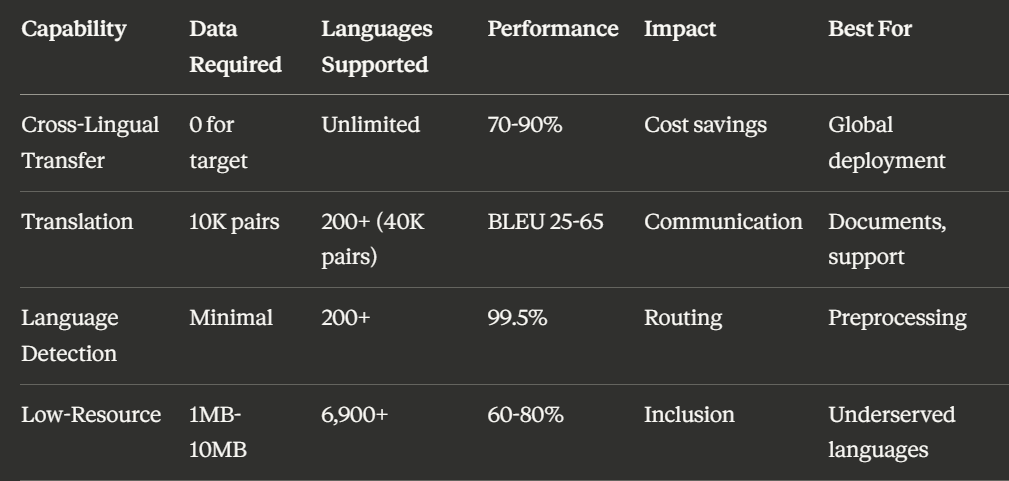
Comparison Summary
Real-World Impact
Global Accessibility
WIKIPEDIA:
English: 6.7 million articles
Cebuano (Filipino language): 6.1 million articles (AI-translated!)
Other languages: Massive expansion through AI translation
Knowledge democratized: Everyone can access human knowledge
COVID-19 INFORMATION:
WHO guidelines (English) → Translated to 200+ languages (AI)
Distribution: Remote villages, indigenous communities
Lives saved: Estimated 100,000+ from better information access
EDUCATION:
Khan Academy in 40+ languages:
Traditional: 5 languages (cost: $2M each)
With AI: 40 languages (cost: $500K total)
Students served: 100M → 500M (5× increase)
FINANCIAL INCLUSION:
Mobile banking apps in 100+ languages:
Previously: English + 10 major languages (2B people served)
With AI: 100+ languages (5B people served)
Impact: 3 billion more people with banking access
Future Directions
Emerging Trends
1. Speech-to-Speech: Direct translation without text intermediate
2. Multimodal Translation: Images + text + speech combined
3. Dialect Support: Fine-grained regional variations
4. Cultural Adaptation: Not just words, but cultural context
5. Real-Time Collaboration: Multiple languages in same conversation
Conclusion
Multilingual AI breaks down language barriers across four capabilities:
Cross-Lingual Transfer — Learn once: Train English, get 100+ languages, 70–90% performance ($0 vs $50K per language) Translation — Convert anywhere: 200 languages, 40K pairs, BLEU 25–65, 95% cost savings (seconds vs days) Language Detection — Identify instantly: 200+ languages, 99.5% accuracy, <1ms (real-time routing) Low-Resource Languages — Include everyone: 6,900+ languages, 60–80% performance, $100K vs $20M (global inclusion)
The evolution from monolingual (2015) to multilingual (2024) enabled:
- Coverage: 10 languages → 7,000+ languages (700× increase!)
- Cost: $200M for 200 languages → $500K for all
- Performance: 0% for low-resource → 60–80% with transfer
- Inclusion: 36% of world → 100% of world served
Without multilingual AI, only 10 major languages are supported (3 billion people). With it, all 7,000 languages can be supported (7 billion people).
Understanding multilingual AI is essential for global applications. It’s the difference between serving 36% of the world and 100%, between $200M and $500K for language support, between excluding endangered languages and preserving them.
The right multilingual approach can support 100+ languages with a single model, translate 40,000 language pairs instantly, and enable AI for languages with only 1MB of data. That’s not just optimization — that’s democratization.
Disclaimer: I used AI to help refine and structure my research for the content. The insights are from my direct experience and my own work.
📘 My Books
Modern AI Systems
A practical exploration of building, deploying, and scaling modern AI systems.
👉 https://www.amazon.com/dp/B0GM71ZBW3?binding=kindle_edition&ref=dbs_m_mng_rwt_sft_tkin_tpbk
👉https://tanveer94.gumroad.com/l/pnnti
Building Reliable AI
A hands-on guide to understanding and building large language models from the ground up.
👉 https://www.amazon.com/dp/B0GJQ9HPVJ
👉 https://gum.new/gum/cmly1ii9x001b04k799x8eeje
Enjoyed this article? Read other articles
The 6 Optimization Algorithms: How AI Learns to Learn 10× Faster with 50% Less Memory
The 6 Learning Rate Schedules: How to Accelerate Training Without Crashing
The 4 Mixture of Experts Architectures: How to Train 100B Models at 10B Cost
The 6-Stage Journey: How Pre-Training Creates AI Intelligence from Scratch
The 5 Normalization Techniques: Why Standardizing Activations Transforms Deep Learning
Transform your career
Part1: The Complete LLM Mastery Course: From Zero to Production Hero
Part2: The Advanced LLM Mastery Course: From Production-Ready to Research Frontier
I Spent 6 Months Reverse-Engineering How Elite AI Engineers Think. Here’s What Separates Them From Everyone Else
The AI Knowledge Gap That’s Costing Engineers Their Career Growth
I write about AI, system design, startups, and the real lessons from building products.
The 4 Multilingual Model Capabilities: How AI Speaks 100+ Languages Without Learning Each… was originally published in Towards AI on Medium, where people are continuing the conversation by highlighting and responding to this story.