This is the first in a sequence of articles on organizational cultures, inspired largely by my experiences with the LessWrong meetup community.
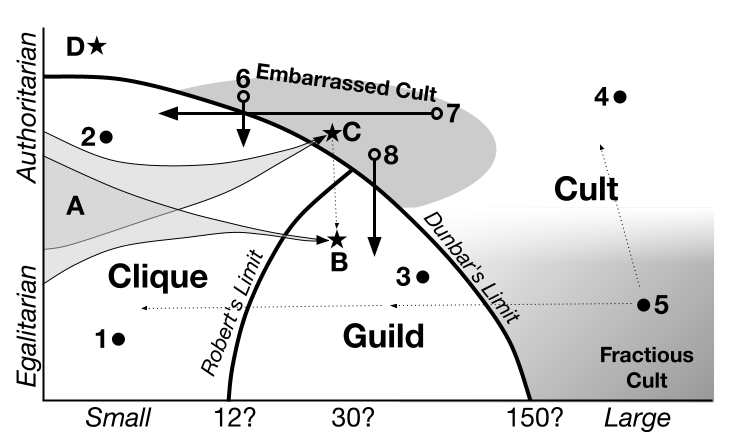
| Clique | Guild | Cult |
|---|---|---|
| Small | Medium | Any size |
| Exit | Voice | Loyalty |
| Consensus | Majority | Counsel |
| Deontology | Consequentialism | Virtue |
- "Let's talk this over"
- "This isn't working out"
- "Point of order, Mr. Chairman"
- "Verily I say unto you"
- "This isn't what our Founder would've wanted"
- "If you don't like it, you can leave"
- "Yeah, so if you could go ahead and get that done, that'd be great"
- "Carried u-... [nervous glances] ...-nanimously"
Clique
A clique is a small, intimate group of friends who all know each other very well. If you're in a clique, you might not know what kind of culture you're in because there might never have been any significant sources of conflict. But if there are, they will be addressed in one of two ways.
#1. "Let's talk this over"
An egalitarian clique will put great effort into resolving conflicts through interpersonal connections in order to keep the group together. This may involve long hours on the metaphorical therapist's couch - NVC, Authentic Relating, etc. - or perhaps, if two friends have a falling-out, a mutual friend of theirs might try to help smooth things over.
#2. "This isn't working out"
In a more authoritarian clique, people will be quicker to concede that their differences are irreconcilable and that the group (at least in its current form) should break up. However, this is seen by all parties as a fairly benign outcome, since there is not much investment in the clique "as such" (rather, the investment is in the individual 1:1 relationships) and it's not hard to start a new one. There is no sense that somebody needs to be "right" and somebody else "wrong".
Guild
#3. "Point of order, Mr. Chairman"
A guild is a medium-sized group where each member may have a few close connections, but will have a much larger number of "weak ties" that are connected to them only indirectly. However, the group is united (and distinguished from the wider society) by a shared institutional identity that makes it "a thing" and not merely a collection of individuals or cliques. This manifests in the use of bureaucratic procedures to resolve conflicts, since the group is too large to expect unanimity, and entrenched enough that schism is seen as more undesirable than having some disagreement over any particular decision.
In my opinion, the guild has become something of a lost art, which ought to be revived. (Future articles will go into this point further.)
Cult
A cult is a group based on personal authority. This authority derives from the inherent virtue of the leader (charisma, strength, wealth, etc.) and not any notion of popular support. A cult's size can exceed Dunbar's Limit because it is held together not by the members' relationships with each other, but by their loyalty to the leader. However, small- and medium-sized cults can also exist, and are perhaps more common than large cults. (Rare is the person who has what it takes to lead a large cult, but you may find yourself at the center of a small cult quite inadvertently.)
#4. "Verily I say unto you"
What the leader says, goes. Members are expected to subordinate their own will and desires to that of the leader. They may advise the leader one way or another, and may bring their disputes to him/her for resolution, but the leader has the ultimate authority and responsibility for the decision.
However, in addition to this "straightforward" kind of cult, there are also various kinds of dysfunctional cults, which (perhaps) give the rest a bad name.
Fractious cults
#5. "This isn't what our Founder would've wanted"
If a cult loses its leader, and if the leader has not raised up a worthy successor, the group will find itself in an unstable zone where its culture is too egalitarian to persist in its super-Dunbar size, because there was never any hierarchy amongst the rank-and-file, only in relation to the leader. Therefore, the group will decay into a more stable configuration (indicated by the dotted arrows), either by someone gaining sufficient personal virtue to become the new leader, or (more likely) splitting into several cliques or guilds, each of which will claim to be the legitimate heir of the original group.
Embarrassed cults
A cult is "embarrassed" when it doesn't want to admit that it's a cult, because the leadership lacks the personal virtue necessary to operate a straightforward cult but still wants to maintain control. They may do this through some combination of pretending that the group's culture is more egalitarian than it actually is, and/or pretending that its size is smaller than it actually is. (This is denoted on the diagram by an arrow with an open circle on its base - the arrowhead is what the group pretends to be, and the base is what the group really is.)
#6. "If you don't like it, you can leave"
"...but we know you're not going to."
The leader of such a group may pretend that they are not claiming any personal authority at all, but "just" observing that the current clique isn't working out (see #2). However, there is an obvious asymmetry in that it is one particular party who is taunting the other one to quit, and not vice-versa. Therefore the subordinate party stands to lose a lot more, and is thus likely to accept a considerable amount of dissatisfaction before they finally decide to leave.
#7. "Yeah, so if you could go ahead and get that done, that'd be great"
In the classic corporate dystopia, HR and management want you to think of your team as a small clique, so that your desire for personal connection will be redirected towards the company. They may ask for your opinion, but have no intention of listening to it. Critics rightly warn young professionals against getting sucked into environments like this, where one is prone to being manipulated into accepting substandard pay and working conditions. The warning usually given is: You should be as loyal to the company as they are to you, i.e. not at all.
#8. "Carried u-... [nervous glances] ...-nanimously"
A group may put on the trappings of a guild to disguise the fact that it is still exercising top-down authority rather than being a bottom-up enterprise. For example, in a typical homeowner's association (HOA), there was never any point at which a group of homeowners got together and decided they wanted to form an HOA. Rather, what usually happens is that a developer buys a large plot of land, builds a bunch of houses on it, and creates an HOA whose membership attaches to each house, which are then sold one-by-one to buyers who otherwise have no connection to each other. Most of the homeowners thus have no real interest in participating in the HOA, but begrudgingly accede to the edicts of a handful of busybodies who have too much time on their hands.
Evolution of a growing clique
The culture of a clique may at first be ambiguous (A) because there is nothing really at stake. As it grows, however, if it does not simply break up, it will need to either follow the egalitarian path and become a guild (B), or the authoritarian path and become a cult (C). And in the latter case, the cult will inevitably be an embarrassed one, because if there had been someone with the requisite virtues to be a cult leader, the group would never have spent much time as a clique in the first place, but would have been a straightforward cult (D) from the beginning, and maintained its cultiness throughout its growth.
Therefore, as is probably clear by now, I think outcome C is bad and B is better. If a group has landed at C, then it may with great effort be pulled kicking-and-screaming to B - but this is likely to ruffle some feathers.
(I also suspect that there is a tendency for groups to get stuck at the "triple point" with around 30 members, in an uncomfortable equilibrium between all three types because the group cannot decide what it wants to be.)
What's so great about guilds? (Plan of the sequence)
Forthcoming articles in this sequence will lay out a case for why we should want more guild-like organizations to exist. (Links will be added as the articles are posted.)
- A guild can grow larger than a clique (This article)
- A guild makes it possible to improve things without schism (Fear of crowding out)
- A lack of guilds leads to a general malaise and atrophy of democratic values (We live in a society)
- A guild can contribute to the social fabric in a way more ambitious than cliques (Call for machers)
- A guild can be more robust than a cult because it can better distribute important responsibilities ("Community organizer" is a double oxymoron)
Other articles (Society is a social construct, pace Arrow; Rubber stamp errors; Anti-civicality) will discuss various norms that are necessary for a guild to function well, but which may seem strange or unintuitive for people who are accustomed to cliques or cults. I will conclude with a reflection (So are you some kind of communist?) on the tension between social and individual moralities.
Discuss