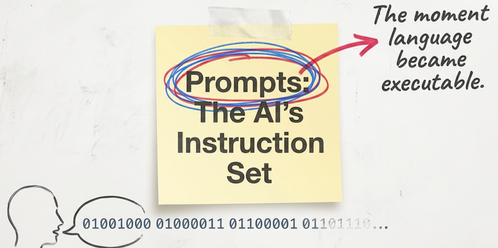
An Essay on Language, Power, and the New Architecture of Intelligence
In the long history of human civilization, certain inventions fundamentally alter the relationship between human intention and physical reality. The ‘lever’ extended muscle. The written ‘word’ extended memory. The ‘printing press’ extended reach. The ‘computer’ extended logic. And now, in the third decade of the twenty-first century, the ‘AI prompt’ has extended something even more fundamental: it has extended the power of language itself into the domain of machine execution.
The Title “Prompts: The AI’s Instruction Set” is deceptively simple. In five words, it reframes what a prompt is, what an AI does, and what it means to interact with intelligent machines. It is not describing a user interface feature. It is describing a civilizational shift.
This essay argues that to understand this Title Phrase fully, one must trace the entire evolutionary arc of the instruction set — from the binary switches of the 1940s to the natural language prompts of today. Only against that historical backdrop does the true magnitude of the statement reveal itself. When we say prompts are the AI’s instruction set, we are saying that the eighty-year quest to make computers accessible to all of humanity has finally arrived at its destination.
What Is an Instruction Set? The Foundation
Before exploring the evolution, we must anchor ourselves in what an instruction set truly is. In classical computing, the Instruction Set Architecture (ISA) is the complete vocabulary of operations that a central processing unit (CPU) can perform. It is the lowest layer of software where the irreducible interface between human will and machine behavior interact and execute.
Every program ever written in any programming language, for any purpose, on any computing devices ultimately dissolves into instruction set commands at runtime. When you stream a video, send an email, or run a simulation, billions of simple ISA instructions are executing every second beneath the surface: move this data, add these numbers, jump to this memory address, compare these values.
The instruction set has three defining characteristics that give it its power. The first is completeness: it defines the full range of what the machine can do. The second is authority: the machine obeys it without question or interpretation. The third is exclusivity: only those who understand its syntax and semantics can use it to direct the machine.
For most of computing history, this exclusivity was a wall. Programming required fluency in a foreign language of logic, syntax, and machine architecture. Most of humanity stood on the outside of that wall. The entire history of software development can be understood as a series of attempts to lower it.
“Every generation of computing technology asked the same question: How do we get the machine to understand more of what humans naturally say?”
The prompt answers that question definitively. When prompts become the instruction set, the wall does not just get lower — it disappears entirely.
The Evolution of Instruction Sets
The journey from binary to natural language is one of the great intellectual and engineering sagas of the modern era. It spans eight decades, dozens of paradigm shifts, and the collective effort of hundreds of thousands of computer scientists, engineers, and visionaries. To understand where we are today, we must walk the full path.
Era 1: Binary — The Age of Switches (1940s)
The first programmable computers, machines like ENIAC and Colossus, had no abstraction whatsoever. To program them was to physically configure them. Operators set switches, rewired panels, and inserted punched paper tape to encode sequences of ones and zeros directly into the machine’s memory.
A single instruction — add two numbers, for example — was represented as a specific pattern of bits: 01001000 01000011 for an x86 ADD operation, meaningless to any human eye. Programming at this level required not only deep mathematical knowledge but an intimate familiarity with the physical architecture of the specific machine being used. There was no portability, no abstraction, no mercy.
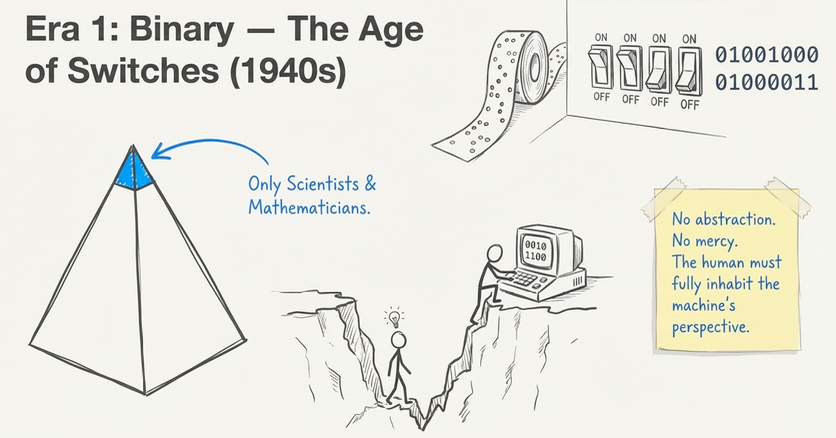
The human was required to fully inhabit the machine’s perspective. Thought had to be translated completely into the machine’s native tongue before anything could happen. The gap between human intention and machine execution was vast, and the entire burden of crossing it fell on the programmer.
Era 2: Assembly Language — Naming the Commands (1950s)
The first great leap forward came in the early 1950s with the invention of assembly language. The insight was elegant in its simplicity: if the machine could be given a program that translated human-readable abbreviations into binary, then programmers would no longer need to memorize binary patterns. They could use words or at least, short fragments of words.
Assembly introduced mnemonics: MOV for move data, ADD for addition, JMP for jump to another instruction, CMP for compare. These were not natural language but they were still a severely constrained and unforgiving formal system, but they were a step toward human legibility. The assembler program performed the translation automatically.

Assembly language remained the dominant programming paradigm for systems that required maximum performance and hardware control. Operating system kernels, device drivers, and early video games were written in assembly. It gave programmers more expressive power while preserving direct access to the hardware. But it remained deeply tied to specific machine architectures, and it demanded expertise that only a small fraction of the population possessed.
Era 3: High-Level Languages — The Age of Abstraction (1960s–70s)
The 1960s brought the most conceptually significant transition in early computing: the invention of high-level programming languages. With languages like FORTRAN (1957), COBOL (1959), and later C (1972), programmers could write code that described what they wanted to compute rather than how the machine should compute it. A compiler — itself a sophisticated program that handled the translation to assembly and then to binary automatically.
This was a revolution in abstraction. A single line of C code : result = (a + b) * c; — could expand into dozens of machine instructions. Programmers no longer needed to think in registers and memory addresses. They thought in variables, functions, and algorithms. The machine’s architecture became largely invisible.
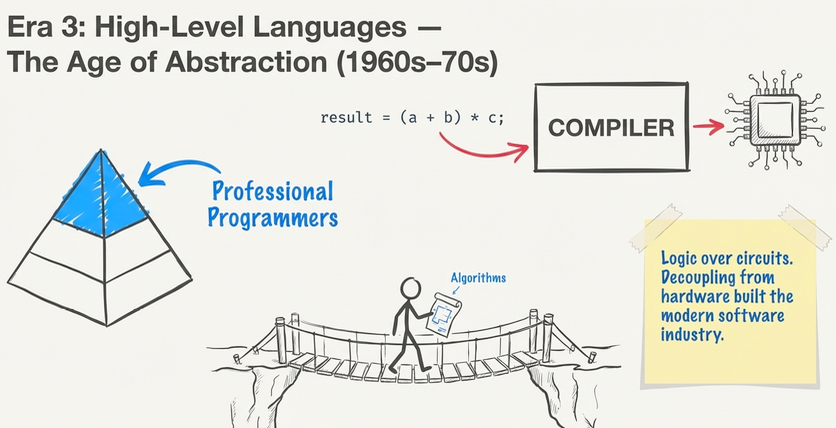
High-level languages also introduced portability. A C program could, in theory, be compiled and run on different machines without rewriting. The instruction set of the underlying hardware no longer mattered to the programmer, the compiler took care of it. This decoupling of programming from hardware was the foundation on which the modern software industry was built.
Era 4: Object-Oriented and Scripting Languages — Programming for Millions (1980s–90s)
The 1980s and 90s saw two parallel revolutions that expanded the programmer population by an order of magnitude. Object-oriented programming languages: Smalltalk, C++, Java — introduced a new way of organizing code around models of real-world entities: objects with properties and behaviors. This made programs easier to design, understand, and maintain for large teams working on complex systems.
Simultaneously, scripting languages like Python, Perl, JavaScript, and Ruby prioritized developer expressiveness and speed over machine efficiency. Python famously made readability a core design principle — its syntax was designed to look almost like pseudocode, the informal English-like notation that programmers used to sketch algorithms before writing actual code. A Python list comprehension like [x * 2 for x in numbers] reads almost like a sentence.
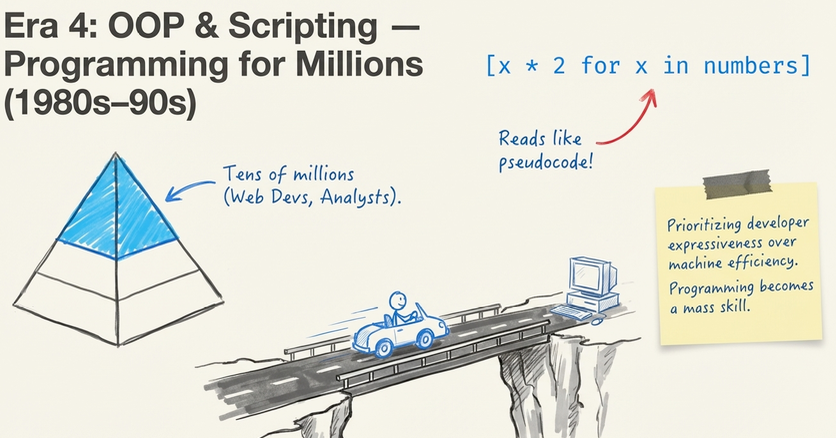
JavaScript, invented in 1995, put programming directly in the web browser and in the hands of every web developer on the planet. By the end of the 1990s, there were tens of millions of people who could write code. The programmer was no longer a rare specialist — programming had become a mass skill, like literacy or driving.
Era 5: Visual and Low-Code Tools — Programming Without Code (2000s–10s)
The 2000s and 2010s attacked the remaining barrier from a different angle. Rather than making programming languages easier to learn, platforms like WordPress, Wix, Squarespace, Zapier, and Microsoft Power Automate removed the need to write code at all for specific categories of tasks. Users could build websites, automate workflows, and connect applications through graphical interfaces, drag-and-drop builders, and simple conditional logic systems.
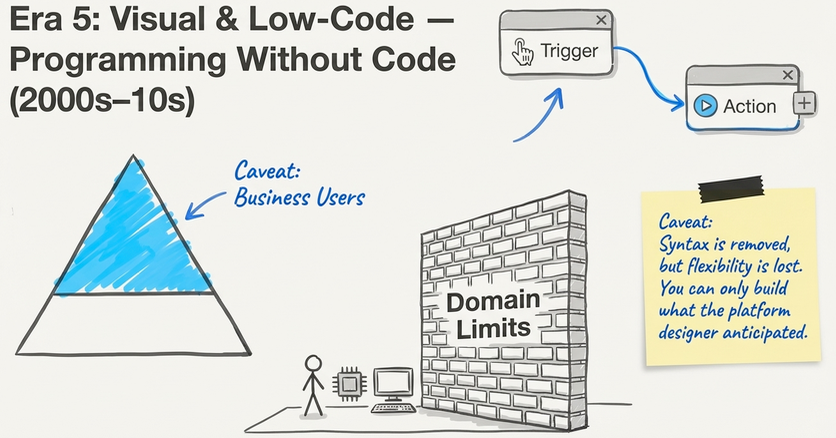
These platforms represented a philosophical shift: the acknowledgment that for many tasks, the abstraction of a visual interface was more appropriate than the abstraction of a programming language. A small business owner should not need to learn JavaScript to run a website. A marketing manager should not need to write Python to automate their email campaigns. Low-code tools made these activities accessible to people for whom learning to program was never a realistic option.
Yet low-code tools had a fundamental limitation: they were domain-specific. They could automate the things their designers had anticipated, but nothing beyond. A Zapier workflow could connect specific applications in specific ways. A WordPress theme could be customized within the options the theme developer provided. The moment a user wanted to do something unexpected, they hit a wall.
Era 6: Natural Language Prompts — The Final Interface (2020s)
And then, in the early 2020s, the final barrier fell. Large language models which are trained on vast corpora of human text and fine-tuned to follow human instructions, made it possible to direct a powerful AI system in plain natural language. No syntax. No compiler. No drag-and-drop interface with limited options. Just words.
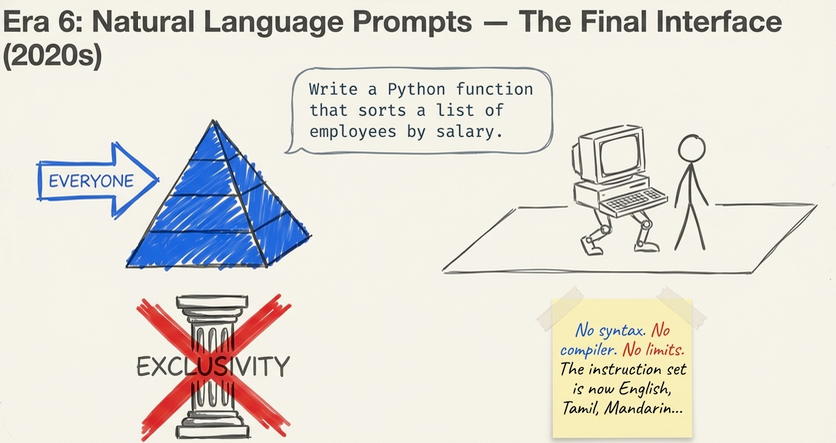
Prompt: “Write a Python function that sorts a list of employees by salary”. “Summarize this document in three bullet points”. “Generate a marketing plan for a new coffee brand targeting university students”. “Explain quantum entanglement as if I am twelve years old”. “Debug this code and explain what was wrong”. The instruction set had become English Or Tamil Or Mandarin Or Arabic Or any of the hundreds of languages that large language models now understand. For the first time in the history of computing, the instruction set is not a foreign language that humans must learn — it is the language humans already speak.
Prompting as Programming — The Deep Parallel
When you tell an AI “Write a cover letter for a software engineer applying to a startup, in a confident but not arrogant tone, approximately 300 words”, you are directing behavior (write a cover letter), constraining output (software engineer, startup, 300 words), and encoding intent (confident but not arrogant). The AI executes your instruction set.
“The prompt is to the AI what the opcode is to the CPU: the fundamental unit of command, the atom of instruction, the point at which human will becomes machine action.”
There is, however, a critical difference between the classical instruction set and the prompt. A CPU instruction set is deterministic: the same instruction always produces the same result. A prompt is probabilistic: the same prompt may produce different outputs each time it is run. This is not a weakness but it is a feature. It reflects the AI’s ability to reason, infer, and generate rather than merely execute.
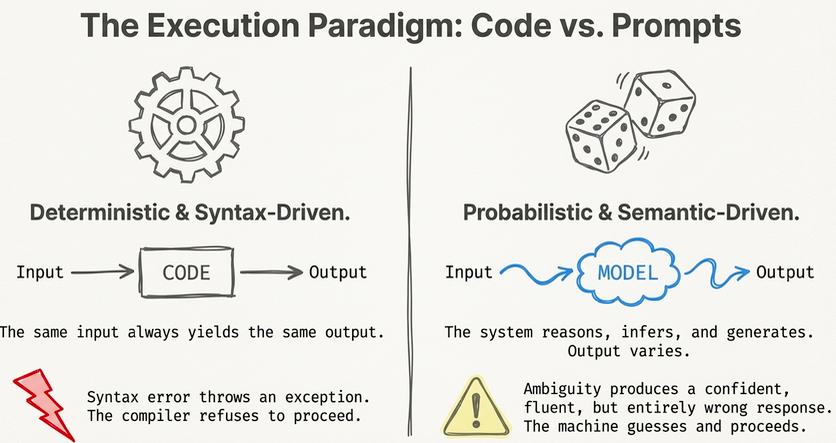
But this probabilistic nature places a new kind of demand on the prompter. A syntax error in traditional code throws an exception — the compiler refuses to proceed and tells you exactly what is wrong. An ambiguous prompt produces a confident, fluent, well-formatted response that may be entirely wrong. The machine does not tell you that your instruction was unclear. It simply interprets it in whichever way seemed most plausible, and proceeds.
This is why mastering prompts — what is increasingly called prompt engineering is a genuine skill. It requires the ability to think precisely, to anticipate how language will be interpreted, to provide context without overwhelming, and to understand how AI models reason. In this sense, prompting is both easier and harder than traditional programming: easier because it requires no syntax knowledge, harder because it requires deep clarity of thought and communication.
The New Demands of the Prompt Era
To say that prompts are the instruction set is not to say that the era of difficulty is over. It is to say that the nature of the difficulty has changed. The new challenges of the prompt era are not technical — they are cognitive, communicative, and ethical.
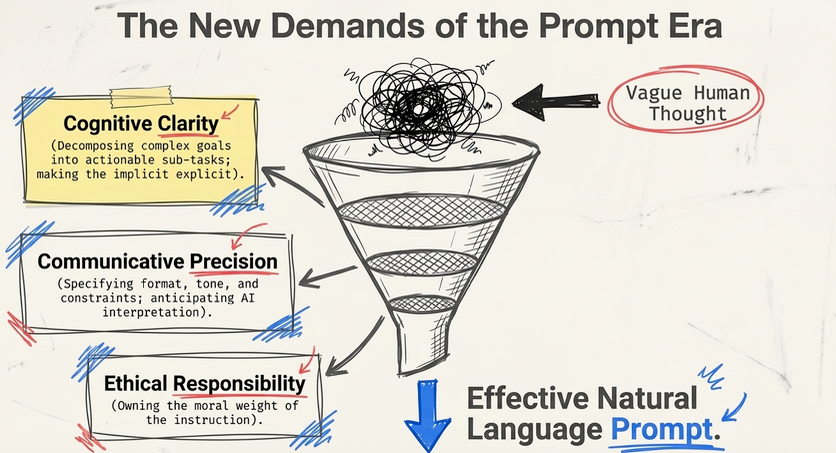
Cognitive Clarity
The primary demand of prompting is clarity of thought. A vague prompt produces a vague result. An ambiguous instruction produces an interpretation the prompter may not have intended. This means that effective prompting requires the prompter to have a clear mental model of what they want before they ask for it, to decompose complex goals into specific, actionable sub-tasks, and to express each one without ambiguity.
This is harder than it sounds. Most people communicate with other humans in an environment of shared context and implicit understanding. We rely on our interlocutors to fill in gaps, to ask clarifying questions, to draw on common knowledge. An AI will also fill in gaps , but it will fill them with whatever its training has led it to expect, which may not match the prompter’s specific context or intention. Effective prompting requires making the implicit explicit.
Communicative Precision
Beyond clarity of thought, effective prompting requires precision of expression. The prompter must be able to specify not just what they want but how they want it: the format, the tone, the level of detail, the assumptions to make, the constraints to respect. They must be able to anticipate how an AI will interpret their words and adjust their language accordingly.
This is a skill that resembles but is distinct from traditional writing skill. A novelist may write beautifully without being an effective prompter, because the skills of literary expression do not necessarily transfer to the skills of precise instruction. Conversely, someone who has never written a poem may be an excellent prompter because they have the habit of thinking systematically and expressing requirements clearly. The new literacy of the AI age is its own discipline.
Ethical Responsibility
Perhaps the most important new demand of the prompt era is ethical. If prompts are the instruction set, then the prompter bears responsibility for the instructions they give. An AI that produces harmful content, biased analysis, or misleading information has usually done so because it received an instruction ‘explicit or implicit’ that led it there. The power to direct an AI is also the power to misuse it.
This places a new kind of moral weight on the prompter. In traditional programming, the ethics of software were largely the concern of the software’s designers and the companies that deployed it. In the prompt era, every user of an AI system is, in a small way, a programmer and every programmer bears some responsibility for what their program does. Prompt literacy must include not just technical effectiveness but ethical awareness.
Conclusion: Language Is the Source Code of the Future
We have traveled a long distance — from the binary switches of ENIAC to the natural language interfaces of large language models, from rooms full of vacuum tubes to smartphones in a billion pockets, from an instruction set that only specialists could write to one that anyone can use. The title “Prompts: The AI’s Instruction Set” marks the arrival at a destination that the entire history of computing has been pointing toward.
The evolution of instruction sets has always been driven by a single imperative: reduce the distance between human intention and machine action. Binary required humans to fully inhabit the machine’s world. Assembly gave the machine’s operations human-readable names. High-level languages let humans think in logic rather than circuitry. Scripting languages let humans think in expressiveness rather than efficiency. Low-code tools let humans think in goals rather than syntax. And now, prompts let humans think in intentions, in the natural, rich, nuanced language of thought itself.
The machine has finally come the rest of the way. It has learned to speak human.
“Every evolution of the instruction set is not a story about technology. It is a story about access — about who gets to build, who gets to create, and who gets to shape the world through machines.”
Binary was for scientists. Assembly was for engineers. C was for professionals. Python was for the technically inclined. The prompt is for everyone.
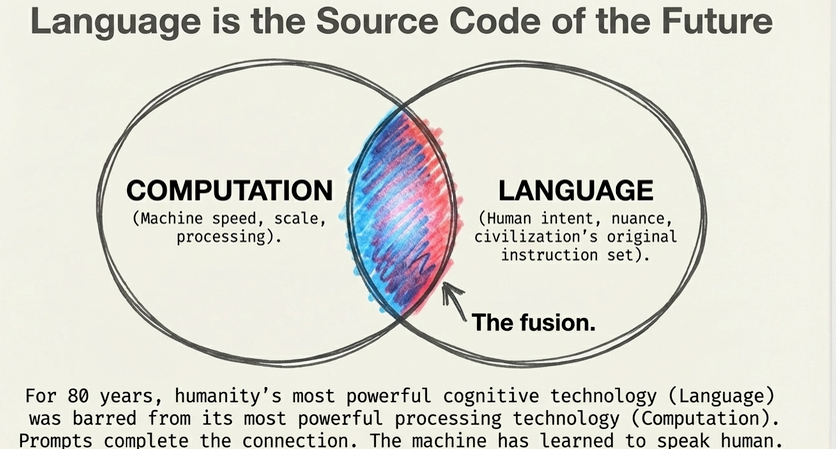
The title is a statement about the relationship between humanity and its tools. It is the announcement that the most powerful information-processing technology ever built has finally become accessible to every person on earth who has mastered the extraordinary, ancient, civilization-building technology of language.
The instruction set evolved for eighty years to arrive here. Prompts did not just inherit that evolution — they completed it. Language has always been the source code of human civilization. Now, at last, it is the source code of our machines too.
PROMPTS: The AI’s Instruction Set was originally published in Towards AI on Medium, where people are continuing the conversation by highlighting and responding to this story.