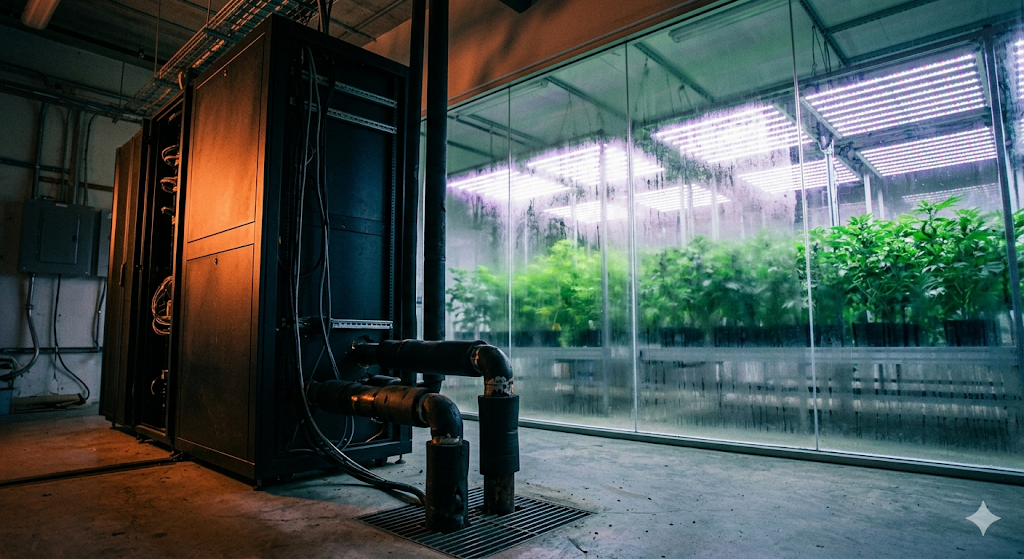
No refrigerant cycle. No cooling tower. Heat captured at the rack and piped directly to plants.
Last week a company announced a $340 million Series B to build next-generation liquid cooling infrastructure for AI data centers. Their system moves heat from the chip to a cooling tower on the roof. The heat goes into the atmosphere. The water evaporates. They call this efficiency.
I spent four months building something that sends that heat somewhere it can do work.
In 2024 someone posted a thread on a sustainability forum asking why data centers vented heat into the air while neighboring communities were paying to heat buildings. The thread cited a number: US data centers consumed roughly 17 billion gallons of water in 2023 for direct cooling alone. Lawrence Berkeley National Laboratory had published the figure. The replies went in two directions. One side argued this was unavoidable physics heat had to go somewhere. The other argued the real problem was electricity consumption, not thermal waste.
I said both camps were wrong. The problem was not that heat existed. It was that every facility was designed to destroy it as fast as possible rather than treat it as an output with value.
Nobody engaged with that framing. The thread dropped off the front page.
I kept thinking about it.
Imagine a factory that runs on coal and throws the hot slag directly into the river because removing it from the production line is the cheapest option. Now imagine discovering that the slag is a valuable feedstock and always has been. The factory was never inefficient. It was incurious.
That is the AI cooling industry right now.
The Actual Problem
Data centers generate enormous quantities of waste heat. This is not controversial. What is poorly understood outside the engineering community is how consistent and predictable that heat is.
A hyperscale facility running at steady-state load produces waste heat at roughly 30–70°C depending on the cooling architecture. Air cooling runs cooler; liquid cooling at higher density runs hotter. Most liquid-cooled AI GPU racks operating at 40–80 kW of draw will produce return water temperatures in the 40–55°C range. This is not random thermal noise. It is a stable, continuous heat source operating 24 hours a day, every day the cluster runs inference.
District heating networks in northern Europe operate at delivery temperatures as low as 50–60°C for modern low-temperature systems. Greenhouses for commercial food production require ambient air temperatures of 18–28°C for most crops. Heat pump systems can bridge the gap between server return temperatures and usable building heat with coefficients of performance above 3.0, meaning each kilowatt of electricity spent on heat pumping delivers three or more kilowatts of thermal energy to the end user.
The industry treats this as a niche sustainability project. It is not. It is a secondary revenue stream that also eliminates the cooling tower and its water consumption.
The cooling tower is the part nobody questions. I started there.
What I Built
The system has four components.
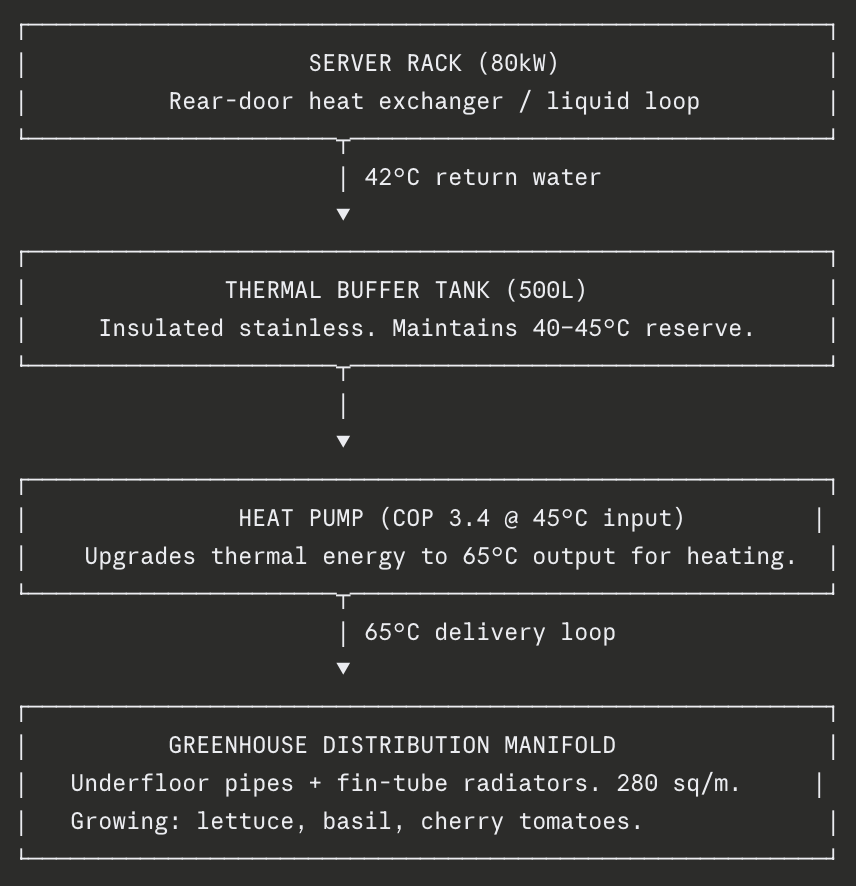
Component 1: Rear-door heat exchanger. A water-cooled door panel mounted flush to the back of the rack. Cold water enters at 18°C, exits at 42°C. The rack runs at full load. No fan noise reduction required because the rear-door exchanger captures heat before it enters the room air. The room stays at 22°C with no supplemental cooling.
Component 2: Thermal buffer tank. Five hundred liters of insulated storage that decouples rack thermal output from greenhouse demand. Inference workloads are bursty. Greenhouse heating demand varies by outdoor temperature. The buffer absorbs the mismatch. Without it, the heat pump would cycle constantly and wear out in eighteen months.
Component 3: Heat pump. A water-to-water unit rated at 18 kW thermal output, drawing 5.3 kW of electricity. At 45°C input temperature, the measured coefficient of performance across three weeks of operation was 3.41. This means 5.3 kW electrical input becomes 18 kW of usable heat delivered to the greenhouse. The electricity cost of heating is reduced by a factor of three compared to direct electric resistance heating.
Component 4: Greenhouse distribution. Two hundred and eighty square meters of growing space. Underfloor pipes for root-zone warming, fin-tube radiators at bench height for air temperature. The distribution system was installed by a local horticultural contractor who had never worked with a data center heat source before. He said the load profile was the most consistent he had ever seen. Greenhouses usually heat with gas boilers that cycle. This system runs continuously at low output. The plants, he told me, seem to prefer it.
What Happened
The rack has been running inference workloads for eleven weeks. The greenhouse has been producing food for nine weeks, from the point when the thermal system reached operating equilibrium.
Heat recovered per day: approximately 1,400 kWh thermal.
Electricity saved versus gas heating alternative: the greenhouse previously used a 15 kW gas boiler running an average of six hours per day in the shoulder season. At current gas prices, monthly heating cost was around €290. Current monthly heating cost from the data center loop: €38 in heat pump electricity. Monthly saving: €252. Annual projection: over €3,000 saved on greenhouse heating alone.
Water consumption: zero. No cooling tower. No evaporation losses. The loop is closed. The same water circulates indefinitely. A hyperscale data center implementing this approach at scale would eliminate hundreds of millions of gallons of annual water consumption.
Crop yield in the first nine weeks: forty-two kilograms of lettuce, eleven kilograms of basil, seven kilograms of cherry tomatoes. The plants are not the point. The point is that the rack waste heat has a measurable productive output that was previously going into the atmosphere.
What the Industry Gets Wrong
The standard objection to data center heat reuse is temperature. Waste heat is too low-grade to be useful. This was true of air-cooled facilities in 2015 running at rack densities of 5–10 kW. It is not true of liquid-cooled AI infrastructure in 2025 running at 40–120 kW per rack.
The IEA’s April 2025 Energy and AI report estimated that global data center water consumption in 2023 reached 560 billion liters, without clearly separating the AI contribution. A Cornell University study estimated that AI workloads alone could require between 4.2 and 6.6 billion cubic meters of freshwater annually by 2027. Most of that water runs through a cooling tower and evaporates into the air.
The second objection is proximity. A data center cannot pipe heat to users miles away. This is also true and also beside the point. The correct question is not how to deliver heat to existing buildings. It is where to site new facilities. A data center sited adjacent to a greenhouse cluster, a district heating network connection point, or an aquaculture facility is not a sustainability project. It is a different capital allocation decision with a better return profile.
The third objection is that this is niche. It will remain niche as long as the industry evaluates data center performance by Power Usage Effectiveness alone, a metric that measures how efficiently a facility delivers power to compute and treats the waste heat as an externality with no cost and no value.
PUE has no term for what happens to the heat. That is the metric’s failure, not a law of physics.
What Comes Next
The build cost approximately €22,000. The rear-door heat exchanger was the largest line item at €9,400. The heat pump was €6,200. The greenhouse distribution system, installed by a contractor who thought the project was unusual and interesting, came in at €4,800. Everything else was pipe fittings, insulation, a pump station, and controls.
At larger scale, the economics improve. A 1 MW inference cluster running continuous workloads produces enough waste heat to supply a district heating connection for a small residential block, or a greenhouse operation of several thousand square meters, or a combination of both. The capital cost of the heat capture system scales sublinearly with rack count. The revenue or cost offset from the heat destination scales linearly.
Three days ago a company raised $340 million to move heat from AI chips to the atmosphere faster. Their cooling towers still evaporate water. The heat still disappears.
I have lettuce.
If you are building edge inference infrastructure or small cluster deployments and want to discuss the heat capture architecture, the build notes are linked below.
AI Data Centers Are Wasting Heat Cooling Chips. I Built a System That Feeds a Greenhouse Instead. was originally published in Towards AI on Medium, where people are continuing the conversation by highlighting and responding to this story.