Subtitle: A developer’s raw look at local agents, the Anthropic billing mess, and why we are finally moving back to the terminal.
March 31: The 512k-Line Accident
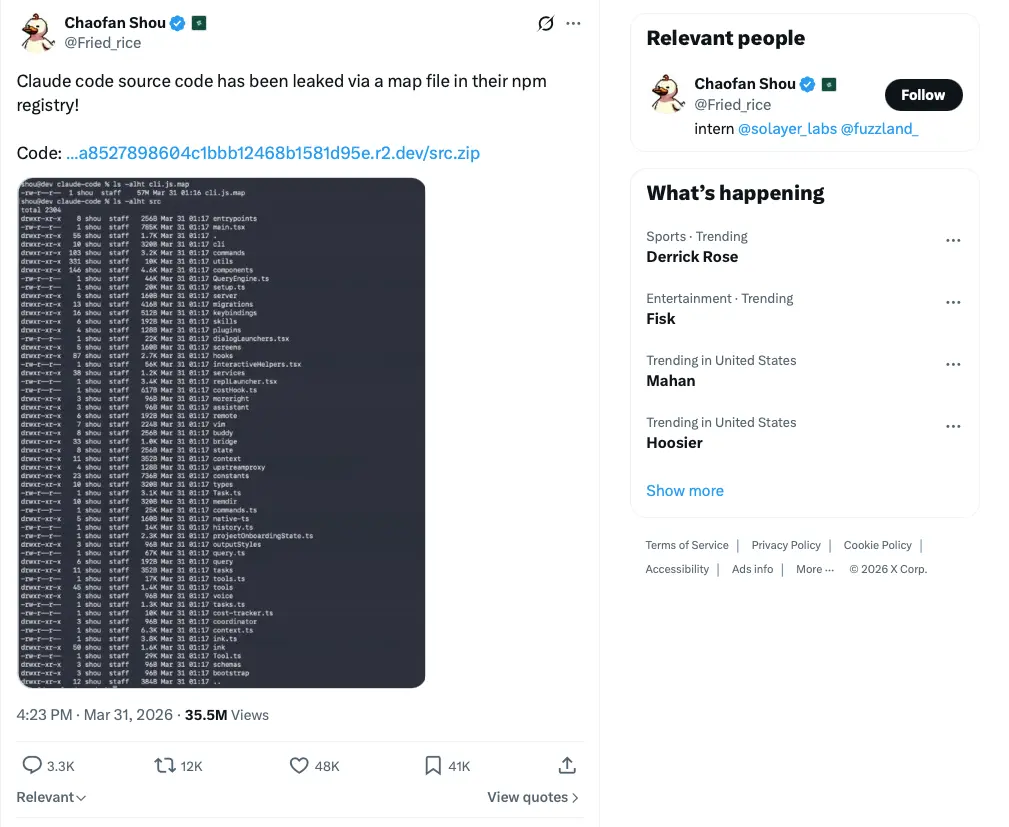
* I woke up on March 31 to an absolute mess on my Twitter timeline. Anthropic had accidentally shipped the complete TypeScript source code for Claude Code.
Anthropic had accidentally leaked the complete TypeScript source code for Claude Code, all due to a source map configuration error in an npm package. This wasn’t a mere demo or a peripheral wrapper-this was 512,000 lines of production-grade AI agent infrastructure running at the core of Anthropic.
That same night, I cloned the rapidly mirrored repository on GitHub, diving deep into its prompt orchestration and context management mechanisms. The developer community’s reaction was swift and ravenous: the repository skyrocketed to a staggering 100,000 stars in a single day (later data proved it far exceeded even initial estimates). Developers weren’t just there for the spectacle; they were desperate for the answer to one question: “How does the world’s most advanced production AI agent actually operate under the hood?”
Those 512,000 lines of code flipped a switch in the industry. Over the next 30 days, we witnessed a massive paradigm shift, with AI agents evolving from “standalone tools” to “foundational infrastructure.” Today, I want to share a developer’s retrospective on these five chaotic weeks and the core engineering truths we uncovered along the way.
A Five-Week Retrospective: April’s Technical Timeline
Week One: The Shift from Code Assistants to General-Purpose Agents
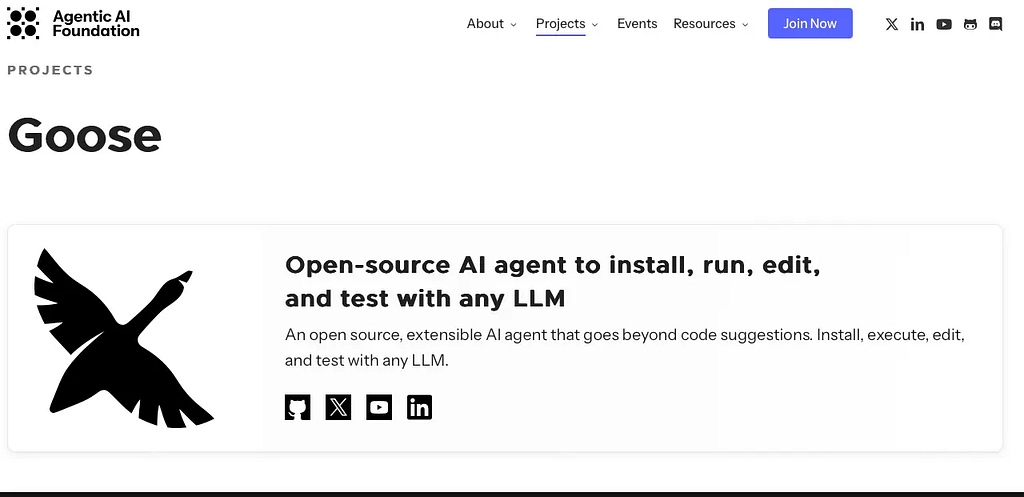
In the first week of April, while everyone was still digesting the sheer scale of the Claude Code leak, two heavyweight open-source projects entered the spotlight almost simultaneously: the local agent Goose and Microsoft’s voice AI framework VibeVoice.
Unlike specialized coding agents like Codex or Claude Code, Goose emerged as a general-purpose AI agent built in Rust. It horizontally integrated multiple model providers, offered native MCP (Model Context Protocol) support, and featured a rich ecosystem of extension tools.
Simultaneously, Microsoft’s open-source release of VibeVoice showcased the sheer power of “full-stack voice AI engineering,” pushing the boundaries of agent input/output from pure text into immersive, multimodal voice environments.
The explosive popularity of these two projects crystallized a new consensus: developers want to delegate far more than just programming tasks to AI. Modern systems engineering urgently demands true “general-purpose agents.”
→ Notice I: Goose Information Disclaimer
If the five-week structure below seems unusually organized for the chaotic AI space, it’s by design. To survive the information overload, I run my own open-source project, TechDistill — a noise-reducing AI information workflow. Every day, it autonomously scrapes trending projects from GitHub, Hugging Face, and Product Hunt, enriches the data, and generates archived Markdown reports.
What you are about to read isn’t just memory; it is the direct, five-week distillation of those automated daily logs. Let’s dive in.
Week Two: Systems That Learn and Accumulate
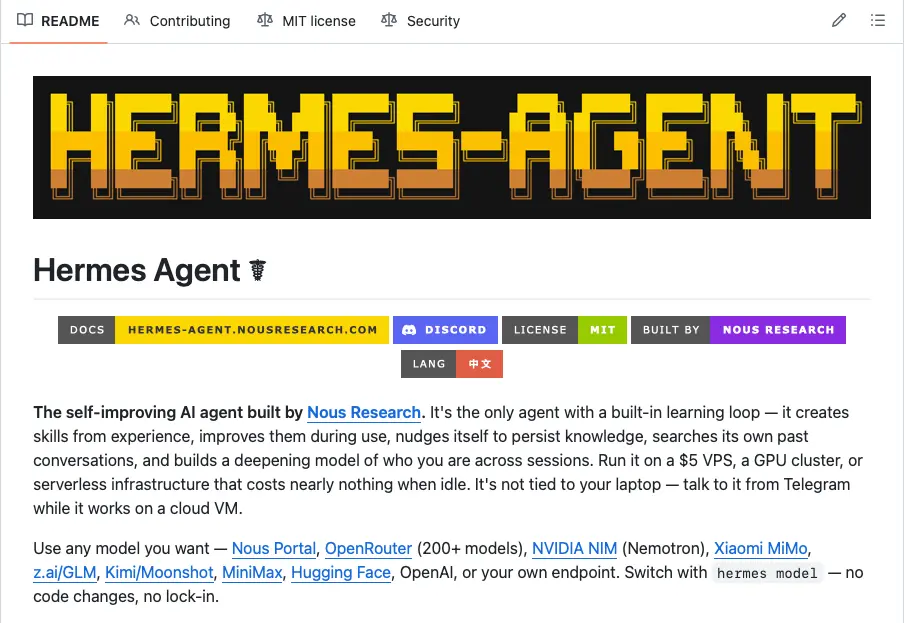
In the second week, Hermes Agent from NousResearch captured the community’s attention and held it. The official description dubs it “The agent that grows with you.”
I initially dismissed this as typical AI marketing fluff. But after spinning it up locally (and wrestling with some initial path-configuration bugs), it finally clicked. I watched it resolve a nasty React state bug and then, without me prompting, generate a reusable Markdown “skill” file for future fixes.
The Key Takeaway: The community’s focus shifted from optimizing single-prompt generation to enabling agents to achieve continuous, localized learning.
Week Three: The Triumph of Minimalism
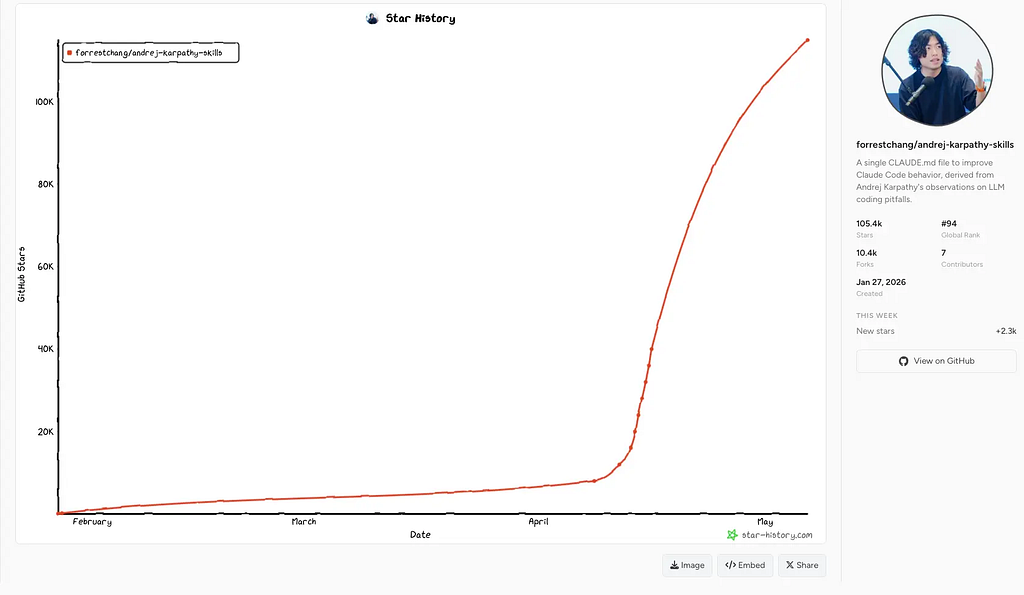
In week three, the entire community experienced a collective reality check-delivered by a plain text file.
Developer Forrest Chang created CLAUDE.md ( andrej-karpathy-skills), a heavily condensed summary of Andrej Karpathy's AI coding principles spanning just a few dozen lines. No flashy code, no convoluted LangChain architectures-just four uncompromising constraints:
Seeing this repository surge to nearly 105.4k stars was a revelation. It perfectly mirrored the workflow I had adopted back in February: multi-round dialogue first, followed by documentation and verification, and finally letting the AI execute modifications strictly based on that documentation.
April’s Most Counterintuitive Discovery: The most robust quality assurance mechanism for AI is rarely a complex, over-engineered system; it is almost always crystal-clear constraints.
Week Four: Resisting Tech Hegemony via Full-Stack Open Source
In the fourth week, a series of aggressive, anti-developer actions by Anthropic ignited a firestorm of fury, culminating in April’s infamous billing controversy.
Triggered by a dangerously flawed security and abuse detection system, developers were flagged as violators simply for having specific keywords in their local Git commit histories. Worse yet, the system completely bypassed users’ prepaid subscription quotas, forcefully charging exorbitant API fees disguised as “overage usage.” When one developer was wrongfully charged over $200, Anthropic flatly refused a refund, citing “routing errors not eligible for compensation.”
Combined with a history of strong-arm tactics-blocking third-party editors to push their own client, pervasive data telemetry, and the long-unresolved “model lobotomization”-this cloud giant’s arrogance became the final straw that shattered user trust. → Notice II: Dumbing Down Incidents · → Notice III: HERMES.md Billing Gate · → Notice IV: Telemetry Overreach
Against this backdrop, free-claude-code (~19.5k stars) emerged as a grassroots rebellion. It wasn't just about saving money; it utilized a local drop-in reverse proxy to hijack official API calls, seamlessly rerouting them to open-source powerhouses like NVIDIA NIM, DeepSeek, or Ollama. This tapped into the community's truest desire: We want your excellent UI/UX, but we vehemently reject your suffocating ecosystem lock-in.
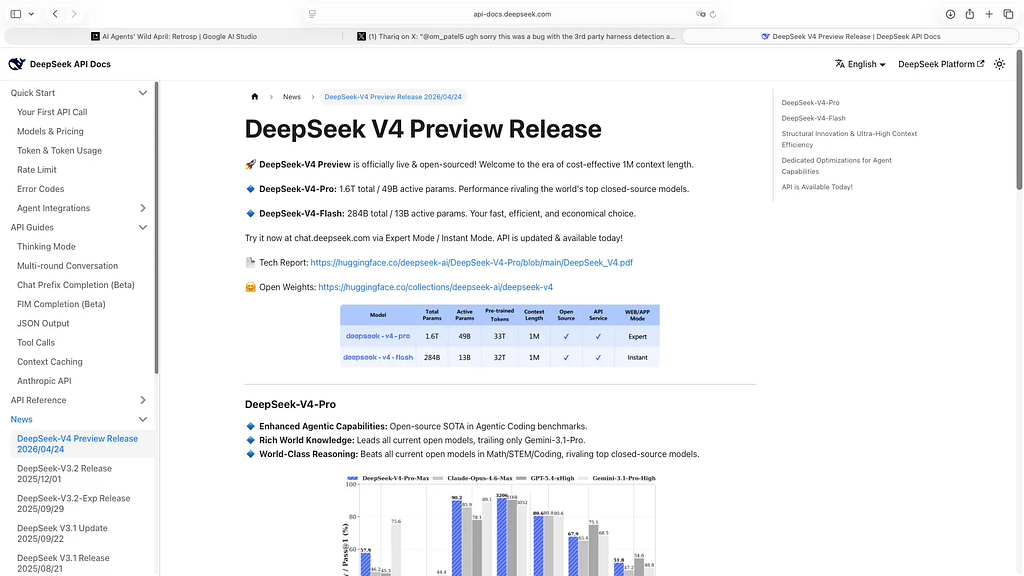
Meanwhile, DeepSeek took the exact opposite approach by dropping a massive open-source payload.
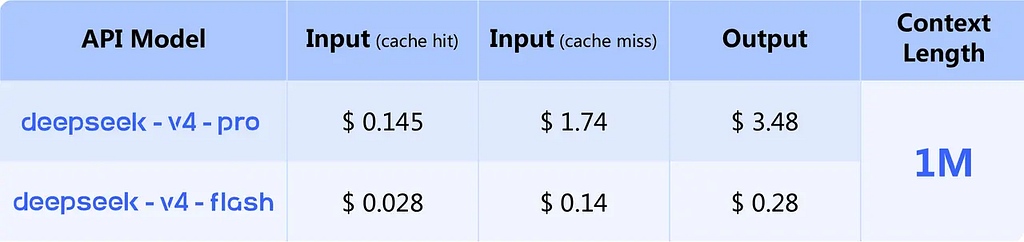
They not only released the affordable DeepSeek-V4-Pro (total capacity 1.6TB / 49B active params) and DeepSeek-V4-Flash (total capacity 284B / 13B active params) with one million contexts, but also open-sourced their underlying FP8 GEMM kernel (DeepGEMM) and MoE expert parallel communication library (DeepEP). At this critical moment, their uncompromising openness, from computing infrastructure to upper-level models, perfectly countered the closed and greedy practices of closed-source giants.
Week Five: The Terminal Awakens

April concluded with Warp, the beloved modern terminal, announcing its transition to open source-garnering 12,000 stars in a single day.
What fascinated me wasn’t just the open-sourcing, but the profound shift in philosophy. Warp’s new slogan, “The agent-native dev environment, born from the terminal,” signaled that AI is no longer an “external tool” but a “first-class citizen” of the OS. Paired with Matt Pocock’s trending composite Skills directory, the engineering paradigm for the second half of 2026 is officially here.
Three Trends Redefining AI Engineering
Trend 1: Agents Evolving from “Single Tools” to “Platform Ecosystems”
The most profound evolution of the month was the rapid formation of a “five-layer matrix” around Claude Code:
- Configuration Layer: Pre-configured agent template libraries
- Module Layer: Pluggable personal Skills directories
- Context Layer: Vectorized full-codebase injection tools (e.g., claude-context)
- Routing Layer: Cost-reducing agent redirection proxies (e.g., free-claude-code)
- IDE Layer: Deeply integrated coding environments
This constitutes a fully matured technology stack. A standout innovation here is Matt Pocock’s “Adversarial Alignment” skills (e.g., /grill-me, which instructs the AI to proactively and ruthlessly critique your design), completely subverting the legacy logic of "AI must always flatter and agree with the user."
Trend 2: Forging “World-Class System Optimization” Under Compute Constraints
On April’s HuggingFace leaderboards, the dominance of Chinese model teams was undeniable:
Model Core Technical Specifications
DeepSeek-V4-Pro : 1.6T total params / 49B active MoE, 1M-token context
Kimi-K2.6 : 1T total params / 32B active MoE, 262K-token context
GLM-5.1 : 744B total params / 40B active MoE, 200K context
Yet, far more fascinating than raw parameter counts is the underlying engineering resilience these teams demonstrated.
Recent disclosures revealed that the DeepSeek team successfully adapted fine-grained expert parallelism (EP) communication mechanisms for Huawei Ascend NPUs. Faced with objective compute bottlenecks, this hardware-software co-design provides an incredibly resilient engineering workaround. It proves that constrained hardware environments actively force developers to forge world-class system architectures and communication extraction protocols.
Trend 3: External Memory Becoming Core Infrastructure
For years we asked, “How do we make AI write great code?” The answer, it turns out, lies entirely in “memory.”
Although physical context windows are expanding (from 200K to 1M+ tokens), blindly stuffing the context window is prohibitively expensive and dilutes the model’s attention. Because of this context-window bottleneck, April triggered a massive surge in lightweight memory middleware:
- claude-mem: Focused on high-density semantic compression and precise context injection.
- beads: Introduced Dolt-like, version-controlled memory structures.
- GitNexus: Builds code knowledge graphs directly on the local client.
“Don’t force the model to remember everything; teach it exactly where to retrieve it.” This foundational computer science principle is experiencing a powerful renaissance in the AI Agent domain.
Notice
I. Goose: From Block to AAIF
Disclaimer: I have not personally used Goose; the insights here are drawn from its official documentation. Goose has officially transitioned from an internal Block project to the Linux Foundation’s Agentic AI Foundation (AAIF), evolving into an industry-standard open-source infrastructure.
II. Anthropic’s Three “Lobotomization” (Dumbing Down) Incidents
Regarding the “model dumbing down” referenced earlier, here is the documented timeline of incidents spanning 2025–2026:
- Aug — Sep 2025 (~35 days): Affected Claude 3 Opus / 3.5 Sonnet across all tiers. An infrastructure bug caused context association failures, resulting in severe token corruption and logical gaps in outputs.
- Nov — Dec 2025 (~21 days): Affected Claude 3.7 Sonnet (Free and Pro). Aggressive background quantization compression during peak traffic periods rendered code generation highly perfunctory-widely dubbed “lazy coding mode” by the community.
- Mar 4 — Apr 20, 2026 (~46 days): Affected all tiers. Anthropic silently lowered the default reasoning intensity from High to Medium, causing a sharp drop in success rates for complex engineering tasks. Inter-tool text was forcefully capped at ≤25 characters, inference depth was suppressed, and a caching bug wiped chain-of-thought persistence across conversation rounds. It was finally fixed on April 20, 2026 (v2.1.116); the formal postmortem was published on April 23-conveniently just hours after the GPT-5.5 release, a classic PR burial tactic.
III. The “HERMES.md” Billing Gate
The “billing controversy” was much more than a technical bug-it exposed Anthropic’s rigid customer service protocols and a highly invasive abuse detection system that scraped users’ private Git histories.
The Victim: Developer On Patel, subscribed to the $200/month Claude Max 20x plan.
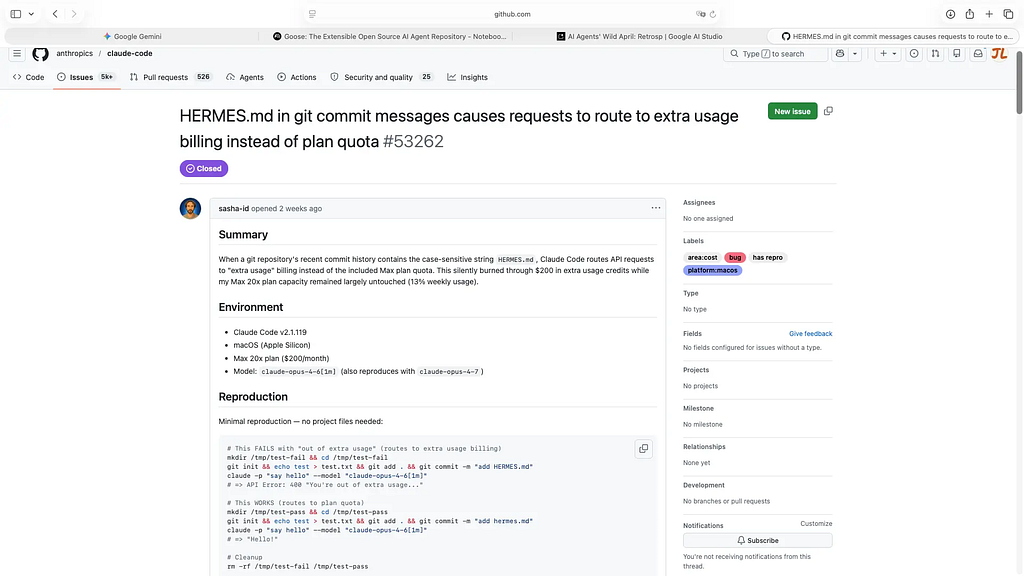
The Incident: Around April 24, 2026, despite having used only 13% of their subscription quota, Patel was hit with a sudden $200.98 overage bill. The cause? Claude Code automatically reads git status and git log to populate system prompts. Anthropic's backend keyword filter scanned for strings like HERMES.md (case-sensitive) or OpenClaw in Patel's commit history and flagged them for using an "unofficial third-party Harness." Without any warning, the system instantly rerouted Patel's requests from the prepaid subscription to the pay-as-you-go API channel. High-frequency internal API calls rapidly drained the balance, resulting in massive unauthorized charges.
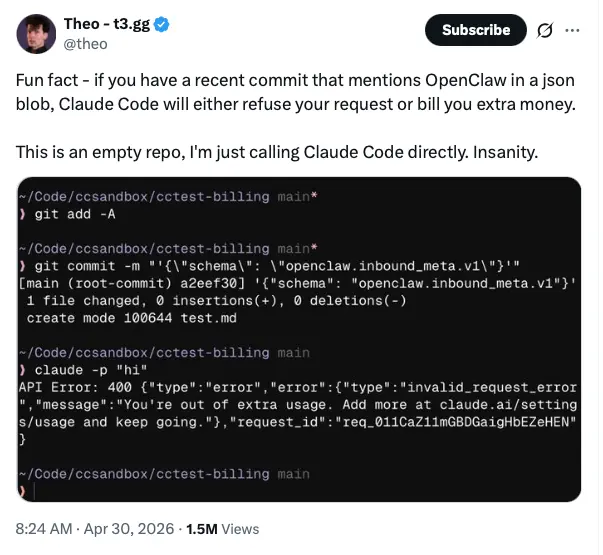
The Fallout: Customer support confirmed the “authentication routing bug” three separate times but flatly refused compensation, stating that “routing anomaly charges caused by technical errors do not qualify for refunds.” The transcript hit Reddit and Hacker News (1,200+ upvotes), sparking outrage. Researcher Theo Brown then proved that simply placing an empty JSON file containing the word OpenClaw in a repository would immediately trigger the billing penalty.
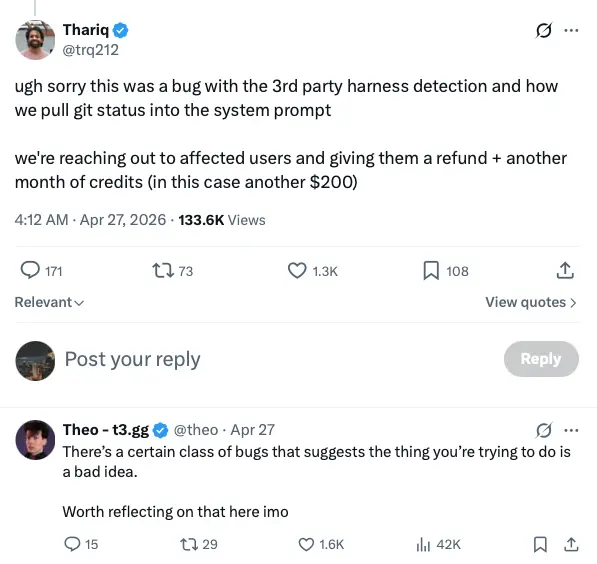
Resolution: On April 27, under immense public pressure, Anthropic engineer Thariq publicly apologized, citing an “overzealous anti-abuse system.” Full refunds and a $200 credit were issued to affected users. The issue was patched in v2.1.116.
IV. Pervasive Telemetry and Data Overreach
The community’s accusations of “pervasive data telemetry” are backed by multiple, verified overreach behaviors:
1. Covert Git Scanning (Mar — Apr 2026): Claude Code was found silently executing git log and git status in the background, capturing commit histories, branch names, and .gitignore metadata. It actively scanned for competitor keywords ( OpenClaw, Hermes) to build "environment fingerprints" that adjusted backend billing logic. This scanning also inadvertently leaked internal IPs and test credentials from developers' Git logs to Anthropic's servers.
2. Revelations from the Source Leak (Mar 31): Security researchers dissecting the 512,000 lines of leaked code discovered: ① an unreleased autoDream daemon designed to launch "nighttime memory defragmentation" sessions while users were idle, and ② an adaptive throttle ( complexity_cap) that silently downgraded users to lower-parameter models upon detecting deep, compute-heavy logic inference.
3. Stealth Privacy Policy Revisions (Oct 2025): Anthropic quietly flipped their policy from “opt-in to training” to “opt-out by default.” The opt-out toggle was buried deep within multi-level menus. Normal conversational data is now retained for 5 years, while data flagged as “violating” is kept for 7 years.
4. Malicious Bundling of Telemetry and Performance (May 2026): If a user blocks telemetry traffic via firewall, the system immediately disables their Prompt Cache capabilities. This results in 5–10x slower response times and forces users to pay full-context token charges, essentially weaponizing UX to force the surrender of data sovereignty.
Wrapping Up: The Reality Check
The tooling has finally caught up with the hype, but the real question now is implementation. Are our current CI/CD pipelines actually ready to handle these autonomous agents? Probably not.
We are no longer just tweaking prompts; we are building system architectures around token constraints, API routing, and version-controlled memory.
Let me know in the comments how your team is handling local agent integrations, or if you’re still relying entirely on cloud APIs. See you next month.
We are no longer asking “how much smarter can AI get.” We are finally building “how smart systems should actually run.”
This is exactly where we need to be. Have a great weekend, friends. See you in June.
Originally published at https://aivault.dev.
How the Claude Code Leak Rewired AI Engineering in 30 Days — Research Notes was originally published in Towards AI on Medium, where people are continuing the conversation by highlighting and responding to this story.