I Almost Ignored OpenHuman — Then I Realized It Might Be the Missing Layer Between ChatGPT and My Real Life
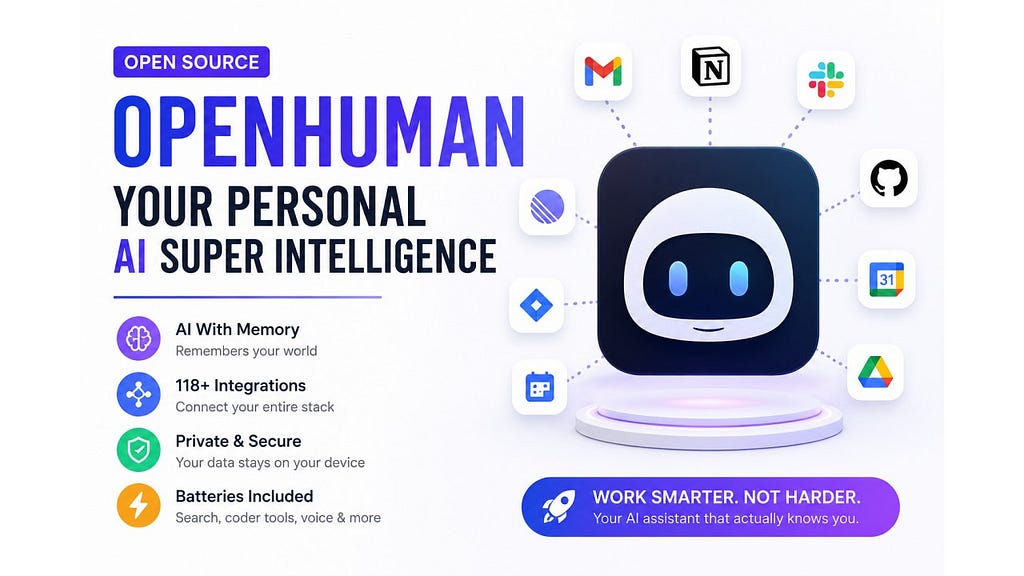
OpenHuman is not just another AI chatbot. It is an open-source desktop agent trying to give AI memory, tools, integrations, and real personal context.
Why OpenHuman Suddenly Feels Important
Most AI tools today are smart, but they still feel disconnected from our real life.
I can ask ChatGPT to explain code. I can ask Claude to summarize a document. I can ask Gemini to help with research. But every time I open a new chat, I still have to explain the same things again: my project, my files, my meetings, my tools, my goals, my previous decisions, and the context behind my work.
That is exactly why OpenHuman caught my attention.
OpenHuman is an open-source personal AI assistant built by TinyHumans AI. It describes itself as a “Personal AI super intelligence” that is private, simple, and powerful. The project is currently in early beta, so it is still under active development and may have rough edges. But the vision is big: instead of becoming another chatbot, OpenHuman wants to become the memory and action layer for your digital life.
The FOMO part is simple: if the next wave of AI is not just “better models” but “AI that actually knows your work context,” tools like OpenHuman could become very important.
What Is OpenHuman?
OpenHuman is a native desktop AI assistant for macOS, Windows, and Linux. According to its documentation, it connects your communication platforms, tools, and workflows into a single intelligence layer that you control. It is built on Rust, Tauri, and React, and it is licensed under GNU GPL-3.0.
That means OpenHuman is not only a web chatbot. It is designed as a desktop-first agentic system.
The goal is to solve one of the biggest problems with current AI: statelessness. Most AI models are powerful, but they do not naturally know your personal context. OpenHuman’s documentation says the system is designed to close the gap between what AI models can do and what they actually know about you.
In simple words, ChatGPT, Claude, Gemini, and other models are like powerful brains. OpenHuman is trying to become the memory, tools, and workflow layer around those brains.
Why It Became Popular
OpenHuman became popular because it hits a very real pain point: AI assistants are useful, but they forget too much.
Developers, founders, analysts, creators, and students are now using AI daily. But most of their real context is spread across Gmail, Slack, GitHub, Jira, Notion, Google Calendar, Google Drive, Linear, local files, and meeting notes. Manually copying that context into an AI chat every time is painful.
OpenHuman’s GitHub README says it supports 118+ third-party integrations through OAuth, including Gmail, Notion, GitHub, Slack, Stripe, Calendar, Drive, Linear, and Jira. It also says active connections can be auto-fetched into memory every twenty minutes.
That is a strong reason for its popularity. It is not only promising “AI answers.” It is promising “AI with your actual context.”
The repository has around 2.7k stars, 266 forks, 22 watchers, and 31 releases, with the latest visible release listed as OpenHuman v0.53.22 on May 9, 2026. GitHub also shows the codebase is mostly Rust and TypeScript, with Rust at 69.5% and TypeScript at 26.4%.
What OpenHuman Can Do
OpenHuman’s core promise is that it can connect to your tools, understand your context, and help you act across your workflow.
The documentation says OpenHuman compresses context across connected sources into structured intelligence. It can surface decisions, action items, risks, sentiment shifts, and buried context that users might otherwise miss. It also claims to preserve privacy by keeping raw data on the device, with encryption keys staying local.
The most interesting part is not only what it can answer. It is how much context it can maintain.
OpenHuman’s documentation describes two major technical ideas: Neocortex and a subconscious loop. Neocortex is described as a memory engine that can work with over one billion tokens and understand time, entities, and relationships. The subconscious system is described as a proactive recall loop that can surface insights without the user explicitly asking.
That is a bold claim, and because the product is still early beta, I would not treat every claim as fully proven in production yet. But architecturally, the idea is very interesting: AI should not just answer; it should remember, connect, compress, and proactively surface what matters.
The Technical Architecture
OpenHuman is built as a desktop app, not just a browser-based chat interface.
The main app uses Tauri + React + Rust. The GitHub language breakdown also supports this direction, showing Rust as the largest part of the repository and TypeScript as the second-largest.
A simplified architecture looks like this:
User Desktop
|
|-- OpenHuman App UI
|      React frontend
|
|-- Native Desktop Shell
|      Tauri
|
|-- Core Engine
|      Rust
|
|-- Local Memory Store
|      SQLite / local files / memory tree
|
|-- Skills Layer
|      TypeScript skill packages
|
|-- Connected Tools
       Gmail, GitHub, Slack, Notion, Jira, Calendar, Drive, etc.
This architecture makes sense because a personal AI agent needs more than a web page. It needs local storage, background jobs, secure integrations, file access, notifications, tool execution, and native desktop behavior.
The OpenHuman Skills repository explains that skills are TypeScript packages that extend the desktop agent with tools, integrations, and background behavior. Skills expose tools that the AI can call, implement lifecycle hooks such as init/start/stop, and use bridge APIs for SQLite, HTTP, persistent state, files, scheduling, notifications, and optional local model access.
That is important because it means OpenHuman can grow like a platform. Instead of hardcoding every feature into the core app, the skills system can allow new integrations and actions to be added over time.
How to Install and Run OpenHuman
OpenHuman gives multiple installation paths.
The simplest option from the GitHub README is to download the app from the OpenHuman website or use the terminal install script. For macOS and Linux, the README shows this command:
curl -fsSL https://raw.githubusercontent.com/tinyhumansai/openhuman/main/scripts/install.sh | bash
For Windows, the README shows this PowerShell command:
irm https://raw.githubusercontent.com/tinyhumansai/openhuman/main/scripts/install.ps1 | iex
The install documentation also lists package-manager options. On macOS or Linux with Homebrew, you can run:
brew install tinyhumansai/openhuman/openhuman
To update it later:
brew upgrade openhuman
On Debian or Ubuntu, the docs show an apt-based setup where you add the OpenHuman repository key and source, then install it using apt. (GitHub)
sudo apt-get install -y gnupg2 curl ca-certificates
curl -fsSL https://tinyhumansai.github.io/openhuman/apt/KEY.gpg \
  | sudo gpg --dearmor -o /etc/apt/keyrings/openhuman.gpg
echo "deb [signed-by=/etc/apt/keyrings/openhuman.gpg arch=amd64] \
  https://tinyhumansai.github.io/openhuman/apt stable main" \
  | sudo tee /etc/apt/sources.list.d/openhuman.list
sudo apt-get update
sudo apt-get install openhuman
There is also an npm install option for users with Node.js 18 or newer:
npm install -g openhuman
After installation, the binary is available as:
openhuman
How to Run It From Source as a Developer
If you want to explore the codebase or contribute, you can clone the repository and run it locally.
A developer flow would look like this:
git clone https://github.com/tinyhumansai/openhuman.git
cd openhuman
git submodule update --init --recursive
The project has migrated to pnpm, and the repository structure includes pnpm-lock.yaml and pnpm-workspace.yaml. The install documentation and repo structure show that OpenHuman uses pnpm for its JavaScript/TypeScript workspace.
Then run the desktop app development command:
pnpm --filter openhuman-app dev:app
You may also need Rust and Tauri prerequisites installed, because the app uses a Rust core and a Tauri desktop shell. The repository language breakdown confirms Rust is the dominant language in the codebase.
Final Thoughts: Why This Could Be a Big Deal
The next major AI shift may not be just “GPT is smarter” or “Claude has a bigger context window.”
The next shift may be this:
AI will stop being a blank chat window.
AI will start becoming a personal operating system layer.
OpenHuman is early, imperfect, and ambitious. But it points toward that future.
It wants to make AI remember.
It wants to make AI act.
It wants to make AI understand your tools.
It wants to make AI personal without sending everything away from your device.
That is why OpenHuman is worth watching.
Because the future may not belong to the smartest chatbot.
It may belong to the AI that actually knows your world.
Sources
OpenHuman GitHub Repository: https://github.com/tinyhumansai/openhuman
OpenHuman Official Documentation: https://tinyhumans.gitbook.io/openhuman
A quick note before you go 👋
I break down real AI shifts before they hit the mainstream 🚀
Click Follow now so you do not miss what matters next and drop a clap 👏 if this helped.
I Almost Ignored OpenHuman — Then I Realized It Might Be the Missing Layer Between ChatGPT and My… was originally published in Towards AI on Medium, where people are continuing the conversation by highlighting and responding to this story.